Grey Aliens
Leonard H. Stringfield
From Wikipedia, the free encyclopedia
| Leonard H. Stringfield |

The cover of Leonard H. Stringfield's 1977 book, Situation Red.
|
| Born |
1920 |
| Died |
1994 |
| Occupation |
Ufologist |
| Genres |
Ufology |
Leonard Stringfield (1920–1994) was an
American Ufologist who took particular interest in crashed
flying saucer stories. He died in 1994.
[1]
Career
Stringfield was director of Civilian Research, Interplanetary Flying Objects (CRIFO), and published a monthly newsletter,
ORBIT. In 1957 he became public relations adviser for the civilian UFO group
NICAP under the direction of
Donald Keyhoe, a friend of his since 1953. From 1967-1969, Stringfield served as an "Early Warning Coordinator" for the
Condon Committee. During the 1970s, he wrote a number of books about alleged recoveries of alien spaceships and alien bodies.
In 1978, Stringfield served as UFO research adviser to
Grenada Prime Minister Sir
Eric Gairy.
Privately, Stringfield worked as Director of Public Relations and
Marketing Services for DuBois Chemicals, a division of Chemed
Corporation, Cincinnati. He self-published "Status Reports" on alleged
UFO "crash-retrievals" until his death. He died December 18, 1994 after a
long battle with lung cancer.
[1]
Associated Organizations
Publications
- Inside Saucer Post...3-0 Blue: CRIFO Views the Status Quo: A Summary Report (1957)
- Situation Red, Fawcett Crest Books 1977 (PB), ISBN 0-449-23654-4
- Retrievals of the Third Kind: A case study of alleged UFOs and
occupants in military custody (1978), presented as a speaker at the
Ninth Annual MUFON Symposium in Dayton, Ohio, July, 1978. (Unofficially:
Status Report I)[2]
- The UFO Crash/Retrieval Syndrome: Status report II: New Sources, New Data (1980)
- UFO Crash/Retrievals: Amassing the Evidence: Status Report III (1982)
- The fatal encounter at Ft. Dix-McGuire: A case study: Status Report IV (1985)
- UFO Crash/Retrievals: Is the coverup lid lifting?: Status Report V (1989)
- UFO Crash/Retrievals: The Inner sanctum : Status Report VI (1991)
- UFO Crash/Retrievals: Search for Proof in a Hall of Mirrors: Status Report VII (1994
Roswell Grey Aliens

Roswell UFO incident
From Wikipedia, the free encyclopedia
Coordinates:  33.97°N 105.24°W
The
Roswell UFO incident took place in the U.S. in June or early July 1947, when an airborne object crashed on a
ranch near
Roswell, New Mexico.
Explanations of what took place are based on both official and
unofficial communications. Although the crash is attributed to a secret
U.S. military Air Force surveillance balloon by the U.S. government,
[1] the most famous explanation of what occurred is that the object was a
spacecraft containing
extraterrestrial life. Since the late 1970s, the Roswell incident has been the subject of much controversy, and
conspiracy theories have arisen about the event.
The
United States Armed Forces
maintains that what was recovered near Roswell was debris from the
crash of an experimental high-altitude surveillance balloon belonging to
what was then a classified (top secret) program named
Mogul. In contrast, many
UFO
proponents maintain that an alien craft was found, its occupants were
captured, and that the military engaged in a massive cover-up. The
Roswell incident has turned into a widely known
pop culture
phenomenon, making the name "Roswell" synonymous with UFOs. Roswell has
become the most publicized of all alleged UFO incidents.
On July 8, 1947, the
Roswell Army Air Field (RAAF)
public information officer Walter Haut, issued a
press release stating that personnel from the field's
509th Operations Group had recovered a "flying disk", which had crashed on a ranch near Roswell. Later that day, the press reported that
Commanding General of the
Eighth Air Force Roger Ramey had stated that a
weather balloon was recovered by the RAAF personnel. A
press conference
was held, featuring debris (foil, rubber and wood) said to be from the
crashed object, which seemed to confirm its description as a weather
balloon.
Subsequently the incident faded from the attention of UFO researchers for over 30 years. In 1978, physicist and
ufologist Stanton T. Friedman interviewed Major Jesse Marcel
who was involved with the original recovery of the debris in 1947.
Marcel expressed his belief that the military covered up the recovery of
an alien spacecraft. His story spread through UFO circles, being
featured in some UFO documentaries at the time. In February 1980, the
National Enquirer
ran its own interview with Marcel, garnering national and worldwide
attention for the Roswell incident. Additional witnesses added
significant new details, including claims of a large-scale
military operation
dedicated to recovering alien craft and aliens themselves, at as many
as 11 crash sites, and alleged witness intimidation. In 1989, former
mortician Glenn Dennis put forth a detailed personal account, wherein he claimed
alien autopsies were carried out at the Roswell base.
In response to these reports, and after
United States congressional inquiries, the
General Accounting Office launched an inquiry and directed the Office of the
United States Secretary of the Air Force
to conduct an internal investigation. The result was summarized in two
reports. The first, released in 1995, concluded that the reported
recovered material in 1947 was likely debris from
Project Mogul.
The second report, released in 1997, concluded reports of recovered
alien bodies were likely a combination of innocently transformed
memories of military accidents involving injured or killed personnel,
innocently transformed memories of the recovery of
anthropomorphic dummies in military programs like
Operation High Dive
conducted in the 1950s, and hoaxes perpetrated by various witnesses and
UFO proponents. The psychological effects of time compression and
confusion about when events occurred explained the discrepancy with the
years in question. These reports were dismissed by UFO proponents as
being either
disinformation
or simply implausible. But at the same time, several high-profile UFO
researchers discounted the possibility that the incident had anything to
do with aliens.
Contemporary accounts
On June 14, 1947, William Brazel, a
foreman working on the Foster homestead, noticed strange clusters of debris approximately 30 miles (50 km) north of
Roswell, New Mexico.
This date—or "about three weeks" before July 8—appeared in later
stories featuring Brazel, but the initial press release from the
Roswell Army Air Field (RAAF) said the find was "sometime last week," suggesting Brazel found the debris in early July.
[2] Brazel told the
Roswell Daily Record that he and his son saw a "large area of bright wreckage made up of rubber strips, tinfoil, a rather tough paper and sticks."
[3] He paid little attention to it but returned on July 4 with his son, wife and daughter to gather up the material.
[4]
Some accounts have described Brazel as having gathered some of the
material earlier, rolling it together and stashing it under some brush.
[5] The next day, Brazel heard reports about "flying discs" and wondered if that was what he had picked up.
[4] On July 7, Brazel saw Sheriff Wilcox and "whispered kinda confidential like" that he may have found a flying disc.
[4] Another account quotes Wilcox as saying Brazel reported the object on July 6.
[2]
Wilcox called RAAF Major Jesse Marcel and a "man in plainclothes"
accompanied Brazel back to the ranch where more pieces were picked up.
"[We] spent a couple of hours Monday afternoon [July 7] looking for any
more parts of the weather device", said Marcel. "We found a few more
patches of tinfoil and rubber."
[6]
As described in the July 9, 1947 edition of the
Roswell Daily Record,
The balloon which held it up, if that was how it worked, must have
been 12 feet long, [Brazel] felt, measuring the distance by the size of
the room in which he sat. The rubber was smoky gray in color and
scattered over an area about 200 yards in diameter. When the debris was
gathered up, the tinfoil, paper, tape, and sticks made a bundle about
three feet long and 7 or 8 inches thick, while the rubber made a bundle
about 18 or 20 inches long and about 8 inches thick. In all, he
estimated, the entire lot would have weighed maybe five pounds. There
was no sign of any metal in the area which might have been used for an
engine, and no sign of any propellers of any kind, although at least one
paper fin had been glued onto some of the tinfoil. There were no words
to be found anywhere on the instrument, although there were letters on
some of the parts. Considerable Scotch tape and some tape with flowers
printed upon it had been used in the construction. No strings or wires
were to be found but there were some eyelets in the paper to indicate
that some sort of attachment may have been used.[7]
A
telex sent to an
Federal Bureau of Investigation (FBI) office from the
Fort Worth, Texas office quoted a Major from the Eighth Air Force (also based in Fort Worth at
Carswell Air Force Base) on July 8, 1947 as saying that "The disc is hexagonal in shape and was suspended from a ballon [
sic] by cable, which ballon [
sic]
was approximately twenty feet in diameter. Major Curtan further advices
that the object found resembles a high altitude weather balloon with a
radar reflector, but that telephonic conversation between their office
and Wright field had not [UNINTELLIGIBLE] borne out this belief."
[8]
Early on Tuesday, July 8, the RAAF issued a press release, which was immediately picked up by numerous news outlets:
[9]
The many rumors regarding the flying disc became a reality yesterday when the intelligence office of the 509th Bomb group
of the Eighth Air Force, Roswell Army Air Field, was fortunate enough
to gain possession of a disc through the cooperation of one of the local
ranchers and the sheriff's office of Chaves County.
The flying object landed on a ranch near Roswell sometime last week.
Not having phone facilities, the rancher stored the disc until such time
as he was able to contact the sheriff's office, who in turn notified
Maj. Jesse A. Marcel of the 509th Bomb Group Intelligence Office. Action
was immediately taken and the disc was picked up at the rancher's home.
It was inspected at the Roswell Army Air Field and subsequently loaned
by Major Marcel to higher headquarters.[10]
Colonel
William H. Blanchard, commanding officer of the 509th, contacted General Roger M. Ramey of the Eighth Air Force in
Fort Worth, Texas, and Ramey ordered the object be flown to
Fort Worth Army Air Field. At the base,
Warrant Officer Irving Newton confirmed Ramey’s preliminary opinion, identifying the object as being a weather balloon and its "kite,"
[5]
a nickname for a radar reflector used to track the balloons from the
ground. Another news release was issued, this time from the Fort Worth
base, describing the object as being a "weather balloon".
Witnesses
Witness accounts, emergence of alien narratives
In 1978, nuclear physicist and author
Stanton T. Friedman
interviewed Jesse Marcel, the only person known to have accompanied the
Roswell debris from where it was recovered to Fort Worth where
reporters saw material which was claimed to be part of the recovered
object. The accounts given by Friedman and others in the following years
elevated Roswell from a forgotten incident to perhaps the most famous
UFO case of all time.
[11] By the early 1990s, UFO researchers such as Friedman,
William Moore,
Karl T. Pflock, and the team of
Kevin D. Randle
and Donald R. Schmitt interviewed several hundred people who had—or
claimed to have had—a connection with the events at Roswell in 1947.
[12] Additionally, hundreds of documents were obtained via
Freedom of Information Act requests, and some were supposedly leaked by insiders, such as the so-called
Majestic 12 papers.
Their conclusions were at least one alien craft had crashed in the
Roswell vicinity, aliens—some possibly still alive—were recovered, and a
massive cover-up of any knowledge of the incident was put in place.
[11]
Over the years, books, articles, television specials, and a made-for-TV movie brought the 1947 incident significant notoriety.
[11] By the mid-1990s, public polls such as a 1997
CNN/
Time
poll, revealed that the majority of people interviewed believed that
aliens had indeed visited Earth, and that aliens had landed at Roswell,
but that all the relevant information was being kept secret by the US
government.
[13]
Various narratives evolved, starting with Friedman's 1978 interviews
with Marcel, through publication of the first book on Roswell in 1980,
to new accounts and new books appearing into the early 1990s. Many new
witnesses had by then emerged, as had new accounts that detailed
recoveries of alien corpses and alien autopsies.
[11] Skeptics such as
Phillip Klass
and Richard Todd published objections to the plausibility of these
accounts, but it was not until 1994 and the publication of the first
United States Air Force report on the incident, that a strong counter-argument to the presence of aliens was widely publicized.
[11]
Various authors enumerated different alien scenarios which often
contradicted each other, based on what the documentary evidence
suggested and on which witness accounts were accepted or dismissed. This
was especially true for the various claimed sites for the crash and
recovery sites of alien craft (various authors had different witnesses
who described different locations for these events).
[11]
The outline from
UFO Crash at Roswell (1991) by Randle and Schmitt is common to many of these accounts:
A UFO crashed northwest of Roswell, New Mexico, in the summer of
1947. The military acted quickly and efficiently to recover the debris
after its existence was reported by a ranch hand. The debris, unlike
anything these highly trained men had ever seen, was flown without delay
to at least three government installations. A cover story was concocted
to explain away the debris and the flurry of activity. It was explained
that a weather balloon, one with a new radiosonde target device, had
been found and temporarily confused the personnel of the 509th Bomb
Group. Government officials took reporters' notes from their desks and
warned a radio reporter not to play a recorded interview with the ranch
hand. The men who took part in the recovery were told never to talk
about the incident. And with a whimper, not a bang, the Roswell event
faded quickly from public view and press scrutiny.[14]
The Roswell Incident (1980)
The first book on the Roswell UFO incident was
The Roswell Incident (1980) by
Charles Berlitz
and William Moore. The authors claimed to have interviewed over ninety
witnesses. Though he was uncredited, Friedman carried out some research
for the book.
[15] The Roswell Incident featured accounts of debris described by Marcel as "nothing made on this earth."
[16] Additional accounts by Bill Brazel,
[17] son of Mac Brazel, neighbor Floyd Proctor
[18] and Walt Whitman Jr.,
[19]
son of newsman W. E. Whitman who had interviewed Mac Brazel, suggested
the material Marcel recovered had super-strength not associated with a
weather balloon. The book introduced the contention that debris which
was recovered by Marcel at the Foster ranch, visible in photographs
showing Marcel posing with the debris, was substituted for debris from a
weather device as part of a cover-up.
[20][21]
The book also claimed that the debris recovered from the ranch was not
permitted a close inspection by the press. The efforts by the military
were described as being intended to discredit and "counteract the
growing hysteria towards flying saucers".
[22] Two accounts
[23] of witness intimidation were included in the book, including the incarceration of Mac Brazel.
[24]
The book included a report of Roswell residents Dan Wilmot and his
wife seeing "two inverted saucers faced mouth to mouth" passing overhead
on July 2,
[25] as were other reports of mysterious objects seen flying overhead.
[26] The Roswell Incident introduced an alien account by
Socorro, New Mexico
resident Barney Barnett, who had died years earlier. Friends of Barnett
said he described the crash of a flying saucer and the recovery of
alien corpses in the vicinity of Socorro, about 150 miles (240 km) west
of the Foster ranch. He and a group of
archaeologists stumbled upon an alien craft, and its occupants on the morning of July 3, only to be led away by military personnel.
[27] Further accounts suggested that the aliens and the craft were transported to
Edwards Air Force Base in
California.
[28]
The book suggested that either there were two crafts that crashed, or
that debris from the vehicle Barnett described had subsequently landed
on the Foster ranch after an explosion.
[27]
Marcel said he "heard about it on July 7"
[29]
when the sheriff Brazel had called him, but said, "[On] Sunday, July 6,
Brazel decided he had better go into town and report this to someone,"
and that Brazel in turn called Marcel, suggesting—though not stating
that Marcel was contacted on July 6.
[30] In 1947, Marcel was quoted as saying that he visited the ranch on Monday, July 7.
[6]
Marcel described returning to Roswell the evening of July 7 to find
that news of the incident had been leaked. Calls were made to Marcel's
house, and he had a visit from a reporter, but he would not confirm the
reports to the press. "The next morning, that written press release went
out, and after that things really hit the fan."
[31]
The book suggested that the military orchestrated Brazel's testimony in
order to make it appear that a mundane object had crash landed on the
ranch. "Brazel [...] [went] to great pains to tell the newspaper people
exactly what the Air Force had instructed him to say regarding how he
had come to discover the wreckage and what it looked like [...]".
[32]
UFO Crash at Roswell (1991)
In 1991, with the benefit of publicity from new witness interviews, Kevin Randle and Donald Schmitt published
UFO Crash at Roswell.
In this account, the timelines of the incident were slightly altered.
The date when Brazel reported the debris and Marcel went to the ranch
was said to be Sunday, July 6, not the next day, as some of the original
accounts suggested, and
The Roswell Incident left unclear.
Marcel and an unidentified counter-intelligence agent were said to have
spent the night at the ranch. The two gathered material on Monday, then
Marcel supposedly dropped by his house on the way to the Roswell base in
the early hours of Tuesday, July 8.
[33]
Some new details emerged, including accounts of a "gouge [...] that extended four or five hundred feet" at the ranch
[34] and descriptions of an elaborate cordon and recovery operation. Several witnesses in
The Roswell Incident described being turned back from the Foster ranch by armed military police, but extensive descriptions were not given.
[citation needed] The Barnett accounts were mentioned, though the dates and locations were changed from the accounts found in
The Roswell Incident.
In the new account, Brazel was described as leading the Army to a
second crash site on the ranch, at which point the Army personnel were
supposedly "horrified to find civilians [including Barnett] there
already."
[35]
Glenn Dennis had emerged as an important witness in 1989, after calling the hotline when an episode of
Unsolved Mysteries featured the Roswell incident. His descriptions of
Roswell alien autopsies were the first account that said there were alien corpses at the Roswell Army Air Base.
[11] No mention, except in passing, was made of the claim found in
The Roswell Incident
that the Roswell aliens and the craft were shipped to Edwards Air Force
Base. The 1991 book purported to establish a chain of events with alien
corpses being seen at a crash site, the bodies then being shipped to
the Roswell base as witnessed by Dennis, and then flown to Fort Worth,
and finally to
Wright Field in
Dayton, Ohio, the last known location of the bodies.
[citation needed]
The book introduced an account from General Arthur E. Exon, an
officer stationed at the alleged final resting place of the recovered
material. He stated there was a shadowy group, which he called the
"Unholy Thirteen", who controlled and had access to whatever was
recovered.
[36] He later stated:
In the '55 time period [when Exon was at the Pentagon],
there was also the story that whatever happened, whatever was found at
Roswell was still closely held and probably would be held until these
fellows I mentioned had died so they wouldn't be embarrassed or they
wouldn't have to explain why they covered it up. [...] [U]ntil the
original thirteen died off and I don't think anyone is going to release
anything [until] the last one's gone.[37]
Crash at Corona (1992)
In 1992, a third book,
Crash at Corona, was published. Written
by Friedman and Don Berliner, it suggested a high-level cover-up of a
UFO recovery, based on documents which were anonymously dropped off at a
UFO researcher's house in 1984. The documents were purported to be 1952
briefing papers for incoming president
Dwight Eisenhower,
describing a high-level government agency whose purpose was to
investigate aliens recovered at Roswell and to keep such information
hidden from public view. Friedman had done much of the research for
The Roswell Incident with William Moore, and
Crash at Corona built on this research.
The title of the book was
Corona, New Mexico rather than Roswell, New Mexico, because Corona is geographically closer to the Foster ranch crash site.
[38]
The timeline of events that the book gives is the same as the previous
account, with Marcel and Sheridan Cavitt, a counter-intelligence agent
who was likely the "man in plainclothes" described by Brazel in 1947,
visiting the ranch on July 6. The 1992 book says, however, that Brazel
was "taken into custody for about a week" and escorted into the offices
of the
Roswell Daily Record on July 10, where he gave an account that he had been told to give by the government.
[39]
A sign of the disagreements between various researchers is evident,
as Friedman and Berliner moved the Barnett account back to near Socorro
and introduced a new eyewitness account of the site. This new account is
from Gerald Anderson who provided vivid descriptions of both a downed
alien craft and four aliens, of which at least one was alive.
[40] The authors note much of the evidence had been dismissed by the authors of
UFO Crash at Roswell and that this had been done "without a solid basis".
[41]
The 1992 authors also mention "a personality conflict between Anderson
and Randle" meaning that Friedman was the author who investigated his
claim.
[42] The book, however, does largely embrace the same sequence of events as the account in
UFO Crash at Roswell,
where aliens are seen at the Roswell Army Air Field, based on the
Dennis account, and then shipped off to Fort Worth, and subsequently to
Wright Field. The book suggests that as many as eight alien corpses were
recovered from two crash sites: three dead and perhaps one alive from
the Foster ranch, and three dead and one living from the Socorro site.
[43]
The Truth about the UFO Crash at Roswell (1994)
In 1994, Randle and Schmitt published
The Truth about the UFO Crash at Roswell.
While it restated a majority of the case as laid out in their earlier
book, new and expanded accounts of aliens were included, and a new
location for the recovery of aliens was detailed. Additionally, an
almost completely new scenario for the sequence of events was laid out.
For the first time, the airborne object was said to have crashed on the
evening of July 4 instead of July 2, which was the date used in all the
previous books. Another important difference was the assertion that the
alien recovery was well under way before Brazel traveled to Roswell with
his news about the debris on the Foster ranch. Apparently several
objects had been tracked by radar for a few days in the vicinity before
one crashed. In all previous accounts, the military was made aware of
the alleged alien crash only when Brazel came forward. Additionally,
Brazel was said to have given his news conference on July 9, and the
1994 book claims that his press conference and the initial news release
announcing the discovery of a "flying disk" were all part of an
elaborate ruse to shift attention away from the "true" crash site.
[citation needed]
The book featured a new witness account describing an alien craft and aliens from Jim Ragsdale,
[who?]
at a new location north of Roswell, instead of closer to Corona on the
Foster ranch. Corroboration was given by accounts from a group of
archaeologists. Five alien corpses were supposedly seen.
[44]
The book states that although the Foster ranch was also a source of
debris, no bodies were recovered from it. The book also features
expanded accounts from Dennis and Kaufmann, and a new account from Ruben
Anaya which describes New Mexico Lieutenant Governor
Joseph Montoya's claim that he saw alien corpses at the Roswell base.
[citation needed]
More disagreement between Roswell researchers forms part of the book.
A full chapter is devoted to dismissing the Barnett and Anderson
accounts from Socorro, a central part of
Crash at Corona and
The Roswell Incident. "[...] Barnett's story [and] the Plains [of San Augustin, near Soccoro] scenario, must be discarded", say the authors.
[45] An appendix is devoted to describing Majestic 12 as a hoax.
[46]
The two Randle and Schmitt books remain highly influential in the UFO
community; their interviews and conclusions widely reproduced on
websites.
[47]
Randle and Schmitt claimed to have "conducted more than two thousand
interviews with more than five hundred people" during their Roswell
investigations.
[37]
By 1994 when
The Truth About the UFO Crash at Roswell was published, a schism had emerged within the UFO community about the events in the Roswell UFO incident.
[48] The
Center for UFO Studies (CUFOS) and the
Mutual UFO Network
(MUFON), two leading UFO societies, disagreed in their views of the
various scenarios presented by Randle–Schmitt and Friedman–Berliner;
several conferences were held to try to resolve the differences. One of
the center issues under discussion was where Barnett was when he saw the
alien craft he was said to have encountered. A 1992 UFO conference
attempted to achieve a consensus among the various scenarios portrayed
in
Crash at Corona and
UFO Crash at Roswell, however, the publication of
The Truth About the UFO Crash at Roswell
had "resolved" the Barnett problem by simply ignoring Barnett and
citing a new location for the alien craft recovery, including a new
group of archaeologists not connected to the ones the Barnett story
cited.
[48]
In 1995, film footage purporting to show an
alien autopsy and claimed to have been taken by a US military official shortly after the Roswell incident was released by
Ray Santilli,
a London-based video entrepreneur. The footage caused an international
sensation when it aired on television networks around the world.
[49]
In 2006, Santilli admitted that the film was mostly a reconstruction,
but continued to claim it was based on genuine footage now lost, and
some original frames that had survived. A fictionalized version of the
creation of the footage and its release was retold in the comedy film
Alien Autopsy (2006).
[50][51]
Air Force and skeptics respond
Air Force reports
During the mid-1990s, the
United States Air Force
issued two reports which accounted for the debris that was found and
reported on in 1947, and which also accounted for the later reports of
alien recoveries. The USAF reports identified the debris as coming from a
top-secret government experiment called
Project Mogul, which tested the feasibility of detecting
Soviet nuclear tests and
ballistic missiles
with equipment that was carried aloft using high-altitude balloons.
Accounts of aliens were explained as resulting from misidentified
military experiments that used anthropomorphic dummies, accidents
involving injured or killed military personnel, and hoaxes perpetrated
by various witnesses and UFO proponents.
[citation needed]
The Air Force report formed a basis for a skeptical response to the
claims many authors were making about the recovery of aliens, though
skeptical researchers such as
Philip J. Klass[49]
and Robert Todd had already been publishing articles for several years
that raised significant doubts about the accounts of aliens in the
incident.
Books published into the 1990s suggested there was much more to the
Roswell incident than the mere recovery of a weather balloon, however,
skeptics, and even some
social anthropologists[52]
saw the increasingly elaborate accounts as evidence of a myth being
constructed. After the release of the Air Force reports, several books,
such as Kal Korff's
The Roswell UFO Crash: What They Don't Want You To Know
(1997), built on the evidence presented in the reports to conclude
"there is no credible evidence that the remains of an extraterrestrial
spacecraft was involved."
[12]
Problems with witness accounts
Hundreds of people were interviewed by the various researchers, but
critics point out that only a few of these people claimed to have seen
debris or aliens. Most witnesses were repeating the claims of others,
and their testimony would be considered hearsay in an American court of
law and therefore inadmissible as evidence. Of the 90 people claimed to
have been interviewed for
The Roswell Incident, the testimony of
only 25 appears in the book, and only seven of these people saw the
debris. Of these, five handled the debris.
[53] Pflock, in
Roswell: Inconvenient Facts and the Will to Believe (2001), makes a similar point about Randle and Schmitt's
UFO Crash at Roswell.
Approximately 271 people are listed in the book who were "contacted and
interviewed" for the book, and this number does not include those who
chose to remain anonymous, meaning more than 300 witnesses were
interviewed, a figure Pflock said the authors frequently cited.
[54]
Of these 300-plus individuals, only 41 can be "considered genuine
first- or second-hand witnesses to the events in and around Roswell or
at the Fort Worth Army Air Field," and only 23 can be "reasonably
thought to have seen physical evidence, debris recovered from the Foster
Ranch." Of these, only seven have asserted anything suggestive of
otherworldly origins for the debris.
[54]
As for the accounts from those who claimed to have seen aliens,
critics identified problems ranging from the reliability of second-hand
accounts, to credibility problems with witnesses making demonstrably
false claims, or multiple, contradictory accounts, to dubious death-bed
confessions or accounts from elderly and easily confused witnesses.
[55][56][57]
Pflock noted that only four people with supposed firsthand knowledge of
alien bodies were interviewed and identified by Roswell authors: Frank
Kaufmann; Jim Ragsdale; Lt. Col. Albert Lovejoy Duran; Gerald Anderson.
[58] Duran is mentioned in a brief footnote in
The Truth About the UFO Crash at Roswell
and never again, while the other three all have serious credibility
problems. A problem with all the accounts, charge critics, is they all
came about a minimum of 31 years after the events in question, and in
many cases were recounted more than 40 years after the fact. Not only
are memories this old of dubious reliability, they were also subject to
contamination from other accounts the interviewees may have been exposed
to.
[11]
The shifting claims of Jesse Marcel, whose suspicion that what he
recovered in 1947 was "not of this world" sparked interest in the
incident in the first place, cast serious doubt on the reliability of
what he claimed to be true.
In
The Roswell Incident, Marcel stated, "Actually, this material may have
looked
like tinfoil and balsa wood, but the resemblance ended there [...] They
took one picture of me on the floor holding up some of the
less-interesting metallic debris [...] The stuff in that one photo was
pieces of the actual stuff we found. It was not a staged photo."
[59]
Timothy Printy points out that the material Marcel positively
identified as being part of what he recovered is material that skeptics
and UFO advocates agree is debris from a balloon device.
[8] After that fact was pointed out to him, Marcel changed his story to say that that material was not what he recovered.
[8]
Skeptics like Robert Todd argued that Marcel had a history of
embellishment and exaggeration, such as claiming to have been a pilot
and having received five Air Medals for shooting down enemy planes,
claims that were all found to be false, and skeptics feel that his
evolving Roswell story was simply another instance of this tendency to
fabricate.
[60]
Contradictory conclusions, questionable research, Roswell as a myth
Critics
[who?]
also point out that the large variety of claimed crash flights suggests
that events that spanned years have been incorporated into one single
event,
[11] and that authors
[who?]
have uncritically embraced anything that suggests aliens, even when the
accounts contradict each other. Pflock said, "[T]he case for Roswell is
a classic example of the triumph of quantity over quality. The
advocates of the crashed-saucer tale [...] simply shovel everything that
seems to support their view into the box marked 'Evidence' and say,
'See? Look at all this stuff. We must be right.' Never mind the
contradictions. Never mind the lack of independent supporting fact.
Never mind the blatant absurdities."
[61]
Korff suggests there are clear incentives for some people to promote
the idea of aliens at Roswell, and that many researchers were not doing
competent work: "[The] UFO field is comprised of people who are willing
to take advantage of the gullibility of others, especially the paying
public. Let's not pull any punches here: The Roswell UFO myth has been
very good business for UFO groups, publishers, for Hollywood, the town
of Roswell, the media, and UFOlogy [...] [The] number of researchers who
employ science and its disciplined methodology is appallingly small."
[62]
Gildenberg and others
[who?] said there were as many as 11 reported alien recovery sites
[11]
and these recoveries bore only a marginal resemblance to the event as
initially reported in 1947, or as recounted later by the initial
witnesses. Some of these new accounts could have been confused accounts
of the several known recoveries of injured and dead servicemen from four
military plane crashes that occurred in the area from 1948 to 1950.
[63] Other accounts could have been based on memories of recoveries of
test dummies,
as suggested by the Air Force in their reports. Charles Ziegler argued
that the Roswell story has all the hallmarks of a traditional folk
narrative. He identified six distinct narratives, and a process of
transmission via storytellers with a core story that was created from
various witness accounts, and was then shaped and molded by those who
carry on the UFO community's tradition. Other "witnesses" were then
sought out to expand the core narrative, with those who give accounts
not in line with the core beliefs being repudiated or simply omitted by
the "gatekeepers."
[64][65] Others then retold the narrative in its new form. This whole process would repeat over time.
Finally, critics have expressed profound frustration at the very
notion that crashed saucers have been, as often claimed, repeatedly
recovered—in the United States, U.S.S.R., Germany, and Iran, reportedly.
Roswellian Syndrome
Prominent skeptics
Joe Nickell and co-author James McGaha identified the myth-making process, which they called the "Roswellian Syndrome".
[66]
The authors used the Roswell event as an example, but pointed out that
the same syndrome is readily observable in other reported
UFO incidents. The authors identified five distinct stages of development of the Roswell myth:
Incident: The initial incident and reporting on July 8, 1947
Debunking: Soon after the initial reports, the mysterious
object was identified as a weather balloon, later confirmed to be a
balloon array from
Project Mogul which had gone missing in flight.
Submergence: The news story ended with the identification of
the weather balloon. However, the event lingered on in the ‘fading and
recreative memories of some of those involved’. Rumor and speculation
simmered just below the surface in Roswell and became part of the
culture at large. In time,
UFOlogists
arrived, asked leading questions, and helped to spin a tale of crashed
flying saucers and a government conspiracy to cover up the true nature
of the event.
Mythologizing: After the story submerged, and, over time,
reemerged, it developed into an ever-expanding and elaborate myth. The
mythologizing process included exaggeration, faulty memory, folklore and
deliberate hoaxing. The deliberate hoaxing was usually self-serving for
personal gain or promotion (for example, the promotion of the 1950
sci-fi movie
The Flying Saucer) and in turn fed the folklore.
Reemergence and Media Bandwagon Effect: Publication of books such as
The Roswell Incident by
Berlitz
and Moore in 1980, television shows and other media coverage
perpetuated the UFO crash story and cover-up conspiracy beliefs.
Conspiracy beliefs typically mirror public sentiments towards the US
government and oscillate along with those attitudes.
The authors predicted that the Roswellian Syndrome would "play out again and again",
[66] not only in the Roswell story, but also in other UFO and conspiracy-theory stories.
Developments since 1990s
Pro-UFO advocates dismiss Roswell incident
One of the immediate outcomes of the Air Force reports on the Roswell
UFO incident was the decision by some prominent UFO researchers to view
the Roswell incident as not involving an alien craft. While the initial
Air Force report was a chief reason for this, another reason was the
release of secret documents from 1948 that showed that top Air Force
officials did not know what the UFO objects being reported in the media
were, and their suspicion that the UFOs might be Soviet spy vehicles.
In January 1997, Karl T. Pflock, one of the more prominent pro-UFO
researchers, said “Based on my research and that of others, I'm as
certain as it's possible to be without absolute proof that no flying
saucer or saucers crashed in the general vicinity of Roswell or on the
Plains of San Agustin in 1947. The debris found by Mac Brazel...was the
remains of something very earthly, all but certainly something from the
Top Secret Project Mogul....The formerly highly classified record of
correspondence and discussions among top Air Force officials who were
responsible for cracking the flying saucer mystery from the mid-1940s
through the early 1950s makes it crystal clear that they didn't have any
crashed saucer wreckage or bodies of saucer crews, but they were
desperate to have such evidence [...]"
[67]
Kent Jeffrey, who organized petitions to ask President
Bill Clinton to issue an
Executive order
to declassify any government information on the Roswell incident,
similarly concluded that no aliens were likely to have been involved.
[68][69]
William L. Moore, one of the earliest proponents of the Roswell
incident as a UFO event, said this in 1997: "After deep and careful
consideration of recent developments concerning Roswell...I am no longer
of the opinion that the extraterrestrial explanation is the best
explanation for this event." Moore was co-author of the first book on
Roswell,
The Roswell Incident.
[70]
In a podcast interview with Canadian filmmaker
Paul Kimball
released on August 25, 2013, Kevin Randle stated that while he still
personally believed that an extraterrestrial spacecraft crashed in New
Mexico, the evidence does not support that conclusion beyond a
reasonable doubt. "We really can't get to the extraterrestrial," stated
Randle. "We can eliminate practically everything else that you care to
mention, but that still doesn't get us to the extraterrestrial."
[71]
Shoddy research revealed; witnesses suspected of hoaxes
Around the same time in the late 1990s, a serious rift developed between two prominent Roswell authors.
Kevin D. Randle and Donald R. Schmitt had co-authored several books on the subject, and were generally acknowledged, along with
Stanton Friedman, to be the leading researchers of the Roswell incident.
[47] The
Air Force reports on the incident suggested that basic research that was claimed to have been carried out was not in fact carried out,
[72] a fact verified in a 1995
Omni magazine article.
[73] Additionally, Schmitt claimed he had a
bachelor's degree, a
master's degree and was in the midst of pursuing a
doctorate in
criminology. He also claimed to be a
medical illustrator. When checked, it was revealed he was in fact a
letter carrier in
Hartford, Wisconsin,
and had no known academic credentials. At the same time, Randle
publicly distanced himself from Schmitt and his research. Referring to
Schmitt’s investigation of witness Dennis’s accounts of a missing nurse
at the Roswell base, he said: "The search for the nurses proves that he
[Schmitt] will lie about anything. He will lie to anyone ... He has
revealed himself as a
pathological liar [...] I will have nothing more to do with him."
[47]
Additionally, several prominent witnesses were shown to be
perpetrating hoaxes, or suspected of doing so. Frank Kaufmann was a
major source of alien reports in the 1994 Randle and Schmitt book
The Truth About the UFO Crash at Roswell. He was the witness whose testimony it was charged was “ignored” by the Air Force when compiling their reports.
[74]
However, after his 2001 death, he was shown to have been forging
documents and inflating his role at Roswell. Randle and Mark Rodeigher
repudiated Kaufmann’s credibility in two 2002 articles.
[75]
Glenn Dennis, who testified that Roswell alien autopsies were carried
out at the Roswell base, and that he and others were the subjects of
threats, was deemed one of the “least credible” Roswell witnesses by
Randle in 1998. In Randle and Schmitt’s 1991 book
UFO Crash at Roswell,
Dennis’s story was featured prominently. Randle said Dennis was not
credible “for changing the name of the nurse once we had proved she
didn't exist.”
[76] Dennis’s accounts were also doubted by researcher Pflock.
[67]
Photo analysis; documentaries; new claims
UFO researcher David Rudiak, and others before him, claimed that a
telegram which appears in one of the 1947 photos of balloon debris in
Ramey's office contains text that confirms that aliens and a "disk" were
found. Rudiak and some other examiners claim that when enlarged, the
text on the paper General Ramey is apparently holding in his hand
includes key phrases "the victims of the wreck" and "in/on the 'disc'"
plus other phrases seemingly in the context of a crashed vehicle
recovery.
[77]
However, pro-UFO interpretations of this document are disputed by other
photoanalyses, such as one facilitated by researcher James Houran,
Ph.D.,
[78]
which suggest that the letters and words are indistinct. Other
objections question the plausibility of a general allowing himself to be
photographed holding such a document, raise issues with the format of
the memo, and ponder the logic of Ramey having in his possession a
document he, as Rudiak argued, has supposedly sent, which says "...the
wreck you forwarded..." and yet is supposedly addressed to the
Headquarters of the Army Air Force in Washington, not the Roswell Army
Air Field.
[79]

Enlargement of Gen. Ramey's held message in the original photo.
In 2002, the
Sci-Fi Channel
sponsored an excavation at the Brazel site, in the hopes of uncovering
debris that the military failed to collect. Although these results have
so far been negative, the
University of New Mexico
archaeological team did verify recent soil disruption at the exact
location that some witnesses said they saw a long, linear impact groove.
Gov.
Bill Richardson of New Mexico, who headed the
United States Department of Energy under President Clinton, apparently found the results provocative. In 2004, he wrote in a foreword to
The Roswell Dig Diaries,
that "the mystery surrounding this crash has never been adequately
explained—not by independent investigators, and not by the U.S.
government."
On October 26, 2007, Richardson (who at the time was a candidate for the
Democratic Party
nomination for U.S. President) was asked about releasing government
files on Roswell. Richardson responded that when he was a Congressman,
he attempted to get information on behalf of his New Mexico
constituents, but was told by both the Department of Defense and Los
Alamos Labs that the information was classified. "That ticked me off,"
he said "The government doesn't tell the truth as much as it should on a
lot of issues." He promised to work on opening the files if he were
elected as President.
[80]
In October 2002, before airing its Roswell documentary, the Sci-Fi Channel hosted a Washington UFO news conference.
John Podesta,
President Clinton's chief of staff, appeared as a member of the public
relations firm hired by Sci-Fi to help get the government to open up
documents on the subject. Podesta stated, "It is time for the government
to declassify records that are more than 25 years old and to provide
scientists with data that will assist in determining the true nature of
the phenomena."
[81]
In February 2005, the
ABC TV network aired a UFO special hosted by news anchor
Peter Jennings.
Jennings lambasted the Roswell case as a "myth ... without a shred of
evidence." ABC endorsed the Air Force's explanation that the incident
resulted solely from the crash of a Project Mogul balloon.
[citation needed]
Top Secret/Majic (2005 edition)
Stanton T. Friedman continues to defend his view that the
Majestic 12
(also known as Majic-12) documents, which describe a secret government
agency hiding information on recovered aliens, are authentic. In an
afterword dated April 2005 to a new edition of his book
Top Secret/Majic
(first published in 1996), he responds to more recent questions on
their validity and concludes "I am still convinced Roswell really
happened, [and] that the Eisenhower Briefing Document [i.e., Majestic
12] ... [and others] are the most important classified documents ever
leaked to the public."
[82]
Witness to Roswell (2007)
In June 2007, Donald Schmitt and his investigation partner Tom Carey published their first book together,
Witness to Roswell.
[83]
In this book, they claim a "continuously growing roster of more than
600 people directly or indirectly associated with the events at Roswell
who support the first account - that initial claim of the flying saucer
recovery."
[84] New accounts of aliens or alien recoveries were described, including the account of
Walter Haut, who wrote the initial press release in 1947.
A new date was suggested for the crash of a mysterious object—the evening of Thursday, July 3, 1947.
[85][86]
Also, unlike previous accounts, Brazel took the debris to Corona, where
he showed fragments to local residents in the local bar, hardware
store, and elsewhere, and to Capitan to the south, where portions of the
object ended up at a
4th of July rodeo.
[87]
Numerous people are described as visiting the debris field and taking
souvenirs before Brazel finally went to Roswell to report the find on
July 6. Once the military was alerted to the debris, extensive efforts
were undertaken to retrieve those souvenirs: "Ranch houses were and
[sic] ransacked. The wooden floors of livestock sheds were pried loose
plank by plank and underground cold storage fruit cellars were emptied
of all their contents."
[88]
The subsequent events are related as per the sequence in previous
books, except for a second recovery site of an alien body at the Foster
ranch. This recovery near the debris field is the same site mentioned in
1991's
UFO Crash at Roswell. The authors suggest that Brazel
discovered the second site some days after finding the debris field, and
this prompted him to travel to Roswell and report his find to the
authorities.
Neither Barnett nor the archaeologists are reported to be present at
this body site. While noting the earlier "major problems" with Barnett's
account, which caused Schmitt and previous partner Randle to omit
Barnett's claim in 1994's
The Truth about the UFO Crash at Roswell,
the new book further notes another site mentioned in the 1994
publication. This site closer to Roswell "turned out to be bogus, as it
was based upon the testimony of a single, alleged eyewitness [Frank
Kaufmann] who himself was later discovered to have been a purveyor of
false information."
[89]
Jim Ragsdale, whose alien account opened that book and who was claimed
to have been present along with some archaeologists, is not mentioned in
the new book.
The 2007 book includes claims that Major Marcel saw alien bodies, a
claim not present in previous books. Two witnesses are cited who say
Marcel briefly mentioned seeing bodies, one a relative and another a
Tech Sergeant who worked with Marcel's intelligence team.
[90]
Much additional new testimony is presented to support notions that
alien bodies were found at the Foster ranch and at another main crash
site along with a craft, then processed at the base in a
hangar
and at the hospital, and the bodies finally flown out in containers,
all under very tight security. The book suggests Brazel found "two or
three alien bodies" about two miles east of the debris field, and
describes the rest of a stricken alien craft along with the remainder of
the crew remaining airborne for some 30 more miles before crashing at
another site about 40 miles north/northwest of Roswell (but not the same
site described by Kaufmann). The authors claim to have located this
final crash site in 2005 where "an additional two or three dead aliens
and one live one were discovered by civilian archaeologists," but offer
no more information about the new site.
[91]
Walter Haut, the Roswell Army Air Field public affairs officer, had
drafted the initial press release which went out over the news wires on
the afternoon of July 8, 1947, announcing a "flying disc". This was
supposedly the only direct involvement Haut had in public statements and
signed affidavits. The book presents a new affidavit that Haut signed
in 2002 in which he claims much greater personal knowledge and
involvement, including seeing alien corpses and craft, and involvement
in a cover-up. Haut died in 2005.
[92]
Another new firsthand account from MP Elias Benjamin describes how he guarded aliens on
gurneys taken to the Roswell base hospital from the same hangar.
[93]
Similarly, family members of Miriam Bush, secretary to the chief
medical officer at Roswell base, told of having been led into an
examination room where alien corpses were laid out on gurneys.
[94]
In both accounts, one of the aliens was said to be still alive. The
book also recounted earlier testimony of the Anaya family about picking
up New Mexico Lt. Governor
Joseph Montoya at the base, and a badly shaken Montoya relating that he saw four alien bodies at the base hangar, one of them alive.
[95]
Benjamin's and Bush's accounts, as do a few lesser ones, again place
aliens at the Roswell base hospital, as had the Glenn Dennis story from
almost 20 years before. The book notes that Dennis had been found to
have told lies, and therefore is a supplier of unreliable testimony, but
had nevertheless told others of incidents at the Roswell base long
before it became associated with aliens in the late 1970s.
[96]
Walter Haut controversy
The 2007 publishing of the Walter Haut affidavit
[97][98] in
Witness to Roswell, wherein Haut described a cover-up and seeing alien corpses, ignited a controversy in UFO circles.
[99]
While many embraced Haut's accounts as confirmation of the presence of
aliens from a person who was known to have been on the base in 1947,
others raised questions about his credibility.
UFO researcher Dennis G. Balthaser, who along with fellow researcher
Wendy Connors interviewed Haut on-camera in 2000, doubted that the same
man he interviewed could have written the affidavit he signed. "[The
2000 video] shows a man that couldn't remember where he took basic
training, names, dates, etc., while the 2002 affidavit is very detailed
and precise with information Haut couldn't accurately remember 2 years
after he was video taped."
[100] Witness to Roswell
co-author Donald R. Schmitt, he notes, admitted that the affidavit was
not written by Haut, but prepared for him to sign, based on statements
Haut had made privately to Schmitt and co-author Tom Carey over a period
of years.
[101]
And further, notes Balthaser, neither he nor Carey were there when Haut
signed the affidavit and the witness' name has not been revealed,
casting doubt on the circumstances of the signing.
Balthaser had further questions about what he saw as problems with
the 2002 account. If the cover-up was decided at a meeting at Roswell,
he asked, "why was it necessary for Major Marcel to fly debris from
Roswell to General Ramey’s office in Ft Worth, since they had all
handled the debris in the meeting and apparently set up the cover-up
operation?" He also wondered which Haut statements were true: a 1993
affidavit he signed, the 2000 video interview, or the 2002 affidavit.
Bill Birnes, writing for UFO Magazine, summarizes that whatever
disagreements there are about the 2000 video and the 2002 affidavit, "I
think Walter Haut's 2002 affidavit really says it all and agrees, on its
material facts, with Walter's 2000 interview with Dennis Balthaser and
Wendy Connors. Dennis said he agrees with me, too, on this point."
[102]
A comparison of the affidavit and interview shows that in both
accounts Haut said he saw a craft and at least one body in a base hangar
and also attended a Roswell staff meeting where General Ramey was
present and where Ramey put a cover-up into place.
[103][104]
Birnes also says that Carey said that while Haut may not have written
the affidavit, "his statements were typed, shown to him for his review
and agreement, and then affirmed by him in the presence of a witness...
The fact that a notary was present and sealed the document should end
any doubt as to the reality of its existence."
[105]
Julie Shuster, Haut's daughter and Director of the International UFO
Museum in Roswell, said that Schmitt had written the affidavit based on
years of conversations he and Carey had had with him. Writing in the
September 2007 MUFON newsletter, she said she and Haut reviewed the
document, that "he did not want to make any changes," and in the
presence of two witnesses, a notary public from the museum and a
visitor, both unidentified, he signed the affidavit.
[106]
UFO FBI document release, 2011

The 2011 FBI document claiming to find "three so-called flying saucers"
In April 2011, the FBI posted a 1950 document from agent Guy Hottel
which discussed a report by an investigator for the Air Forces (sic) of
"three so-called flying saucers" and their occupants having been
recovered in New Mexico.
[107] The document says:
- Office Memorandum • United States Government
- TO: DIRECTOR, FBI [and then across from it, right justified] DATE: March 22, 1950
- FROM: GUY HOTTEL, SAC, WASHINGTON
- SUBJECT: FLYING SAUCERS
- INFORMATION CONCERNING
- [Handwritten:]
- Flying Discs or Flying Saucers
- The following information was furnished to SA [redacted] by [two lines redacted].
- An investigator for the Air Forces stated that three so-called
flying saucers had been recovered in New Mexico. They were described as
being circular in shape with raised centers, approximately 50 feet in
diameter. Each one was occupied by three bodies of human shape but only
three feet tall, dressed in metallic cloth of a very fine texture. Each
body was bandaged in a manner similar to the blackout suits used by
speed flyers and test pilots.
- According to Mr. [redacted] informant, the saucers were found in New
Mexico due to the fact that the Government has a very high-powered
radar set-up in that area and it is believed that the radar interferes
with the controlling mechanism of the saucers.
- No further evaluation was attempted by SA [redacted] concerning the above.
- RHK:VIM
Though no dates are mentioned regarding the events, the memo has a
typed date of March 22, 1950, and two differently-sized date stamps: one
March 29, 1950 (larger, at bottom) and one March 28, 1950, the latter
of which has a handwritten number above it: 62-838-94-209, the last part
with "-209" being somewhat widely spaced from the former. (Other things
are typed and handwritten on the copy of the memorandum that is
included with this article.)
No location more specific than "New Mexico" is seen.
Some sources connected the memo to the Roswell UFO incident of 1947.
[108]
Other sources said the memo had been in the public domain for years,
and was revealed as a hoax as far back as 1952 in an article in
True magazine.
[109] They said the hoax was perpetrated by several men who were peddling a device purported to be able to locate
gold,
oil,
gas or anything their victims sought, based on supposed alien
technology. The two men, Silas Newton and Leo A. Gebauer, were convicted
of
fraud in 1953.
[110]
In 2013, the FBI issued a press release regarding the memo. In
addressing the memo's context, the Bureau wrote, "Finally, the Hottel
memo does not prove the existence of UFOs; it is simply a second- or
third-hand claim that we never investigated. Some people believe the
memo repeats a hoax that was circulating at that time, but the Bureau’s
files have no information to verify that theory."
[111]
Area 51 (2011)
American journalist
Annie Jacobsen's
Area 51: An Uncensored History of America's Top Secret Military Base (2011), based on interviews with scientists and engineers who worked in
Area 51, dismisses the alien story. It suggested that
Josef Mengele, a German
Schutzstaffel officer and a physician in
Auschwitz, was recruited by the Soviet leader
Joseph Stalin to produce "grotesque, child-size aviators" to be remotely piloted and landed in America in order to cause hysteria similar to
Orson Welles'
War of the Worlds (1938). The aircraft, however, crashed and the incident was hushed up by the Americans.
[citation needed]
Jacobsen wrote that the bodies found at the crash site were children
around 12 years old with large heads and abnormally-shaped, over-sized
eyes. They were neither aliens nor consenting airmen, but human guinea
pigs.
[112] The book was criticized for extensive errors by scientists from the
Federation of American Scientists.
[113]
Summary: In August of 1976, four young art students in their early twenties left for a
canoe
and camping trip in Maine's Allagash Wilderness. On one night during the
trip, they encountered a huge oval, glowing object rising above the
trees nearby, and were soon engulfed in a beam of light from the craft.
As discovered in hypnosis sessions years later, it was at this point
that all four were abducted into the craft and subjected to physical
examinations.

 Allagash, Maine - location map
Jack and Jim Weiner, Charlie Foltz, and Chuck Rak

On the evening of Thursday, August 26, they reached
Eagle Lake,
set up camp and decided to go night fishing for trout. The pitch
darkness of the area necessitated the building of a huge bonfire to mark
their campsite so that they could find their way back to it. Shortly
after beginning to fish, Chuck became aware of a feeling of being
watched. He told us that:
“I turned toward the direction from
where I felt this and saw a large bright sphere of colored light
hovering motionless and soundless about 200-300 feet above the
southeastern rim of the cove."
Chuck yelled for the others to
look behind them. There, rising above the trees was a huge oval glowing
object. As their eyes became adapted to its intense brightness, a
gyroscopic motion was noted, as if there were pathways of energy flowing
equatorially and longitudinally from pole to pole. This divided the
sphere into four oscillating quadrants of
bright colored light.
The color changes were very liquid and enveloping, as if the entire
object had a plasmatic motion to it, like a thick sauce does as it
starts a rolling boil.
Charlie grabbed a flashlight and blinked
it at the object. Instantly, the huge rising glowing object came to an
abrupt halt and began to slowly approach the canoe. Simultaneously, a
tube-shaped beam of light erupted from the object and hit the water. A
glowing ring with a dark center reflected on the water's surface,
indicating that the beam was hollow. The object and its beam of light
began moving toward the
canoe.
Terrified, the campers began paddling frantically toward their bonfire
and camp as the beam swept across the lake directly at them and engulfed
them.
It was from this point on that the conscious memories of
the four differed according to each witness' vantage point. The next
thing Charlie remembered was paddling for shore and standing at the
campsite with the others, watching the object move away.
Chuck Rak remembers staying in the
canoe
after the others had piled out in panic onto the shore. Transfixed,
still holding his idle paddle, he could not take his eyes off the
object.
Jack and Jim were able to consciously remember a bit
more. Jack said that "It was just behind us and I could see that we were
never going to outrun the Beam. It was advancing too fast and I
remember thinking, 'Holy shit! This is it! We'll never get away.' The
next thing I knew, we were on the shore getting out of the
canoe
looking directly at the object which was now about 20 or 30 feet above
the water. The beam was coming out of the bottom of it like the object
was sitting on the beam. It hovered there, right in front of us,
completely silent for what seemed like four or five minutes.
"Suddenly
the beam was pointing up towards the sky. The object began to move up
and away from us towards the southwestern sky and then shot into the
stars and was gone in just a second."
Jim Weiner said that "There
was no mistake that it was coming directly to us. Then I remember
standing on the lakeshore watching the object hovering above the lake 50
to 75 yards in front of us . . . Then the search beam went upward into
the sky and we saw it moving away at a tremendous speed. We all seemed
to be in a state of shock . . . We just stood there unable to move or
talk."
http://www.ufoevidence.org/cases/case466.htm
http://www.ufocasebook.com/Allagash.html
http://en.wikipedia.org/wiki/Allagash_Abductions
http://ufos.about.com/od/aliensalienabduction/p/allagash.htm
Under
hypnosis, all four witnesses relived detailed and traumatic UFO
abduction experiences during the period of missing time. All were
transferred from their
canoe
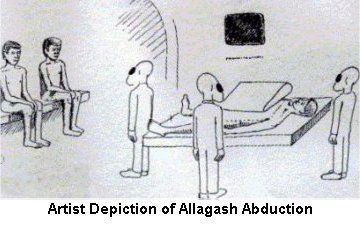
into the UFO by the hollow tube-like beam of light. On board, they
encountered strange humanoid creatures that exerted some kind of mind
control over them so that they could not resist their demands.
Fowler
suggested to Jim that he and the others undergo regressive hypnosis.
After the sessions, it was revealed that all four of the men had been
abducted, and subjected to humiliating physical examinations, including
the taking of skin and fluid samples.
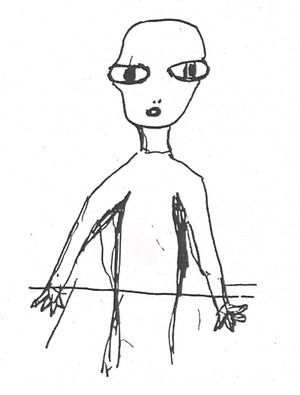
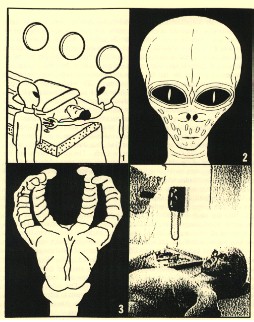
Sketch The men's
description of the aliens was consistent, and being artists, they were
able to make detailed sketches of the entities, the craft, and the
examining instruments.
http://en.wikipedia.org/wiki/Allagash_Abductions


Allagash Abductions
From Wikipedia, the free encyclopedia
The
Allagash Abduction is a purported
UFO sighting and
alien abduction that is alleged to have occurred in 1976.
Claims
Jim Weiner, Jack Weiner, Charles Foltz and Charles Rak claim that they were abducted by aliens during a camping trip near
Allagash, Maine on August 20, 1976. According to the four men,
hypnotic regression
enabled them to recall the experience of being taken aboard a UFO and
"probed and tested by four-fingered beings with almond-shaped eyes and
languid limbs".
[1]
The incident was the subject of a book,
The Allagash Abductions by Raymond E. Fowler. The incident was also dramatized in an episode of
Unsolved Mysteries and featured in the TV program
Abducted by UFOs.
Travis Walton
From Wikipedia, the free encyclopedia
Travis Walton (born February 10, 1953)
[1] is an American
logger who was allegedly abducted by a
UFO on November 5, 1975, while working with a logging crew in the
Apache-Sitgreaves National Forest in
Arizona.
[2] Walton could not be found, but reappeared after a five-day search.
The Walton case received mainstream publicity and remains one of the best-known instances of alleged
alien abduction. UFO historian
Jerome Clark writes that "Few abduction reports have generated as much controversy" as the Walton case.
[3]:527
It is furthermore one of the very few alleged alien abduction cases
with some corroborative eyewitnesses, and one of few alleged abduction
cases where the time allegedly spent in the custody of
aliens plays a rather minor role in the overall account.
UFO researchers
Jenny Randles
and Peter Houghe write that "Neither before or since has an abduction
story begun in the manner related by Walton and his coworkers.
Furthermore, the Walton case is singular in that the victim vanished for
days on end with police squads out searching … it is an atypical 'Close
Encounter: Fourth Kind' (
CE4) … which bucks the trend so much that it worried some investigators; others defend it staunchly."
[4]:186
Background
The case began on Wednesday, November 5, 1975. Then 22 years old,
Walton was employed by Mike Rogers, who had for nine years contracted
with the
United States Forest Service
for various duties. Rogers and Walton were best friends; Walton dated
Rogers' sister Dana, whom he later married. Others on the crew were Ken
Peterson, John Goulette, Steve Pierce, Allen Dallis and Dwayne Smith.
They all lived in the town of
Snowflake, Arizona.
[3]:627
Rogers was hired to thin out scrub brush and undergrowth from a large area (more than 1,200
acres) near
Turkey Springs, Arizona.
The job was the most lucrative contract Rogers had received from the
Forest Service, but the job was behind schedule. As a result, they
worked overtime to fulfill the contract, typically from 6 a.m. until
sunset.
[3]:628
Discovery in the woods
Just after 6 p.m. on November 5, Rogers and his crew finished their
work for the day and piled into Rogers' truck for the drive back to
Snowflake. The crew reported that shortly after beginning the drive
home, they saw a bright light from behind a hill. They drove closer and
said they saw a large silvery disc hovering above a clearing and shining
brightly. It was around 8 feet (2.4 m) high and 20 feet (6.1 m) in
diameter.
[citation needed]
Rogers stopped the truck and Walton leaped out and ran toward the
disc. The others said they shouted at Walton to come back but he
continued toward the disc. The men in the truck reported that Walton was
nearly below the object when the disc began making noises similar to a
loud
turbine. The disc then began to wobble from side to side, and Walton began to cautiously walk away from the object.
[citation needed]
Jerome Clark
wrote that just after Walton moved away from the disc, the others
insisted they saw a beam of blue-green light coming from the disc and
"strike" Walton. Clark went on to write that Walton "rose a foot into
the air, his arms and legs outstretched, and shot back stiffly some 10
feet (3.0 m), all the while caught in the glow of the light. His right
shoulder hit the earth, and his body sprawled limply over the ground."
[3]:628-629
The search
About 7:30 p.m., Peterson called police from
Heber, Arizona,
near Snowflake. Deputy Sheriff Chuck Ellison answered the telephone;
Peterson initially reported only that one of a logging crew was missing.
Ellison then met the crew at a shopping center. They related the tale
to him — all the men distraught, two of them in tears — and though he
was somewhat skeptical of the fantastic account, Ellison would later
reflect "that if they were acting, they were awfully good at it."
[3]:629
Ellison notified his superior — Sheriff Marlin Gillespie — who told
Ellison to keep the crew in Heber until he could arrive with Officer Ken
Coplan to interview the men. In less than an hour, Gillespie and Coplan
arrived, and they heard the tale from the crew. Rogers insisted on
returning to the scene immediately to search for Walton, with tracking
dogs, if possible. No dogs were available, but the police and some of
the crew returned to the scene. Crew members Smith, Pierce and Goulette
were too upset to be of much help in a search, so they elected to return
to Snowflake and relate the bad news to friends and family.
At the scene, the law enforcement officers became suspicious of the
story related by the crew, mainly because there was nothing in the way
of physical evidence to back up the account. Though more police and
volunteers arrived to search the area, they found not a trace of Walton.
Winter nights could be bitterly cold in the mountains, and Walton had
worn only jeans, a denim jacket and a shirt; police were worried that
Walton could fall victim to
hypothermia if he were lost.
Rogers and Sheriff Coplan went to tell the news to Walton's mother,
Mary Walton Kellett, who lived on a small ranch at Bear Creek, some 10
miles (16 km) from Snowflake. Rogers told her what had happened, and she
asked him to repeat the account. She then asked calmly if anyone other
than the police and the eyewitnesses had heard the story. Coplan thought
her reserved response was odd; this factor contributed to the growing
suspicion among police that something other than a UFO was responsible
for Walton's absence. On the other hand, Clark noted that Kellett was
known as being generally guarded, and had furthermore raised six
children largely by herself under often trying circumstances, which "had
long since taught her to not to fly to pieces in the face of crises and
tragedies. Yet in the days ahead, as events overwhelmed her, she would
show emotion before friends, acquaintances and strangers alike — a fact
that would go unmentioned in debunking treatments of the Walton
episode."
[3]:631
About 3 a.m., Kellett telephoned Duane Walton, her second-oldest child. He left his home in
Glendale, Arizona, and drove to Snowflake.
By morning on November 6, officials and volunteers had scoured the
area around the scene where Walton went missing. No trace of him was
discovered, and police suspicions were growing that the UFO tale was
concocted to cover up an accident or homicide. Saturday morning, Rogers
and Duane Walton arrived at Sheriff Gillespie's office "explosively
angry" because they had returned to the scene and found no police there.
By that afternoon, police were searching for Walton with
helicopters, horse-mounted officers, and
jeeps.
[3]:361
Publicity
By Saturday, word of Walton's disappearance had spread internationally. News reporters,
ufologists
and the curious began travelling to Snowflake. Among the visitors was
Fred Sylvanus, a Phoenix UFO investigator, who interviewed Rogers and
Duane Walton on Saturday, November 8. While repeatedly expressing worry
for Walton's well-being (and criticizing what they saw as a halfhearted
search effort by police), both men would make statements that would
return to haunt them, when seized upon by critics.
[3]:632
On the recordings made by Sylvanus, Rogers noted that because of
Walton's disappearance and the subsequent search, he would be unable to
complete his contract with the Forest Service, and he hoped the search
for his missing friend would mitigate the situation. Duane Walton
reported he and Walton were quite interested in UFOs, and that some
twelve years earlier, Duane had witnessed a UFO similar to the one
witnessed by the logging crew. Duane reported that he and Walton had
both decided that if they had a chance, they would get as close as
possible to any UFO they might see. Duane also suggested that Walton
would not be injured by the aliens, because "they don't harm people".
[3]:631
Without intending to do so, Rogers and Duane Walton had laid "the
foundations for an alternative interpretation of the case" with their
statements.
[3]:632
Walton would later report that he never had a "keen" interest in UFOs,
even after his supposed abduction, but the tape recorded statement of
his brother Duane, while Walton was still missing, runs contrary to
Walton's statements.
[5]
Shortly after the Sylvanus interview, Snowflake town marshal Sanford Flake announced that the entire affair was a
prank
engineered by Duane and Travis. They had fooled the logging crew by
lighting a balloon and "releasing it at the appropriate time". Flake's
wife disagreed, suggesting that her husband's story was "just as
farfetched as Duane Walton's".
[3]:632
In the meantime, Police officers were making repeated visits to
Kellett's home; Duane once returned there to find her in tears as she
was being questioned in her living room. Duane told the police to leave
unless they had something new to relate, or to ask. Duane suggested that
she speak with police only on the front porch, which would allow her to
end the interview anytime she chose by simply going inside. She did
exactly that after Marshal Flake arrived to relate a message, which
Clark notes, contributed to the feeling among skeptics that Kellett was
"hiding something. Or someone".
[3]:632
Duane also spoke with William H. Spaulding of
Ground Saucer Watch. Spaulding suggested that if Walton ever returned, GSW could provide a doctor to examine him in confidence.
Polygraph
On Monday, November 10, all of Rogers' remaining crew took
polygraph
examinations administered by Cy Gilson, an Arizona Department of Public
Safety employee. His questions asked if any of the men caused harm to
Walton (or knew who had caused Walton harm), if they knew where Walton's
body was buried, and if they told the truth about seeing a UFO. The men
all denied harming Walton (or knowing who had harmed him), denied
knowing where his body was, and insisted they had indeed seen a UFO.
[6]
Excepting Dallis (who had not completed his exam, thus rendering it
invalid), Gilson concluded that all the men were truthful, and the exam
results were conclusive. Clark quotes from Gilson's official report:
"These polygraph examinations prove that these five men did see some
object they believed to be a UFO, and that Travis Walton was not injured
or murdered by any of these men on that Wednesday". If the UFO was
fake, Gilson thought, "five of these men had no prior knowledge of it".
[6][3]:633
Following the polygraph tests, Sheriff Gillespie announced that he
accepted the UFO story, saying "There's no doubt they're telling the
truth."
[3]:633
In 2009, Walton was a participant on game show
The Moment of Truth.
When asked if he was abducted by a UFO in 1975, he responded, "Yes", an
answer which the polygraph examiner determined to be deceptive prior to
taping. Walton, in response to this outcome, said that polygraphs are
97% accurate, even in the best of cases.
[7]


The "medical" exam
Duane remembered Spaulding's promise of a confidential medical
examination. Without having notified authorities of Walton's return,
Duane drove him to
Phoenix, Arizona, late Tuesday morning, where they were to meet with Dr. Lester Steward.
[3]:635
The Waltons reported that they were disappointed to learn that Steward was not a
medical doctor as Spaulding had promised, but a
hypnotherapist.
Spaulding and Steward would later report that the Waltons had stayed
with them for over two hours, while the Waltons insist they were at
Steward's office for, at most, 45 minutes, most of which was occupied
with trying to determine the nature of Steward's qualifications.
[3]:635 The precise time spent with Steward would later become an issue in the case.
Walton's return makes the news
By Tuesday afternoon, word of Walton's return had leaked out to the
public. Duane took a telephone call from Spaulding, and told Spaulding
not to bother the family again. Clark writes that after this telephone
call, "Spaulding became a sworn enemy in the case."
[3]:663
Among the other telephone calls after news of Walton's return was one from Coral Lorenzen of
Aerial Phenomena Research Organization
(APRO), a civilian UFO research group. She promised Duane that she
could arrange an examination for Walton by two medical doctors —
general practitioner Joseph Saults and
pediatrician Howard Kandell — at Duane's home. Duane agreed, and the exam began at about 3:30 p.m. Tuesday.
[3]:636
Clark writes that "between Lorenzen's call and the physicians'
examination, another party would enter, and hugely complicate, the
story".
[3]:636 Lorenzen was telephoned by an employee of the
National Enquirer, an American tabloid newspaper known for its sensationalistic tone. The
Enquirer
employee promised to finance APRO's investigation, in exchange for
APRO's "cooperation and access to the Waltons". Since the Enquirer's
financial resources were far greater than APRO's, Lorenzen agreed to the
arrangement.
[3]:363
The medical examination revealed that Walton was essentially in good health, but they did note two unusual features:
- A small red spot at the crease of Walton's right elbow that was
consistent with a hypodermic injection, but the doctors also noted that
the spot was not near a vein.[3]:636
- Analysis of Walton's urine revealed a lack of ketones.
This was unusual, given that if Walton had indeed been gone for five
days with little or no food as he insisted (and as his weight loss
suggested), his body should have begun breaking down fats in order to
survive, and this should have led to very high levels of ketone in his
urine. Critics would argue this inconsistency is evidence against
Walton's story.[3]:636
Walton would later speculate that he had gotten the mark on his elbow
in the course of his logging work; critics would speculate that the
mark showed where Walton (or someone else) had injected drugs into his
system. Clark dismisses this possibility of drugging as most unlikely,
given that the medical doctors found no sign of it, but he also notes
that perhaps "more difficult to explain is the absence of
bruises, which one might expect in the wake of Walton's alleged beam-driven collision with the ground".
[3]:637
Walton in the UFO
In his survey of UFO abduction literature, Terry Matheson writes that "Walton's experience stands out by virtue of its
not being particularly bizarre as far as abduction accounts go."
[9]:111-112
Walton reported that after approaching the UFO near the work site,
the last thing he remembered was being struck by the beam of light. When
he woke, Walton said he was on a reclined bed. A bright light shone
above him, and the air was heavy and wet. He was in pain, and had some
trouble breathing, but his first thought was that he was in a normal
hospital.
[citation needed]
As his faculties returned, Walton says he realized he was surrounded
by three figures, each wearing a sort of orange jumpsuit. The figures
were not human. Walton described the beings as typical of the so-called
Greys
which feature in some abduction accounts: "shorter than five feet, and
they had bald heads, no hair. Their heads were domed, very large. They
looked like fetuses [...] They had large eyes — enormous eyes — almost
all brown, without much white in them. The creepiest thing about them
were those eyes … they just stared through me." Their ears, noses and
mouths "seemed real small, maybe just because their eyes were so huge."
[3]:646
Walton related that he feared for his safety and got to his feet, and
shouted at the creatures to stay away. He grabbed a glasslike cylinder
from a nearby shelf and tried to break its tip to create a makeshift
knife, but found the object unbreakable, so instead waved it at the
creatures as a weapon. The trio of creatures left him in the room.
[citation needed]
Matheson finds this portion of the narrative troublingly
inconsistent, noting that "despite his 'weakened' condition, 'aching
body' and 'splitting pain in his skull', maladies [sic] for which no
cause is suggested, he has no trouble jumping up from his operating
table, seizing a conveniently placed glasslike rod, and, assuming a
karate 'fighting stance', frightened them with this display of
macho aggression, enough at least to cause them to run away."
[9]:110
Walton then left the "exam room" via a hallway, which led to a
spherical room with only a high-backed chair placed in the center of the
room. Though he was afraid there might be someone seated in the chair,
Walton says he walked towards it. As he did, lights began to appear in
the room. The chair was empty, so Walton says he sat in it. When he did,
the room was filled with lights, similar to stars projected on a round
planetarium ceiling.
[citation needed]
The chair was equipped on the left arm with a single short thick
lever with an oddly shaped molded handle atop some dark brown material.
On the right arm, there was an illuminated, lime-green screen about five
inches square with black lines intersected at all angles.
[10]
When Walton pushed the lever, he reported that the stars rotated
around him slowly. When he released the lever, the stars remained at
their new position. He decided to stop manipulating the lever, since he
had no idea what it might do.
[citation needed]
He left the chair, and the stars disappeared. Walton thought he had
seen a rectangular outline on the rounded wall — perhaps a door — and
went to look for it.
[citation needed]
Just then, Walton heard a sound behind him. He turned, expecting more
of the short, large eyed creatures, but was pleasantly surprised to see
a tall human figure wearing blue coveralls with a glassy helmet. At the
time, Walton said, he did not realize how odd the man's eyes were:
larger than normal, and a bright gold color.
[citation needed]
Walton says he then asked the man a number of questions, but the man
only grinned and motioned for Walton to follow him. Walton also said
that because of the man's helmet he might have been unable to hear him,
so he followed the man down a hallway which led to a door and a steep
ramp down to a large room Walton described as similar to an aircraft
hangar. Walton says he realized he had just left a disc-shaped craft
similar to the one he had seen in the forest just before he had been
struck by the bluish light, but the craft was perhaps twice as large.
[citation needed]
In the hangar-like room, Walton reported seeing other disc-shaped
craft. The man led him to another room, containing three more humans — a
woman and two men — resembling the helmeted man. These people did not
wear helmets, so Walton says he began asking questions of them. They
responded with the same dull grin, and led him by his arm to a small
table.
[citation needed]
Once he was seated on the table, Walton says he realized the woman held a device like an
oxygen mask, which she placed on his face. Before he could fight back, Walton says he passed out.
[citation needed]
When he woke again, Walton says he was outside the gas station in
Heber, Arizona. One of the disc-shaped craft was hovering just above the
highway. After a moment, the craft shot away, and Walton stumbled to
the telephones and called his brother-in-law, Grant Neff. He thought
that only a few hours had passed.
[citation needed]
After hearing Walton's story, Gillespie speculated that Walton may
have been hit on the head and drugged, then taken to a normal hospital
where he had confused the details of a routine exam with something more
spectacular. Walton dismissed this, noting that the medical examination
had found no trace of head trauma or drugs in his system. Walton told
Sheriff Gillespie that he was willing to take a polygraph, a
truth serum,
or undergo hypnosis to support his account. Gillespie said that a
polygraph would suffice, and he promised to arrange one in secret to
avoid the growing
media circus.
[citation needed]
Duane and Travis then drove to
Scottsdale, Arizona,
where a meeting with APRO consultant James A. Harder had been arranged.
Harder hypnotized Walton, hoping to uncover more details of the missing
five days. Clark writes that "Unlike many other abductees, however,
Walton's conscious recall and unconscious 'memory' were the same, and he
could account for only a maximum of two hours, and perhaps less, of his
missing five days. Curiously … Walton encountered an impenetrable
mental block and expressed the view that he would 'die' if the
regression continued."
[3]:637
Suppressed polygraph exam and controversy
In the meantime, Spaulding had announced to the press that he and
"Dr." Steward had questioned Walton for two hours, and had uncovered
inconsistencies in Walton's account that would "Blow this story out".
[3]:637 The
Phoenix Gazette ran a story about Steward, who related his claims that the "Waltons fear exposure" of a carefully crafted lie.
[3]:638
Sheriff Gillespie arranged for a polygraph, but when word of the exam
was leaked to the press, Duane canceled it, thinking that Gillespie had
broken his promise to keep the test a secret. Gillespie would later
insist he had not leaked word of the polygraph, and that the case had
become too sensationalistic to keep anything secret for long.
[citation needed]
The National Enquirer
wanted Walton to take a polygraph as soon as possible, and arranged for
one, after Duane insisted that he and Walton have the power to veto any
public disclosure of the test results. Harder thought that Walton was
too distraught to take a polygraph, but the examiner — John J McCarthy,
of the Arizona Polygraph Laboratory — said he could take Walton's
nervous state into consideration.
[citation needed]
In interviewing Walton before the exam began, McCarthy extracted two admissions from him: First, that he had smoked
marijuana a few times, but had never used the drug regularly, and secondly, that he and Mike Rogers' younger brother had committed
check fraud
a few years earlier by altering payroll checks. It was his only serious
brush with the law – Walton completed two years probation without
further incident – but Walton remained deeply embarrassed about the
check fraud episode. (Incidentally,
Philip J. Klass
notes that Walton once claimed to have been jailed for this crime,
though he actually received two years' probation as a first-time
offender.)
[11]
McCarthy then administered the polygraph, which remains mired in
controversy. Walton asserts McCarthy behaved unprofessionally, while
McCarthy insists Walton both failed the polygraph and tried to cheat. At
one point, says Walton, McCarthy asked if Walton had "colluded" with
anyone to perpetrate a hoax. Walton said he was unfamiliar with the
word, and Walton reported that McCarthy replied, in a confrontational
and aggressive manner, that collusion was planning or
conspiring with another, just as Walton had colluded to steal and forge payroll checks.
[citation needed]
After completing the exam, McCarthy determined that Walton was lying.
Clark quotes from McCarthy's official report: "Based on his reaction on
all charts, it is the opinion of this examiner that Walton, in concert
with others, is attempting to perpetrate a UFO hoax, and that he has not
been on any spacecraft".
[3]:640 Later, McCarthy would assert that "sometimes Travis would hold his breath, in an effort to 'beat the machine'."
[5]
The Waltons, APRO and
The National Enquirer then agreed to
keep the results of this polygraph a secret, due in large part, they
insisted, to doubts about McCarthy's methods and objectivity. Eight
months later, when word of this decision was made public, there would be
more charges of deception and
cover-up.
Walton would later take and pass two additional polygraph exams, though
the suppressed results of the first exam would shadow him and earn
mention in nearly every discussion of the case to the present.
[citation needed]
Once word of the suppressed polygraph was made public by Klass, many
who had thought Walton had related a true account (or at least what he
thought
was a true account) reconsidered the case with a more skeptical eye.
Walton, Duane and APRO members argued that McCarthy was biased, and had
asked Walton embarrassing, irrelevant questions in an effort to create
turbulent conditions more likely to produce a negative result. According
to Clark,
[12]
the opinions of recognized polygraph experts were divided about the
propriety of McCarthy's exam: Harry Reed supported the validity of
McCarthy's exam, while psychologist David Raskin of the
University of Utah asserted that McCarthy's method was "more than 30 years out of date."
[citation needed]
Philip J. Klass —
an aviation journalist by profession, but also a well-known UFO
debunker — launched a concerted, sustained critique against Walton's
claims, arguing especially that there was a strong financial motive to
the entire affair. Rogers knew he would be unable to complete his
contract with the Forest Service, argued Klass, and concocted a scheme
to invoke the contract's
act of God clause, thus dissolving the contract without fault.
[5] Others argued against this idea,
[3]
noting that defaulting on a Forest Service contract was not necessarily
the catastrophe Klass implied: Rogers had failed to complete two of his
many earlier Forest Service contracts, yet had been rehired without
apparent prejudice. Furthermore, despite his anxiety over the contract,
Rogers never invoked or tried to invoke the "act of God" clause in the
aftermath of Walton's disappearance.
[5]
Klass and others also noted that
The UFO Incident was broadcast on
NBC just a few weeks before Walton's disappearance. This made-for-television film was a fictionalized account of the
Hill Abduction, the first widely publicized case of
alien abduction. Klass and others speculated that Walton had been inspired by the program.
[5]
Walton denied that he had watched the program, but Klass notes that
Mike Rogers watched at least a portion of the program. Clark argues that
Walton's account of his time on the UFO is quite different from the
Hill account, and that furthermore, "there is not a great deal of
similarity between Walton's and any other abduction narrative" publicly
discussed as of November, 1975.
[3]:649
Aftermath
In 1978, Walton published
The Walton Experience, in which he outlined his own narrative of the event and its aftermath. The same year, Bill Barry published
The Ultimate Encounter,
in which he argues that the various debunkers, especially Klass, did
not make persuasive cases and that Walton and others alleging similar
experiences related events more or less as they believed they had
happened.
Matheson argues that Walton's book makes a few fundamental errors
that severely harm his case. While Walton "proclaims self-righteously"
that he intends only to relate events and not "interpret" them, Matheson
writes, "the reader will see almost immediately that large sections of
the book are nothing more than highly speculative, purely imaginative
recreations on his part".
[9]:109 For example, after he is knocked unconscious by the blue beam, Walton offers precise,
novelistic
dialogue describing the conversations of his fellow crew workers after
they drove away in a panic. Yet Walton never mentions whether he is
paraphrasing their words based on what they related to him, if he
interviewed the others to determine who said what, or if he simply
assumed what they said. Matheson argues that this represents a "lack of
concern for literal accuracy that the reader cannot help but suspect is
characteristic of the entire work".
[9]:110
After the initial furor subsided, Walton remained in Snowflake and
eventually became the foreman at a lumber mill; he married Dana Rogers
and they had several children. Beyond the film based on his encounter,
Walton has occasionally appeared at
UFO conventions or on television specials.
[citation needed]
Fire in the Sky
In 1993, Walton's book was adapted into a film,
Fire in the Sky, directed by
Robert Lieberman and starring
D. B. Sweeney as Travis Walton,
Robert Patrick as Mike Rogers and
Scott MacDonald
as Walton's brother Dan Walton. Clark writes that the film found
"Moderate success, mixed reviews, and ufologists' complaints about its
inaccuracies and exaggerations."
[3]:650
Especially inaccurate was the portion of the film detailing his time on
the UFO; it bears almost no resemblance to the original narrative.
Screenwriter
Tracy Tormé
even sent letters to many ufologists, claiming that the changes were
requested by studio officials, and apologizing for making such
substantial alterations to Walton's narrative. (Randles and Hough, 188)
Walton and Mike Rogers made a few promotional appearances to support the film; they debated Klass on
Larry King Live. At one point, Klass lost his temper and called Rogers a "goddamned liar."
[3]:650 In his book, Clark does not offer any background context to explain Klass's remark on
Larry King Live.
In the renewed publicity generated by the motion picture, Walton,
Mike Rogers and Allen Dallis agreed to take polygraph examinations at
the behest of "a skeptical ufologist, Jerry Black".
[3]:650
Again, the tests were conducted by Cy Gilson, and the men all asserted
that the events as they related them were true. Gilson concluded that
all three men were truthful in regard to their responses about the
events of November 5, 1975.
[citation needed]
At the time of the film's release, Walton re-issued
The Walton Experience under the same title as the film; expanding it to include text rebutting Klass's commentary.
See also
Pascagoula,Mississippi - October 11th,1973:
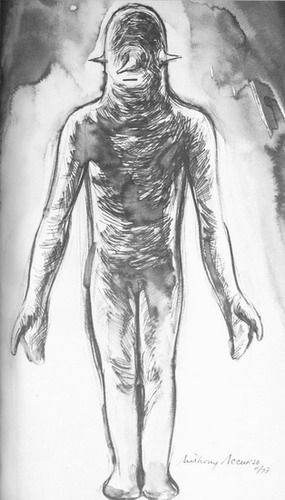


Pascagoula Abduction
From Wikipedia, the free encyclopedia
Charles Hickson,
Calvin Parker |
| Alleged abduction |
| Status |
Single Abductees |
| First abduction date |
October 11, 1973 |
| Location |
Pascagoula River, Mississippi |
| Taken from |
Abandoned industrial site |
| Media |
| Book |
Mendez William (1983), UFO Contact at Pascagoula, ISBN 0-9608558-6-6 |
The
Pascagoula Abduction occurred in 1973 when co-workers Charles Hickson and Calvin Parker claimed that they were
abducted by aliens while fishing near
Pascagoula, Mississippi. The case earned substantial
mass media attention, and is, along with the earlier
Hill Abduction, among the best-known claims of alien abduction.
[citation needed]
The UFO Encounter
On the evening of October 11, 1973, 42-year-old Charles Hickson and 19-year-old Calvin Parker — co-workers at a
shipyard — were
fishing off a pier on the west bank of the
Pascagoula River in
Mississippi.
They heard a whirring/whizzing sound, saw two flashing blue lights, and
reported that an oval shaped "craft", some 8 feet across and 8 or more
feet high, suddenly appeared near them.
[1] The ship seemed to
levitate about 2 feet above the ground.
A door opened on the ship, they said, and three creatures emerged and
seized the men, floating or levitating them into the craft. Both men
reported being
paralyzed and
numb. Parker claimed that he had
fainted
due to fright. They described the terrifying creatures as being roughly
humanoid in shape, and standing about five feet tall. The creatures'
skin was pale in color and wrinkled, and they had no eyes that the men
could discern, and slits for mouths. Their heads also appeared connected
directly to their shoulders, with no discernible neck. There were three
"
carrot-like" growths instead - one where the nose would be on a human, the other two where ears would normally be. The beings had
lobster-like claws
at the ends of their arms, and they seemed to have only one leg
(Hickson later described the creatures' lower bodies looking as if their
legs were fused together) ending in elephant-like feet. Hickson also
reported that the creatures moved in mechanical, robotic ways.
On the ship, Hickson claimed that he was somehow levitated or hovered
a few feet above the floor of the craft, and was examined by what
looked like a large football-shaped mechanical eye, about 6 to 8 inches
in diameter, that seemed to scan his body. Parker claimed that he could
not recall what had happened to him inside the craft, although later,
during sessions of hypnotic regression he offered some hazy details. The
men were released after about 20 minutes and the creatures levitated
them, with Hickson's feet dragging along the ground, back to their
original positions on the river bank.
In a later interview over 20 years after the initial incident,
Parker's story became much more elaborate. Here Parker confessed to
lying about fainting in sight of the creatures. He claimed that he was
in fact conscious when the creatures took him on board the craft and led
him into a room at the other end of a hallway to the left of the
craft's entrance. He claims he was laid down on a sloped table and
examined by a 'petite,' evidently female, being. Though he was
paralyzed, he was able to observe the being inject a needle into the
base of the underside of his penis. The being later communicated with
him telepathically, suggesting that he had been taken for a reason.
While he was not able to define it, Parker felt a sense of imminent
harm. Nevertheless, he was led back outside the craft and deposited back
into his original position unharmed. He then claimed that 19 years
later, he came in contact with the same craft again. This time he
voluntarily walked aboard the craft and met with the same female being
that had examined his body in 1973. He claimed he had a conversation
with the being, in English, in which she communicated to him a religious
message. She informed him that they shared the same God, that the bible
was an authentic text, and that her species wanted to live on earth but
could not due to humanity's tendency towards war and destruction.
[2]
Hickson and Parker contact police
Both men said they were terrified by what had happened. They claimed
to have sat in a car for about 45 minutes, trying to calm themselves.
Hickson drank some
whiskey. After some discussion, they tried to report their story to officials at
Keesler Air Force Base, but personnel told them the
United States Air Force had nothing to do with
UFO reports (
Project Blue Book had been discontinued about four years before), and suggested the men notify
police.
At about 10:30 p.m., Hickson and Parker arrived at the
Jackson County, Mississippi Sheriff's office. They brought the
catfish
they'd caught while fishing; it was the only proof they had to back up
their story. Sheriff Fred Diamond thought the men seemed sincere and
genuinely frightened and he thought Parker was especially disturbed.
Diamond harbored some doubt about the fantastic story, however, due in
part to Hickson's admitted whiskey consumption.
The "Secret Tape"
Diamond interviewed the men, who related their story. After repeated
questioning, Diamond left the two men alone in a room that was, unknown
to Hickson or Parker, rigged with a hidden
microphone.
As
Jerome Clark,
writes, "Sheriff Diamond assumed that if they were lying, that fact
would become immediately apparent when the two spoke privately. Instead,
they continued to talk in the voices of the terribly distressed."
(Clark, 447) This so-called "secret tape" was held on file at the
Jackson County Sheriff's department, and has since earned wider
circulation amongst UFO researchers and enthusiasts.
[3]
Parker, who seemed particularly shaken, spoke repeatedly of his wish to
see a doctor. A partial transcript of their interrogation and of the
"secret tape" is available;
[4] immediately below is part of the conversation on the "secret tape", as transcribed by
NICAP:
- CALVIN: I got to get home and get to bed or get some nerve
pills or see the doctor or something. I can't stand it. I'm about to go
half crazy.
- CHARLIE: I tell you, when we're through, I'll get you something to settle you down so you can get some damn sleep.
- CALVIN: I can't sleep yet like it is. I'm just damn near crazy.
- CHARLIE: Well, Calvin, when they brought you out-when they
brought me out of that thing, goddamn it I like to never in hell got you
straightened out.
- His voice rising, Calvin said, "My damn arms, my arms, I remember
they just froze up and I couldn't move. Just like I stepped on a damn
rattlesnake."
- "They didn't do me that way", sighed Charlie.
- Now both men were talking as if to themselves.
- CALVIN: I passed out. I expect I never passed out in my whole life.
- CHARLIE: I've never seen nothin' like that before in my life. You can't make people believe-
- CALVIN: I don't want to keep sittin' here. I want to see a doctor-
- CHARLIE: They better wake up and start believin'... they better start believin'.
- CALVIN: You see how that damn door come right up?
- CHARLIE: I don't know how it opened, son. I don't know.
- CALVIN: It just laid up and just like that those son' bitches-just like that they come out.
- CHARLIE: I know. You can't believe it. You can't make people believe it-
- CALVIN: I paralyzed right then. I couldn't move-
- CHARLIE: They won't believe it. They gonna believe it one of
these days. Might be too late. I knew all along they was people from
other worlds up there. I knew all along. I never thought it would happen
to me.
- CALVIN: You know yourself I don't drink
- CHARLIE: I know that, son. When I get to the house I'm gonna
get me another drink, make me sleep. Look, what we sittin' around for. I
gotta go tell Blanche... what we waitin' for?
- CALVIN (panicky): I gotta go to the house. I'm gettin' sick. I gotta get out of here.
- Then Charlie got up and left the room, and Calvin was alone.
- CALVIN: It's hard to believe . . . Oh God, it's awful... I know there's a God up there...
Seeing that the police were skeptical of their story, Hickson and Parker insisted that they take
lie detector tests to prove their honesty.
Publicity
Hickson and Parker returned to work the day after the encounter
(Friday, October 12). They did not initially discuss their purported UFO
encounter, but coworkers noted that Parker seemed very anxious and
preoccupied. Within hours, Sheriff Diamond telephoned the men at work,
stating that news reporters were swarming in his office, seeking more
information about the UFO story. An angry Hickson accused Diamond of
breaking his confidentiality pledge, but Diamond insisted he had not
done so, and that the case was too sensational to keep quiet.
Hickson's foreman overheard Hickson's side of the conversation, and
asked what had occurred. Hickson related his story to the foreman and to
shipyard owner Johnny Walker. After hearing the tale, Walker suggested
that Hickson and Parker contact Joe Colingo, a locally prominent
attorney (who was Walker's brother-in-law and also represented the
shipyard).
Colingo met the men, and, during their conversation, Hickson expressed fears about having been exposed to
radiation.
Colingo and detective Tom Huntley then took Parker and Hickson to a
local hospital, which lacked the facilities for a radiation test.
(Clark's book does not make clear if Huntley is a police detective or a
private detective.)
From the hospital, the men went to
Keesler Air Force Base,
where they were examined extensively by several doctors. Afterward,
reported Huntley, Parker and Hickson were interviewed by the military
intelligence chief of the base, with the "whole base command" observing
the proceedings. (Clark, 448)
Colingo drew up a contract to represent Hickson and Parker. However,
nothing came of this, and Hickson would later have nothing to do with
Colingo, charging the lawyer with base financial motivations: Colingo,
said Hickson, "just wanted to make a buck." (Clark, 449)
Within days, Pascagoula was the center of an international news story, with reporters swarming the town. Professor
James A. Harder (a U.C. Berkeley engineering professor and
APRO member) and Dr.
J. Allen Hynek (an astronomer formerly with
Project Blue Book)
both arrived and interviewed Parker and Hickson. Harder tried to
hypnotize the men, but they were too anxious and distracted for the
procedure to work—Parker especially so. Hynek withheld ultimate judgment
on the case, but did announce that, in his judgment, Hickson and Parker
were honest men who seemed genuinely distressed about what had
occurred.
Tiring of the publicity, Hickson and Parker went to
Jones County, Mississippi
(about 150 miles north of Pascagoula), where both men hoped to find
relief with family members. Parker was eventually hospitalized for what
Clark describes as "an
emotional breakdown." (Clark, 449)
In an interview several years after the claimed UFO event, Hickson
speculated that Parker fared worse after the encounter because he had
never previously experienced a profoundly frightening ordeal. While
Hickson described the UFO encounter as the most terrifying event in his
life, he also noted that he had seen combat in the
Korean War,
and that he thus had some familiarity with a terrifying experience. The
younger Parker, on the other hand, had never suffered through a
terrifying encounter, let alone a bizarre confrontation with something
that was not even supposed to exist.
On September 9, 2011, Charles Hickson died at age 80, but never backed off the alien abduction story despite ridicule.
[5]
Polygraph
As noted above, both Parker and Hickson volunteered to take
polygraph
exams to prove their stories. In the end, only Hickson did so, and the
examiner determined that Hickson believed the story about the UFO
abduction.
Aviation journalist and UFO skeptic
Philip J. Klass argued that there was reason to question the reliability of Hickson's lie detector exam, writing,
- The polygraph test was given to Hickson by a young operator, just
out of school, who had not completed his formal training, who had not
been certified by his own school and who had not taken a state licensing
examination. Furthermore, that the lawyer for Hickson and Parker - who
also was acting as their "booking agent" - had turned down the chance to
have his clients tested WITHOUT CHARGE by the very experienced Capt.
Charles Wimberly, chief polygraph operator from the nearby Mobile Police
Dept. Also, that the lawyer did not contact other experienced polygraph
operators close to Pascagoula. Instead, the lawyer had imported from
New Orleans - more than 100 miles away - the young, inexperienced,
uncertified, unlicensed operator who, by a curious coincidence, worked
for a friend of the lawyer![6]
Subsequent investigation by Joe Esterhas of
Rolling Stone
uncovered some additional information, leading to increased skepticism
about the abduction claim. The supposed UFO landing and abduction site
was in full view of two 24-hour toll booths, and neither operator saw
anything that night. Also, the site was in range of security cameras
from nearby Ingalls Shipyard, but the cameras did not capture anything
unusual that night.
[7]
Aftermath

Map showing coastal route
US 90, connecting
Pascagoula with
Ocean Springs, Mississippi.
Parker has avoided most public attention since the event. Hickson appeared on
Dick Cavett's
talk show in January 1974, and spoke at occasional UFO conferences; he co-wrote a book about the event with William Mendez titled
UFO Contact at Pascagoula (1983, reprinted 1987).
In 2001, retired navy chief petty officer Mike Cataldo revealed that
he observed an unusual craft at dusk on the same date. While travelling
with crew mates Ted Peralta and Mack Hanna on
U.S. Route 90 from
Pascagoula to
Ocean Springs,
an object like a large tambourine with small flashing lights approached
from the northwest and crossed the freeway, before hovering over the
treeline and disappearing. As he approached his home in St Andrews,
Ocean Springs, the craft made a second appearance at lower altitude.
[8]
See also
List of UFO sightigs
Varginha,Brazil - January 20, 1996
Varginha UFO incident
From Wikipedia, the free encyclopedia

This mushroom-like
water tower at the central park of Varginha City is a symbol of the Varginha Incident
Varginha UFO incident is the name given to a series of events involving the alleged sighting and capture by the military of an
extraterrestrial being in
Varginha,
Brazil, in 1996. Such reports were first broadcast on the Sunday TV show
Fantástico of
Rede Globo, and quickly gathered extensive media coverage worldwide, including an article in
The Wall Street Journal, and has become since then the most famous case in modern Brazilian
ufology.
The Brazilian government has officially denied any claims of being involved in the capture of
EBE's, but some
theorists claim otherwise, accusing the government of a
cover up.
For some the lack of reliable sources is evidence against its
actuality; the testimony of unnamed, anonymous "official" individuals
are frequently featured.
UFO investigator
Kevin D. Randle writes that "this case is as complicated as any other in the UFO field."
[1]
Randle notes that there is a lack of physical evidence supporting the
case, and adds, "In fact, we have been unable to verify much of
anything."
[2]
Overview
According to media reports, the creature was first sighted by three
women ranging from 14 to 21 years old: sisters Liliane and Valquíria
Fátima Silva, and their friend Kátia Andrade Xavier. They allegedly saw
the creature in the afternoon of January 20, 1996: A
biped
about 1.6 metres (5 ft), with a large head and very thin body, with
V-shaped feet, brown skin, and large red eyes. It seemed to be wobbly or
unsteady, and the girls assumed it was injured or sick. The creature
was said to have a strong, unpleasant odor.
[citation needed] Witnesses
[who?] have noted physical similarities between this alleged creature and the
chupacabra, a
cryptozoological creature reported in
Puerto Rico and Central America.
The Silva sisters say they fled, then told their mother that they had seen the
devil.
She didn’t believe them at first, but when she went to the area where
they had allegedly seen the creature and smelled a strong
ammonia-like
odor, her opinion changed. After relating their tale to family and
friends, rumors began to spread throughout the city: UFOs were sighted,
aliens were captured. Two days later, another creature was allegedly
found lying along a road. Three military trucks were sent to retrieve
it. It was captured by S2 officials (Brazil's military intelligence),
and sent to a hospital to be examined.
[citation needed] l As related by Moffett in the
Wall Street Journal, "The
army
finds itself besieged on several fronts. A local mystic predicts that
Varginha will suffer some kind of cataclysm this September as
retribution for its blitzkrieg on the interplanetary visitors. An
armed-forces news conference marking 'Victory Day' in
World War II
degenerated into a shouting match between a general and a television
reporter pressing him about the extraterrestrials. An official briefing
to debunk UFO conspiracies was overshadowed by an auto mechanic's claim
to have seen yet another weird cylindrical aircraft, a cosmic encounter
he re-enacted with the aid of an aluminum coffee thermos ...
Stanton Friedman, a
Canada-based UFO expert, says Varginha has the makings of a 'cosmic
Watergate.'"
[3]
Brazilian
mass media
was saturated for some time with speculation, rumors and accounts
regarding the UFO's and the strange creatures. A soldier, Marco Eli
Cherese, was said to have died under mysterious circumstances related to
the UFO affair.
[citation needed]
Vitorio Pacaccini,
a Brazilian UFO enthusiast, became a central figure in the Varginha
affair. He appeared on television, offering testimony he reported was
from reliable government officials, which confirmed the events as true.
The sources, however, were anonymous, said Pacaccini, and feared
reprisal. Randle notes that Pacaccini insists that the first to
encounter the strange creature was not the girls, but rather, a group of
fire department workers. In the early morning of January 20, according
to Pacaccini, four firemen were alerted to a strange animal which had
been first spotted by a group of girls, who began throwing rocks at it.
They captured the dizzy creature, and whisked it away.
[citation needed]
Moffett writes that there have been over half a dozen sightings of
the creatures, though "it is unclear how all of these beings could have
fit into the minivan-sized spacecraft that was spotted here in January."
There was disagreement as to whether one creature had been sighted
multiple times, or if several creatures had been sighted individually.
[citation needed]
Officials in Varginha denied that anything unusual occurred, but considered dedicating a park to the creatures.
[citation needed]
On the other hand, this incident made the city very famous, bringing
numerous ET tourists. Now, the UFO tourism has become an important
commercial activity of Varginha city. Many "
Grey" dolls with famous football team uniforms are on sale in the main streets.
[citation needed]
See also
The Zimbabwe School Close Encounter -
September 16th,1994.
The Zimbabwe School Close Encounter
Source: Loy Lawhon, About.com
Original Source
http://www.ufoevidence.org/
Summary: On
the morning of September 16, 1994, teachers and school
officials at the
Ariel School in Ruwa, Zimbabwe were amazed when
the school's students,
aged approximately 5 to 12 years old, reported
that a flying object had
landed on the school grounds.
Ruwa, Zimbabwe
September 16, 1994
On the morning of September 16, 1994, teachers and school officials
at the Ariel School in Ruwa, Zimbabwe were amazed when the school's
students, aged approximately 5 to 12 years old, reported that a flying
object had landed on the school grounds.
The teachers at the school were in a meeting, so the 62 children
were basically unsupervised while in the schoolyard on morning recess.
The only available adult seems to have been one of the mothers, who was
operating the school tuck shop - a sort of snack bar where candy, snacks
and sodas are sold.
According to some sources, UFOs had been seen in the skies over
Zimbabwe for two days before the incident occurred. Ruwa is about 20
kilometers from Harare, the capitol of Zimbabwe. Ariel School is a
private elementary school with students of mixed ethnic heritage.
The children said that they had first seen three objects in the sky.
These objects would disappear and then reappear in a different
location. The objects moved closer and closer to the ground and finally
landed in a brushy area adjacent to the schoolyard. This area had not
been fully cleared yet and was off-limits to the students. The object
landed, or hovered just above the ground, in an area about 100 meters
from the students.
The children said that a small man, about one meter in height,
appeared on top of the object. The little man, who was described as
having a scrawny neck, long black hair, and huge eyes, walked a short
way across the ground toward the students. When he noticed the children,
he vanished and then reappeared at the back of the object. The object
then took off and vanished.
The smaller children were very frightened and cried for help. They
believed that the little man was a demon who would eat them. Black
African children have heard legends of tokoloshis, demons who eat
children. The children ran to the tuck shop operator, but she did not
want to leave the shop unattended and so did not go.
The late Cynthia Hind, known as Africa's foremost UFO investigator,
investigated the case the next day. When she was first contacted, she
asked the headmaster of the school, Colin Mackie, to have the children
draw pictures of what they had seen. When she arrived at the school, he
had about 35 drawings for her. The drawings were of very similar
objects.
'I swear by every hair on my head and the whole Bible that I am telling the truth.'
The headmaster affirmed that he believed that the students were
telling the truth, and one little girl told Cynthia Hind that, 'I swear
by every hair on my head and the whole Bible that I am telling the
truth.'
Dr. John Mack, the abduction researcher, and his associate Dominique
Callimanopulos went to Ruwa and spent two days interviewing and
counseling twelve of the children and their parents.
"Those thoughts came from the man - the man's eyes."
Curiously, the older students said that they felt that the creatures
communicated with them somehow, sending the message that we humans are
destroying our planet, polluting the environment in ways that will have
dire consequences.
The Sightings TV show did a report on the Ariel School landing, and
CSETI has a RealPlayer video taken from the TV program with actual
testimony from the children.
|
|
62 children witness UFOnaut.
September 1977; Parkstone, Dorset, UK:
July 13, 1959, Blenheim, New Zealand:
November 2, 1967, Ririe, Idaho:
December 8, 1967; Idaho Falls, ID:
January 1, 1970; Duncan, B.C., Canada:
April 16,1974, Casale Monferrato, Italy:
May 3, 1975, San Antonio, Texas:
Goffstown, New Hampshire - November 2, 1973: