For the past 20 years, MIT's Plasma Science and Fusion Center
(PSFC) has been experimenting with nuclear fusion through the world's
smallest tokamak-type (doughnut-shaped) nuclear fusion device -- the Alcator C-Mod.
The
goal? To produce the world's smallest fusion reactor -- one that
crushes a doughnut-shaped fusion reaction into a 3.3 meter radius --
three of which could power a city the size of Boston.
And MIT researchers are getting close to their goal, despite a recent cut in federal funding that could slow their progress.
The
lessons already learned from MIT's smaller Alcator C-Mod fusion device
have enabled researchers, including MIT Ph.D candidate Brandon Sorbom
and PSFC Director Dennis Whyte, to develop the conceptual ARC
(affordable, robust, compact) reactor.
"We wanted to produce something that could produce power, but be as small as possible," Sorbom said.
A
working ARC fusion reactor would use 50 megawatts (MW) of power to
produce 500MW of fusion power, 200MW of which could be delivered to the
grid. That's enough to provide 200,000 homes with electricity.
MIT
A look inside MIT's C-Mod, which is only 0.68 meters in radius
the
smallest fusion reactor with the strongest magnetic field
in the world.
When writing your resume, make sure you sell yourself,
rather than present a long list of job Read Now
While three other fusion devices roughly the same size as the
ARC have been built over the past 35 years, they didn't produce anywhere
near its power. What sets MIT's reactor apart is its superconductor
technology, which would enable it to create 50 times the power it
actually draws. (MIT's PSFC last year published a paper on the prototype ARC reactor in the peer reviewed journal ScienceDirect.)
The
ARC reactor's powerful magnets are modular, meaning they can be easily
removed and the central vacuum vessel in which the fusion reaction
occurs can be replaced quickly; besides allowing upgrades, a removable
vessel means a single device could be used to test many vacuum vessel
designs.
Fusion
reactors work by super heating hydrogen gas in a vacuum, the fusing of
hydrogen atoms form helium. Just as with splitting atoms in today's
fission nuclear reactors, fusion releases energy. The challenge with
fusion has been confining the plasma (electrically charged gas) while
heating it with microwaves to temperatures hotter than the Sun.
Sustainable energy
The
result of successfully building an ARC reactor would be a plentiful
source of clean and reliable power, because the needed fuel -- hydrogen
isotopes -- is in unlimited supply on Earth.
"What we've done is
establish the scientific basis...for, in fact, showing there's a viable
pathway forward in the science of the containment of this plasma to make
net fusion energy -- eventually," Whyte said.
Fusion research
today is at the threshold of exploring "burning plasma," through which
the heat from the fusion reaction is confined within the plasma
efficiently enough for the reaction to be sustained for long periods of
time.
MIT
A look at the exterior of MIT's C-Mod nuclear fusion device. The C-Mod project has paved the way for a conceptual ARC reactor. Normally, gas such as hydrogen is made up of neutral molecules
bouncing around. When you superheat a gas, however, the electrons
separate from the nuclei creating a soup of charged particles rattling
around at high speeds. A magnetic field can then press those charged
particles into a condensed shape, forcing them to fused together.
The
40-year conundrum of fusion power is that no one has been able to
create a fusion reactor that puts out more power than is required to
operate it. In other words, more power is required to keep the plasma
hot and generating fusion power than the fusion power it produces.
Europe's working tokamak reactor named JET, holds the world's record for power creation; it generates 16MW of fusion power but requires 24MW of electricity to operate.
MIT's
researchers, however, believe they have the answer to the net power
problem and it'll be available in a relatively tiny package compared to
today's nuclear fission power plants. By making the reactor smaller, it
also makes it less expensive to build. Additionally, the ARC would be
modular, allowing its many parts to be removed for repairs to upgrades,
something not previously achieved.
What sets MIT's fusion device apart
What
MIT alone has done is create the world's strongest magnetic containment
field for a reactor its size. The higher the magnetic field, the
greater the fusion reaction and the greater the power produced.
"We're
highly confident that we will be able to show this medium can make more
fusion power than it takes to keep it hot," Whyte said.
MIT Plasma Science and Fusion Center
A cutaway view of the proposed ARC reactor. Thanks to powerful new
magnet technology, the much smaller, less-expensive ARC reactor would
deliver the same power output as a much larger reactor.
Fusion reactors would have several advantages over today's
fission nuclear reactors. For one, fusion reactors would produce little
radioactive waste. Fusion reactors produce what are called "activation
products" with the fusion neutrons.
The small amount of
radioactive isotopes produced are short lived, with a half life lasting
tens of years vs. thousands of years from fission waste products, Sorbom
said.
The reactors would also use less energy to operate than fission reactors.
While
MIT's current Alcator C-Mod produces no electricity, it demonstrates
the effects of a magnetic containment field on super-heated plasma, and
by hot we're talking about 100 million degrees Fahrenheit. By
comparison, our Sun is a chilly 27 million degrees Fahrenheit.
Far
from being dangerous, the 100-million-degree plasma instantly cools and
resumes a gaseous state when it touches the inner sides of the reactor.
That's why a powerful magnetic containment field is needed.
Just
like a fission nuclear reactor, a fusion reactor would essentially be a
steam engine. The heat from the controlled fusion reaction is used to
turn a steam turbine that, in turn, drives electrical generators.
MIT's
current C-Mod fusion device uses plentiful deuterium as its plasma
fuel. Deuterium is a hydrogen isotope that is not radioactive and can be
extracted from seawater.
In order to create a conceptual ARC
reactor, however, a second hydrogen isotope is needed: tritium. That's
because the rate at which deuterium-deuterium isotopes fuse is about 200
times less than the rate at which deuterium-tritium isotopes fuse.
Tritium,
while radioactive, only has a half-life of about 10 years. Although
tritium does not occur naturally, it can be created by bombarding
lithium with neutrons. As a result, it can be easily produced as a
sustainable source of fuel.
With fusion reactors, smaller is better
While MIT's reactor might not fit conveniently into Tony Stark's chest (that is
a movie after all), it would be the smallest fusion reactor with the
most powerful magnetic containment chamber on earth. It would produce
the power of eight Teslas or about two MRI machines.
By
comparison, in southern France, seven nations (including the U.S.) have
collaborated to build the world's largest fusion reactor, the International Thermonuclear Experimental Reactor (ITER) Tokamak. The ITER fusion chamber has a fusion radius of 6.5 meters and its superconducting magnets would produce 11.8 Teslas of force.
However,
the ITER reactor is about twice the size of ARC and weighs 3,400 tons
-- 16 times as heavy as any previously manufactured fusion vessel. The
D-shaped reactor will be between 11 meters and 17 meters in size and
have a tokamak plasma radius of 6.2 meters, almost twice the ARC's
3.3-meter-radius.
The concept for the ITER project began in 1985,
and construction began in 2013. It has an estimated price tag of between
$14 billion and $20 billion. Whyte, however, believes ITER will end up
being vastly more expensive, $40 billion to $50 billion, based on "the
fact that the U.S. contribution" is $4 billion to $5 billion, "and we
are 9% partners."
Additionally, ITER's timetable for completion is 2020, with full deuterium-tritium fusion experiments starting in 2027.
When
completed, ITER is expected to be the first fusion reactor to generate
net power, but that power will not produce electricity; it will simply
prepare the way for a reactor that can.
MIT's ARC reactor is
projected to cost $4 billion to $5 billion dollars and could be
completed in a four to five years, Sorbom said.
The reason ARC
could be completed sooner and at one-tenth the cost of ITER is due to
its size and the use of the new high-field superconductors that operate
at higher temperatures than typical superconductors.
Typically,
fusion reactors use low-temperature super conductors as magnetic coils.
The coils must cooled to about 4 degrees Kelvin, or minus 452 degrees
Fahrenheit, to function. MIT's tokamak fusion device uses a
"high-temperature" rare-earth barium copper oxide (REBCO)
superconducting tape for its magnetic coils, which is far less expensive
and efficient. Of course, "high temperature" is relative: the REBCO
coils operate at 100 degrees Kelvin, or about minus 280 degrees
Fahrenheit, but that's warm enough to use abundant liquid nitrogen as a
cooling agent.
Lucas Mearian
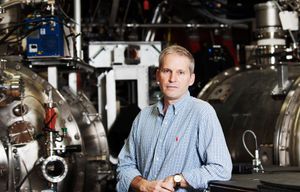
In his left hand, Brandon Sorbom holds a rare-earth barium copper
oxide (REBCO) superconducting tape used in the fusion reactor's magnetic
coils. In his right hand is a typical copper electrical cable. The use
of the new super conducting tape lowers costs and enables MIT to use
plentiful liquid nitrogen as a cooling agent. "The enabling technology to be able to shrink
the fusion device size is this new superconducting technology," Sorbom
said. "While the [REBCO] superconductors have been around since the late
1980s in labs, in the last five years or so companies have been
commercializing this stuff into tapes for large scale projects like
this."
In addition to size and cost, REBCO tape is also able to
increase fusion power 10-fold compared to standard superconducting
technology.
Before MIT's ARC can be built, however, researchers
must first prove they can sustain a fusion reaction. Currently, MIT's
C-Mod reactor runs only a few seconds each time it's fired up. In fact,
it requires so much power, that MIT must use a buffer transformer in
order store enough electricity to run it without browning out the city
of Cambridge. And, with a plasma radius of just 0.68 meter, C-Mod has is
far smaller than even the ARC reactor would
So before it builds the ARC reactor, MIT's next fusion device -- the Advanced Divertor and RF tokamak eXperiment (ADX) -- will test various means to effectively handle the Sun-like temperatures without degrading the plasma performance.
After
achieving sustainable performance, the ARC will determine whether net
power generation is possible. The last hurdle before fusion reactors can
supply power to the grid is transferring the heat to a generator.
IPP, Wolfgang Filser
A researcher works inside of the Wendelstein 7-X (W7-X) an
experimental nuclear fusion reactor built in Greifswald, Germany, by the
Max-Planck-Institut für Plasmaphysik (IPP). The reactor, completed in
October 2015, is the largest to date. Throwing a wrench into its efforts, MIT learned
earlier this year that funding for its fusion reactor under the
Department of Energy (DOE) is coming to an end. The decision to shut
down Alcator C-Mod was driven by budget constraints, according to Edmund
Synakowski, associate director of science for Fusion Energy Sciences
(FES) at the DOE.
In the current budget, Congress has provided $18
million for MIT's C-Mod, which will support at least five weeks of
operations in its final year and cover the costs associated with the
shutdown of the facility, Synakowski said in an email reply to Computerworld. (Researchers hope to find other funding sources to make up for the loss.)
The
PSFC has about 50 Ph.D students working to develop fusion energy. Past
students have left MIT to start their own companies or take develop
academic projects outside of MIT.
Making sure that scientists and
students at MIT can transition into collaborations at other DOE-funded
fusion energy research facilities in the U.S. -- especially the two
primary facilities: DIII-D at General Atomics in San Diego, and NSTX-U
at Princeton Plasma Physics Laboratory -- has been "one of the major
concerns," Synakowski said.
Over the past fiscal year, FES worked
with MIT to establish a new five-year cooperative agreement, beginning
on Sept. 1, 2015, to enable its scientists to transition to FES-funded
collaborations.
Whyte, however, believes the promise of fusion energy is too important for research to wind down.
"Fusion
is too important to have only one pathway to it," Whyte said. "My motto
is smaller and sooner. If we can [create] the technology that allows us
to access smaller devices and build a variety of them..., then this
allows us to get to a place where we've got more options on the table to
develop fusion on a faster timescale."
Recommended for You
And, Whyte said, the scientific basis for small fusion reactors has been established at MIT.
"We
did that despite the fact that we have the smallest of the major
experiments around the world. We actually have the record for achieving
pressure of this plasma. Pressure is one of the fundamental bars you
have to get over," Whyte said. "We're very excited about this."
Plans left over from an unfinished Cold War tech rivalry could help meet the world’s clean energy needs.
Today, the Max Planck Institute in Greifswald, Germany, started up a
nuclear fusion reactor using hydrogen fuel, the Associated Press
reports. German Chancellor Angela Merkel, herself a former physicist,
ceremoniously pushed the button. But the basic design of the new reactor
is as old as the color TV.
Photo of the plasma generated today in the Wendelstein 7-X.
Scientists have struggled to build a bug-free fusion reactor since
the 1950s. The original Soviet model, a bagel-shaped device called a
tokamak, is relatively simple to build and is the same design that
underpins the massive ITER reactor under construction in France. Using
powerful magnetic fields, the machine superheats hydrogen gas until it
becomes plasma. At this point, the hydrogen atoms begin fusing into
helium.
Not to be outdone by the Soviets, the Americans had their own fusion
research program. Lyman Spitzer of Princeton University designed the
American alternative in 1951. Dubbed the stellarator, the extra magnetic
coils that wind their way around the outside of the tube to keep the
plasma fuel under better control, but they make for a much more
complicated design.
So far, both models have had problems. For tokamaks, the plasma
current tends to halt unexpectedly, causing powerful electric fields to
escape and damage the reactor, and for stellerators, construction costs
have kept most on the drawing board. But the Planck Institute is giving
the stellarator blueprint another shot.
The Institute’s reactor, called the Wendelstein 7-X, has been under
construction since 1993—it was “hell on Earth” to build, the project’s
leader told
Science. The first test run was completed in December using helium
fuel, which is easier to heat than hydrogen, the standard fuel. At
today’s event, the Associated Press spoke to physics professor David Anderson of the University of Wisconsin, who was optimistic about that first test:
“The impressive results obtained in the startup of the
machine were remarkable,” he said. “This is usually a difficult and
arduous process. The speed with which W7-X became operational is a
testament to the care and quality of the fabrication of the device and
makes a very positive statement about the stellarator concept itself.
W7-X is a truly remarkable achievement and the worldwide fusion
community looks forward to many exciting results.”
Today’s test smashed hydrogen atoms together to produce superheated
plasma—but only for a fraction of a second. The Wendelstein 7-X isn’t
set up to provide power to northeastern Germany—it’s just testing the
design for future reactors. It could be decades before stellarators
replace other power sources.
Germany just turned on a new experimental fusion reactor
Today, scientists began the first tests of an ambitious new fusion reactor in Greifswald, Germany. Dubbed W7-X, the new reactor is based on the Stellerator design,
in contrast to the Tokamak reactors that dominate much fusion research.
It's still unclear whether the new design will have an advantage in
producing a workable fusion reaction, but the W7-X represents a major
step forward in researching that question. The experiment conducted
today was relatively simple, heating hydrogen particles into a suspended
plasma state, but it represents a crucial first step in the facility's
ambitious research plans.
German
Chancellor Angela Merkel pressed the button to initiate the symbolic
first test. "As an industrial nation we want to show that an affordable,
safe, reliable and sustainable power supply is possible, without any
loss of economic competitiveness," Merkel said in a statement to the
press. "The advantages of fusion energy are obvious."
Following the first successful test of the Wendelstein X-7 Stellarator—extremely sophisticated nuclear reactor in Germany—the Chinese have accomplished a wildly impressive in one of their reactors. According to the South China Morning Post,
China's Experimental Advanced Superconducting Tokamak (EAST) was able
to sustain 90 million Fahrenheit plasma (50 million Kelvin) for 102
seconds. For context, the center of the sun is thought to be only about a
third as hot.
Unlike
the mind-bendingly complex supercomputer-optimized shape of the X-7
Stellerator, China's EAST is torus-shaped, like a donut, and uses
magnetic field to keep its plasma fields in check. At a glance, the most
jaw-dropping part of its most recent test is seems to be
the temperature—hotter than the sun. But in actuality, other fusion experiments have reached up into the billions of degrees and ion colliders like the LHC have been known to reach into the trillions.
The
really important part is how long the reactor was able to maintain that
plasma. Keeping plasma around and under control for a long enough time is one of the chief barriers to practical nuclear fusion.
The Wendelstein X-7 Stellerator's first successful test was only a
fraction of a second, though the team behind it hopes to be able to
extend that out to a whopping 30 minutes, citing the Stellerator's much
calmer operation. It was much, much harder to build than China's
Soviet-designed EAST, but should eventually prove easier to operate.
In
the meantime, however, EAST's feat is a true triumph that places it on
the leading edge of the nuclear fusion race. Other reactors of its
design have a hard time maintaining plasma of this temperature for 20
seconds before a reactor meltdown starts to be a concern, much less a
minute and 42.
Researchers
from EAST tell the South China Morning Post that their experimental
data may prove useful in the development of the International
Thermonuclear Experimental Reactor (ITER)
which is currently being built in France. That project has the lofty
goal of generating 500 megawatts through fusion power for 400 seconds. That sort of success might still be way off in the distance, but we are certainly taking steps towards it.
http://nextbigfuture.com/
Chinese experimental nuclear fusion reactor contained a 50 million degree plasma for 102 seconds
The goal of the Experimental Advanced Superconducting Tokamak was to
reach 100 million Kelvins for over 1,000 seconds (nearly 17 minutes). It
would still take years to build a commercially viable plant that could
operate in a stable manner for several decades.
Most of the tokomak devices built over the last 60 years have not been able to sustain for more than 20 seconds.
The team claimed to have solved a number of scientific and engineering
problems, such as precisely controlling the alignment of the magnet, and
managing to capture the high-energy particles and heat escaping from
the “doughnut”.
A team at the Max Planck Institute in Greifswald, Germany was able to
heat hydrogen to even more intense temperatures -- up to 100 million
degrees C -- but for much shorter periods of time. The German government
has dedicated more than £1 billion to the search for nuclear fusion
This $14-billion machine is set to usher in a new era of nuclear fusion power
By Jessica Orwig
February 19, 2016 4:28 PM
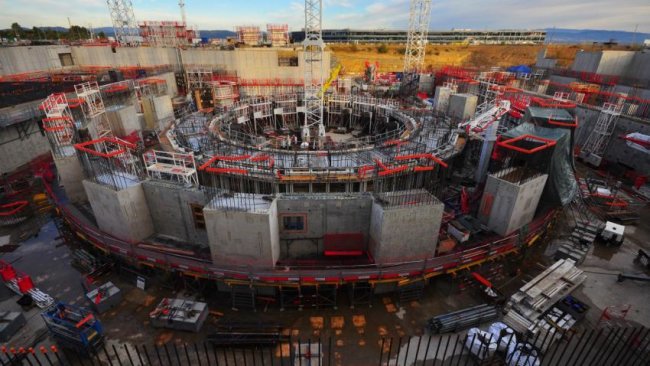
(ITER Collaboration) Picture of ITER under construction. The
first and largest machine of its kind is currently under construction
at the French scientific research center called Cadarache, which
specializes in nuclear power research.
It's called ITER, Latin for "The Way," and is expected to
usher in a new era of nuclear fusion-powered electricity — something
scientists and engineers have been working toward for over 40 years.
By fusing two forms of hydrogen, called deuterium and tritium,
together, the machine would generate 500 megawatts of power. That's ten
times more energy than it would require to operate.
Once completed, ITER would measure 100 feet in diameter and height,
representing a new breed of nuclear fusion device. If it reaches its
energy output goals, it will be the first machine of its kind to bridge
the gap from fusion research in the lab to readily available fusion
power for cities.
As of June 2015, construction costs for the machine exceeded $14 billion.
But, in the end, experts say it will be worth it. After all, nuclear
fusion is the process that powers stars like our Sun and offers a number
of advantages to current energy sources if we can harness that power
here on Earth:
Fusion generates non-radioactive waste that can be completely recycled within 100 years, unlike the toxic radioactive residue that today's nuclear fission reactors produce.
There's no chance of a runaway reaction because any malfunction would halt the fusion process, meaning that fusion reactors don't run the risk of a nuclear meltdown.
It's a clean source of energy compared to coal, natural gas, and crude oil.
Fusion reactors can run on seawater, offering a relatively renewable source of energy.
The problem with fusion
Right now, the biggest one is this: Fusion machines in operation
today use more energy to run than they put out, which is the exact
opposite of what you want from a power plant.
The problem stems from the super-heated plasma that machines, called
tokamaks, produce and where the fusion reactions takes place. Below is a
schematic of the plasma, shown in purple:
(Uploaded by Matthias W Hirsch on Wikipedia)
While
reaching these temperatures is a feat of engineering in and of itself,
tokamaks can't sustain the plasma flow for very long. The record for the
longest sustained plasma is 6 minutes and 30 seconds, which a French tokamak achieved in 2003.
This pulsing behavior, which comes with turning the plasma
repeatedly on and off in short bursts, is what scientists have been
trying to bypass for decades because pulsing costs too much energy to be
a viable approach for net energy gain.
Instead, the ideal approach is to build a machine that can produce a self-sustaining plasma. That's where ITER comes in.
Below is a cross section of what the inside of ITER will look like where the rotating particles are deuterium and tritium atoms:
The plasma inside ITER will
reach 150 million degrees, or ten times hotter than the center of the
Sun and enough to fuse deuterium and tritium.
An important byproduct of the
fusion is helium — specifically the nucleus of helium atoms. Once
produced, these atoms bounce around, imparting energy in the form of
heat, which helps to keep the plasma intrinsically hot, without the aid
of additional, external energy input.
"That's how it will be almost completely self sustaining,"Jonathan Menard, the program director of a major fusion facility at the Princeton Plasma Physics Lab (PPPL), told Business Insider.
This type of fusion burning is very similar to what's happening in the core of our Sun.
The future of fusion
(Science Magazine on YouTube) An illustration of Wendelstein 7-X's main plasma generator. Another machine in Germany called Wendelstein 7-X — which was recently turned on for the first time — is also expected to generate self-sustaining plasma.
However, Menard noted that it isn't likely that this machine
will generate enough surplus energy to serve as a potential nuclear
fusion power plant, which is what ITER is being designed to do.
Still another form of fusion reactors use lasers instead of plasma, like the National Ignition Facility in California, but that area of research still has a ways to go before it can compete with the tokamaks of the world.
"So far, the laser based systems are pretty inefficient an we think
the [plasma] fusion systems are closer to having net energy," Menard
said.
Construction began on ITER in 2007 and is expected to end in 2019
with the firing of its first plasma in 2020. The machine is expected to
reach full deuterium–tritium fusion experiments for potential net energy
gain by 2027.
In the mean time, fusion research facilities across the globe are using their tokamaks, like PPPL's National Spherical Torus Experiment, to explore different aspects of how ITER will operate.
"Particularly [we're investigating] how well those alpha particles or helium nuclei are confined," Menard said.
Check out a virtual tour through the ITER facility on YouTube, or below:
The LPP Fusion research team is still working with the tungsten electrodes
but they know the beryllium electrodes will be needed soon. Tungsten is
being used now because of its extreme resistance to the heat generated
by runaway electrons during the early stages of FF-1’s pulse. They are
combining that thermal resistance with a technique called
“pre-ionization” to prevent vaporization of the electrodes and the
resulting impurities in the plasma (see earlier report here.) This, they
expect, will greatly increase the density of the tiny plasmoid the
device produces and thus the fusion energy yield.
If LPP Fusion is successful they could reduce the cost of energy to 10-20 times.
Two cylinders of nearly pure beryllium metal were delivered to
LPPFusion’s Middlesex, NJ lab on January 14. The cylinders, weighing
together 35 kg, are to be machined over the next five months into two
anodes and a cathode for experiments in the second half of 2016. They
were fabricated from 97.8% pure beryllium at the Ulba Metallurgical
Plant in Kazakhstan. The two anodes will be machined in California and
the cathode in Massachusetts, after acceptance testing for purity and
strength, which were guaranteed by Ulba.
The Beryllium cylinders
As the plasma density increases, so will the intensity of the x-ray
pulse emitted by the plasmoid. In tungsten, the x-rays will be absorbed
in the outermost micron of the metal. When they are strong enough, the
x-rays will start to vaporize even tungsten. Before we reach that point,
LPP Fusion wants to switch to beryllium. Beryllium, a far lighter metal
with only four electrons per atom, is almost transparent to x-rays.
What x-rays beryllium does absorb will be spread out harmlessly
throughout the bulk of the electrodes.
Tungsten electrode pictures
LPP Fusion did not want to use beryllium first because they need to test
and perfect the pre-ionization technique on the tougher tungsten.
Beryllium is much less resistant to the runaway electrons than tungsten.
Once they get the pre-ionization to work well, we’ll test it further
using a silver-coated electrode to simulate the less thermally resistant
beryllium. Then they can switch to beryllium.
They have to be sure that the beryllium will not significantly erode
because vaporized beryllium could recondense as beryllium dust. While
bulk beryllium is harmless, beryllium dust is dangerous. If inhaled in
air at above 0.1 parts per billion, it can set off an immune reaction
that leads to serious or fatal lung disease. By comparison, the
decaborane fuel we will be using later this year is harmful only at
concentrations in air of 50 ppb, 500 times as much as beryllium dust. As
a result, the beryllium is being machined at specialized facilities
with high levels of safety protections. Because of this safety hazard
LPPFusion will have to use special precautions, including a sealed glove
box, if they do anything to the electrodes that could create dust.
However, with tests to ensure no dust is produced, careful monitoring
and careful safety procedures, we will be able to ensure our own safety
around the beryllium.
Since only 400 tons of beryllium is currently produced world-wide, some
of the LPP Fusion newsletter readers have asked if supplies will be
adequate for production of millions of focus fusion generators. In fact,
beryllium is as abundant in the Earth’s crust as lead, whose global
production is 4 million tons per year. Beryllium production at the
moment is limited by low demand, and strict regulations relating to its
use in fission reactors and nuclear weapons. As focus fusion production
gears up, it will be technically easy to ramp beryllium production up to
the roughly 40,000 tons per year needed. Changes to regulations should
also be possible, as focus fusion generators would make fission power
obsolete and could lead to the cessation of uranium production, firmly
closing the door to more nuclear weapons and obviating the need for
controlling beryllium.
The key to LPP Fusion progress is taking shots with our machine, Focus
Fusion-1 or FF-1 for short, which gives us the experimental data to test
our theories and demonstrate progress towards net energy. We estimate
that to accomplish net energy demonstration we have to do 1,500 more
shots. So far they have carried out 1,900 shots. Each shot costs us
about $900.
For $75 you can fund the charging of one of their 12 capacitors for one
shot, for $150, two capacitors and so on up to $900 for a full shot.
Everyone who funds a given shot will be recognized in a list kept
permanently on the website.
The popular question is when will we have commercial nuclear fusion that
has a significant impact on the energy production of the world.
Updated Prospects for Commercial Nuclear Fusion
The ITER project and the national ignition projects are decades away
according to their own timelines. They are really counting on advanced
superconductors to reduce the size and improve projected cost and
performance.
So the near term possibilities are the smaller projects.
Helion
Energy got funding increased towards tens of millions instead of a few
million. John Slough works out of the University of Washington. If
all proceeds on schedule then a Helion Energy machine that that proves
commercial energy gain would be a 50 Megawatt system built in 2019.
$200 million will be needed for the commercial pilot plant. The plan
would be to start building commercial systems by 2022. I would give
Helion the edge in terms of odds to be first to succeed. However, just
like nuclear fission, their can be more than one successful technology.
Different countries can adopt different or even multiple designs. There
will also be nuclear fusion for space propulsion (actually easier than
beating coal or natural gas for energy production. Run a fusion
propulsion for minutes or hours and it is better than ion drive. Nuclear
fusion will have a lot of applications that will need different
designs.
Prototypes every two years
LPP Fusion (Lawrenceville Plasma Physics) - the target is to make LPP
Fusion with a commercial system 4 years after net energy gain is proved.
The hop is two years to prove net energy gain. Then 2019-2022 for a
commercial reactor (2022 if we allow for 3 years of slippage). They
could lower energy costs by ten times.
LPP Fusion is very public about their research. They are minimally
funded with a few million. They are trying to get tungsten and berrylium
anodes and cathodes to work for their dense plasma focus design. Think
of an advanced spark plug design. They are trying to get a handle on
contamination from the firings. They are looking to coat their chamber
with titanium. They have to up the amperage to about 3-4 megaamps.
General Fusion- has a steam punk like design with giant pistons striking
a sphere with molten metal and plasmoids. They have Jeff Bezos funding
as well as Canadian and Malaysian government. 2023 (targeting 4 cents
per kwh)
Tri-Alpha Energy (previously talked about 2015-2020, but now likely
2020-2025). They have best funding of the venture funded fusion. They
have raised over $150 million.
Lockheed Compact Fusion has a target date of 2024 and made big news
recently with some technical details and an effort to get partners. Not
much news out of Lockheed. Experts have criticized the technical details
that they released. Outsiders think that they are too optimistic about
how small they can make it by several factors.
China is also working on supercritical water reactors that along with
factory production efficiency and massive industrial scale could
provide lower cost energy.
Really good solar with really good batteries scaled up by 100 times or more could also be transformative
Germany is about to start up a monster machine that could revolutionize the way we use energy
By Jessica Orwig
October 30, 2015 11:21 AM
(Science Magazine on YouTube) For more than 60 years, scientists have dreamed of a clean, inexhaustible energy source in the form of nuclear fusion.
And they're still dreaming.
But thanks to the efforts of the Max Planck Institute for Plasma Physics, experts hope that might soon change.
Last year, after 1.1 million construction hours, the institute
completed the world's largest nuclear-fusion machine of its kind, called
a stellarator.
The machine, which has a diameter of 52 feet, is called the W7-X.
And after more than a year of tests, engineers are finally ready to
fire up the $1.1 billion machine for the first time. It could happen
before the end of this month, Science reported.
The black horse of nuclear reactors
Known in the plasma physics community as the "black horse" of
reactors that use nuclear fusion, stellarators are notoriously difficult
to build.
The GIF below shows the many different layers of W7-X, which took 19 years to complete:
From 2003 to 2007, as the project was being built, it suffered
some major construction setbacks — including one of its contracted
manufacturers going out of business — that nearly canceled the whole
endeavor.
Only a handful of stellarators have been attempted, and even fewer have been completed.
By comparison, the more popular cousin to the stellarator, called a tokamak, is in wider use. Over three dozen
tokamaks are operational around the world, and more than 200 have been
built throughout history. These machines are easier to construct and, in
the past, have performed better as a nuclear reactor than stellarators.
But tokamaks have a major flaw that W7-X is reportedly immune to,
suggesting that Germany's latest monster machine could be a game
changer.
How a nuclear-fusion reactor works
(Uploaded by Matthias W Hirsch on Wikipedia) Schematic
of the average tokamak. Notice how it has fewer layers than the
stellarator and the shape of the magnetic coils is different. The
key to a successful nuclear-fusion reactor of any kind is to generate,
confine, and control a blob of gas, called a plasma, that has been
heated to temperatures of more than 180 million degrees Fahrenheit.
At these blazing temperatures, the electrons are ripped from their atoms, forming ions.
Normally, the ions bounce off one another like bumper cars, but under
these extreme conditions the repulsive forces are overcome.
The ions are therefore able to collide and fuse together,
which generates energy, and you have accomplished nuclear fusion.
Nuclear fusion is different from what fuels today's nuclear reactors,
which operate with energy from atoms that decay, or break apart, instead
of fusing together.
Nuclear fusion is the process that has been fueling our sun for about
4.5 billion years and will continue to do so for another estimated 4
billion years.
Once engineers have heated the
gas in the reactor to the right temperature, they use super-chilled
magnetic coils to generate powerful magnetic fields that contain and
control the plasma.
The W7-X, for example, houses 50 six-ton magnetic coils, shown in
purple in the GIF below. The plasma is contained within the red coil:
The difference between tokamaks and stellarators
For years, tokamaks have been
considered the most promising machine for producing energy in the way
the sun does because the configuration of their magnetic coils contains a
plasma that is better than that of currently operational stellarators.
(Science Magazine on YouTube) Schematic of W7-X. But
there's a problem: Tokamaks can control the plasma only in short bursts
that last for no more than seven minutes. And the energy necessary to
generate that plasma is more than the energy engineers get from these
periodic bursts.
Because of the stellarators' design, experts suspect it could sustain a plasma for at least 30 minutes
at a time, which is significantly longer than any tokamak. The French
tokamak "Tore Supra" holds the record: Six minutes 30 seconds.
If W7-X succeeds, it could turn the nuclear-fusion community on its head and launch stellarators into the limelight.
"The world is waiting to see if
we get the confinement time and then hold it for a long pulse," David
Gates, the head of stellarator physics at the Princeton Plasma Physics
Laboratory, told Science.
A
prominent North Carolina investor is backing a new kind of fusion that
operates at much lower temperatures than thought possible, which would
make it easier to commercialize. So far the early results show promise.
Tom Darden, the founder and CEO of the $2.2 billion
private equity fund Cherokee Investment Partners, made his mark by
acquiring and cleaning up hundreds of environmentally contaminated
sites. Today he is also an early stage investor in clean technology,
having put his own money into dozens of companies in areas ranging from
smart grid to renewable energy, and prefab green buildings. More
recently he’s backed a new approach to fusion, a potentially abundant
and carbon-free form of energy that would operate at a much lower
temperatures than big government projects around the world, which
require temperatures of 100 million degrees centigrade and more. This new technology, called Low Energy Nuclear Reaction (LENR)
is related but very different from the cold fusion technology that in
1989 researchers Stanley Pons and Martin Fleischmann claimed to have
licked when they revealed to the world a simple tabletop machine
designed to achieve a fusion reaction at room temperature. Their
experiment was eventually debunked and since then the term cold fusion
has become almost synonymous with scientific chicanery. What does Darden, a no-nonsense, investor with a sharp eye on
the bottom line and a successful track record, see in this new, risky
technology? Fortune’s Brian Dumaine spoke to him to find out. Q: How did you get involved with low-temperature fusion?
A: Well, I thought the issue was moot after scientists failed to
replicate the Fleischman and Pons initial cold fusion experiments. I was
literally unaware that people were working on this in labs. I’ve made
about 35 clean technology investments, and I thought that if someone’s
doing this I should have heard about it. Then three years ago I started
to hear about progress being made in the field and I said, “Damn, you
have to be kidding, it doesn’t make sense.”
As it turns out, many of those early efforts to replicate cold fusion
did not correctly load the test reactors or attempt to properly measure
heat. The scientists trying to replicate the work of Fleischman and
Pons were mainly looking for nuclear signals, like radiation, which
generally are not present. They missed that heat was the main
by-product. In addition, I learned that there have been nearly 50
reported positive test results, including experiments at Oak Ridge, Los
Alamos, EPRI, and SRI. Q: The conventional wisdom is that LENR violates the laws of physics.
A: That’s right. To create fusion energy you have to break the bonds
in atoms and that takes a tremendous amount of force. That’s why the big
government fusion projects have to use massive lasers or extreme
heat—millions degrees centigrade—to break the bonds. Breaking those
bonds at much lower temperatures is inconsistent with the laws of
physics, as they’re now known. Q: What changed your mind?
A: Scientists get locked into paradigms until the paradigm shifts.
Then everyone happily shifts to the new truth and no one apologizes for
being so stupid before. Low temperature fusion could be consistent with
existing theories, we just don’t know how. It’s like when physicists say
that according to the laws of aerodynamics bumblebees can’t fly but
they do. Q: So you licensed the technology of Andrea Rossi, an Italian
scientist and entrepreneur who’s been having some success with cold
fusion.
A: That’s right. Rossi’s was one of the first investments we made.
We’ve been seeing the creation of isotopes and energy releases at
relatively low temperatures—1,000 degrees centigrade, which could be a
sign that fusion has occurred. We have sponsored tests and more research
for Rossi’s work. A group of Swedish scientists tested the technology,
and they got good results. A number of other people say they are also
getting positive results but these haven’t been confirmed. A Russian
scientist, for example claims to have replicated Rossi’s work in
Switzerland and got excess heat. That’s a good sign. Q: So you’re optimistic?
A: Yes, In fact, Rossi was awarded an important U.S. patent recently,
which is part of what we licensed, covering the use of nickel, platinum
or palladium powders, as well as other components, in his
heat-producing device. This is one of very few LENR-related patents to
date.
But let me make one thing very clear. We don’t know for sure yet
whether it will be commercially feasible. We’ve invested more than $10
million so far in Rossi’s and other LENAR technology and we’ll spend
substantially more than that before we know for certain because we want
to crush all the tests. (Recently, we have been joined by Woodford
Investment Management in the U.K., which has made a much larger
investment into our international LENR activities—so we are well
funded.) Cold fusion has such a checkered past and is so filled with hypesters
and people with a gold rush, get-rich-quick mentality. We need to be
calm, prudent and not exaggerate. I don’t want to say that cold fusion
is real until we can absolutely prove it in ten different ways and then
persuade our worst critics to join our camp. Q: If it does work, what are the implications?
A: I’m doing this for the environment. If cold fusion works, it would
address air pollution including carbon. It could be a game changer.
Bezos, Allen-fueled startups tackle nuclear fusion’s power
Originally published November 1, 2015 at 8:00 pm Updated November 1, 2015 at 9:33 pm
http://www.seattletimes.com/
This is the C-2U machine at Tri Alpha Energy, a fusion company in Lake Forest, Calif. The machine was used to superheat a ball of hydrogen to 10 million degrees Celsius and hold it for 5 milliseconds, a... (EMILY BERL/NYT) More Backed by investors like Jeff Bezos and Paul Allen, young firms, including one in Redmond, say they’ll succeed where the government has failed in developing a fusion reactor.
By DINO GRANDONI
The New York Times
group of startups with ties to the Seattle area is promising a new and virtually unlimited source of power, one that produces none of the gases scientists say contribute to global warming. The only problem? A way to harness the energy source, nuclear fusion — the reaction that gives birth to sunlight — still needs to be invented. Such an achievement has long evaded government scientists and university researchers, despite decades of work and billions of dollars in research.
But backed by hundreds of millions in venture capital and some of the wealthiest people in the technology industry — including Amazon.com founder Jeff Bezos and Microsoft co-founder Paul Allen — a handful of young companies say they can succeed where government has fallen short. Nuclear fusion is one of many areas of science and energy now getting the backing of venture capitalists. The investor dollars coming into fusion startups, like those in many areas of science, still pale in comparison with the money spent by governments.
But signs of progress, including some results that have eclipsed government projects, have generated hope among some scientists that the companies could help develop a fusion reactor within their lifetimes. At the very least, they talk a confident game — even though the history of fusion science is littered with frustration and false starts. Some fusion scientists, unable to evaluate the startups’ unpublished scientific results, doubt the companies’ chances.
“The fusion era is here and coming,” said William Lese, a managing partner at Braemar Energy Ventures, a venture-capital firm with a stake in General Fusion, one of the leading startups in the field. “The increase in activity in this space is perhaps a sign of that.” Nuclear fusion occurs when two atoms are squeezed together so tightly that they merge. That single, larger atom releases a tremendous amount of energy.
This happens naturally at the center of the sun, where gravity easily crushes hydrogen into helium, spewing forth the sunlight that reaches Earth. But on Earth, making hydrogen hot and dense enough to sustain a controlled fusion reaction — one that does not detonate like a thermonuclear bomb — has been a challenge.
Huge incentive
The potential upsides of the power, though, provide a huge incentive. Fusion reactions release no carbon dioxide. Their fuel, derived from water, is abundant. Compared with contemporary nuclear reactors, which produce energy by splitting atoms, a fusion plant would produce little radioactive waste.
The possibilities have attracted Amazon’s Bezos. He has invested in General Fusion, a startup in British Columbia, through Bezos Expeditions, which manages his venture capital investments. Paul Allen, meanwhile, is betting on another fusion company, Tri Alpha Energy, based in Lake Forest, Calif., an hour south of Los Angeles, through his venture arm, Vulcan Capital.
Peter Thiel — the co-founder of PayPal, who once lamented the superficiality of the technology sector by saying, “We were promised flying cars and we got 140 characters” — has invested in a third fusion startup, Redmond-based Helion Energy, through Mithril Capital Management.
Government backing Government money fueled a surge in fusion research in the 1970s, but the fusion budget was cut nearly in half over the next decade.
Federal research narrowed on what scientists saw as the most promising prototype — a machine called a tokamak, which uses magnets to contain and fuse a spinning, doughnut-shape cloud of hydrogen. Today’s startups are trying to perfect some of the ideas that the government left by the wayside. After earning his doctorate from the University of California, Irvine, in the mid-1990s, Michl Binderbauer had trouble securing federal funds to research an alternative approach to fusion that the U.S. government briefly explored — one that adds the element boron into the hydrogen fuel.
Binderbauer, along with his doctorate adviser, Norman Rostoker, founded Tri Alpha Energy, eventually raising money from the venture-capital arms of Allen and the Rockefeller family. The company has raised over $200 million.
“We basically said, ‘What would an ideal reactor look like?’ ” said Binderbauer, is now the company’s chief technology officer. Rostoker died late last year.
General Fusion is pursuing an approach that uses pistons to generate shock waves through the hydrogen gas. Compressed hard enough, the hydrogen atoms will begin to fuse. General Fusion has raised about $74 million from private investors and another $20 million from the Canadian government. Its reactor concept, like that of Tri Alpha Energy, would yield power plants much smaller than a commercially viable tokamak, which would need to be larger than many stadiums are in order to work.
General Fusion’s idea to compress a ball of hydrogen, too, is borrowed from a government project aborted decades ago. The company’s innovation on that approach is to use cannon-size pistons for the compression. Difficult challenge Critics in the nuclear-physics field say it is unlikely startups will succeed with these alternative approaches.
“They just keep pounding on the same dead horse,” said Edward Morse, a nuclear physicist at the University of California, Berkeley. “What happens in fusion is that the same ideas pop up every two decades. It’s like a game of whack-a-mole.”
In addition, private funds cannot match those of the most ambitious government fusion-energy project, the International Thermonuclear Experimental Reactor, or ITER, a stadium-size tokamak being built in France by the European Union, along with the United States and five other nations, for about $14 billion.
The United States is committed to funding about 9 percent of the project.
Hedging bet Still, the Energy Department is also hedging its bet, granting $30 million to alternative fusion projects, including Redmond’s Helion Energy, which received $4 million.
“In all of our selections, it’s not about a startup vs. something else,” said Eric Rohlfing, deputy director for technology of the Advanced Research Projects Agency-Energy, the government agency that made the grants. “It’s about the quality of the idea.” The startups counter critics by saying that they can be more efficient than government projects.
When Tri Alpha Energy’s panel of outside advisers visited the construction site of the company’s lab in 2007, the concrete was still being poured. Some advisers doubted the company would be conducting experiments within a year, as Binderbauer said they would. But by the following year, the machine was ready. “When I walked these guys out there to see that, their jaws dropped,” Binderbauer said. I do recall being surprised by how fast they said they would get the facility ready,” said Burton Richter, a professor emeritus at Stanford and Nobel laureate in physics who advised Tri Alpha Energy.
Reaching a milestone
This past June, Tri Alpha reached a milestone: Its machine superheated a ball of hydrogen to 10 million degrees Celsius and held it for 5 milliseconds — much longer than government projects achieved using the same method.
“You may ask: ‘Five milliseconds? That’s nothing.’ Certainly, that’s the blink of an eye to a layperson,” Binderbauer said. “But in our field, that’s half an eternity.” Other fusion efforts have set even more ambitious goals.
When Lockheed Martin announced its own fusion project last year, the company said it expected to build a prototype within five years. But history would suggest that struggles lie ahead. For example, the U.S. government’s other major approach to fusion, used by a California lab that fires 192 giant lasers at a container holding hydrogen to compress and fuse it, missed a 2012 deadline for producing more energy than the lasers put in.
That checkered past is not stopping the startups. “We’re moving very quickly,” said Michael Delage, vice president for strategy at General Fusion. “Is it two years away? Three years away? Four years away? Maybe.“ We’ll let you know when we get there.”
DINO GRANDON
http://nextbigfuture.com/
September 25, 2015
Patent details for Nuclear Fusion using lasers and ultradense deuterium
Researchers at the University of Gothenburg and the University of Iceland are researching a new type of nuclear fusion process.
This produces almost no neutrons but instead fast, heavy electrons
(muons), since it is based on nuclear reactions in ultra-dense heavy
hydrogen (deuterium). The new fusion process can take place in
relatively small laser-fired fusion reactors fueled by heavy hydrogen
(deuterium). They have gotten twice the energy from what they put in and
believe they can get to 20 times the energy out as put in.
The nuclear fusion method comprises the following steps:
1. bringing hydrogen in a gaseous state into contact with a hydrogen
transfer catalyst configured to cause a transition of the hydrogen from
the gaseous state to an ultra-dense state;
2. collecting the hydrogen in the ultra-dense state on a carrier
configured to substantially confine the hydrogen in the ultra-dense
state within a fuel collection portion of the carrier;
3. transporting the carrier to an irradiation location; and subjecting,
at the irradiation location, the hydrogen in the ultra-dense state to
irradiation having sufficient energy to achieve break-even in energy
generation by nuclear fusion.
Computational studies of the laser pulse energy required for break-even
exist (see S.A. Slutz and R.A. Vesey, "Fast ignition hot spot break-even
scaling". Phys. Plasmas 12 (2005) 062702 ). These studies yield a pulse
energy around 1 J at break-even. In their experiments, break-even is
indeed observed at 1 J pulse energy. From break-even to an energy gain
of 1000, a further factor of at least 4 in laser pulse energy is
required. they conclude that the available information agrees that
useful power output from nuclear fusion in ultra-dense hydrogen will be
found at laser pulse energy of 4 J - 1 kJ. Such a pulse energy is
feasible.
By hydrogen in an "ultra-dense state" should, at least in the context of
the present application, be understood hydrogen in the form of a
quantum material (quantum fluid) in which adjacent nuclei are within one
Bohr radius of each other. In other words, the nucleus-nucleus distance
in the ultra-dense state is considerably less than 50 picometers. In
the following, hydrogen in the ultradense state will be referred to as
H(-1) (or D(-1) when deuterium is specifically referred to). The terms
"hydrogen in an ultra-dense state" and "ultra-dense hydrogen" are used
synomymously throughout this application.
A "hydrogen transfer catalyst" is any catalyst capable of absorbing
hydrogen gas molecules (H2) and dissociating these molecules to atomic
hydrogen, that is, catalyze the reaction H2 → 2H. The name hydrogen
transfer catalyst implies that the so-formed hydrogen atoms on the
catalyst surface can rather easily attach to other molecules on the
surface and thus be transferred from one molecule to another. The
hydrogen transfer catalyst may further be configured to cause a
transition of the hydrogen into the ultradense state if the hydrogen
atoms are prevented from re-forming covalent bonds. The mechanisms
behind the catalytic transition from the gaseous state to the
ultra-dense state are quite well understood, and it has been
experimentally shown that this transition can be achieved using various
hydrogen transfer catalysts, including, for example, commercially
available so-called styrene catalysts, as well as (purely) metallic
catalysts, such as Iridium and Palladium. It should be noted that the
hydrogen transfer catalyst does not necessarily have to transition the
hydrogen in the gaseous state to the ultra-dense state directly upon
contact with the hydrogen transfer catalyst. Instead, the hydrogen in
the gaseous state may first be caused to transition to a dense state
H(1), to later spontaneously transition to the ultra-dense state H(-1).
Also in this latter case has the hydrogen transfer catalyst caused the
hydrogen to transition from the gaseous state to the ultra-dense state.
At a rate of one carrier foil per second carrying 3 µg ultra-dense
deuterium giving fusion ignition, the energy output of a power station
using this method is approximately 1 MW. This would use 95 g of
deuterium per year to produce 9 GWh, or one 5 liter gas bottle at 100
bar standard pressure. By using several lines of target carrier
production, several laser lines or a higher repetition rate laser, the
output of the power station can be scaled relatively easily.
Catalytic conversion
The catalytic process may employ commercial so called styrene catalysts,
i.e. a type of solid catalyst used in the chemical industry for
producing styrene (for plastic production) from ethylene benzene. This
type of catalyst is made from porous Fe-O material with several
different additives, especially potassium (K) as so called promoter. The
function of this catalyst has been studied in detail.
The catalyst is designed to split off hydrogen atoms from ethyl benzene
so that a carbon-carbon double bond is formed, and then to combine the
hydrogen atoms so released to hydrogen molecules which easily desorb
thermally from the catalyst surface. This reaction is reversible: if
hydrogen molecules are added to the catalyst they are dissociated to
hydrogen atoms which are adsorbed on the surface. This is a general
process in hydrogen transfer catalysts. We utilize this mechanism to
produce ultra-dense hydrogen, which requires that covalent bonds in
hydrogen molecules are not allowed to form after the adsorption of
hydrogen in the catalyst.
The potassium promoter in the catalyst provides for a more efficient
formation of ultra-dense hydrogen. Potassium (and for example other
alkali metals) easily forms so called circular Rydberg atoms K*. In such
atoms, the valence electron is in a nearly circular orbit around the
ion core, in an orbit very similar to a Bohr orbit. At a few hundred °C
not only Rydberg states are formed at the surface, but also small
clusters of Rydberg states K N *, in a form called Rydberg Matter (RM).
This type of cluster is probably the active form of the potassium
promoter in normal industrial use of the catalyst.
The clusters K N * transfer part of their excitation energy to the
hydrogen atoms at the catalyst surface. This process takes place during
thermal collisions in the surface phase. This gives formation of
clusters H N * (where H indicates proton, deuteron, or triton) in the
ordinary process also giving the K N * formation, namely cluster
assembly during the desorption process. If the hydrogen atoms could form
covalent bonds, molecules H2 would instead leave the catalyst surface
and no ultra-dense material could be formed. In the RM material, the
electrons are not in s orbitals since they always have an orbital
angular momentum greater than zero. This implies that covalent bonds
cannot be formed since the electrons on the atoms must be in s orbitals
to form the normal covalent sigma (σ) bonds in H2. The lowest energy
level for hydrogen in the form of RM is metallic (dense) hydrogen called
H(1), with a bond length of 150 picometer (pm). The hydrogen material
falls down to this level by emission of infrared radiation. Dense
hydrogen is then spontaneously converted to ultra-dense hydrogen called
H(-1) with a bond distance of 2-4 pm depending on which particles
(protons, deuterons, tritons) are bound. This material is a quantum
material (quantum fluid) which probably involves both electron pairs
(Cooper pairs) and nuclear pairs (proton, deuteron or triton pairs, or
mixed pairs). These materials are probably both superfluid and
superconductive at room temperature, as predicted for ultra-dense
deuterium and confirmed in recent experiments.
A novel source which simplifies the study of ultradense deuterium D(-1)
is now described. This means one step further toward deuterium fusion
energy production. The source uses internal gas feed and D(-1) can now
be studied without time-of-flight spectral overlap from the related
dense phase D(1). The main aim here is to understand the material
production parameters, and thus a relatively weak laser with focused
intensity less than a trillion watts per square centimeter is employed
for analyzing the D(-1) material. The properties of the D(-1) material
at the source are studied as a function of laser focus position outside
the emitter, deuterium gas feed, laser pulse repetition frequency and
laser power, and temperature of the source. These parameters influence
the D(-1) cluster size, the ionization mode, and the laser fragmentation
patterns
An attempt is made to explain the recently reported occurrence of
ultradense deuterium as an isothermal transition of Rydberg matter into a
high density phase by quantum mechanical exchange forces. It is
conjectured that the transition is made possible by the formation of
vortices in a Cooper pair electron fluid, separating the electrons from
the deuterons, with the deuterons undergoing Bose–Einstein condensation
in the core of the vortices. If such a state of deuterium should exist
at the reported density of about 130,000 g/cm3, it would greatly
facility the ignition of a thermonuclear detonation wave in pure
deuterium, by placing the deuterium in a thin disc, to be ignited by a
pulsed ultrafast laser or particle beam of modest energy.
An attempt is made to explain the recently reported occurrence of 14 MeV
neutron induced nuclear reactions in deuterium metal hydrides as the
manifestation of a slightly radioactive ultra-dense form of deuterium,
with a density of 130,000 g/cm3 observed by a Swedish research group
through the collapse of deuterium Rydberg matter. In accordance with
this observation it is proposed that a large number of deuterons form a
“linear-atom” supermolecule. By the Madelung transformation of the
Schrödinger equation, the linear deuterium supermolecule can be
described by a quantized line vortex. A vortex lattice made up of many
such supermolecules is possible only with deuterium, because deuterons
are bosons, and the same is true for the electrons, which by the
electron–phonon interaction in a vortex lattice form Cooper pairs. It is
conjectured that the latent heat released by the collapse into the
ultra-dense state has been misinterpreted as cold fusion. Hot fusion
though, is here possible through the fast ignition of a thermonuclear
detonation wave from a hot spot made with a 1 kJ 10 petawatt laser in a
thin slice of the ultra-dense deuterium.