Among projects in the works for the US Navy is the development of new
gun rounds, including the possibility of a smaller version of the
electromagnetic projectile launching technology used by the rail gun
weapon now in development. The rail gun, which can hurl a projectile at
well over 5,000 miles per hour, is being evaluated for possible mounting
on a Zumwalt-class destroyer by the mid-2020s.
"When we take that projectile with the rail gun, why not make it small
enough to put in a five-inch round ... with a couple of hundred
five-inch rounds that now can shoot something as far, almost as
accurately as a rail gun?" Rear Admiral Peter Fanta suggested.
BAE Systems states that HVP is 24 inches long and weighs 28 pounds,
including a 15-pound payload. The total length and weight of an HVP
launch package, BAE Systems states, is 26 inches and 40 pounds. BAE
states that the maximum rate of fire for HVP is 20 rounds per minute
from a Mk 45 5-inch gun, 10 rounds per minute from the 155mm gun on
DDG-1000 class destroyers (called the Advanced Gun System, or AGS), and 6
rounds per minute from EMRG. HVP’s firing range, BAE Systems states, is
more than 40 nautical miles (when fired from a Mk 45 Mod 2 5-inch gun),
more than 50 nautical miles (Mk 45 Mod 4 5-inch gun), more than 70
nautical miles (155mm gun on DDG-1000 class destroyers), and more than
100 nautical miles (EMRG).
The Navy describes the HVP as “a next generation, common, low drag,
guided projectile capable of completing multiple missions for gun
systems such as the Navy 5-Inch, 155-mm, and future railguns.... HVP’s
low drag aerodynamic design enables high velocity, maneuverability, and
decreased time-to-target. These attributes coupled with accurate
guidance electronics provide low cost mission effectiveness against
current threats and the ability to adapt to air and surface threats of
the future.
Railgun tests and engineering to get to operational railgun by 2021
If the Navy does take the railgun out to sea on a fast transport, it
will be in 2017 at the earliest. In lieu of testing the prototype rail
gun in an at-sea environment, the Navy might instead proceed directly to
developing an operational weapon system.
According to Fanta, most of the key technologies behind railguns—which
have until now mostly been in the realm of science fiction—have been
unlocked. “It’s engineering at this point, it’s no longer science,”
Fanta told Defense News. “It’s no longer the deep dark secrets of what
can I do with this sort of energy. It’s engineering and how much power
density can I get, how much beam quality can I get, what sort of
metallurgy do I need to sustain multiple shots over multiple periods of
time. The rail gun as well as the laser.”
SOURCES - Defense News, Aviation Week, FAS, General Atomics
China conducted the third flight test of a new hypersonic missile
this week as part of its strategic nuclear program and efforts to
develop delivery vehicles capable of defeating U.S. countermeasures,
defense officials said.
The flight test of the developmental Wu-14 hypersonic glide vehicle
was monitored by U.S. intelligence agencies Tuesday during a flight test
in western China.
The latest flight test followed earlier tests of the Wu-14 on Jan. 9
and Aug. 7. The three tests indicate that China’s development of a
strike vehicle capable of traveling up to eight times the speed of sound
is a high-priority element in China’s large-scale military buildup.
A Pentagon spokesman confirmed the test but declined to provide details.
“We are aware of reports regarding this test and we routinely monitor
foreign defense activities,” Marine Corps Lt. Col. Jeff Pool told the Washington Free Beacon.
“However, we don’t comment on our intelligence or assessments of
foreign weapon systems,” Pool added, noting that the Pentagon has
encouraged China to adopt greater openness with regard to its defense
investments and military objectives “to avoid miscalculation.”
Last month in Beijing, the United States and China agreed to a new
military accord that called for notifying each country of major military
activities. It could not be learned if the Chinese notified the
Pentagon in advance of the Wu-14 test.
The Wu-14 was launched atop a Chinese ballistic missile and released along the edge of space.
Past tests of the glide vehicle were clocked as reaching an estimated
speed of Mach 10, or 10 times the speed of sound—around 7,680 miles per
hour.
Such speeds create difficult aeronautics and physics challenges for
guidance systems and place extreme stress on materials used in
construction of the vehicle.
The annual report of the congressional U.S.-China Economic and
Security Review Commission, made public Nov. 20, reveals China’s
hypersonic weapons program is a major development effort.
The report said the People’s Liberation Army “is developing
hypersonic glide vehicles as a core component of its next-generation
precision strike capability.”
“Hypersonic glide vehicles could render existing U.S. missile defense
systems less effective and potentially obsolete,” the report said.
The report said once deployed the Wu-14 “could enable China to
conduct kinetic strikes anywhere in the world within minutes to hours.”
China plans to deploy its high-speed glide vehicle by 2020 and a scramjet powered hypersonic vehicle by 2025.
Lee Fuell, technical director for force modernization and employment
at the National Air and Space Intelligence Center (NASIC), told the
Commission that Chinese glide vehicle is launched on a ballistic
missile, dives to hypersonic speed and glides to its target. The weapon
currently is assessed to be “associated with [China’s] nuclear deterrent
forces.”
“Of great concern would be if [China] was to apply the same
technology and capability with a conventional warhead or even just
without a warhead because of the kinetic energy that it has in
combination with their theater ballistic missiles … in a theater role,”
Fuell said.
The intelligence analyst said that hypersonic vehicles “are extremely
difficult to defend against because just the time is so compressed
between initial detection, being able to get a track, being able to get a
fire control solution, and then just being able to have a weapon that
can intercept them in some way just because of the speed at which
they’re moving.”
“If that is combined with more traditional ballistic missile attacks
forcing a target to defend against very high aspect warheads coming in
this way at the same time they have to defend against low altitude, very
high speed targets coming in [another] way, it makes the defense
problem orders of magnitude worse for the defender,” he said.
The commission report stated that China is expanding its strategic
nuclear forces “significantly,” with deployment of new missiles,
submarines, and multiple-warhead weapons.
Rick Fisher, a China military affairs analyst, said more tests are needed for China to turn the Wu-14 into a working weapon.
“But the real story is that such a program is now well underway,”
said Fisher, with the International Assessment and Strategy Center. “For
hypersonic systems, all tests, failures, and successes, provide a
positive contribution toward the goal of developing a weapon.”
The Wu-14 is part of what military analysts have said in a growing
hypersonic arms race involving China, Russia, and the United States.
Russia’s government announced last month that Moscow plans to field hypersonic missiles by 2020.
By contrast, U.S. development of a hypersonic weapons program has been limited.
The Aug. 25 test of the Army’s Advanced Hypersonic Weapon ended in
disaster after the booster launching the weapon blew up shortly after
launch from a test base on Kodiak Island, Alaska.
Funding for hypersonic weapons development also has been limited to
around $360 million dollars, an amount critics say is small compared to
estimated investments by China.
“It is now necessary for the United States to substantially increase
funding in two areas,” Fisher, the China military analyst said. “First
the U.S. must expand and accelerate its own hypersonic weapons program.”
The Pentagon should fund several types of hypersonic systems in a
development competition, Fisher said, as well as further research in
counter-hypersonic arms.
Past Pentagon research has included development of both
guided-but-unpowered glide vehicles, and high-technology
scramjet-powered hypersonic vehicles.
A space plane called the X-37 also is being developed as part of a program known as conventional Prompt Global Strike.
U.S. intelligence analysts have said the current Chinese Wu-14
program is currently part of its strategic nuclear program. However,
China also could use the Wu-14 as part of its conventional strike
program, such as planning attacks on aircraft carriers in the western
Pacific.
“While missile based counter-systems may provide an early solution,
there is much more potential in the realm of energy weapons,” Fisher
said.
“For example, rail guns offer great potential for early solutions to
maneuvering hypersonic weapons and this technology deserves much greater
funding,” he said.
Fisher also said the United States should increase capabilities for
targeting China’s space and high altitude reconnaissance and
surveillance systems, to include satellites.
“These will be absolutely necessary for China to successfully employ its long range hypersonic weapons,” he said.
A Chinese Embassy spokesman could not be reached for comment.
Lora Saalman, an expert on China’s hypersonic development at the
Carnegie Endowment, said after China’s second Wu-14 test in August that
the closeness of the first two tests showed that Beijing is
“fast-tracking” the strategic program.
“When compared with the yearly gaps in between its [anti-satellite]
and [ballistic missile defense] tests in 2007, 2010, 2013, and 2014, the
WU-14 accelerates China’s development timeline exponentially,” she said
in an email in August.
Saalman believes the Wu-14 is part of a Chinese version of the U.S. conventional Prompt Global Strike program.
Lora Saalman, an expert on China’s hypersonic development at the
Carnegie Endowment, said China’s third test of the Wu-14 in one year is
unusual.
“Not only does this third test of the WU-14 in one year indicate that
this is a priority program for China, it also suggests that U.S.
historical concerns over a Chinese quantitative ‘sprint to parity’ in
nuclear weapons are misdirected,” she said.
“Instead, China is racing ahead on qualitatively developing their
advanced conventional weapons,” Saalman stated in an email. “Such
developments are significant in that the posture guiding use of these
weapons is not guided by nuclear taboo or no first use.”
Mark Schneider, a former Pentagon strategic forces specialist, said
the latest Chinese hypersonic vehicle test poses “a serious threat.”
“The National Air and Space Intelligence Center has said in open
testimony before the China Commission that the vehicle is nuclear and
there may also be a conventional version,” Schneider said.
“There is not really a race in hypersonic weapons,” he added. “U.S. programs are small scale due to budget cuts.”
Russia’s announced programs on hypersonics include a high-speed
missile for a new stealth bomber, hypersonic warheads for Russian
ballistic missiles, and a joint cruise missile program with India,
Schneider said. “We are clearly losing our technical edge.”
There is nothing more fascinating in the aviation world than the “black projects”
– aircraft programs that are so secret that even those with the highest
security clearance may have no idea they exist. But occasionally the
veil of secrecy is accidentally lifted – or projects are declassified –
offering a fleeting glimpse into this shadowy world. Here we take to
the air with six different planes – some now released into the public
domain, others still highly classified or even non-existent.
TR-3A Black Manta
Images by Adrian Mann
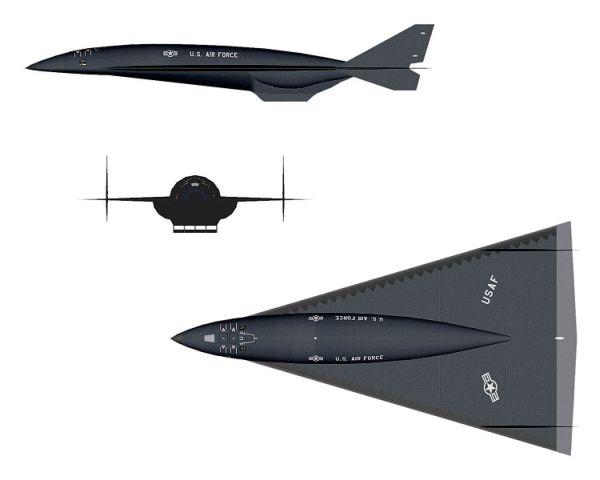
Allegedly active during the 1980s and ’90s, little is known of the TR-3A Black Manta
beyond rumour and hearsay. Popularly embraced as a subsonic stealth
aircraft manufactured by Northrop Grumman (famed for its “flying wing”
designs), the TR-3A was rumoured to have been used in the Gulf War in
conjunction with F-117A stealth fighters, but little evidence exists to
support this. Another theory – again unsubstantiated – holds that the
vehicle identified as the TR-3 was a prototype for the B-2 Spirit.
Two 1977 designs
from Teledyne Ryan, a firm specialising in unmanned aerial vehicles,
have been linked to the TR-3A. This stems in part from the fact that
“TR” stands for Teledyne Ryan – a fanciful connection considering “TR”
is well known to denote “tactical reconnaissance. Teledyne Ryan was
purchased by Northrop Grumman in 1999, adding fuel to the fire of
conspiracy theory. But aside from a patent (below) that is said to
resemble the configuration of whatever aircraft has been identified with
the TR-3A, there is little, if any, credible evidence linking it to
Teledyne Ryan.
The designation “TR-3″ likely came about due to confusion with another black project, Tier III, which led to the RQ-3 Darkstar.
Another theory holds that the aircraft dubbed the TR-3 may have grown
out of the Tactical High Altitude Penetrator (THAP) studies, of which
little exists in the public domain. This article
discusses THAP’s potential mission as a recon-strike platform, which
could account for a plethora of sightings throughout the 1980s and
’90s. However, there is significant debate over whether THAP progressed
to the flight testing stage. If THAP was not responsible for the
“TR-3A” sightings, it’s possible another secret demonstrator associated
with the A-12 Avenger programme (below) could have been… Flying Triangle dubbed “TR-3B”
The online world is buzzing with information about the alleged “TR-3B“,
from rumours of its fantastical capabilities to intriguing video
footage. Yet despite numerous sightings suggesting the existence of a
large triangular aircraft that can fly slowly and quietly, little
information exists about this rumoured black project. Like the TR-3A
above, the designation “TR-3B” is almost certainly a misnomer.
The most dramatic claims frame the “TR-3B” as a nuclear powered
tactical reconnaissance aircraft capable of disrupting gravity. But a
more likely – and in many ways more interesting – argument for these
strange flying triangles, is that they’re lighter-than-air
vehicles or some sort of stealthy troop transport aircraft. Given the
technologies proven by Have Blue and Tacit Blue in the 1970s and ’80s
and the number of projects that have allegedly been tested at Groom
Lake since that time, it’s not impossible to think that some of these
flying triangle reports may have some substance to them, if not under
the designation TR-3B. A-12 Avenger II (and the Mysterious Jet that May Have Preceeded it)
Image via U.S. Navy
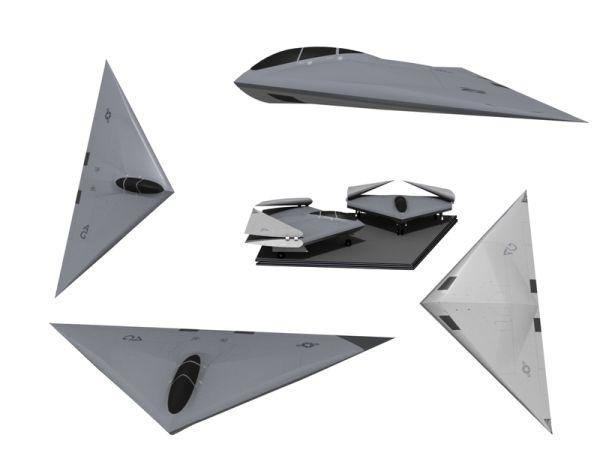
The A-12 Avenger II
was envisioned by McDonnell Douglas and General Dynamics as an
all-weather, carrier-based stealth bomber for the U.S. Navy and
Marines. Shrowded in secrecy at the time of development in 1983, the
A-12 reportedly gained the nickname “Flying Dorito”. Concept drawings
and mock-ups show a flying wing design in the shape of an isosceles
triangle, with the cockpit near the apex.
Development
of the A-12 was hampered by problems. The project was cancelled in
January 1991 by then-Secretary of Defense Dick Cheney when the estimated
price of each plane allegedly hit $165 million. The cancellation was
said to be a breach of contract, resulting in years of legal wrangling.
In 2009, a court finally ruled in favour of the government and ordered
the contractors to pay more than a $2 billion in charges, but the battle
ranges on to this day.
Images via U.S. Navy
After the cancellation of the A-12 Avenger II the Navy purchased the
F/A-18E/F Super Hornet. While there was never a full scale prototype,
an earlier (1976 – 1984) classified General Dynamics technology
demonstrator called Model 100 (funded under the Have Key program) may
have paved the way for the cancelled A-12. It has been suggested that this aircraft remains secret due to the ongoing legal issues. The A-12 has also been linked to a secret plane called Sneaky Pete, which may or may not be the Model 100, or a development thereof. We were able to locate one A-12 mock-up thanks to those savvy online explorers at Virtual Globetrotting.
X-44 Manta
Image via strange-mecha.com
(Image licensed under Creative Commons Attirbution-ShareAlike 3.0 Unported)
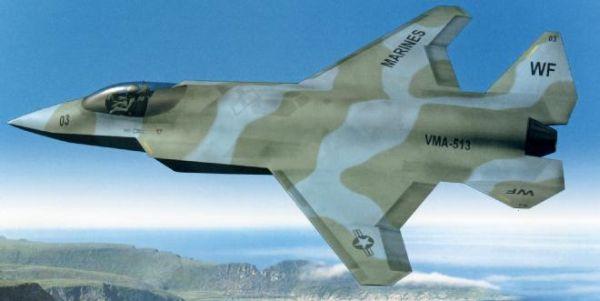
The X-44 Manta
was a conceptual design by Lockheed Martin, based on the original F-22
Raptor (below). The X-44 was essentially a tailless Raptor with large
delta wing and advanced thrust vectoring nozzles replacing normal
aerodynamic control surfaces. Benefits would be a more stealthy, light
airframe, with increased fuel volume and maneuverability. The plan was
to convert an early F-22 prototype but the program was allegedly
terminated in 2000. The X-44 render looks similar to the proposed FB-22, reportedly cancelled in 2006.
Image via Rob Shenk
(Image licensed under Creative Commons Attribution-Share Alike 2.0 Generic)
It’s hard to know what to make of many alleged black projects. Could
some of these exotic aircraft be one and the same? How much
disinformation is out there? The X-44 was essentially a flying wing
design with a name similar to the TR-3A “Black Manta”, although in the
X-44’s case, MANTA apparently denoted Multi-Axis No-Tail Aircraft.
Could this be a case of one black project’s name being mistakenly
attributed to another, like TR-3 and Tier III? In 2005,
GlobalSecurity.org reported that the X-44 designation may be reserved for a possible NASA full-scale manned tailless flight control demonstrator.
Like other black projects, Britain’s effort to create a stealth
demonstrator remains shadowy, despite cancellation in the 1990s. The Replica program was a BAE Systems design study tied in with the RAF’s now defunct Future Offensive Air System (FOAS). It is known to have run from 1994 to 1999, with a full-sized mock-up subjected to rigorous testing to determine its radar cross section (above).
FOAS set out to replace the RAF’s Tornado GR4 jets with a range of
manned and unmanned platforms by 2017. The program was cancelled in
June 2005 after the UK joined the U.S. Joint-Unmanned Combat Air System
(J-UCAS) program, which was itself cancelled the next year but later
revived as the Navy-only UCAS-D program. After the termination of FOAS, knowledge gained from Replica was poured into the Joint Strike Fighter (JSF).
Images via United States Air Force
Initial arguments over Britain’s access to the JSF source code
prompted Britain to consider a potential alternative. While likely
referring to an adapted Eurofighter Typhoon, Replica
remains in the shadows, despite public acknowledgement of the program
and photos of the full scale mock-up stored at BAE Warton. This could
be due to the ongoing use of Replica’s technology in forthcoming
projects, such as the JSF, but also Taranis,
a BAE unmanned demonstrator. Again publicly acknowledged, Taranis is
set to fly next year although sightings suggest it – or perhaps
something else – flew in 2009, which the British government vehemently
denies.
The Aurora spyplane is the world’s most famous top secret aircraft,
and a reliable photograph would be one of the most coveted finds in the
history of classified aviation. Historically presented as a hypersonic
replacement for the ageing SR-71 Blackbird spyplane (below), there’s
considerable evidence available in the public domain to suggest no
specific aircraft called “Aurora” ever existed.
SR-71 Blackbird (image via U.S. Air Force)
The name “Aurora” reportedly slipped out in the 1985 US budget
alongside an allocation of $455 million for “black aircraft
production”. Excited journalists, writing in the March 1990 edition of Aviation Week & Space Technology,
linked “Aurora” to the reported black aircraft, and later to a family
of exotic aviation projects, claiming that by 1987 funding had reached
$2.3 billion. Ben Rich, former director of the Lockheed Skunk Works
(which built the F-117, below), said there never was a hypersonic
Blackbird follow-on and claimed Aurora was the name given to the B-2
Stealth Bomber competition funding.
F-117 Nighthawk (image by U.S. Air Force)
Helping to fuel the Aurora legend was a disjointed catalogue of sightings
and mysterious sonic booms. The most compelling sighting came in
August 1989, when Chris Gibson, an engineer aboard the Galveston Key rig
in the North Sea, observed a strange isosceles triangle-shaped aircraft
refuelling from a KC-135 Stratotanker, escorted by two F-111 bombers.
Gibson, a member of the Royal Observer Corps and trained aircraft
recognition expert, could not identify the mysterious plane.
Image via Google Earth
In the early 1990s, the disclosed “Aurora” designation and the “North Sea sighting”
were linked to several other reports that helped perpetuate the story
of a top secret SR-71 follow-on. One was a report of an aircraft over
Amarillo, Texas, with an engine described as emitting a “strange, loud
pulsating roar”. Caught on film was an alleged “donuts-on-a-rope”
contrail that has become synonymous with the Aurora myth. While some
attribute this to a potential pulse wave detonation engine, others have
argued the contrails could have been made by ordinary jet aircraft.
Images via Google Earth
Finally, a series of bizarre sonic booms heard over California up
until 1993 were attributed to Aurora after seismologists concluded they
did not characterise earthquakes, but indictated “something at 90,000
feet, Mach 4 to Mach 5.2″. Intriguingly, each unexplained sonic boom
came on a Thursday morning between 6 and 7am. In addition, Groom Lake
(Area 51) has a six mile long runway, now closed, that some say would
be a requirement for testing a high speed, mach 5 plus, aircraft.
It’s telling that, more than 20 years after Aurora debuted in
aviation and popular science publications, no solid evidence has been
found to support its existence, despite the hype and hordes of
investigators digging for information. At this point it seems likely
that the top secret aircraft known as Aurora stems from sightings of
various aircraft (some potentially black projects) and not necessarily a
single airframe. That said, Chris Gibson’s sighting and the strange
skyquakes remain a mystery to this day.
DARPA's former headquarters in the Virginia Square neighborhood of Arlington. This agency recently moved to 675 North Randolph Street, near the Ballston Common Mall.
The Defense Advanced Research Projects Agency (DARPA) is an agency of the United States Department of Defense
responsible for the development of new technologies for use by the
military. DARPA has been responsible for funding the development of many
technologies which have had a major effect on the world, including computer networking, as well as NLS, which was both the first hypertext system, and an important precursor to the contemporary ubiquitous graphical user interface.
DARPA began as the Advanced Research Projects Agency (ARPA) created in 1958 by President Dwight D. Eisenhower
for the purpose of forming and executing research and development
projects to expand the frontiers of technology and science and able to
reach far beyond immediate military requirements.[3] The administration was responding to the Soviet launching of Sputnik 1 in 1957, and ARPA's mission was to ensure U.S. military technology be more sophisticated than that of the nation's potential enemies. From DARPA's own introduction:[4]
DARPA’s original mission, established in 1958, was to prevent
technological surprise like the launch of Sputnik, which signaled that
the Soviets had beaten the U.S. into space. The mission statement has
evolved over time. Today, DARPA’s mission is still to prevent
technological surprise to the US, but also to create technological
surprise for our enemies.
ARPA was renamed to "DARPA" (for Defense) in March 1972, then renamed
"ARPA" in February 1993, and then renamed "DARPA" again in March 1996.
DARPA is independent from other more conventional military research and development
and reports directly to senior Department of Defense management. DARPA
has around 240 personnel (about 140 technical) directly managing a $3
billion budget. These figures are "on average" since DARPA focuses on
short-term (two to four year) projects run by small, purpose-built
teams.
The creation of DARPA was authorized by President Eisenhower
in 1958 for the purpose of forming and executing research and
development projects to expand the frontiers of technology and science,
and able to reach far beyond immediate military requirements.,[3] the two relevant acts being the Supplemental Military Construction Authorization (Air Force)[5]
(Public Law 85-325) and Department of Defense Directive 5105.15, in
February 1958. Its creation was directly attributed to the launching of Sputnik and to U.S. realization that the Soviet Union had developed the capacity to rapidly exploit military technology.
Additionally, the political and defense communities recognized the
need for a high-level Department of Defense organization to formulate
and execute R&D projects that would expand the frontiers of
technology beyond the immediate and specific requirements of the
Military Services and their laboratories. In pursuit of this mission,
DARPA has developed and transferred technology programs encompassing a
wide range of scientific disciplines which address the full spectrum of
national security needs.
From 1958 to 1965, ARPA's emphasis centered on major national issues, including space, ballistic missile defense, and nuclear test detection. During 1960, all of its civilian space programs were transferred to the National Aeronautics and Space Administration (NASA) and the military space programs to the individual Services.
This allowed ARPA to concentrate its efforts on the Project Defender (defense against ballistic missiles), Project Vela (nuclear test detection), and Project AGILE (counterinsurgency R&D) Programs, and to begin work on computer processing, behavioral sciences, and materials sciences. The DEFENDER and AGILE Programs formed the foundation of DARPA sensor, surveillance, and directed energy R&D, particularly in the study of radar, infrared sensing, and x-ray/gamma ray detection.
ARPA at this point (1959) played an early role in Transit (also called NavSat) a predecessor to the Global Positioning System (GPS).[6]
"Fast-forward to 1959 when a joint effort between DARPA and the Johns
Hopkins Applied Physics Laboratory began to fine-tune the early
explorers’ discoveries. TRANSIT, sponsored by the Navy and developed
under the leadership of Dr. Richard Kirschner at Johns Hopkins, was the
first satellite positioning system."[7][8]
During the late 1960s, with the transfer of these mature programs to
the Services, ARPA redefined its role and concentrated on a diverse set
of relatively small, essentially exploratory research programs. The
agency was renamed the Defense Advanced Research Projects Agency (DARPA)
in 1972, and during the early 1970s, it emphasized direct energy
programs, information processing, and tactical technologies.
Concerning information processing, DARPA made great progress, initially through its support of the development of time-sharing (all modern operating systems rely on concepts invented for the Multics system, developed by a cooperation among Bell Labs, General Electric and MIT, which DARPA supported by funding Project MAC at MIT with an initial two-million-dollar grant).[9]
DARPA supported the evolution of the ARPANET (the first wide-area packet switching network), Packet Radio Network, Packet Satellite Network and ultimately, the Internet and research in the artificial intelligence fields of speech recognition and signal processing, including parts of Shakey the robot.[10] DARPA also funded the development of the Douglas Engelbart's NLS computer system and The Mother of All Demos; and the Aspen Movie Map, which was probably the first hypermedia system and an important precursor of virtual reality.
Later history
The Mansfield Amendment
of 1973 expressly limited appropriations for defense research (through
ARPA/DARPA) to projects with direct military application. Some[who?]
contend that the amendment devastated American science, since
ARPA/DARPA was a major funding source for basic science projects of the
time; the National Science Foundation never made up the difference as expected.
The resulting "brain drain"
is also credited with boosting the development of the fledgling
personal computer industry. Many young computer scientists fled from the
universities to startups and private research labs like Xerox PARC.
Between 1976 and 1981, DARPA's major projects were dominated by air,
land, sea, and space technology, tactical armor and anti-armor programs,
infrared sensing for space-based surveillance, high-energy laser
technology for space-based missile defense, antisubmarine warfare,
advanced cruise missiles, advanced aircraft, and defense applications of
advanced computing. These large-scale technological program
demonstrations were joined by integrated circuit research, which
resulted in submicrometer electronic technology and electron devices
that evolved into the Very Large Scale Integration (VLSI) Program and the Congressionally mandated charged particle beam program.
Many of the successful programs were transitioned to the Services, such as the foundation technologies in automatic target recognition, space based sensing, propulsion, and materials that were transferred to the Strategic Defense Initiative Organization (SDIO), later known as the Ballistic Missile Defense Organization (BMDO), now titled the Missile Defense Agency (MDA).
Recent history
During the 1980s, the attention of the Agency was centered on
information processing and aircraft-related programs, including the National Aerospace Plane (NASP) or Hypersonic Research Program. The Strategic Computing Program
enabled DARPA to exploit advanced processing and networking
technologies and to rebuild and strengthen relationships with
universities after the Vietnam War. In addition, DARPA began to pursue new concepts for small, lightweight satellites (LIGHTSAT) and directed new programs regarding defense manufacturing, submarine technology, and armor/anti-armor.
On October 28, 2009 the agency broke ground on a new facility in Arlington, Virginia a few miles from the Pentagon.[11]
In fall 2011, DARPA hosted the 100-Year Starship Symposium with the aim of getting the public to start thinking seriously about interstellar travel.[12]
According to former DARPA Director Tony Tether and W. B. Bonvillian (“Power Play”, W. B. Bonvillian, The American Interest, Volume II, p 39, November–December 2006), DARPA's key characteristics to be replicated to reproduce DARPA's success are:[13]
Small and flexible: DARPA has only about 140 technical professionals; DARPA presents itself as “100 geniuses connected by a travel agent.”[14]
Flat organization: DARPA avoids hierarchy, essentially operating at
only two management levels to ensure the free and rapid flow of
information and ideas, and rapid decision-making.
Autonomy and freedom from bureaucratic impediments: DARPA has an
exemption from Title V civilian personnel specifications, which provides
for a direct authority to hire talents with the expediency not allowed
by the standard civil service processes.
Eclectic, world-class technical staff and performers: DARPA seeks
great talents and ideas from industry, universities, government
laboratories, and individuals, mixing disciplines and theoretical and
experimental strength. DARPA neither owns nor operates any laboratories
or facilities, and the overwhelming majority of the research it sponsors
is done in industry and universities. Very little of DARPA’s research
is performed at government labs.
Teams and networks: At its very best, DARPA creates and sustains
great teams of researchers from different disciplines that collaborate
and share in the teams’ advances.
Hiring continuity and change: DARPA’s technical staff is hired or
assigned for four to six years. All key staff i.e. Office Directors and
Program Managers are rotated to ensure constant infusion of fresh
thinking and perspectives.
Project-based assignments organized around a challenge model: DARPA
organizes a significant part of its portfolio around specific technology
challenges. It foresees innovation-based capabilities and then works
back to the fundamental breakthroughs required to make them possible.
Although individual projects typically last three to five years, major
technological challenges may be addressed over longer time periods,
ensuring patient investment on a series of focused steps and keeping
teams together for ongoing collaboration.
Outsourced support personnel: DARPA extensively leverages technical,
contracting, and administrative services from other DoD agencies and
branches of the military. This provides DARPA the flexibility to get
into and out of an area without the burden of sustaining staff, while
building cooperative alliances with its “agents.” These outside agents
help create a constituency in their respective organizations for
adopting the technology.
Outstanding program managers: The best DARPA program managers have
always been freewheeling zealots in pursuit of their goals. The
Director’s most important task is to recruit and hire very creative
people with big ideas, and empower them.
Acceptance of failure: DARPA pursues breakthrough opportunities and
is very tolerant of technical failure if the payoff from success will be
great enough.
Orientation to revolutionary breakthroughs in a connected approach:
DARPA historically has focused not on incremental but radical
innovation. It emphasizes high-risk investment, moves from fundamental
technological advances to prototyping, and then hands off the system
development and production to the military services or the commercial
sector.
Mix of connected collaborators: DARPA typically builds strong teams
and networks of collaborators, bringing in a range of technical
expertise and applicable disciplines, and involving university
researchers and technology firms that are often not significant defense
contractors or beltway consultants.
Current program offices
DARPA has seven program offices, all of which report to the DARPA director:
The Defense Sciences Office (DSO)
vigorously pursues the most promising technologies within a broad
spectrum of the science and engineering research communities and
develops those technologies into important, radically new military
capabilities.[15]
The Information Innovation Office (I2O) aims to ensure U.S. technological superiority in all areas where information can provide a decisive military advantage.
The Microsystems Technology Office (MTO)
mission focuses on the heterogeneous microchip-scale integration of
electronics, photonics, and microelectromechanical systems (MEMS). Their
high risk/high payoff technology is aimed at solving the national level
problems of protection from biological, chemical and information attack
and to provide operational dominance for mobile distributed command and
control, combined manned/unmanned warfare, and dynamic, adaptive
military planning and execution.
The Strategic Technology Office (STO) mission is to focus on technologies that have a global theater-wide impact and that involve multiple Services.[16]
The Tactical Technology Office (TTO)
engages in high-risk, high-payoff advanced military research,
emphasizing the "system" and "subsystem" approach to the development of
aeronautic, space, and land systems as well as embedded processors and
control systems. This research includes an effort within the TTO to
develop a small satellite launch vehicle.[17] This vehicle is under development by AirLaunch LLC.[18] This is part of the Force Application and Launch from Continental United States (FALCON) effort.
The Biological Technologies Office (BTO)
fosters, demonstrates, and transitions breakthrough fundamental
research, discoveries, and applications that integrate biology,
engineering, and computer science for national security. Created in
April 2014 by DARPA director Aratir Prabhakar, taking programs from the MTO and DSO divisions.[19]
The Advanced Technology Office (ATO)
researched, demonstrated, and developed high payoff projects in
maritime, communications, special operations, command and control, and
information assurance and survivability mission areas.[citation needed]
The Special Projects Office (SPO)
researched, developed, demonstrated, and transitioned technologies
focused on addressing present and emerging national challenges. SPO
investments ranged from the development of enabling technologies to the
demonstration of large prototype systems. SPO developed technologies to
counter the emerging threat of underground facilities used for purposes
ranging from command-and-control, to weapons storage and staging, to the
manufacture of weapons of mass destruction. SPO developed significantly
more cost-effective ways to counter proliferated, inexpensive cruise
missiles, UAVs, and other platforms used for weapon delivery, jamming,
and surveillance. SPO invested in novel space technologies across the
spectrum of space control applications including rapid access, space
situational awareness, counterspace, and persistent tactical grade
sensing approaches including extremely large space apertures and
structures.
The Information Systems Office (ISO)
in the 1990s developed system applications of advanced information
technologies. It was a predecessor to the Information Exploitation
Office.[citation needed]
A 1991 reorganization created several offices which existed throughout the early 1990s:[20]
The Electronic Systems Technology Office
combined areas of the Defense Sciences Office and the Defense
Manufacturing Office. This new office will focus on the boundary between
general-purpose computers and the physical world, such as sensors,
displays and the first few layers of specialized signal-processing that
couple these modules to standard computer interfaces.
The Computing Systems Technology Office
combined functions of the old Information Sciences and Tactical
Technology office. The office "will work scalable parallel and
distributed heterogeneous computing systems technologies," DoD said.[citation needed]
The Software and Intelligent Systems Technology Office and the Computing Systems office
will have responsibility associated with the Presidential
High-Performance Computing Initiative. The Software office will also be
responsible for "software systems technology, machine intelligence and
software engineering."
The Land Systems Office was created to develop advanced land vehicle and anti-armor systems, once the domain of the Tactical Technology Office
The Undersea Warfare Office
combined areas of the Advanced Vehicle Systems and Tactical Technology
offices to develop and demonstrate submarine stealth and counterstealth
and automation.
Reorganization in 2010 merged two offices:
The Transformational Convergence Technology Office (TCTO)
mission was to advance new crosscutting capabilities derived from a
broad range of emerging technological and social trends, particularly in
areas related to computing and computing-reliant subareas of the life
sciences, social sciences, manufacturing, and commerce. The TCTO was
folded into the I2O in 2010.[16]
ARPA/DARPA is well known as a high-tech government agency, and as
such has many appearances in popular fiction. Some realistic references
to ARPA in fiction are in Tom Swift and the Visitor from Planet X (DARPA consults on a technical threat),[42] in episodes of television program The West Wing (the ARPA-DARPA distinction), the television program Numb3rs[43] (DARPA research into creating the first self-aware computer), and in the motion picture Executive Decision (use of a one-of-a-kind experimental prototype in an emergency). It is also in the movie Chain Reaction, starring Keanu Reeves and Morgan Freeman.[citation needed]
Other references often attribute to DARPA an operational or political
role, in addition to its high-tech responsibilities. Examples are the Matthew Reilly books Temple and Hell Island, the James Rollins Sigma Force book series, and the video game series Metal Gear Solid, as well as the video games Infamous, Vanquish, and Tom Clancy's Splinter Cell: Conviction. DARPA also appears in three novels by Andy McDermott, The Search for Excalibur, The Covenant of Genesis and The Empire of Gold.[citation needed] The institution Dharma Initiative in the series Lost bear a resemblance to DARPA more than in the name.