
































Gynoid
From Wikipedia, the free encyclopedia
A
gynoid is anything that resembles or pertains to the
female human form. The term has more recently been applied to a
humanoid robot
designed to more accurately look like a human female with much more
realism than normal androids, or of those with a sexual connotation.
However, it has not gained popular usage to refer specifically to
female robots, as the term
android is used almost universally to refer to robotic humanoids regardless of apparent gender.
Android is perceived as implying a male-styled robot according to some cultural readings however.
[1][2][3][4][5]
The name is also used in American English medical terminology as a shortening of the term
gynecoid (gynaecoid in British English).
[6]
Name
The term
gynoid was used by
Gwyneth Jones in her 1985 novel
Divine Endurance to describe a robot slave character in a futuristic China, that is judged by her beauty.
[3]
The
portmanteau fembot (female robot) was popularized by the television series
The Bionic Woman and later used in the
Austin Powers films,
[7] among others.
Robotess is the oldest gender-specific term, originating in 1921 from the
same source as
robot.
Female robots
Examples of female robots include:
The reaction of people to robots that appeared female to different
degrees has been studied. The reaction of people to such robots has been
attributed in part to gender stereotypes. This research has been used
to elucidate gender cues, clarifying which behaviors and aesthetics
elicit a stronger gender-induced response.
[14]
As sexual devices
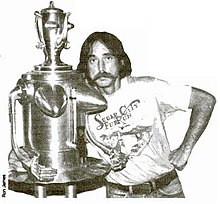
“Sweetheart”, shown with its creator, Clayton Bailey; the busty female
robot (also a functional coffee maker) that created a controversy when
it was displayed at the
Lawrence Hall of Science at
UC Berkeley.
Female robots have generated controversy. In 1983, a busty female robot named "Sweetheart" was removed from a display at the
Lawrence Hall of Science after a petition was presented claiming it was insulting to women. The robot's creator,
Clayton Bailey, a professor of art at
California State University, Hayward called this "censorship" and "next to book burning."
[15]
Female robots as sexual devices have also appeared, with early
constructions being crude. The first was produced by Sex Objects Ltd, a
British company, for use as a "sex-aid". It was called simply "36C",
from her chest measurement, and had a 16-bit microprocessor and voice
synthesiser that allowed primitive responses to speech and push button
inputs.
[16]
Gynoids may be "eroticized", and some examples such as Aiko include
sensitivity sensors in their breasts and genitals to facilitate sexual
response.
[17]
The fetishization of gynoids in real life has been attributed to male
desires for custom-made passive women, and has been compared to
life-size
sex dolls.
[4]
In fiction
Artificial women have been a common trope in fiction and mythology
since the writings of the ancient Greeks. This has continued with modern
fiction, particularly in the genre of science fiction. In science
fiction, female-appearing robots are often produced for use as domestic
servants and sexual slaves, as seen in the film
Westworld,
Paul McAuley's novel
Fairyland (1995), and
Lester del Rey's short story "
Helen O'Loy" (1938),
[2] and sometimes as warriors, killers, or laborers.
Metaphors
Misogyny
The treatment of gynoids in fiction has been seen as a metaphor for misogyny, as in the film
Blade Runner,
in which all three of the important female characters are gynoids, two
of whom use their sexuality to attempt to manipulate or kill the
protagonist Rick Deckard, often using sexualised imagery, such as when
Pris attempts to strangle him between her thighs. Daniel Dinello writes
that the violence with which the gynoids are treated represents
Deckard's hatred of women. The third gynoid, Rachel, acts as a
submissive female, even after Deckard "virtually rapes her".
[2] Thomas Foster writes, about the novel
Dead Girls by
Richard Calder,
that the technological bodies of gynoids depict sexism in an unnatural
context, highlighting its negative impact. They also show that
stereotypes and societal attitudes will not necessarily be altered
through technological progress.
[18]
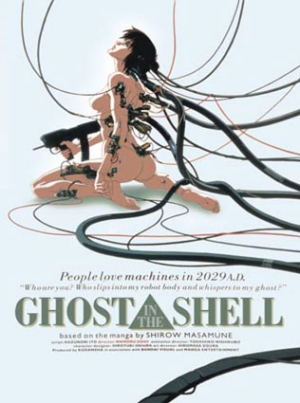
Japanese
anime and
manga both have a long tradition of female robot characters. The artist
Hajime Sorayama is particularly influential, with his "sexy robot" images, found in his collection
The Gynoids (1993).
[19]
These pieces depict primarily females with metallic skin. Some may
interpret "gynoid" art as comments on gender and sexual conventions, and
race, by highlighting the "whiteness" of the traditional pin-up girl.
[20]
The sexualised images of gynoids have also been interpreted as
fetishisation of the female body, racial differences, and/or technology.
[21]
Female freedom
Gynoids have also been used as a
metaphor in
feminist discourse, as part of
cyborg feminism, representing female physical strength and freedom from the expectation to reproduce.
[citation needed]
The perfect woman
A long tradition exists in literature of men of depictions of a
certain type of ideal woman, and fictional gynoids have been seen as an
extension of this theme.
[1] Examples include
Hephaestus in the
Iliad who created female servants of metal and
Ilmarinen in the
Kalevala who created an artificial wife. Probably most famous, however, is
Pygmalion, one of the earliest conceptualizations of constructions similar to gynoids in literary history, from
Ovid's account of Pygmalion.
[1] In this myth a female statue is sculpted that is so beautiful that the creator falls in love with it, and after praying to
Venus, the goddess takes pity on him and converts the statue into a real woman,
Galatea, with whom Pygmalion has children.
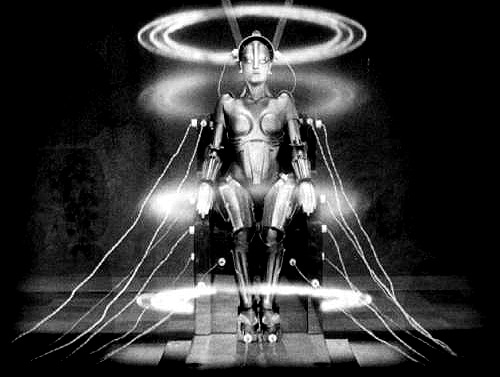
The first gynoid in film, the
maschinenmensch ("machine-human"), also called "Parody", "Futura", "Robotrix", or the "Maria impersonator", in
Fritz Lang's
Metropolis
is also an example: a femininely shaped robot is given skin so that she
is not known to be a robot and successfully impersonates the imprisoned
Maria and works convincingly as an
exotic dancer.
[1]
Such gynoids are designed according to cultural stereotypes of a
perfect women, being "sexy, dumb, and obedient", and reflect the
emotional frustration of their creators.
[2] Fictional gynoids are often unique products made to fit a particular man's desire, as seen in the novel
Tomorrow's Eve and films
The Benumbed Woman,
The Stepford Wives,
Mannequin and
Weird Science,
[22] and the creators are often male "
mad scientists" such as the characters
Rotwang in
Metropolis, Tyrell in
Blade Runner, and the husbands in
The Stepford Wives.
[23] Gynoids have been described as the "ultimate geek fantasy: a metal-and-plastic woman of your own".
[7]
The Bionic Woman television series coined the word
fembot. These fembots were a line of powerful lifelike gynoids with the faces of protagonist
Jaime Sommers's best friends.
[24] They fought in two multi-part episodes of the series: "Kill Oscar" and "Fembots in Las Vegas", and despite the feminine
prefix,
there were also male versions, including some designed to impersonate
particular individuals for the purpose of infiltration. While not truly
artificially intelligent, the fembots still had extremely sophisticated programming that allowed them to pass for human in most situations. The term
fembot was also used in
Buffy the Vampire Slayer (referring to a robot duplicate of the title character, a.k.a. the
Buffybot) and
Futurama.
The 1987 science fiction
cult movie Cherry 2000 also portrayed a gynoid character which was described by the male protagonist as his "perfect partner". The 1964 TV series
My Living Doll features a robot, portrayed by
Julie Newmar, who is similarly described.
Gender
Fiction about gynoids or female cyborgs reinforce essentialist ideas of femininity, according to Magret Grebowicz.
[25] Such essentialist ideas may present as sexual or gender stereotypes. Among the few non-eroticized fictional gynoids include
Rosie the Robot Maid[citation needed] from
The Jetsons. However, she still has some stereotypically feminine qualities, such as a matronly shape and a predisposition to cry.
[26]

Exaggeratedly feminine Fembots with guns in their breasts, from
Austin Powers: International Man Of Mystery.
The stereotypical role of wifedom has also been explored through use of gynoids. In
The Stepford Wives,
husbands are shown as desiring to restrict the independence of their
wives, and obedient and stereotypical spouses are preferred. The
husbands' technological method of obtaining this "perfect wife" is
through the murder of their human wives and replacement with gynoid
substitutes that are compliant and housework obsessed, resulting in a
"picture-postcard" perfect suburban society. This has been seen as an
allegory of male chauvinism of the period, by representing marriage as a
master-slave relationship, and an attempt at raising feminist
consciousness during the era of second wave feminism.
[23]
In a parody of the fembots from
The Bionic Woman, attractive, blonde fembots in alluring baby-doll night-gowns were used as a lure for the fictional agent
Austin Powers in the movie
Austin Powers: International Man Of Mystery. The film's sequels had
cameo appearances of characters revealed as fembots.
Judith Halberstam
writes that these gynoids inform the viewer that femaleness does not
indicate naturalness, and their exaggerated femininity and sexuality is
used in a similar way to the title character's exaggerated masculinity,
lampooning stereotypes.
[27]
Sex objects
Some argue that gynoids have often been portrayed as sexual objects.
Female cyborgs have been similarly used in fiction, in which natural
bodies are modified to become objects of fantasy.
[1] The female robot in visual media has been described as "the most visible linkage of technology and sex" by Steven Heller.
[28]
Feminist critic Patricia Melzer writes in
Alien Constructions: Science Fiction and Feminist Thought that gynoids in Richard Calder's
Dead Girls
are inextricably linked to men's lust, and are mainly designed as
sex-objects, having no use beyond "pleasing men's violent sexual
desires".
[29] The gynoid character Eve from the film
Eve of Destruction
has been described as "a literal sex bomb", with her subservience to
patriarchal authority and a bomb in place of reproductive organs.
[22] In the film
The Perfect Women, the titular robot Olga is described as having "no sex", but Steve Chibnall writes in his essay "Alien Women" in
British Science Fiction Cinema
that it is clear from her fetishistic underwear that she is produced as
a toy for men, with an "implicit fantasy of a fully compliant sex
machine".
[30] In the film
West World,
female robots actually engaged in intercourse with human men as part of
the make-believe vacation world human customers paid to attend.
Sex with gynoids has been compared to necrophilia.
[31]
Sexual interest in gynoids and fembots has been attributed to
fetishisation of technology, and compared to Sadomasochism in that it
reorganizes the social risk of sex. The depiction of female robots
minimizes the threat felt by men from female sexuality and allow the
"erasure of any social interference in the spectator's erotic enjoyment
of the image".
[5] Gynoid fantasies are produced and collected by online communities centered around chat rooms and web-site galleries.
[32]
Isaac Asimov writes that his robots were generally sexually neutral
and that giving the majority masculine names was not an attempt to
comment on gender. He first wrote about female-appearing robots at the
request of editor
Judy-Lynn del Rey.
[33][34]
Asimov's short story "Feminine Intuition" (1969) is an early example
that showed gynoids as being as capable and versatile as male robots,
with no sexual connotations.
[35]
Early models in "Feminine Intuition" were "female caricatures", used to
highlight their human creators' reactions to the idea of female robots.
Later models lost obviously feminine features, but retained "an air of
femininity".
[36]
In animation
Dr.Slump
In
Dr.Slump anime and
manga series, which is the debut series of
Toriyama Akira,
Dr.Senbei makes a fembot called
Arale Norimaki
which looks like a little girl. She is known for her naivety, energetic
personality, lack of common sense, and amazingly unbelievable strength.
See also
Cyborg
From Wikipedia, the free encyclopedia
| Part of a series on |
| Cyborgs |
| Cyborgology |
|
|
| Theory |
|
|
| Centers |
|
|
| Politics |
|
|
|
|
A
cyborg, short for "
cybernetic organism", is a being with both organic and
biomechatronic parts. See for example
biomaterials,
bionics, and
biomechatronics. The term was coined in 1960 by
Manfred Clynes and
Nathan S. Kline.
[1] D. S. Halacy's
Cyborg: Evolution of the Superman
in 1965 featured an introduction which spoke of a "new frontier" that
was "not merely space, but more profoundly the relationship between
'inner space' to 'outer space' – a bridge...between mind and matter."
[2]
The term cyborg is often applied to an organism that has restored
function or enhanced abilities due to the integration of some artificial
component or technology that relies on some sort of
feedback.
[3][4] While cyborgs are commonly thought of as
mammals, they might also conceivably be any kind of
organism
and the term "Cybernetic organism" has been applied to networks, such
as road systems, corporations and governments, which have been classed
as such. The term can also apply to micro-organisms which are modified
to perform at higher levels than their unmodified counterparts. It is
hypothesized that cyborg technology will form a part of the
future human evolution.
Some cyborgs may be represented as visibly mechanical (e.g. the
Cybermen in the
Doctor Who franchise or
The Borg from
Star Trek or
Darth Vader from
Star Wars); or as almost indistinguishable from humans (e.g. the
Terminators from the
Terminator films, the
"Human" Cylons from the
re-imagining of Battlestar Galactica etc.) The 1970s television series
The Six Million Dollar Man featured one of the most famous fictional cyborgs, referred to as a
bionic man; the series was based upon a novel by
Martin Caidin titled
Cyborg.
Cyborgs in fiction often play up a human contempt for over-dependence
on technology, particularly when used for war, and when used in ways
that seem to threaten
free will.
Cyborgs are also often portrayed with physical or mental abilities far
exceeding a human counterpart (military forms may have inbuilt weapons,
among other things).
Overview
According to some definitions of the term, the
metaphysical and physical attachments
humanity has with even the most basic technologies have already made them cyborgs.
[5] In a typical example, a human with an
artificial cardiac pacemaker or
implantable cardioverter-defibrillator
would be considered a cyborg, since these devices measure voltage
potentials in the body, perform signal processing, and can deliver
electrical stimuli, using this synthetic
feedback mechanism to keep that person alive. Implants, especially
cochlear implants,
that combine mechanical modification with any kind of feedback response
are also cyborg enhancements. Some theorists cite such modifications as
contact lenses,
hearing aids, or
intraocular lenses
as examples of fitting humans with technology to enhance their
biological capabilities; however, these modifications are as cybernetic
as a pen or a wooden leg.
The term is also used to address human-
technology
mixtures in the abstract. This includes not only commonly used pieces
of technology such as phones, computers,super computers count also, the
Internet, etc. but also artifacts that may not popularly be considered
technology; for example, pen and paper, and
speech and
language.
Augmented with these technologies, and connected in communication with
people in other times and places, a person becomes capable of much more
than they were before. This is like computers, which gain power by using
Internet protocols to connect with other computers. Cybernetic
technologies include highways, pipes, electrical wiring, buildings,
electrical plants, libraries, and other infrastructure that we hardly
notice, but which are critical parts of the
cybernetics that we work within.
Bruce Sterling in his universe of
Shaper/Mechanist suggested an idea of alternative cyborg called
Lobster, which is made not by using internal implants, but by using an external shell (
e.g. a
Powered Exoskeleton).
[6]
Unlike human cyborgs that appear human externally while being synthetic
internally, a Lobster looks inhuman externally but contains a human
internally. The computer game
Deus Ex: Invisible War prominently featured cyborgs called
Omar, where "Omar" is a Russian translation of the word "Lobster" (since the Omar are of Russian origin in the game).
Origins
The concept of a man-machine mixture was widespread in
science fiction before World War II. As early as 1843,
Edgar Allan Poe described a man with extensive prostheses in the short story "
The Man That Was Used Up". In 1908,
Jean de la Hire introduced
Nyctalope (perhaps the first true
superhero was also the first literary cyborg) in the novel
L'Homme Qui Peut Vivre Dans L'eau (
The Man Who Can Live in the Water).
Edmond Hamilton presented space explorers with a mixture of organic and machine parts in his novel
The Comet Doom
in 1928. He later featured the talking, living brain of an old
scientist, Simon Wright, floating around in a transparent case, in all
the adventures of his famous hero,
Captain Future.
He uses the term explicitly in the 1962 short story, "After a Judgment
Day," to describe the "mechanical analogs" called "Charlies," explaining
that "[c]yborgs, they had been called from the first one in the
1960s...cybernetic organisms." In the short story "No Woman Born" in
1944,
C. L. Moore
wrote of Deirdre, a dancer, whose body was burned completely and whose
brain was placed in a faceless but beautiful and supple mechanical body.
The term was coined by
Manfred E. Clynes and
Nathan S. Kline in 1960 to refer to their conception of an
enhanced human being who could survive in
extraterrestrial environments:
| “ |
For
the exogenously extended organizational complex functioning as an
integrated homeostatic system unconsciously, we propose the term
'Cyborg'. - Manfred E. Clynes and Nathan S. Kline[7] |
” |
Their concept was the outcome of thinking about the need for an
intimate relationship between human and machine as the new frontier of
space exploration was beginning to take place. A designer of
physiological
instrumentation and electronic data-processing systems, Clynes was the
chief research scientist in the Dynamic Simulation Laboratory at
Rockland State Hospital in New York.
The term first appears in print five months earlier when
The New York Times reported on the Psychophysiological Aspects of Space Flight Symposium where Clynes and Kline first presented their paper.
| “ |
A
cyborg is essentially a man-machine system in which the control
mechanisms of the human portion are modified externally by drugs or
regulatory devices so that the being can live in an environment
different from the normal one.[8] |
” |
A book titled
Cyborg: Digital Destiny and Human Possibility in the Age of the Wearable computer was published by
Doubleday in 2001.
[9] Some of the ideas in the book were incorporated into the 35mm motion picture film
Cyberman.
Cyborg tissues in engineering
Cyborgs tissues structured with carbon nanotubes and plant or fungal
cells have been used in artificial tissue engineering to produce new
materials for mechanical and electrical uses. The work was presented by
Di Giacomo and Maresca at MRS 2013 Spring conference on Apr, 3rd, talk
number SS4.04.
[10]
The cyborg obtained is inexpensive, light and has unique mechanical
properties. It can also be shaped in desired forms. Cells combined with
MWCNTs co-precipitated as a specific aggregate of cells and nanotubes
that formed a viscous material. Likewise, dried cells still acted as a
stable matrix for the MWCNT network. When observed by optical microscopy
the material resembled an artificial “tissue” composed of highly packed
cells. The effect of cell drying is manifested by their “ghost cell”
appearance. A rather specific physical interaction between MWCNTs and
cells was observed by electron microscopy suggesting that the cell wall
(the most outer part of fungal and plant cells) may play a major active
role in establishing a CNTs network and its stabilization. This novel
material can be used in a wide range of electronic applications from
heating to sensing and has the potential to open important new avenues
to be exploited in electromagnetic shielding for radio frequency
electronics and aerospace technology. In particular using Candida
albicans cells cyborg tissue materials with temperature sensing
properties have been reported.
[11]
Individual cyborgs

Jens Naumann, a man with acquired blindness, being interviewed about his vision BCI on CBS's The Early Show
Generally, the term "cyborg" is used to refer to a human with
bionic, or robotic,
implants.
In current
prosthetic applications, the
C-Leg system developed by
Otto Bock HealthCare is used to replace a
human leg
that has been amputated because of injury or illness. The use of
sensors in the artificial C-Leg aids in walking significantly by
attempting to replicate the user's natural gait, as it would be prior to
amputation.
[13] Prostheses like the C-Leg and the more advanced
iLimb are considered by some to be the first real steps towards the next generation of real-world cyborg applications. Additionally
cochlear implants and
magnetic implants which provide people with a sense that they would not otherwise have had can additionally be thought of as creating cyborgs.
In
vision science, direct
brain implants have been used to treat non-
congenital
(acquired) blindness. One of the first scientists to come up with a
working brain interface to restore sight was private researcher
William Dobelle.
Dobelle's first prototype was implanted into "Jerry", a man blinded in
adulthood, in 1978. A single-array BCI containing 68 electrodes was
implanted onto Jerry's
visual cortex and succeeded in producing
phosphenes,
the sensation of seeing light. The system included cameras mounted on
glasses to send signals to the implant. Initially, the implant allowed
Jerry to see shades of grey in a limited field of vision at a low
frame-rate. This also required him to be hooked up to a two-ton
mainframe, but shrinking electronics and faster computers made his
artificial eye more portable and now enable him to perform simple tasks
unassisted.
[14]
In 1997, Philip Kennedy, a scientist and physician designed the
world's first human cyborg named Johnny Ray. Ray was a Vietnam veteran
in Georgia who suffered a stroke. Unfortunately, Ray's body, as doctor's
called it, was "locked in". Ray wanted his old life back so he agreed
to Kennedy's experiment. Kennedy embedded a Neurotrophic Electrode near
the part of Ray's brain so that Ray would be able to have some movement
back in his body. The surgery went successfully, but in 2002, Johnny Ray
passed away.
[15]
In 2002, Canadian Jens Naumann, also blinded in adulthood, became the
first in a series of 16 paying patients to receive Dobelle's second
generation implant, marking one of the earliest commercial uses of BCIs.
The second generation device used a more sophisticated implant enabling
better mapping of phosphenes into coherent vision. Phosphenes are
spread out across the visual field in what researchers call the
starry-night effect. Immediately after his implant, Jens was able to use
his imperfectly restored vision to drive slowly around the parking area
of the research institute.
[16]
In 2002, under the heading Project Cyborg, a British scientist,
Kevin Warwick,
had an array of 100 electrodes fired into his nervous system in order
to link his nervous system into the Internet. With this in place he
successfully carried out a series of experiments including extending his
nervous system over the Internet to control a robotic hand, a
loudspeaker and amplifier. This is a form of extended sensory input and
the first direct electronic communication between the nervous systems of
two humans.
[17][18]
In 2004, under the heading Bridging the Island of the Colourblind Project, a British and completely color-blind artist,
Neil Harbisson, started wearing an
eyeborg on his head in order to hear colors.
[19] His prosthetic device was included within his 2004 passport photograph which has been claimed to confirm his cyborg status.
[20] In 2012 at
TEDGlobal,
[21] Harbisson explained that he did not feel like a cyborg when he started to use the
eyeborg, he started to feel like a cyborg when he noticed that the software and his brain had united and given him an extra sense.
[21]
Animal cyborgs
The US-based company Backyard Brains released what they refer to as
"The world's first commercially available cyborg" called the RoboRoach.
The project started as a
University of Michigan biomedical engineering student senior design project in 2010
[22] and was launched as an available
beta product on 25 February 2011.
[23] The RoboRoach was officially released into production via a
TED talk at the
TED Global conference,
[24] and via the crowdsourcing website
Kickstarter in 2013,
[25] the kit allows students to use
microstimulation to momentarily control the movements of a walking cockroach (left and right) using a bluetooth-enabled
smartphone as the controller. Other groups have developed cyborg insects, including researchers at
North Carolina State University[26] and
UC Berkeley,
[27] but the RoboRoach was the first kit available to the general public and was funded by the
National Institute of Mental Health as a device to serve as a teaching aid to promote an interest in
neuroscience.
[24] Several animal welfare organizations including the
RSPCA [28] and
PETA [29] have expressed concerns about the ethics and welfare of animals in this project.
Social cyborgs
More broadly, the full term "cybernetic organism" is used to describe larger
networks of communication and control.
For example, cities, networks of roads, networks of software,
corporations, markets, governments, and the collection of these things
together. A corporation can be considered as an artificial intelligence
that makes use of replaceable human components to function. People at
all ranks can be considered replaceable agents of their functionally
intelligent government institutions, whether such a view is desirable or
not. The example above is reminiscent of the "organic paradigm" popular
in the late 19th century due to the era's breakthroughs in
understanding of cellular biology.
Jaap van Till
tries to quantify this effect with his Synthecracy Network Law: V ~
N !, where V is value and N is number of connected people. This
factorial growth is what he claims leads to a herd or hive like thinking
between large, electronically connected groups.
Cyborg proliferation in society
In finance
Due to advances in IT, human investors are able to employ super
computers to engage in financial activities such as trading at faster
speeds across borders than ever before. Because of the increasing
reliance on artificial intelligence and advanced computerization, modern
finance is becoming “cyborg finance,” because the key players are part
human and part machine.
The new cyborg investor is distinct from past conceptions of
investors because this new investor conception is faster, more data
driven, automated, and less human.
One key characteristic of cyborg finance is the use of incredibly
powerful and fast computers to analyze and execute trading opportunities
based on complex mathematical models. The software employing these
algorithms is often proprietary and non-transparent, thus it is
sometimes referred to as
“black-box trading.”
In medicine
In medicine, there are two important and different types of cyborgs:
the restorative and the enhanced. Restorative technologies "restore lost
function, organs, and limbs".
[30]
The key aspect of restorative cyborgization is the repair of broken or
missing processes to revert to a healthy or average level of function.
There is no enhancement to the original faculties and processes that
were lost.
On the contrary, the enhanced cyborg "follows a principle, and it is
the principle of optimal performance: maximising output (the information
or modifications obtained) and minimising input (the energy expended in
the process)".
[31] Thus, the enhanced cyborg intends to exceed normal processes or even gain new functions that were not originally present.
Although prostheses in general supplement lost or damaged body parts
with the integration of a mechanical artifice, bionic implants in
medicine allow model organs or body parts to mimic the original function
more closely.
Michael Chorost
wrote a memoir of his experience with cochlear implants, or bionic ear,
titled "Rebuilt: How Becoming Part Computer Made Me More Human."
[32] Jesse Sullivan
became one of the first people to operate a fully robotic limb through a
nerve-muscle graft, enabling him a complex range of motions beyond that
of previous prosthetics.
[33] By 2004, a fully functioning
artificial heart was developed.
[34]
The continued technological development of bionic and nanotechnologies
begins to raise the question of enhancement, and of the future
possibilities for cyborgs which surpass the original functionality of
the biological model. The ethics and desirability of "enhancement
prosthetics" have been debated; their proponents include the
transhumanist
movement, with its belief that new technologies can assist the human
race in developing beyond its present, normative limitations such as
aging and disease, as well as other, more general incapacities, such as
limitations on speed, strength, endurance, and intelligence. Opponents
of the concept describe what they believe to be biases which propel the
development and acceptance of such technologies; namely, a bias towards
functionality and efficiency that may compel assent to a view of human
people which de-emphasizes as defining characteristics actual
manifestations of humanity and personhood, in favor of definition in
terms of upgrades, versions, and utility.
[35]
A
brain-computer interface,
or BCI, provides a direct path of communication from the brain to an
external device, effectively creating a cyborg. Research of Invasive
BCIs, which utilize electrodes implanted directly into the grey matter
of the brain, has focused on restoring damaged eyesight in the blind and
providing functionality to paralyzed people, most notably those with
severe cases, such as
Locked-In syndrome.
This technology could enable people who are missing a limb or are in a
wheelchair the power to control the devices that aide them through
neural signals sent from the brain implants directly to computers or the
devices. It is possible that this technology will also eventually be
used with healthy people.
[36]
Deep brain stimulation is a neurological surgical procedure used for therapeutic purposes. This process has aided in treating patients diagnosed with
Parkinson's disease,
Alzheimer's disease,
Tourette syndrome,
epilepsy, chronic headaches, and mental disorders. After the patient is
unconscious, through anesthesia, brain pacemakers or electrodes, are
implanted into the region of the brain where the cause of the disease is
present. The region of the brain is then stimulated by bursts of
electrical current to disrupt the oncoming surge of seizures. Like all
invasive procedures, deep brain stimulation may put the patient at a
higher risk. However, there have been more improvements in recent years
with deep brain stimulation than any available drug treatment.
[37]
Retinal implants
are another form of cyborgization in medicine. The theory behind
retinal stimulation to restore vision to people suffering from retinitis
pigmentosa and vision loss due to aging (conditions in which people
have an abnormally low amount of ganglion cells) is that the retinal
implant and electrical stimulation would act as a substitute for the
missing ganglion cells (cells which connect the eye to the brain.)
While work to perfect this technology is still being done, there have
already been major advances in the use of electronic stimulation of the
retina to allow the eye to sense patterns of light. A specialized
camera is worn by the subject, such as on the frames of their glasses,
which converts the image into a pattern of electrical stimulation. A
chip located in the user's eye would then electrically stimulate the
retina with this pattern by exciting certain nerve endings which
transmit the image to the optic centers of the brain and the image would
then appear to the user. If technological advances proceed as planned
this technology may be used by thousands of blind people and restore
vision to most of them.
A similar process has been created to aide people who have lost their
vocal cords. This experimental device would do away with previously
used robotic sounding voice simulators. The transmission of sound would
start with a surgery to redirect the nerve that controls the voice and
sound production to a muscle in the neck, where a nearby sensor would be
able to pick up its electrical signals. The signals would then move to a
processor which would control the timing and pitch of a voice
simulator. That simulator would then vibrate producing a multitonal
sound which could be shaped into words by the mouth.
[38]
An August 26, 2012 article from
Harvard University's homepage, by
Peter Reuell of the
Harvard Gazette, proceeds to discuss three-dimensional cyborg tissue research, published in the journal
Nature Materials, with possible medical implications done by
Charles M. Lieber, the
Mark Hyman Jr. Professor of Chemistry, and
Daniel Kohane, a
Harvard Medical School Anesthesiology Professor at
Boston Children's Hospital.
[39]
In the military
Military organizations' research has recently focused on the utilisation of
cyborg animals for the purposes of a supposed tactical advantage.
DARPA has announced its interest in developing "cyborg insects" to transmit data from sensors implanted into the insect during the
pupal
stage. The insect's motion would be controlled from a
Micro-Electro-Mechanical System (MEMS) and could conceivably survey an
environment or detect explosives and gas.
[40] Similarly, DARPA is developing a
neural implant to remotely control the movement of
sharks.
The shark's unique senses would then be exploited to provide data
feedback in relation to enemy ship movement or underwater explosives.
[41]
In 2006, researchers at Cornell University invented
[42] a new surgical procedure to implant artificial structures into insects during their metamorphic development.
[43][44] The first insect cyborgs,
moths with integrated electronics in their
thorax, were demonstrated by the same researchers.
[45][46] The
initial success of the techniques has resulted in increased research
and the creation of a program called Hybrid-Insect-MEMS, HI-MEMS. Its
goal, according to
DARPA's
Microsystems Technology Office,
is to develop "tightly coupled machine-insect interfaces by placing
micro-mechanical systems inside the insects during the early stages of
metamorphosis".
[47]
The use of neural implants has recently been attempted, with success,
on roaches. Surgically applied electrodes were put on the insect, which
were remotely controlled by a human. The results, although sometimes
different, basically showed that the roach could be controlled by the
impulses it received through the electrodes.
DARPA is now funding this research because of its obvious beneficial applications to the military and other areas
[48]
In 2009 at the
Institute of Electrical and Electronics Engineers (IEEE) Micro-electronic mechanical systems (MEMS) conference in
Italy, researchers demonstrated the first "wireless" flying-beetle cyborg.
[49] Engineers at the
University of California at
Berkeley
have pioneered the design of a "remote controlled beetle", funded by
the DARPA HI-MEMS Program. Filmed evidence of this can be viewed here.
[50] This was followed later that year by the demonstration of wireless control of a "lift-assisted" moth-cyborg.
[51]
Eventually researchers plan to develop HI-MEMS for dragonflies, bees, rats and pigeons.
[52][53] For the HI-MEMS
cybernetic
bug to be considered a success, it must fly 100 metres (330 ft) from a
starting point, guided via computer into a controlled landing within 5
metres (16 ft) of a specific end point. Once landed, the cybernetic bug
must remain in place.
[52]
In art
The concept of the cyborg is often associated with science fiction.
However, many artists have tried to create public awareness of
cybernetic organisms; these can range from paintings to installations.
Some artists who create such works are
Neil Harbisson,
Moon Ribas,
Patricia Piccinini,
Steve Mann,
Orlan,
H. R. Giger,
Lee Bul,
Wafaa Bilal,
Tim Hawkinson and
Stelarc.
Stelarc is a performance artist who has visually probed and
acoustically amplified his body. He uses medical instruments,
prosthetics, robotics, virtual reality systems, the Internet and
biotechnology to explore alternate, intimate and involuntary interfaces
with the body. He has made three films of the inside of his body and has
performed with a third hand and a virtual arm. Between 1976–1988 he
completed 25 body suspension performances with hooks into the skin. For
'Third Ear' he surgically constructed an extra ear within his arm that
was internet enabled, making it a publicly accessible acoustical organ
for people in other places.
[54] He is presently performing as his avatar from his
second life site.
[55]
Tim Hawkinson promotes the idea that bodies and machines are coming
together as one, where human features are combined with technology to
create the Cyborg. Hawkinson's piece
Emoter presented how society is now dependent on technology.
[56]
Wafaa Bilal is an Iraqi-American performance artist who had a small
10 megapixel digital camera surgically implanted into the back of his
head, part of a project entitled 3rd I.
[57] For one year, beginning 15 December 2010, an image is captured once per minute 24 hours a day and streamed live to
www.3rdi.me
and the Mathaf: Arab Museum of Modern Art. The site also displays
Bilal's location via GPS. Bilal says that the reason why he put the
camera in the back of the head was to make an "allegorical statement
about the things we don't see and leave behind."
[58]
As a professor at NYU, this project has raised privacy issues, and so
Bilal has been asked to ensure that his camera does not take photographs
in NYU buildings.
[58]
Machines are becoming more ubiquitous in the artistic process itself,
with computerized drawing pads replacing pen and paper, and drum
machines becoming nearly as popular as human drummers. This is perhaps
most notable in
generative art and
music.
Composers such as Brian Eno have developed and utilized software which
can build entire musical scores from a few basic mathematical
parameters.
[59]
Scott Draves is a generative artist whose work is explicitly described as a "cyborg mind". His
Electric Sheep project generates abstract art by combining the work of many computers and people over the internet.
[60]
Artists as cyborgs
Artists have explored the term cyborg from a perspective involving
imagination. Some work to make an abstract idea of technological and
human-bodily union apparent to reality in an art form utilizing varying
mediums, from sculptures and drawings to digital renderings. Artists
that seek to make cyborg-based fantasies a reality often call themselves
cyborg artists, or may consider their artwork "cyborg". How an artist
or their work may be considered cyborg will vary depending upon the
interpreter's flexibility with the term. Scholars that rely upon a
strict, technical description of cyborg, often going by Norbert Wiener's
cybernetic theory and Manfred E. Clynes and Nathan S. Kline's first use
of the term, would likely argue that most cyborg artists do not qualify
to be considered cyborgs.
[61] Scholars considering a more flexible description of cyborgs may argue it incorporates more than cybernetics.
[62]
Others may speak of defining subcategories, or specialized cyborg
types, that qualify different levels of cyborg at which technology
influences an individual. This may range from technological instruments
being external, temporary, and removable to being fully integrated and
permanent.
[63]
Nonetheless, cyborg artists are artists. Being so, it can be expected
for them to incorporate the cyborg idea rather than a strict, technical
representation of the term,
[64] seeing how their work will sometimes revolve around other purposes outside of cyborgism.
[61]
In body modification
As medical technology becomes more advanced, some techniques and
innovations are adopted by the body modification community. While not
yet cyborgs in the strict definition of Manfred Clynes and Nathan Kline,
technological developments like implantable silicon silk electronics,
[65] augmented reality
[66] and QR codes
[67] are bridging the disconnect between technology and the body. Hypothetical technologies such as digital tattoo interfaces
[68][69] would blend body modification aesthetics with interactivity and functionality, bringing a
transhumanist way of life into present day reality.
In addition, it is quite plausible for anxiety expression to
manifest. Individuals may experience pre-implantation feelings of fear
and nervousness. To this end, individuals may also embody feelings of
uneasiness, particularly in a socialized setting, due to their
post-operative, technologically augmented bodies, and mutual
unfamiliarity with the mechanical insertion. Anxieties may be linked to
notions of otherness or a cyborged identity.
[70]
In popular culture
Cyborgs have become a well-known part of science fiction literature
and other media. Although many of these characters may be technically
androids, they are often referred to as cyborgs. Well-known examples from film and television include
RoboCop,
Terminators,
Evangelion,
The Six Million Dollar Man,
Replicants from
Blade Runner,
Daleks and
Cybermen from
Doctor Who, the
Borg from
Star Trek,
Darth Vader and
General Grievous from
Star Wars,
Inspector Gadget, and
Cylons from the 2004
Battlestar Galactica series. From
manga and
anime are characters such as
8 Man (the inspiration for
RoboCop),
Kamen Rider,
Ghost in the Shell's Motoko Kusanagi, as well as characters from western comic books like
Tony Stark (after his Extremis and Bleeding Edge armor) and
Victor "Cyborg" Stone. The
Deus Ex videogame series deals extensively with the near-future rise of cyborgs and their corporate ownership, as does the
Syndicate series.
Cyborgization in critical deaf studies
Joseph Michael Valente,
describes "cyborgization" as an attempt to codify "normalization"
through cochlear implantation in young deaf children. Drawing from Paddy
Ladd's work on Deaf epistemology and
Donna Haraway's
Cyborg ontology, Valente "use[s] the concept of the cyborg as a way of
agitating constructions of cyborg perfection (for the deaf child that
would be to become fully hearing)". He claims that cochlear implant
manufacturers advertise and sell cochlear implants as a mechanical
device as well as an uncomplicated medical "miracle cure". Valente
criticizes cochlear implant researchers whose studies largely to date do
not include cochlear implant recipients, despite cochlear implants
having been approved by the United States Food and Drug Administration
(FDA) since 1984.
[71]
Pamela J. Kincheloe discusses the representation of the cochlear
implant in media and popular culture as a case study for present and
future responses to human alteration and enhancement.
[72]
Cyborg Foundation
In 2010, the
Cyborg Foundation became the world's first international organization dedicated to help humans become cyborgs.
[73] The foundation was created by cyborg
Neil Harbisson and
Moon Ribas
as a response to the growing amount of letters and emails received from
people around the world interested in becoming a cyborg.
[74] The foundation's main aims are to extend human senses and abilities by creating and applying cybernetic extensions to the body,
[75] to promote the use of cybernetics in cultural events and to defend cyborg rights.
[76] In 2010, the foundation, based in
Mataró (Barcelona), was the overall winner of the Cre@tic Awards, organized by Tecnocampus Mataró.
[77]
In 2012, Spanish film director Rafel Duran Torrent, created a short
film about the Cyborg Foundation. In 2013, the film won the Grand Jury
Prize at the
Sundance Film Festival's Focus Forward Filmmakers Competition and was awarded with $100,000 USD.
[78]
See also
Nyctalopics
Although there are varietals of cyborgs and applied
cybernetics, the actual process of becoming a cyborg is known as
nyctalopics. The term is coined after the first description of a
cyborg,
Nyctalope, who appeared in the works of
Jean de La Hire.
Biorobotics
From Wikipedia, the free encyclopedia
Biorobotics is a term that loosely covers the fields of
cybernetics,
bionics and even
genetic engineering as a collective study.
Biorobotics is often used to refer to a real subfield of
robotics:
studying how to make robots that emulate or simulate living biological
organisms mechanically or even chemically. The term is also used in a
reverse definition: making biological organisms as manipulatable and
functional as robots, or making biological organisms as components of
robots.
In the latter sense, biorobotics can be referred to as a
theoretical
discipline of comprehensive genetic engineering in which organisms are
created and designed by artificial means. The creation of life from
non-living matter for example, would be biorobotics. The field is in its
infancy and is sometimes known as
synthetic biology or
bionanotechnology.
In fiction, biorobotics makes many appearances, like the biots of the novel
Rendezvous with Rama or the replicants of the film
Blade Runner.
Biorobotics in Fiction
Biorobotics has made many appearances in works of fiction, often in the form of synthetic biological organisms.
The robots featured in
Rossum's Universal Robots,
the play that originally coined the term robot, are presented as
synthetic biological entities closer to biological organisms than the
mechanical objects that the term robot came to refer to. The
replicants in the film
Blade Runner are biological in nature: they are organisms of living tissue and cells created artificially. In the novel
The Windup Girl by Paolo Bacigalupi, "windups" or "New People" are genetically engineered organisms.
The word biot, a portmanteau of "
biological rob
ot", was originally coined by
Arthur C. Clarke in his 1972 novel
Rendezvous with Rama.
Biots are depicted as artificial biological organisms created to
perform specific tasks on the space vessel Rama. This affects their
physical attributes and cognitive abilities.
Humanoid
Cylons in the 2004 television series
Battlestar Galactica
are another example of biological robots in fictions. Almost
undistinguishable from humans, they are artificial creations created by
mechanical cylons.
The authors of the
Star Wars book series
The New Jedi Order reprised the term biot. The
Yuuzhan Vong uses the term to designate their biotechnology.
The term bioroid, or biological android, as also been used to designate artificial biological organisms, like in the manga
Appleseed. In 1985 the animated
Robotech television series popularized the term when it reused the term from the 1984 Japanese series
The Super Dimension Cavalry Southern Cross.
In
Warhammer 40k Imperium (Warhammer 40,000)
uses servitors, vat-grown humans with cybernetic parts replacing most
parts of the body.They lack emotions or intelligence and are only
capable of simple tasks. A more advanced imperial robots are used by the
imperium,Instead of using humans they are mostly machine and has
biological brain and some other biological parts.Unlike servitors they
are capable of having programmed instincts when killing but still they
lack any true intelligence.
Practical experimentation
A biological brain, grown from cultured neurons which were originally
separated, has been developed as the neurological entity subsequently
embodied within a robot body by
Kevin Warwick and his team at
University of Reading.
The brain receives input from sensors on the robot body and the
resultant output from the brain provides the robot's only motor signals.
The biological brain is the only brain of the robot.
[1]
Android (robot)
From Wikipedia, the free encyclopedia
An
android is a
robot[1] or
synthetic organism[2][3][4] designed to look and act like a
human, especially one with a body having a flesh-like resemblance.
[2] Until recently, androids have largely remained within the domain of
science fiction, frequently seen in film and television. However, advancements in
robot technology have allowed the design of functional and realistic humanoid robots.
[5]
Etymology
The word was coined from the
Greek root ἀνδρ- 'man' and the suffix
-oid 'having the form or likeness of'.
[6]
The
Oxford English Dictionary traces the earliest use (as "Androides") to
Ephraim Chambers'
Cyclopaedia, in reference to an
automaton that St.
Albertus Magnus allegedly created.
[3][7] The term "android" appears in US patents as early as 1863 in reference to miniature human-like toy automatons.
[8] The term
android was used in a more modern sense by the French author
Auguste Villiers de l'Isle-Adam in his work
Tomorrow's Eve (1886).
[3]
This story features an artificial humanlike robot named Hadaly. As said
by the officer in the story, "In this age of Realien advancement, who
knows what goes on in the mind of those responsible for these mechanical
dolls." The term made an impact into English
pulp science fiction starting from
Jack Williamson's
The Cometeers (1936) and the distinction between mechanical robots and fleshy androids was popularized by
Edmond Hamilton's
Captain Future (1940–1944).
[3]
Although
Karel Čapek's robots in
R.U.R. (Rossum's Universal Robots) (1921) – the play that introduced the word
robot
to the world – were organic artificial humans, the word "robot" has
come to primarily refer to mechanical humans, animals, and other beings.
[3] The term "android" can mean either one of these,
[3] while a
cyborg ("cybernetic organism" or "bionic man") would be a creature that is a combination of organic and mechanical parts.
The term "
droid", coined by
George Lucas for the original
Star Wars
film and now used widely within science fiction, originated as an
abridgment of "android", but has been used by Lucas and others to mean
any robot, including distinctly non-human form machines like
R2-D2. The word "android" was used in
Star Trek: The Original Series episode
What Are Little Girls Made Of? The abbreviation "andy", coined as a
pejorative by writer
Philip K. Dick in his novel
Do Androids Dream of Electric Sheep?, has seen some further usage, such as within the TV series
Total Recall 2070.
[9]
Authors have used the term
android in more diverse ways than
robot or
cyborg.
In some fictional works, the difference between a robot and android is
only their appearance, with androids being made to look like humans on
the outside but with robot-like internal mechanics.
[3] In other stories, authors have used the word "android" to mean a wholly organic, yet artificial, creation.
[3] Other fictional depictions of androids fall somewhere in between.
[3]
Eric G. Wilson, who defines androids as a "synthetic human being",
distinguishes between three types of androids, based on their body's
composition:
- the mummy type - where androids are made of "dead things" or "stiff,
inanimate, natural material", such as mummies, puppets, dolls and
statues
- the golem type - androids made from flexible, possibly organic material, including golems and homunculi
- the automaton type - androids which are a mix of dead and living parts, including automatons and robots[4]
Although human morphology is not necessarily the ideal form for
working robots, the fascination in developing robots that can mimic it
can be found historically in the assimilation of two concepts:
simulacra (devices that exhibit likeness) and
automata (devices that have independence).
Projects
Japan
The Intelligent Robotics Lab, directed by
Hiroshi Ishiguro at
Osaka University, and Kokoro Co., Ltd. have demonstrated the
Actroid at
Expo 2005 in
Aichi Prefecture, Japan. In 2006, Kokoro Co. developed a new
DER 2
android. The height of the human body part of DER2 is 165 cm. There are
47 mobile points. DER2 can not only change its expression but also move
its hands and feet and twist its body. The "air servosystem" which
Kokoro Co. developed originally is used for the actuator. As a result of
having an actuator controlled precisely with air pressure via a
servosystem, the movement is very fluid and there is very little noise.
DER2 realized a slimmer body than that of the former version by using a
smaller cylinder. Outwardly DER2 has a more beautiful proportion.
Compared to the previous model, DER2 has thinner arms and a wider
repertoire of expressions. Once programmed, it is able to choreograph
its motions and gestures with its voice.
The Intelligent Mechatronics Lab, directed by Hiroshi Kobayashi at the
Tokyo University of Science, has developed an android head called
Saya, which was exhibited at Robodex 2002 in
Yokohama,
Japan. There are several other initiatives around the world involving
humanoid research and development at this time, which will hopefully
introduce a broader spectrum of realized technology in the near future.
Now Saya is
working at the Science University of Tokyo as a guide.
The
Waseda University (Japan) and
NTT Docomo's manufacturers have succeeded in creating a shape-shifting robot
WD-2.
It is capable of changing its face. At first, the creators decided the
positions of the necessary points to express the outline, eyes, nose,
and so on of a certain person. The robot expresses its face by moving
all points to the decided positions, they say. The first version of the
robot was first developed back in 2003. After that, a year later, they
made a couple of major improvements to the design. The robot features an
elastic mask made from the average head dummy. It uses a driving system
with a 3DOF unit. The WD-2 robot can change its facial features by
activating specific facial points on a mask, with each point possessing
three
degrees of freedom.
This one has 17 facial points, for a total of 56 degrees of freedom. As
for the materials they used, the WD-2's mask is fabricated with a
highly elastic material called Septom, with bits of steel wool mixed in
for added strength. Other technical features reveal a shaft driven
behind the mask at the desired facial point, driven by a DC motor with a
simple pulley and a slide screw. Apparently, the researchers can also
modify the shape of the mask based on actual human faces. To "copy" a
face, they need only a 3D scanner to determine the locations of an
individual's 17 facial points. After that, they are then driven into
position using a laptop and 56 motor control boards. In addition, the
researchers also mention that the shifting robot can even display an
individual's hair style and skin color if a photo of their face is
projected onto the 3D Mask.
Korea
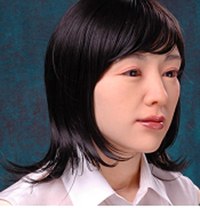
EveR-2, the first android that has the ability to
sing
KITECH researched and developed
EveR-1,
an android interpersonal communications model capable of emulating
human emotional expression via facial "musculature" and capable of
rudimentary conversation, having a vocabulary of around 400 words. She
is
160 cm tall and weighs
50 kg, matching the average figure of a Korean woman in her twenties. EveR-1's name derives from the
Biblical Eve, plus the letter
r for
robot. EveR-1's advanced computing processing power enables
speech recognition and vocal synthesis, at the same time processing
lip synchronization and visual recognition by 90-degree micro-
CCD cameras with
face recognition technology.
An independent microchip inside her artificial brain handles gesture
expression, body coordination, and emotion expression. Her whole body is
made of highly advanced synthetic jelly silicon and with 60 artificial
joints in her face, neck, and lower body; she is able to demonstrate
realistic facial expressions and sing while simultaneously dancing. In
South Korea, the
Ministry of Information and Communication has an ambitious plan to put a robot in every household by 2020.
[10]
Several robot cities have been planned for the country: the first will
be built in 2016 at a cost of 500 billion won, of which 50 billion is
direct government investment.
[11]
The new robot city will feature research and development centers for
manufacturers and part suppliers, as well as exhibition halls and a
stadium for robot competitions. The country's new Robotics Ethics
Charter will establish ground rules and laws for human interaction with
robots in the future, setting standards for robotics users and
manufacturers, as well as guidelines on ethical standards to be
programmed into robots to prevent human abuse of robots and vice versa.
[12]
United States
Walt Disney and a staff of
Imagineers created
Great Moments with Mr. Lincoln that debuted at the
1964 New York World's Fair.
[13]
Hanson Robotics, Inc., of Texas and
KAIST produced an android portrait of
Albert Einstein,
using Hanson's facial android technology mounted on KAIST's life-size
walking bipedal robot body. This Einstein android, also called "
Albert Hubo", thus represents the first full-body walking android in history (see video at
[14]). Hanson Robotics, the FedEx Institute of Technology,
[15] and the University of Texas at Arlington also developed the android portrait of sci-fi author
Philip K. Dick (creator of
Do Androids Dream of Electric Sheep?, the basis for the film
Blade Runner), with full conversational capabilities that incorporated thousands of pages of the author's works.
[16] In 2005, the PKD android won a first place
artificial intelligence award from
AAAI.
United Kingdom
In 2001,
Steve Grand OBE, creator of the computer game
Creatures,
created an android, or anthropoid, he named it Lucy. The intention was
that she would have to learn everything, including how to use her
mechanical
vocal chords to speak. Her systems were made to be similar to a human's.
Use in fiction
Androids are a staple of
science fiction.
Isaac Asimov pioneered the fictionalization of the science of
robotics and
artificial intelligence, notably in his 1950s series
I, Robot and
Foundation and Empire.
[17]
One thing common to most fictional androids is that the real-life
technological challenges associated with creating thoroughly human-like
robots – such as the creation of
strong artificial intelligence – are assumed to have been solved.
[18]
Fictional androids are often depicted as mentally and physically equal
or superior to humans – moving, thinking and speaking as fluidly as
them.
[3][18]
The tension between the nonhuman substance and the human appearance –
or even human ambitions – of androids is the dramatic impetus behind
most of their fictional depictions.
[4][18] Some android heroes seek, like
Pinocchio, to become human, as in the films
Bicentennial Man,
Hollywood,
Enthiran and
A.I. Artificial Intelligence,
[18] or
Data in
Star Trek: The Next Generation. Others, as in the film
Westworld, rebel against abuse by careless humans.
[18] Android hunter
Deckard in
Do Androids Dream of Electric Sheep? and its film adaptation
Blade Runner discovers that his targets are, in some ways, more human than he is.
[18] Android stories, therefore, are not essentially stories "about" androids; they are stories about the
human condition and what it means to be human.
[18]
One aspect of writing about the meaning of humanity is to use discrimination against androids as a mechanism for exploring
racism in society, as in
Blade Runner.
[19] Perhaps the clearest example of this is
John Brunner's 1968 novel
Into the Slave Nebula, where the blue-skinned android slaves are explicitly shown to be fully human.
[20] More recently, the androids
Bishop and Annalee Call in the films
Aliens and
Alien Resurrection are used as vehicles for exploring how humans deal with the presence of an "
Other".
[21]
Female androids, or "
gynoids",
are often seen in science fiction, and can be viewed as a continuation
of the long tradition of men attempting to create the stereotypical
"perfect woman".
[22] Examples include the
Greek myth of
Pygmalion and
the female robot Maria in
Fritz Lang's
Metropolis. Some gynoids, like Pris in
Blade Runner, are designed as sex-objects, with the intent of "pleasing men's violent sexual desires,"
[23] or as submissive, servile companions, such as in
The Stepford Wives. Fiction about gynoids has therefore been described as reinforcing "essentialist ideas of femininity",
[24] although others have suggested that the treatment of androids is a way of exploring racism and
misogyny in society.
[25]


