Fruits and vegetables have changed a lot since the onset of
agriculture 10,000 years ago, as generation after generation of farmers
artificially bred crops to select for more desirable traits like size
and taste.
But that change can be hard to visualize. So James Kennedy, a chemistry teacher in Australia, created some terrific infographics to show just how drastic the evolution has been. This
one, for instance, shows how corn has changed in the last 9,000 years —
from a wild grass in the early Americas known as teosinte to the plump
ears of corn we know today:
The evolution of corn (maize) is a fascinating story.
For a long time, scientists couldn't figure out where domesticated corn
originally came from — it doesn't look like anything that grows in the
wild. It took serious sleuthing
by geneticists, botanists, and archaeologists to figure out that maize
split off from teosinte grass some 9,000 years ago. (The two are
surprisingly similar at the DNA level, differing by just a handful of
genes.)
As maize became domesticated in Mesoamerica, it was radically altered through selective breeding.
Early farmers would examine their plants and save the seeds of those
that were larger or tastier, or whose kernels were easier to grind. By
4000 BC, cobs were already an inch long. Within just a few thousand
years, cobs had grown to many times that size. Later on, plant hybridization became an important breeding method to further cultivate certain traits.
Nowadays, corn is grown all over the planet, and humans are still making changes using more advanced breeding techniques. In the 1980s, for instance, seed companies turned to genetic engineering
— so, for instance, scientists inserted genes from Bt soil bacteria
into corn to help the plant ward off pests. And some researchers are
hoping to develop corn varieties that can withstand drought.
Here's another great graphic
from Kennedy. Modern-day watermelons don't look anything like their
distant ancestors from Southern Africa. That, too, is the result of
thousands of years of breeding. Yet a few of the biggest advances also
came in the United States in the 1950s and 1960s, when crop scientists helped breed varieties that were resistant to disease and had a thicker rind — allowing watermelons to be grown all over the country.
Even to this day, we're still producing new types of watermelon — like the black Densuke watermelon grown on a single island in Japan. And crop scientists have produced seedless watermelons by adding chemicals to double a watermelon's chromosomes and then breeding the result with a normal watermelon.*
The evolution of peaches
(James Kennedy)
And here are peaches, which started out in China and were selected
for size and juiciness over thousands of years. Note that the water
content of peaches has changed drastically in just 6,000 years.
Mind you, not all attempts at selective breeding turn out so well. As Sarah Yager recently wrote
at the Atlantic, apple growers in the United States during the 20th
century tried to breed Red Delicious apples to be as bright and shiny as
possible and stay on shelves for as long as possible without noticeable
bruising. The result? "As genes for beauty were favored over those for
taste, the skins grew tough and bitter around mushy, sugar-soaked
flesh." Nowadays, as storage and transport have become more advanced,
tastier apple varieties like the Honeycrisp or Gala are surpassing the
Red Delicious.
(Thanks to Calestous Juma for the pointer to Kennedy's blog.)
Further reading:
You can see many of Kennedy's other wonderful graphics on his blog. He also, for instance, had a fun series showing the ingredients inside bananas orstrawberries.
BERLIN – Scientists say ancient DNA samples indicate massive migration to Europe from the east took place some 4,500 years ago.
The
findings support the theory that some Indo-European languages, such as
Germanic and Slavic, were introduced by people from the steppe.
Researchers
from Europe, the United States and Australia analyzed the DNA of 69
people who lived between 8,000 and 3,000 years ago. According to their
research, published Monday in the journal Nature, genes from the Yamnaya
who lived north of the Black and Aral Seas appeared in what is now
northern Germany some four-and-one half millennia ago.
The
researchers say since major language replacements are believed to
require large-scale migration, the huge influx of ancient steppe DNA
still in many present-day Europeans could account for the rise of
Indo-European languages.
Sintashta (Russian: Синташта) is an archaeological site in Chelyabinsk Oblast, Russia. It is the remains of a fortified settlement dating to the Bronze Age, c. 2800–1600 BC,[1] and is the type site of the Sintashta culture. The site has been characterised "fortified metallurgical industrial center".[2]
Sintashta is situated in the steppe just east of the Ural Mountains. The site is named for the adjacent Sintashta River, a tributary to the Tobol.
The shifting course of the river over time has destroyed half of the
site, leaving behind thirty one of the approximately fifty or sixty
houses in the settlement.[3]
The settlement consisted of rectangular houses arranged in a circle
140 m in diameter and surrounded by a timber-reinforced earthen wall
with gate towers and a deep ditch on its exterior. The fortifications at
Sintashta and similar settlements such as Arkaim were of unprecedented scale for the steppe region. There is evidence of copper and bronzemetallurgy
taking place in every house excavated at Sintashta, again an
unprecedented intensity of metallurgical production for the steppe.[3] Early Abashevo culture ceramic styles strongly influenced Sintashta ceramics.[4]
Due to the assimilation of tribes in the region of the Urals, such as
the Pit-grave, Catacomb, Poltavka, and northern Abashevo into the
Novokumak horizon, it would seem inaccurate to provide Sintashta with a
purely Aryan attribution.[5] In the origin of Sintashta, the Abashevo culture would play an important role.[4]
Five cemeteries have been found associated with the site, the largest of which (known as Sintashta mogila or SM) consisted of forty graves. Some of these were chariot burials, producing the oldest known chariots in the world. Others included horse sacrifices—up
to eight in a single grave—various stone, copper and bronze weapons,
and silver and gold ornaments. The SM cemetery is overlain by a very
large kurgan
of a slightly later date. It has been noted that the kind of funerary
sacrifices evident at Sintashta have strong similarities to funerary
rituals described in the Rig Veda, an ancient Indian religious text often associated with the Proto-Indo-Iranians.[3] Radiocarbon dates from the settlement and cemeteries span over a millennium, suggesting an earlier occupation belonging to the Poltavka culture.
The majority the dates, however, are around 2100–1800 BC, which points
at a main period of occupation of the site consistent with other
settlements and cemeteries of the Sintashta culture.[3]
Map of the approximate maximal extent of the Andronovo culture. The
formative Sintashta-Petrovka culture is shown in darker red. The
location of the earliest spoke-wheeled chariot finds is indicated in purple. Adjacent and overlapping cultures (Afanasevo culture, Srubna culture, BMAC) are shown in green.
The Sintashta culture, also known as the Sintashta-Petrovka culture[1] or Sintashta-Arkaim culture,[2] is a Bronze Agearchaeological culture of the northern Eurasian steppe on the borders of Eastern Europe and Central Asia, dated to the period 2100–1800 BCE.[3] The earliest known chariots
have been found in Sintashta burials, and the culture is considered a
strong candidate for the origin of the technology, which spread
throughout the Old World and played an important role in ancient warfare.[4] Sintashta settlements are also remarkable for the intensity of copper mining and bronzemetallurgy carried out there, which is unusual for a steppe culture.[5]
Because of the difficulty of identifying the remains of Sintashta
sites beneath those of later settlements, the culture was only recently
distinguished from the Andronovo culture.[2] It is now recognised as a separate entity forming part of the 'Andronovo horizon'.[1]
The Sintashta culture emerged from the interaction of two antecedent
cultures. Its immediate predecessor in the Ural-Tobol steppe was the Poltavka culture, an offshoot of the cattle-herding Yamnaya horizon
that moved east into the region between 2800 and 2600 BCE. Several
Sintashta towns were built over older Poltovka settlements or close to
Poltovka cemeteries, and Poltovka motifs are common on Sintashta
pottery. Sintashta material culture also shows the influence of the late Abashevo culture, a collection of settlements in the forest steppe zone north of the Sintashta region that were also predominantly pastoralist.[6]
The first Sintashta settlements appeared around 2100 BCE, during a
period of climatic change that saw the already arid Kazakh steppe region
become even more cold and dry. The marshy lowlands around the Ural and
upper Tobol rivers, previously favoured as winter refuges, became
increasingly important for survival. Under these pressures both Poltovka
and Abashevo herders settled permanently in river valley strongholds,
eschewing more defensible hill-top locations.[7] The Abashevo culture was already marked by endemic intertribal warfare;[8]
intensified by ecological stress and competition for resources in the
Sintashta period, this drove the construction of fortifications on an
unprecedented scale and innovations in military technique such as the
invention of the war chariot. Increased competition between tribal
groups may also explain the extravagant sacrifices seen in Sintashta
burials, as rivals sought to outdo one another in acts of conspicuous consumption analogous to the North American potlatch tradition.[7]
Metal production
The Sintashta economy came to revolve around copper metallurgy. Copper ores from nearby mines (such as Vorovskaya Yama) were taken to Sintashta settlements to be processed into copper and arsenical bronze. This occurred on an industrial scale: all the excavated buildings at the Sintashta sites of Sintashta, Arkaim and Ust'e contained the remains of smelting ovens and slag.[7] Much of this metal was destined for export to the cities of the Bactria–Margiana Archaeological Complex (BMAC) in Central Asia. The metal trade between Sintashta and the BMAC for the first time connected the steppe region to the ancient urban civilisations of the Near East: the empires and city-states of Iran and Mesopotamia
provided an almost bottomless market for metals. These trade routes
later became the vehicle through which horses, chariots and ultimately Indo-Iranian-speaking people entered the Near East from the steppe.[9][10]
Ethnic and linguistic identity
The people of the Sintashta culture are thought to have spoken Proto-Indo-Iranian, the ancestor of the Indo-Iranian language family. This identification is based primarily on similarities between sections of the Rig Veda, an Indian religious text which includes ancient Indo-Iranian hymns recorded in Vedic Sanskrit, with the funerary rituals of the Sintashta culture as revealed by archaeology.[11]
There is however linguistic evidence of a list of common vocabulary
between Finno-Ugric and Indo-Iranian languages. While its origin as a
creole of different tribes in the Ural region may make it inaccurate to
ascribe the Sintashta culture exclusively to Indo-Iranian ethnicity,
interpreting this culture as a blend of two cultures with two distinct
languages is a reasonable hypothesis based on the evidence.[12]
The Abashevo culture is a later Bronze Age (ca. 2500–1900 BCE) archaeological culture found in the valleys of the Volga and Kama River north of the Samara bend and into the southern Ural Mountains. It receives its name from the village of Abashevo in Chuvashia. Artifacts are kurgans and remnants of settlements. The Abashevo was the easternmost of the Russian forest zone cultures that descended from Corded Ware ceramic traditions. The Abashevo culture played a significant role in the origin of the Sintashta culture.[1] The Abashevo culture does not pertain to the Andronovo culture and genetically belongs to the circle of Central European cultures of the Fatyanovo culture type corded ware ceramics.[2]
The economy was mixed agriculture. Cattle, sheep, and goats, as well
as other domestic animals were kept. Horses were evidently used,
inferred by cheek pieces typical of neighboring steppe cultures.[3] The population of Sintashta derived their stock-breeding from Abashevo, although the role of the pig shrinks sharply.[4]
It follows the Yamna culture and Balanovo culture[5] in its inhumation practices in tumuli. Flat graves were also a component of the Abashevo culture burial rite,[6] as in the earlier Fatyanovo culture.[7]
Grave offerings are scant, little more than a pot or two. Some graves
show evidence of a birch bark floor and a timber construction forming
walls and roof.[8]
There is evidence of copper smelting, and the culture would seem
connected to copper mining activities in the southern Urals. The
Abashevo culture was an important center of metallurgy[9] and stimulated the formation of Sintashta metallurgy.[10]
The Abashevo ethno-linguistic identity is a subject of speculation,
although it likely reflected a merger of the earlier Iranian steppe Poltavka culture, an extension of Fatyanovo-Balanovo traditions,[11] and contacts with speakers of Uralic; Abashevo was likely the area in which some loan-words entered Uralic. The skulls of the Abashevo differ[how?] from those of the Timber Grave culture, early Catacomb culture, or the Potapovka culture.[12] Abashevo probably witnessed a bilingual population undergo a process of assimilation.[13] Some members of the hunter-gatherer Volosovo culture
were apparently also absorbed into the Abashevo populace, as
corded-impressed Abashevo pottery has been found alongside comb-stamped
Volosovo ceramics at archaeological sites  : sometimes even in
the same structure.[14]
Abashevo occupied part of the area of the earlier Fatyanovo-Balanovo culture, the eastern variant of the earlier Corded Ware culture,
but whatever relationship there is between the two cultures is
uncertain. The pre-eminent expert on the Abashevo culture, A. Pryakhin,
concluded that it originated from contacts between Fatyanovo / Balanovo
and Catacomb / Poltavka peoples in the southern forest-steppe.[15] Early Abashevo ceramic styles strongly influenced Sintashta ceramics.[16]
It was preceded by the Yamna culture and succeeded by the Srubna culture and the Sintashta culture.[17]
The Fatyanovo–Balanovo culture, 3200 BC–2300 BC, is an eastern extension of the Corded Ware culture into Russia.
It runs from Lake Pskov in the west to the middle Volga in the east, with its northern reach in the valley of the upper Volga. It is really two cultures, the Fatyanovo in the west, the Balanovo in the east. The Fatyanovo culture emerged at the northeastern edge of the Middle Dnieper culture, and probably was derived from an early variant of the Middle Dnieper culture.[1]
Fatyanovo migrations correspond to regions with hydronyms of a Baltic
language dialect mapped by linguists as far as the Oka river and the
upper Volga. Spreading eastward down the Volga they discovered the
copper ores of the western Ural foothills, and started long term
settlements in lower Kama river region. The Balanovo culture occupied
the region of the Kama–Vyatka–Vetluga interfluves[2] where metal resources (local copper sandstone deposits[3]) of the region were exploited.[4]
Fatyanovo ceramics show mixed Corded Ware / Globular Amphorae traits. The later Abashevo culture
pottery looked somewhat like Fatyanovo-Balanovo Corded Ware, but
Abashevo kurgans were unlike Fatyanovo flat cemeteries, although flat
graves[5] were a recognizable component of the Abashevo burial rite. Balanovo burials (like the Middle Dnieper culture[6]) were both of the flat and kurgan type, containing individual and also mass graves.[7]
Settlements are scant, and bear evidence of a degree of
fortification. The villages were usually situated on the high hills of
the riverbanks, consisting of several above-ground houses built from
wooden logs with saddle roofs, and also joined by passages.[8]
The economy seems to be quite mobile, but then we are cautioned that
domestic swine are found, which suggests something other than a mobile
society. The Fatyanovo culture is viewed as introducing an economy based
on domestic livestock (sheep, cattle, horse & dog) into the forest
zone of Russia.[9] The Balanovo also used draught cattle and two wheeled wagons.[10]
As is usual with such ancient cultures, our main knowledge comes from their inhumations.
Shaft graves were evident, which might be lined with wood. The deceased
were wrapped in animal skins or birch bark and placed into wooden
burial chambers in subterranean rectangular pits.[11]
The interments are otherwise in accord with Corded Ware practices, with
males resting on their right side and females on their left.[12]
Local metal objects of a Central European provenance type were present.
Copper ornaments and tools have been found in Balanovo burials. Burial
goods depended on sex, age, and social position. Copper axes primarily
accompanied persons of high social position, stone axe-hammers were
given to men, flint axes to children and women. Amulets are frequently
found in the graves[13] as well as metal working implements.[14]
The theory for an intrusive culture is based upon the physical type
of the population, flexed burial under barrows, the presence of
battle-axes and ceramics. There are similarities between Fatyanovo and Catacomb culture stone battle-axes.[15]
The Volosovo culture of indigenous forest foragers was different in its
ceramics, economy, and mortuary practices. It dispersed when the
Fatyanovo people pushed into the Upper and Middle Volga basin.[16] Ceramic finds indicate Balanovo coexisted with the Finno-Permic Volosovo people (mixed Balanovo-Volosovo sites), and also displace them.[17]
Note that the ethnic and linguistic attribution of the Volosovo culture
is uncertain; Häkkinen maintains that their language was neither Uralic
nor Indo-European, but a substratum to Finno-Permic.[18]
The cultures of the Prikamsky subarea in the Late Bronze Age continued
preceding traditions in pottery, house designs, and stable animal
husbandry with the breeding of horse, cattle, and to a lesser extent,
pigs and sheep. Scholars interpret some of these cultures with stages in
the development of the proto-Permian language.[19] Some have argued that this culture represents the acculturation of Pit-Comb Ware culture people of this area from contacts with Corded Ware agriculturists in the West.[20] It does not seem to represent a northern extension of the Indo-European Yamna culture horizon further south.
Historical sources mention a people inhabiting the region of the earlier Fatyanovo region. The Hypatian Codex of Chronicles mentions that in 1147 the Prince of Rostov-Suzdal defeated the Golyad' (Голядь) who lived by the River Porotva. The Protva is a tributary of the Oka river near Moscow, where there is a wealth of Baltic hydronyms.
The Middle Dnieper culture is an eastern extension of the Corded Ware culture, ca. 3200—2300 BC, of northern Ukraine and Belarus. As the name indicates, it was centered on the middle reach of the Dnieper River and is contemporaneous with the latter phase and then a successor to the Indo-EuropeanYamna culture, as well as to the latter phase of the Tripolye culture.
Geographically it is directly behind the area occupied by the Globular Amphora culture (south and east), and while commencing a little later and lasting a little longer, it is otherwise contemporaneous with it.
More than 200 sites are attested to, mostly as barrow inhumations under tumuli; some of these burials are secondary depositions into Yamna-era kurgans.
Grave goods included pottery and stone battle-axes. There is some
evidence of cremation in the northerly area. Settlements seem difficult
to define; the economy was much like that of the Yamna and Corded Ware
cultures, semi-to-fully-nomadic pastoralism.[1]
Within the context of the Kurgan hypothesis of Marija Gimbutas,
this culture is a major center for migrations (or invasions, if you
prefer) from the Yamna culture and its immediate successors into
Northern and Central Europe.
It has been argued that the area where the Middle Dnieper culture is
situated would have provided a better migration route for steppe tribes
along the Pripyat tributary of the Dnieper and perhaps provided the cultural bridge between Yamna and Corded Ware cultures. This area has also been a classic invasion route as seen historically with the armies of the MongolGolden Horde (moving east to west from the steppes) and Napoleon Bonaparte (moving west to east from Europe).[2]
On the other hand the Middle-Dnieper culture has been viewed as a
contact zone between Yamnaya steppe tribes and occupants of the forest
steppe zone possibly signaling communications between pre-Indo-Iranian speakers and pre-Balto-Slavs as interpreted by an exchange of material goods evident in the archaeological record sans migration.[3]
Sredny Stog culture
From Wikipedia, the free encyclopedia
The Sredny Stog culture is a pre-kurgan archaeological culture, named after the Russian term for the Dnieper river islet of Seredny Stih, Ukraine, where it was first located, dating from the 5th millennium BC. It was situated across the Dnieper river on both its shores, with sporadic settlements to the west and east.[1] One of the best known sites associated with this culture is Dereivka,
located on the right bank of the Omelnik, a tributary of the Dnieper,
and is the most impressive site within the Sredny Stog culture complex,
being about 2,000 square meters in area.
Overview
The Sredny Stog culture seems to have had contact with the agricultural Cucuteni-Trypillian culture in the west and was a contemporary of the Khvalynsk culture.
In its three largest cemeteries, Alexandria (39 individuals), Igren (17) and Dereivka (14), evidence of inhumation in flat graves (ground level pits) has been found.[2] This parallels the practise of the Cucuteni-Trypillian culture, and is in contrast with the later Yamna culture, which practiced tumuli burials, according to the Kurgan hypothesis. In Sredny Stog culture, the deceased were laid to rest on their backs with the legs flexed. The use of ochre
in the burial was practiced, as with the kurgan cultures. For this and
other reasons, Yuri Rassamakin suggests that the Sredny Stog culture
should be considered as an areal term, with at least four distinct
cultural elements co-existing inside the same geographical area.
The expert Dmytro Telegin
has divided the chronology of Sredny Stog into two distinct phases.
Phase II (ca. 4000–3500 BC) used corded ware pottery which may have
originated there, and stone battle-axes of the type later associated
with expanding Indo-European cultures to the West. Most notably, it has
perhaps the earliest evidence of horse domestication (in phase II), with finds suggestive of cheek-pieces (psalia).
In the context of the modified Kurgan hypothesis of Marija Gimbutas, this pre-kurgan archaeological culture could represent the Urheimat (homeland) of the Proto-Indo-European language.
The culture ended at around 3500 BC, when Yamna culture expanded
westward replacing Sredny Stog, and coming into direct contact with the
Cucuteni-Trypillian culture in the western Ukraine.
Characteristic for the culture are the inhumations in kurgans (tumuli) in pit graves with the dead body placed in a supine position with bent knees. The bodies were covered in ochre. Multiple graves have been found in these kurgans, often as later insertions.[citation needed]
Significantly, animal grave offerings were made (cattle, sheep, goats and horse), a feature associated with Proto-Indo-Europeans .[2]
The earliest remains in Eastern Europe of a wheeled cart were found in the "Storozhova mohyla" kurgan (Dnipropetrovsk, Ukraine, excavated by Trenozhkin A.I.) associated with the Yamna culture.
Spread and identity
The Yamna culture is identified with the late Proto-Indo-Europeans (PIE) in the Kurgan hypothesis of Marija Gimbutas. It is the strongest candidate for the Urheimat (homeland) of the Proto-Indo-European language, along with the preceding Sredny Stog culture, now that archaeological evidence of the culture and its migrations has been closely tied to the evidence from linguistics.[3]
Pavel Dolukhanov argues that the emergence of the Pit-Grave culture
represents a social development of various local Bronze Age cultures,
representing "an expression of social stratification and the emergence
of chiefdom-type nomadic social structures", which in turn intensified
inter-group contacts between essentially heterogeneous social groups.[4]
It is said to have originated in the middle Volga based Khvalynsk culture and the middle Dnieper based Sredny Stog culture.[citation needed] In its western range, it is succeeded by the Catacomb culture; in the east, by the Poltavka culture and the Srubna culture.
Genetics
DNA from the remains of nine individuals associated with the Yamna culture from Samara Oblast and Orenburg Oblast
has been analyzed. The remains have been dated to 2700-3339 BCE.
Y-chromosome sequencing revealed that one of the individuals belonged to
haplogroup R1b1-P25 (the subclade could not be determined), one individual belonged to haplogroup R1b1a2a-L23 (and to neither the Z2103 nor the L51 subclades), and five individuals belonged to R1b1a2a2-Z2103. The individuals belonged to mtDNA haplogroups U4a1, W6, H13a1a1a, T2c1a2, U5a1a1, H2b, W3a1a and H6a1b. A recent genome wide association study revealed The autosomal DNA characteristics are very close to the Corded Ware
culture and estimated a 73% ancestral contribution from the Yamna into
the Corded Ware. The same study estimated a 45-50% ancestral
contribution of the Yamna into modern Central & Northern Europeans,
and a 20-30% contribution into modern Southern Europeans [excluding
Sardinians].[5]
The Proto-Indo-Europeans were the speakers of the Proto-Indo-European language (PIE), a reconstructedprehistoric language of Eurasia.
Knowledge of them comes chiefly from the linguistic reconstruction, along with material evidence from archaeology and archaeogenetics.
According to some archaeologists, PIE speakers cannot be assumed to
have been a single, identifiable people or tribe, but were a group of
loosely related populations ancestral to the later, still partially
prehistoric, Bronze Age
Indo-Europeans. This view is held especially by those archaeologists
who posit an original homeland of vast extent and immense time depth.
However, this view is not shared by linguists, as proto-languages, like
all languages before modern transport and communication, occupied small
geographical areas over a limited time span, and were spoken by a set of
close-knit communities—a tribe in the broad sense.
The Proto-Indo-Europeans likely lived during the late Neolithic,
or roughly the 4th millennium BC. Mainstream scholarship places them in
the forest-steppe zone immediately to the north of the western end of
the Pontic-Caspian steppe in Eastern Europe.
Some archaeologists would extend the time depth of PIE to the middle
Neolithic (5500 to 4500 BCE) or even the early Neolithic (7500 to 5500
BC), and suggest alternative location hypotheses.
By the early second millennium BC, offshoots of the Proto-Indo-Europeans had expanded far and wide across Eurasia, including Anatolia (Hittites), the Aegean (Mycenaean Greece), Western Europe (Corded Ware culture), the edges of Central Asia (Yamna culture), and southern Siberia (Afanasevo culture).[1]
The following basic traits of the Proto-Indo-Europeans and their
environment are widely agreed upon but still hypothetical due to their
reconstructed nature:
worship of a sky god,[3]*dyeus ph2tēr (lit. "sky father"; > Ancient GreekΖεύς (πατήρ) / Zeus (patēr); *dieu-ph2tēr > LatinJupiter; Illyrian Deipaturos)[6][7]
oral heroic poetry or song lyrics that used stock phrases such as imperishable fame[2] and wine-dark sea
a patrilineal kinship-system based on relationships between men[2]
The Proto-Indo-Europeans had a patrilineal society, relying largely on agriculture, but partly on animal husbandry, notably of cattle and sheep. They had domesticated horses – *eḱwos (cf. Latin equus). The cow (*gwous)
played a central role, in religion and mythology as well as in daily
life. A man's wealth would have been measured by the number of his
animals (small livestock), *peḱus (cf. English fee, Latin pecunia).
They practiced a polytheisticreligion centered on sacrificialrites, probably administered by a priestly caste. Burials in barrows or tomb chambers apply to the Kurgan culture, in accordance with the original version of the Kurgan hypothesis, but not to the previous Sredny Stog culture, which is also generally associated with PIE. Important leaders would have been buried with their belongings in kurgans, and possibly also with members of their households or wives (human sacrifice, suttee).
Many Indo-European societies know a threefold division of priests, a warrior class, and a class of peasants or husbandmen. Georges Dumézil has suggested such a division for Proto-Indo-European society.
If there were a separate class of warriors, it probably consisted of single young men. They would have followed a separate warrior code unacceptable in the society outside their peer-group. Traces of initiation rites in several Indo-European societies suggest that this group identified itself with wolves or dogs (see also Berserker, werewolf).
As for technology, reconstruction indicates a culture of the late Neolithic bordering on the early Bronze Age,
with tools and weapons very likely composed of "natural bronze" (i.e.,
made from copper ore naturally rich in silicon or arsenic). Silver and gold
were known, but not silver smelting (as PIE has no word for lead, a
by-product of silver smelting), thus suggesting that silver was
imported. Sheep were kept for wool, and textiles were woven. The wheel was known, certainly for ox-drawn wagons.
History of research
Researchers have made many attempts to identify particular
prehistoric cultures with the Proto-Indo-European-speaking peoples, but
all such theories remain speculative. Any attempt to identify an actual
people with an unattested language depends on a sound reconstruction of
that language that allows identification of cultural concepts and
environmental factors associated with particular cultures (such as the
use of metals, agriculture vs. pastoralism, geographically distinctive
plants and animals, etc.).
The scholars of the 19th century who first tackled the question of the Indo-Europeans' original homeland (also called Urheimat, from German),
had essentially only linguistic evidence. They attempted a rough
localization by reconstructing the names of plants and animals
(importantly the beech and the salmon) as well as the culture and technology (a Bronze Age culture centered on animal husbandry and having domesticated the horse).
The scholarly opinions became basically divided between a European
hypothesis, positing migration from Europe to Asia, and an Asian
hypothesis, holding that the migration took place in the opposite
direction.
In the early 20th century, the question became associated with the expansion of a supposed "Aryan race".[8] The question remains contentious within some flavours of ethnic nationalism (see also Indigenous Aryans).
A series of major advances occurred in the 1970s due to the convergence of several factors. First, the radiocarbon dating method (invented in 1949) had become sufficiently inexpensive to be applied on a mass scale. Through dendrochronology
(tree-ring dating), pre-historians could calibrate radiocarbon dates to
a much higher degree of accuracy. And finally, before the 1970s, parts
of Eastern Europe and Central Asia had been off limits to Western
scholars, while non-Western archaeologists did not have access to
publication in Western peer-reviewed journals. The pioneering work of
Marija Gimbutas, assisted by Colin Renfrew, at least partly addressed
this problem by organizing expeditions and arranging for more academic
collaboration between Western and non-Western scholars.
The Kurgan hypothesis, as of 2014 the most widely held theory, depends on linguistic and archaeological evidence, but is not universally accepted.[9][10] It suggests PIE origin in the Pontic-Caspian steppe during the Chalcolithic.[citation needed] A minority of scholars prefers the Anatolian hypothesis, suggesting an origin in Anatolia during the Neolithic. Other theories (Armenian hypothesis, Out of India theory, Paleolithic Continuity Theory, Balkan hypothesis) have only marginal scholarly support.[citation needed]
Scheme of Indo-European migrations from ca. 4000 to 1000 BCE according to the Kurgan hypothesis. The magenta area corresponds to the assumed Urheimat (Samara culture, Sredny Stog culture).
The red area corresponds to the area which may have been settled by
Indo-European-speaking peoples up to ca. 2500 BCE; the orange area to
1000 BCE.[11]
There has been a great variety of ideas of the location of the first
speakers of Proto-Indo-European, few of which have survived scrutiny by
academic specialists in Indo-European studies sufficiently well to be
included in modern academic debate.[12] The three remaining contenders are summarized here.
In the 20th century, Marija Gimbutas created the Kurgan hypothesis. The name is taken from the kurgans (burial mounds) of the Eurasian steppes. The hypothesis is that the Indo-Europeans were a nomadic tribe of the Pontic-Caspian steppe (now Eastern Ukraine and Southern Russia) and expanded in several waves during the 3rd millennium BC. Their expansion coincided with the taming of the horse. Leaving archaeological signs of their presence (see battle-axe people), they subjugated the peaceful European Neolithic farmers of Gimbutas' Old Europe. As Gimbutas' beliefs evolved, she put increasing emphasis on the patriarchal, patrilinear nature of the invading culture, sharply contrasting it with the supposedly egalitarian, if not matrilinear culture of the invaded, to a point of formulating essentially feminist archaeology. A modified form of this theory by JP Mallory,
dating the migrations earlier to around 3500 BC and putting less
insistence on their violent or quasi-military nature, remains the most
widely held view of the Proto-Indo-European Urheimat.
The Anatolian hypothesis is that the Indo-European languages spread peacefully into Europe from Asia Minor from around 7000 BCE with the advance of farming (wave of advance). The leading propagator of the theory is Colin Renfrew.
The culture of the Indo-Europeans as inferred by linguistic
reconstruction contradicts this theory, since early Neolithic cultures
had neither the horse, nor the wheel, nor metal, terms for all of which
are securely reconstructed for Proto-Indo-European. Renfrew dismisses
this argument, comparing such reconstructions to a theory that the
presence of the word "café" in all modern Romance languages implies that
the Ancient Romans had cafés too - the linguistic counter-argument to
this being that whereas there can be no clear Proto-Romance
reconstruction of the word "café" according to historical linguistic
methodology, words such as "wheel" in the Indo-European languages
clearly point to an archaic form of the protolanguage. Another one of
arguments against Renfrew is the fact that ancient Anatolia is known to
have been inhabited by non-Indo-European people, namely the Hattians, Khalib/Karub, and Khaldi/Kardi; though this does not preclude the possibility that the earliest Indo-European speakers may have been there too.
Using stochastic models
of word evolution to study the presence or absence of different words
across Indo-European languages, Gray and Atkinson suggest that the
origin of Indo-European goes back about 8500 years, the first split
being that of Hittite from the rest, supporting the Indo-Hittite hypothesis. They attempt to avoid one problem associated with traditional glottochronology
– that of linguistic borrowing. However, they inherit the main problems
of glottochronology, including the lack of proof that languages have a
steady rate of lexical replacement. Their calculations rely entirely on Swadesh lists,
and while the results are quite robust for well attested branches,
their crucial calculation of the age of Hittite rests on a 200–word
Swadesh list of one single language.[13] A more recent paper analyzing 24 mostly ancient languages, including three Anatolian languages, produced the same time estimates and early Anatolian split.[14]
These claims are still controversial, however, and most traditional
linguists consider these methods too inaccurate to prove the Anatolian
hypothesis.[15]
The Armenian hypothesis is based on the Glottalic theory and suggests that the Proto-Indo-European language was spoken during the 4th millennium BCE in the Armenian Highland. It is an Indo-Hittite model and does not include the Anatolian languages in its scenario. The phonological peculiarities of PIE proposed in the Glottalic theory would be best preserved in the Armenian language and the Germanic languages,
the former assuming the role of the dialect which remained in situ,
implied to be particularly archaic in spite of its late attestation. Proto-Greek would be practically equivalent to Mycenean Greek and date to the 17th century BCE, closely associating Greek migration to Greece with the Indo-Aryan migration to India at about the same time (viz., Indo-European expansion at the transition to the Late Bronze Age, including the possibility of Indo-European Kassites). The Armenian hypothesis argues for the latest possible date of Proto-Indo-European (sans Anatolian), a full millennium later than the mainstream Kurgan hypothesis. In this, it figures as an opposite to the Anatolian hypothesis, in spite of the geographical proximity of the respective Urheimaten suggested, diverging from the time-frame suggested there by a full three millennia.[16]
Frequency distribution of R1a1a, also known as R-M17 and R-M198, adapted from Underhill et al. (2009).
The rise of archaeogenetic
evidence which uses genetic analysis to trace migration patterns also
added new elements to the origins puzzle. In terms of genetics, the subcladeR1a1a (R-M17 or R-M198) is the most commonly associated with Indo-European speakers. The subclade's parent Y-chromosome DNA haplogroupR1a1 is thought to have originated in either the Eurasian Steppe (north of the Black Sea and Caspian Sea) or the Indus Valley.[17] The mutations that characterize haplogroup R1a occurred ~10,000 years BP. Its defining mutation (M17) occurred about 10,000 to 14,000 years ago. Ornella Semino et al. propose a postglacial (Holocene) spread of the R1a1 haplogroup from north of the Black Sea during the time of the Late Glacial Maximum, which was subsequently magnified by the expansion of the Kurgan culture into Europe and eastward.[18] Data so far collected indicate that there are two widely separated areas of high frequency, one in Eastern Europe, around Poland and the Russian core, and the other in South Asia, around North India.
The historical and prehistoric possible reasons for this are the
subject of on-going discussion and attention amongst population
geneticists and genetic genealogists, and are considered to be of
potential interest to linguists and archaeologists also.
Out of 10 human male remains assigned to the Andronovo horizon from the Krasnoyarsk region, nine possessed the R1a Y-chromosome haplogroup and one C-M130
haplogroup (xC3). mtDNA haplogroups of nine individuals assigned to the
same Andronovo horizon and region were as follows: U4 (two
individuals), U2e, U5a1, Z, T1, T4, H, and K2b. Furthermore, 90% of the
Bronze Age period mtDNA haplogroups were of west Eurasian origin and the
study determined that at least 60% of the individuals overall (out of
the 26 Bronze and Iron Age human remains' samples of the study that
could be tested) had light hair and blue or green eyes.[19]
A 2004 study also established that during the Bronze Age/Iron Age period, the majority of the population of Kazakhstan
(part of the Andronovo culture during Bronze Age), was of west Eurasian
origin (with mtDNA haplogroups such as U, H, HV, T, I and W), and that
prior to the 13th–7th centuries BCE, all samples from Kazakhstan
belonged to European lineages.[20] Luigi Luca Cavalli-Sforza and Alberto Piazza argue that Renfrew and Gimbutas reinforce rather than contradict each other. Cavalli-Sforza (2000)
states that "It is clear that, genetically speaking, peoples of the
Kurgan steppe descended at least in part from people of the Middle
Eastern Neolithic who immigrated there from Turkey." Piazza & Cavalli-Sforza (2006) state that:
if the expansions began at 9,500 years ago from Anatolia and at 6,000 years ago from the Yamnaya culture region, then a 3,500-year period elapsed during their migration to the Volga-Don region from Anatolia, probably through the Balkans.
There a completely new, mostly pastoral culture developed under the
stimulus of an environment unfavourable to standard agriculture, but
offering new attractive possibilities. Our hypothesis is, therefore,
that Indo-European languages derived from a secondary expansion from the
Yamnaya culture region after the Neolithic farmers, possibly coming from Anatolia and settled there, developing pastoral nomadism.
Spencer Wells suggests in a (2001) study that the origin, distribution and age of the R1a1haplotype points to an ancient migration, possibly corresponding to the spread by the Kurgan people in their expansion across the Eurasian steppe around 3000 BCE. About his old teacher Cavalli-Sforza's proposal, Wells (2002)
states that "there is nothing to contradict this model, although the
genetic patterns do not provide clear support either", and instead
argues that the evidence is much stronger for Gimbutas' model:
While we see substantial genetic and archaeological evidence for an
Indo-European migration originating in the southern Russian steppes,
there is little evidence for a similarly massive Indo-European migration
from the Middle East to Europe. One possibility is that, as a much
earlier migration (8,000 years old, as opposed to 4,000), the genetic
signals carried by Indo-European-speaking farmers may simply have
dispersed over the years. There is clearly some genetic evidence
for migration from the Middle East, as Cavalli-Sforza and his colleagues
showed, but the signal is not strong enough for us to trace the
distribution of Neolithic languages throughout the entirety of
Indo-European-speaking Europe.
Kurgan hypothesis
From Wikipedia, the free encyclopedia
Map of Indo-European migrations
from ca. 4000 to 1000 BC according to the Kurgan model. The Anatolian
migration (indicated with a dotted arrow) could have taken place either
across the Caucasus or across the Balkans. The magenta area corresponds
to the assumed Urheimat (Samara culture, Sredny Stog culture).
The red area corresponds to the area that may have been settled by
Indo-European-speaking peoples up to ca. 2500 BC, and the orange area by
1000 BC.
Historical spread of the chariot. Dates given in image are approximate BC years.
Indo-European isoglosses, including the centum and satem languages (blue and red, respectively), augment, PIE *-tt- > -ss-, *-tt- > -st-, and m-endings.
The Kurgan hypothesis (also theory or model) is the dominant theory of several scenarios for the Indo-European origins.[note 1] It postulates that the people of an archaeological "Kurgan culture" in the Pontic steppe were the most likely speakers of the Proto-Indo-European language. The term is derived from kurgan (курган), a Turkic loanword in Russian for a tumulus or burial mound.
The Kurgan hypothesis was first formulated in the 1950s by Marija Gimbutas, who used the term to group various cultures, including the Yamna,
or Pit Grave, culture and its predecessors. David Anthony instead used
the core Yamna Culture and its relationship with other cultures as a
point of reference.
Marija Gimbutas defined the "Kurgan culture" as composed of four successive periods, with the earliest (Kurgan I) including the Samara and Seroglazovo cultures of the Dnieper/Volga region in the Copper Age (early 4th millennium BC). The bearers of these cultures were nomadic pastoralists, who, according to the model, by the early 3rd millennium BC expanded throughout the Pontic-Caspian steppe and into Eastern Europe.[3]
When it was first proposed in 1956, in The Prehistory of Eastern Europe, Part 1, Marija Gimbutas's contribution to the search for Indo-European origins was a pioneering interdisciplinary synthesis of archaeology and linguistics. The Kurgan model of Indo-European origins identifies the Pontic-Caspian steppe as the Proto-Indo-European (PIE) Urheimat,
and a variety of late PIE dialects are assumed to have been spoken
across the region. According to this model, the Kurgan culture gradually
expanded until it encompassed the entire Pontic-Caspian steppe, Kurgan IV being identified with the Pit Grave culture of around 3000 BC.
While arguments for the identification of the Proto-Indo-Europeans as
steppe nomads from the Pontic-Caspian region had already been made in
the 19th century by Theodor Benfey and Otto Schrader,[4]
the idea had never gained traction prior to Gimbutas, with most
scholars favouring a Northern European origin instead, linking the
Proto-Indo-Europeans to the Corded Ware culture. Gimbutas, who acknowledges Schrader as a precursor,[5]
was able to marshal a wealth of archaeological evidence from the
territory of the Soviet Union (and other then-communist countries) not
readily available to scholars from western countries,[6] enabling her to achieve a fuller picture of prehistoric Europe.
The mobility of the Kurgan culture facilitated its expansion over the entire Pit Grave region, and is attributed to the domestication of the horse and later the use of early chariots.[note 2] The first strong archaeological evidence for the domestication of the horse comes from the Sredny Stog culture north of the Azov Sea in Ukraine, and would correspond to an early PIE or pre-PIE nucleus of the 5th millennium BC.[note 2]
Subsequent expansion beyond the steppes led to hybrid, or in Gimbutas's terms "kurganized" cultures, such as the Globular Amphora culture to the west. From these kurganized cultures came the immigration of Proto-Greeks to the Balkans and the nomadic Indo-Iranian cultures to the east around 2500 BC.
Kurgan culture
Cultural horizon
Gimbutas defined and introduced the term "Kurgan culture" in 1956
with the intention to introduce a "broader term" that would combine Sredny Stog II, Pit-Grave and Corded ware horizons (spanning the 4th to 3rd millennia in much of Eastern and Northern Europe).[note 3]
The model of a "Kurgan culture" postulates cultural similarity between
the various cultures of the Copper Age to Early Bronze Age (5th to 3rd
millennia BC) Pontic-Caspian steppe to justify the identification as a
single archaeological culture or cultural horizon. The eponymous construction of kurgans
is only one among several factors. As always in the grouping of
archaeological cultures, the dividing line between one culture and the
next cannot be drawn with any accuracy and will be open to debate.
Cultures that Gimbutas considered as part of the "Kurgan Culture":
Yamna (Pit Grave): This is itself a varied cultural horizon, spanning the entire Pontic-Caspian steppe from the mid-4th to the 3rd millennium.
Yamna culture
David Anthony considers the term "Kurgan Culture" so lacking in
precision as to be useless, instead using the core Yamna Culture and its
relationship with other cultures as a point of reference.[7] He points out that
The Kurgan culture was so broadly defined that almost any culture
with burial mounds, or even (like the Baden culture) without them could
be included.[7]
He does not include the Maikop culture among those that he considers
to be IE-speaking, presuming instead that they spoke a Caucasian
language.[8]
Stages of culture and expansion
Overview of the Kurgan hypothesis.
Gimbutas' original suggestion identifies four successive stages of the Kurgan culture:
Kurgan I, Dnieper/Volga region, earlier half of the 4th millennium BC. Apparently evolving from cultures of the Volga basin, subgroups include the Samara and Seroglazovo cultures.
Kurgan IV or Pit Grave culture, first half of the 3rd millennium BC, encompassing the entire steppe region from the Ural to Romania.
There were three successive proposed "waves" of expansion:
Wave 1, predating Kurgan I, expansion from the lower Volga to the Dnieper, leading to coexistence of Kurgan I and the Cucuteni-Trypillian culture. Repercussions of the migrations extend as far as the Balkans and along the Danube to the Vinča culture in Serbia and Lengyel culture in Hungary.
Wave 2, mid 4th millennium BC, originating in the Maykop culture and resulting in advances of "kurganized" hybrid cultures into northern Europe around 3000 BC (Globular Amphora culture, Baden culture, and ultimately Corded Ware culture). According to Gimbutas this corresponds to the first intrusion of Indo-European languages into western and northern Europe.
Wave 3, 3000–2800 BC, expansion of the Pit Grave culture
beyond the steppes, with the appearance of the characteristic pit graves
as far as the areas of modern Romania, Bulgaria, eastern Hungary and Georgia, coincident with the end of the Cucuteni-Trypillian culture and Trialeti culture in Georgia (c.2750 BC).
3500–3000: Middle PIE. The Pit Grave culture is at its peak, representing the classical reconstructed Proto-Indo-European society with stone idols, predominantly practicing animal husbandry in permanent settlements protected by hillforts, subsisting on agriculture, and fishing along rivers. Contact of the Pit Grave culture with late Neolithic Europe cultures results in the "kurganized" Globular Amphora and Baden cultures (Wave 2). The Maykop culture shows the earliest evidence of the beginning Bronze Age, and Bronze weapons and artifacts are introduced to Pit Grave territory. Probable early Satemization.
3000–2500: Late PIE. The Pit Grave culture extends over the entire Pontic steppe (Wave 3). The Corded Ware culture extends from the Rhine to the Volga,
corresponding to the latest phase of Indo-European unity, the vast
"kurganized" area disintegrating into various independent languages and
cultures, still in loose contact enabling the spread of technology and
early loans between the groups, except for the Anatolian and Tocharian
branches, which are already isolated from these processes. The Centum-Satem break is probably complete, but the phonetic trends of Satemization remain active.
The term "kurganized" used by Gimbutas implied that the culture could
have been spread by no more than small bands who imposed themselves on
local people as an elite. This idea of the IE language and its
daughter-languages diffusing east and west without mass movement has
proved popular with archaeologists. However, geneticists have opened up
the possibility that these languages spread through population
movements.
Haplogroup R1a1a distribution.
Geneticists have noted the correlation of a specific haplogroupR1a1a defined by the M17 (SNP marker) of the Y chromosome
and speakers of Indo-European languages in Europe and Asia. The
connection between Y-DNA R-M17 and the spread of Indo-European languages
was first proposed by Zerjal and colleagues in 1999.[9] and subsequently supported by other authors.[10]Spencer Wells deduced from this correlation that R1a1a arose on the Pontic-Caspian steppe.[11]
Subsequent studies on ancient DNA tested the hypothesis. Skeletons from the Andronovo culture horizon (strongly supposed to be culturally Indo-Iranian) of south Siberia were tested for DNA. Of the 10 males, 9 carried Y-DNA R1a1a (M17). Fairly close matches were found between the ancient DNA STR haplotypes and those in living persons in both eastern Europe and Siberia.[12] Mummies in the Tarim Basin also proved to carry R1a1a and were presumed to be ancestors of Tocharian speakers.[13]
A study published in 2012 states that "R1a1a7-M458 was absent in
Afghanistan, suggesting that R1a1a-M17 does not support, as previously
thought, expansions from the Pontic Steppe, bringing the Indo-European
languages to Central Asia and India."[14]
However, this study does not in any way conflict with the hypothesis of
expansions from the Pontic Steppe, since the study does not take into
account the early wave of the Indo-European speaking people. Even today
the R1a1a7-M458 are very rare, almost absent, in the area of the
proposed Indo-European origins between the Black Sea and the Caspian Sea;
the R1a1a7-M458 marker first started in Poland 10,000 years ago (KYA),
and arrived in the western fringes of the Pontic steppe 5,000 years ago
and the eastern fringes only 2,500 years ago, while the first
Indo-European wave (4500–4000 BC Early PIE) began up to 4,000 years
before this.
The DNA testing of remains from kurgans also indicated a high
prevalence of people with characteristics such as blue (or green) eyes,
fair skin and light hair, implying an origin close to Europe for this
population.[15]
Several 4,600 year-old human remains at a Corded Ware site in Eulau, Germany, were also found to belong to haplogroup R1a1a.[16]
The Kurgan hypothesis describes the initial spread of Proto-Indo-European during the 5th and 4th millennia BC.[17] The question of further Indo-Europeanization of Central and Western Europe, Central Asia and Northern India during the Bronze Age is beyond its scope, far more uncertain than the events of the Copper Age, and subject to some controversy.
The Anatolian languages are a family of extinct Indo-European languages that were spoken in Asia Minor (ancient Anatolia), the best attested of them being the Hittite language. The Maykop culture (also spelled Maikop), ca. 3700 BC—3000 BC,[18] was a major Bronze Age archaeological culture in the Western Caucasus region of Southern Russia. The Hittites were an ancient Anatolian people who established an empire at Hattusa in north-central Anatolia around 1600 BC. This empire reached its height during the mid-14th century BC under Suppiluliuma I, when it encompassed an area that included most of Asia Minor as well as parts of the northern Levant and Upper Mesopotamia. After c. 1180 BC, the empire came to an end during the Bronze Age collapse, splintering into several independent "Neo-Hittite" city-states, some of which survived until the 8th century BC.
The European Funnelbeaker and Corded Ware
cultures have been described as showing intrusive elements linked to
Indo-Europeanization, but recent archaeological studies have described
them in terms of local continuity, which has led some archaeologists to
declare the Kurgan hypothesis "obsolete".[19]
However, it is generally held unrealistic to believe that a
proto-historic people can be assigned to any particular group on basis
of archaeological material alone.[20]
The Corded Ware culture has always been important in locating Indo-European origins. The German archaeologist Alexander Häusler
was an important proponent of archeologists that searched for homeland
evidence here. He sharply criticised Gimbutas' concept of "a" Kurgan
culture that mixes several distinct cultures like the pit-grave culture.
Häusler's criticism mostly stemmed from a distinctive lack of
archeological evidence until 1950 from what was then the East Bloc, from
which time on plenty of evidence for Gimbutas's Kurgan hypothesis was
discovered for decades.[21]
He was unable to link Corded Ware to the Indo-Europeans of the Balkans,
Greece or Anatolia, or to the Indo-Europeans in Asia. Nevertheless,
establishing the correct relationship between the Corded Ware and
Pontic-Caspian regions is still considered essential to solving the
entire homeland problem.[22]
Gimbutas
believed that the expansions of the Kurgan culture were a series of
essentially hostile, military incursions where a new warrior culture
imposed itself on the peaceful, matriarchal cultures of "Old Europe", replacing it with a patriarchalwarrior society,[26] a process visible in the appearance of fortified settlements and hillforts and the graves of warrior-chieftains:
"The process of Indo-Europeanization was a cultural, not a physical,
transformation. It must be understood as a military victory in terms of
successfully imposing a new administrative system, language, and
religion upon the indigenous groups."[27]
In her later life, Gimbutas increasingly emphasized the violent nature of this transition from the Mediterranean cult of the Mother Goddess to a patriarchal society and the worship of the warlike Thunderer (Zeus, Dyaus), to a point of essentially formulating feminist archaeology.
Many scholars who accept the general scenario of Indo-European
migrations proposed, maintain that the transition was likely much more
gradual and peaceful than suggested by Gimbutas. The migrations were
certainly not a sudden, concerted military operation, but the expansion
of disconnected tribes and cultures, spanning many generations. To what
degree the indigenous cultures were peacefully amalgamated or violently
displaced remains a matter of controversy among supporters of the Kurgan
hypothesis. JP Mallory
(in 1989) accepted the Kurgan hypothesis as the de facto standard
theory of Indo-European origins, but he recognizes valid criticism of
Gimbutas' radical scenario of military invasion:
One might at first imagine that the economy of argument involved with
the Kurgan solution should oblige us to accept it outright. But critics
do exist and their objections can be summarized quite simply – almost
all of the arguments for invasion and cultural transformations are far
better explained without reference to Kurgan expansions, and most of the
evidence so far presented is either totally contradicted by other
evidence or is the result of gross misinterpretation of the cultural
history of Eastern, Central, and Northern Europe."[28]
Kortlandt's proposal
Frederik Kortlandt in 1989 proposed a revision of the Kurgan model.[29]
He states the main objection which can be raised against Gimbutas'
scheme (e.g., 1985: 198) is that it starts from the archaeological
evidence and looks for a linguistic interpretation. Starting from the
linguistic evidence and trying to fit the pieces into a coherent whole,
he arrives at the following picture: The territory of the Sredny Stog culture
in the eastern Ukraine he calls the most convincing candidate for the
original Indo-European homeland. The Indo-Europeans who remained after
the migrations to the west, east and south (as described by Mallory 1989) became speakers of Balto-Slavic, while the speakers of the other satem languages would have to be assigned to the Pit Grave horizon, and the western Indo-Europeans to the Corded Ware
horizon. Returning to the Balts and the Slavs, their ancestors should
be correlated to the Middle Dnieper culture. Then, following Mallory
(197f) and assuming the origin of this culture to be sought in the
Sredny Stog, Yamnaya and Late Tripolye cultures,
he proposes the course of these events corresponds with the development
of a satem language which was drawn into the western Indo-European
sphere of influence.
Criticisms
Occurrence of horse riding in Europe
Renfrew (1999: 268) holds that mounted warriors appear in Europe only
as late as 1000 BC and these could in no case have been "Gimbutas's
Kurgan warriors" predating the facts by some 2,000 years. Mallory (1989,
p.136) enumerates linguistic evidence pointing to PIE period employment
of horses in paired draught, something that would not have been
possible before the invention of the spoked wheel and chariot, normally
dated after about 2500 BC.[30]
According to Krell (1998), Gimbutas' homeland theory is completely
incompatible with the linguistic evidence. Krell compiles lists of items
of flora, fauna, economy, and technology that archaeology has accounted
for in the Kurgan culture and compares it with lists of the same
categories as reconstructed by traditional historical-Indo-European
linguistics. Krell finds major discrepancies between the two, and
underlines the fact that we cannot presume that the reconstructed term
for 'horse', for example, referred to the domesticated equid in the
protoperiod just because it did in later times. It could originally have
referred to a wild equid, a possibility that would "undermine the
mainstay of Gimbutas's arguments that the Kurgan culture first
domesticated the horse and used this new technology to spread to
surrounding areas."[31][30]
Pastoralism vs. agriculture
Kathrin Krell (1998) finds that the terms found in the reconstructed
Indo-European language are not compatible with the cultural level of the
Kurgans. Krell holds that the Indo-Europeans had agriculture whereas
the Kurgan people were "just at a pastoral stage" and hence might not
have had sedentary agricultural terms in their language, despite the
fact that such terms are part of a Proto-Indo-European core vocabulary.[30]
Krell (1998), "Gimbutas' Kurgans-PIE homeland hypothesis: a
linguistic critique", points out that the Proto-Indo-European had an
agricultural vocabulary and not merely a pastoral one. As for
technology, there are plausible reconstructions suggesting knowledge of
navigation, a technology quite atypical of Gimbutas' steppe-centered
Kurgan society. Krell concludes that Gimbutas seems to first establish a
Kurgan hypothesis, based on purely archaeological observations, and
then proceeds to create a picture of the PIE homeland and subsequent
dispersal which fits neatly over her archaeological findings. The
problem is that in order to do this, she has had to be rather selective
in her use of linguistic data, as well as in her interpretation of that
data.[30][31]
Sarmatian Kurgan 4th century BC, Fillipovka, South Urals, Russia. This kurgan was excavated in a dig led by Russian Academy of Sciences
Archeology Institute Prof. L. Yablonsky in the summer of 2006. It is
the first kurgan known to be completely destroyed and then rebuilt to
its original appearance.
Kurgan (Russian: курга́н, Polish: kurhan, Georgian: ყორღანი (q'orghani)) is the Turkic word for tumulus, a type of burial mound or barrow, heaped over a burial chamber, often of wood.[1] The noun is derived from Turkish "kurgan", which means "mound". These are mounds of earth and stones raised over a grave or graves. Originating with its use in Soviet archaeology, the word is now widely used for tumuli in the context of Eastern European and Central Asian archaeology.
The earliest kurgans appeared in the 4th millennium BC in the Caucasus,[2] and are associated with the Indo-Europeans.[3] Kurgans were built in the Eneolithic, Bronze, Iron, Antiquity and Middle Ages, with old traditions still active in Southern Siberia and Central Asia. Kurgan cultures are divided archeologically into different sub-cultures, such as Timber Grave, Pit Grave, Scythian, Sarmatian, Hunnish and Kuman-Kipchak.
A plethora of placenames that include the word "kurgan" appear from Lake Baikal to the Black Sea.
The earliest kurgans appeared in the 4th millennium BC in the Caucasus.[2] Kurgan barrows were characteristic of Bronze Age peoples, from the Altay Mountains to the Caucasus, Ukraine, Romania, and Bulgaria. Kurgans were used in the Ukrainian and Russian Steppes but spread into eastern, central, and northern Europe in the 3rd millennium BC.
The Kurgan hypothesis postulates that the Proto-Indo-Europeans were the bearers of the Kurgan culture of the Black Sea and the Caucasus and west of the Urals. The hypothesis was introduced by Marija Gimbutas in 1956, combining kurgan archaeology with linguistics to locate the origins of the Proto-Indo-European (PIE) speaking peoples. She tentatively named the culture "Kurgan" after their distinctive burial mounds and traced its diffusion into Europe. This hypothesis has had a significant impact on Indo-European studies.[note 1]
Those scholars who follow Gimbutas identify a "Kurgan culture" as reflecting an early Indo-European
ethnicity which existed in the steppes and southeastern Europe from the
5th to 3rd millennia BC. In Kurgan cultures, most of the burials were
in kurgans, either clan kurgans or individual ones. Most prominent
leaders were buried in individual kurgans, now called "Royal kurgans",
which attract the greatest attention and publicity.
Scythian-Saka-Siberian monuments
The monuments of these cultures coincide with Scythian-Saka-Siberian monuments. Scythian-Saka-Siberian monuments have common features, and sometimes common genetic roots.[4] Also associated with these spectacular burial mounds are the Pazyryk, an ancient people who lived in the Altai Mountains lying in Siberian Russia on the Ukok Plateau, near the borders with China, Kazakhstan and Mongolia.[5] The archaeological site on the Ukok Plateau associated with the Pazyryk culture is included in the Golden Mountains of AltaiUNESCO World Heritage Site.[6]
Scythian-Saka-Siberian classification includes monuments from the 8th
to the 3rd century BC. This period is called the Early or Ancient Nomads epoch. "Hunnic" monuments date from the 3rd century BC to the 6th century AD, and other Turkic ones from the 6th century AD to the 13th century AD, leading up to the Mongolian epoch.
The tradition of kurgan burials touched not only the peoples who
buried their deceased in kurgan structures, but also neighboring peoples
without this tradition. Various Thracian kings and chieftains were
buried in elaborate mound tombs found in modern Bulgaria; Philip II of Macedon, the father of Alexander the Great, was buried in a magnificent kurgan in present Greece; and Midas, a king of ancient Phrygia, was buried in a kurgan near his ancient capital of Gordion[7]
Usage
Architecture
Burial mounds are complex structures with internal chambers. Within
the burial chamber at the heart of the kurgan, elite individuals were
buried with grave goods and sacrificial offerings, sometimes including
horses and chariots. The structures of the earlier Neolithic
period from the 4th to the 3rd millenniums BC, and Bronze Age until the
1st millennium BC display continuity of the archaic forming methods
driven by the common ritual-mythological ideas.
In all periods, the development of the kurgan structure tradition in
the various ethnocultural zones can be distinguished by common
components or typical features in the construction of the monuments.
They include:
funeral chambers
tombs
surface and underground constructions of different configurations
a mound of earth or stone, with or without an entrance
the presence of an entryway into the chamber, into the tomb, into the fence, or into the kurgan
the location of a sacrificial
site on the embankments, inside the mound, inside the moat, inside the
embankments, and in their links, entryways, and around the kurgan
the location of a fire pit in the chamber
a wooden roof over or under the kurgan, at the top of the kurgan, or around the kurgan
the location of stone statues, columns, poles and other objects;
bypass passages inside the kurgan, inside tombs, or around the kurgan
funeral paths from the moat or bulwark.
Depending on a combination of elements, each historical and cultural nomadic zone has its architectural peculiarities.
Pre-Scythian-Saka-Sibirian kurgans (Bronze Age)
In the Bronze Age were built kurgans with stone reinforcements. Some
of them are believed to be Scythian burials with built-up soil, and
embankments reinforced with stone (Olhovsky, 1991).
Pre-Scythian-Saka-Sibirian kurgans were surface kurgans and
underground wooden or stone tombs constructed on the surface or
underground and then covered with a kurgan. The kurgans of Bronze
culture across Europe and Asia were similar to housing; the methods of
house construction applied to the construction of the tombs.[8] Kurgan Ak-su - Aüly
(12th–11th centuries BC) with a tomb covered by a pyramidal timber roof
under a kurgan has space surrounded by double walls serving as a bypass
corridor. This design has analogies with Begazy, Sanguyr, Begasar, and
Dandybay kurgans.[8]
These building traditions survived into the early Middle Ages, to the
8th-10th centuries AD. The Bronze Pre-Scythian-Saka-Sibirian culture
developed in close similarity with the cultures of Yenisei, Altai, Kazakhstan, southern, and southeast Amur regions. In the 2nd millennium BC appeared so-called "kurgans-maidans". On a prepared platform were made earthen images of a swan, a turtle, a snake, or other image, with and without burials. Similar structures were found in Ukraine, in South America, and in India.
Some kurgans had facing or tiling. One tomb in Ukraine has 29 large
limestone slabs set on end in a circle underground. They were decorated
with carved geometrical ornamentation of rhombuses, triangles, crosses,
and on one slab, figures of people. Another example has an earthen
kurgan under a wooden cone of thick logs topped by an ornamented cornice
up to 2 m in height.
The Scythian-Saka-Sibirian kurgans in the Early Iron Age are notable for their grandiose mounds throughout the Eurasian continent. The base diameters of the kurgans reach 500 m (1,600 ft) in Siberia[citation needed] (Great Salbyk kurgan (53°54′10″N90°45′47″E[10][11]) of the settled Tagar culture); in neighboring China they reach 5,000 m (16,000 ft)[citation needed] (kurgan of the first emperor of China
in the 3rd century BC near Sian) (Mason, 1997: 71). Kurgans could be
extremely tall: the Great Salbyk kurgan is 22–27 m (72–89 ft)[citation needed] (the height of a 7-story building); the kurgan of the Chinese emperor is over 100 m (330 ft)[citation needed]. The presence of such structures in Siberia testifies to a high standard of living and a developed construction culture of the nomads.
Gender
Females were buried in about 20% of graves of the lower and middle Volga river region during the Yamna and Poltavka cultures.[12] Two thousand years later, females dressed as warriors were buried in the same region. David Anthony notes, "About 20% of Scythian-Sarmatian "warrior graves" on the lower Don and lower Volga contained females dressed for battle as if they were men, a phenomenon that probably inspired the Greek tales about the Amazons."[12] A near-equal ratio of male-to-female graves was found in the eastern Manych steppes and Kuban-Azov steppes during the Yamna culture.[12] In Ukraine, the ratio was intermediate between the other two regions.[12]
Archaeological remains
The most obvious archeological remains associated with the Scythians are the great burial mounds, some over 20 m high, which dot the Ukrainian and Russian steppe
belts and extend in great chains for many kilometers along ridges and
watersheds. From them much has been learnt about Scythian life and art.[13]
Excavated kurgans
Some excavated kurgans include:
The Ipatovo kurgan revealed a long sequence of burials from the Maykop culture c. 4000 BC down to the burial of a Sarmatian princess of the 3rd century BC, excavated 1998–99.
Kurgan 4 at Kutuluk near Samara,
Russia, dated to c. 24th century BC, contains the skeleton of a man,
estimated to have been 35 to 40 years old and about 152 cm tall.[14]
Resting on the skeleton's bent left elbow was a copper object 65 cm
long with a blade of a diamond-shaped cross-section and sharp edges, but
no point, and a handle, originally probably wrapped in leather. No
similar object is known from Bronze Age Eurasian steppe cultures.
The Novovelichkovskaya kurgan of c. 2000 BC on the Ponura River, Krasnodar
region, southern Russia, contains the remains of 11 people, including
an embracing couple, buried with bronze tools, stone carvings, jewelry,
and ceramic vessels decorated with red ocher. The tomb is associated
with the Novotitorovka culture nomads.
The Kostromskaya kurgan of the 7th century BC produced a famous Scythian gold stag (now Hermitage Museum), next to the iron shield it decorated.[15]
Apart from the principal male body with his accoutrements, the burial
included thirteen humans with no adornment above him, and around the
edges of the burial twenty-two horses were buried in pairs.[16] It was excavated by N. I. Veselovski in 1897.[17]
The Issyk kurgan, in southern Kazakhstan,
contains a skeleton, possibly female, c. 4th century BC, with an
inscribed silver cup, gold ornaments, Scythian animal art objects and
headdress reminiscent of Kazakh bridal hats; discovered in 1969.
Kurgan 11 of the Berel cemetery, in the Bukhtarma River
valley of Kazakhstan, contains a tomb of c. 300 BC, with a dozen
sacrificed horses preserved with their skin, hair, harnesses, and
saddles intact, buried side by side on a bed of birch bark next to a
funeral chamber containing the pillaged burial of two Scythian nobles;
excavated in 1998.
The Ryzhanovka kurgan, a 10 metre high kurgan 125 km south of Kiev, Ukraine, containing the tomb of a Scythian chieftain, 3rd century BC, was excavated in 1996.
Memorial of the Battle of Varna,
which took place on 10 November 1444 near Varna, Bulgaria. The facade
of the mausoleum is built into the side of an ancient Thracian tomb.
Kurgan building has a long history in Poland. The Polish word for kurgan is kopiec or kurhan. Some excavated kurgans in Poland:
Mounds at Jawczyce
were described by Bishop Nankerus in 1322. Kurgan mounds dated to the
Neolithic or Bronze Age included a burial of an elderly person, probably
male. Some weapons and pottery fragments were also found in the tomb.[23]
Near Sieradz a tomb dated to the Trzciniec culture of c. 1500 BC contains a man and woman buried together.
A kurgan burial site at Łubna-Jakusy and a kurgan cremation near Guciów are examples of Trzciniec culture of c. 1500 BC.
The Krakus Mound is located in Kraków. Legend says it is the burial place of Krakus, founder of the city.
Wanda Mound, burial place of the daughter of Krakus, is located in Kraków.
Piłakno near Mrągowo, excavated in 1988, is an example of west Baltic kurhan culture.[24]
In Bełchatow there is a pagan temple built upon a kurgan. Dating of this structure awaited results of carbon 14 tests in 2001.[25]
The mound called Kopiec Tatarski at Przemyśl
is triangular in shape, 10 meters in length, and pointing east. In
1869, T. Żebrawski found bones and ancient coins. In 1958, A. Kunysz
found skulls and bones and medieval ceramics. a structure called Templum S. Leonardi was constructed around 1534 on top of the mound; it was destroyed in World War II.
Kopiec Esterki was erected in the 14th century by Casimir III of Poland for his deceased wife.
Kopiec Wyzwolenia (Mound of Liberation) commemorates the 250th anniversary of the passage of the Polish Hussars through the city of Piekary Śląskie under John III Sobieski. It was completed in 1937.[26]
Salbyk kurgan before excavation, 5th-4th century BC, upper Enisey-Irtysh interfluvial. Salbyk kurgan is surrounded by balbals, and topped with Kurgan stelae.
Scythian royal Alexandropol (Ukraine) kurgan C14 dated 394–366 BC, before excavation in 1852–6.
Engraving of Ukraine's Perepyat kurgan cemetery group before its excavation.
Undated unattributed unexplored kurgan on the west side of the Samara Bend, Russian Federation, with a visible tunnel made by grave robbers.
Kántor-kurgan near the city of Szentes
Józsepi-kurgan near the Mindszent
Kurgans near Mindszent. One of them is covered by trees.
A 'bred back' Heck Horse, closely resembling the now-extinct Tarpan, a subspecies of wild horse extant at the time of original domestication.
A number of hypotheses exist on many of the key issues regarding the domestication of the horse. Although horses appeared in Paleolithiccave art as early as 30,000 BCE, these were truly wild horses and were probably hunted for meat. How and when horses became domesticated is disputed. The clearest evidence of early use of the horse as a means of transport is from chariot
burials dated c. 2000 BCE. However, an increasing amount of evidence
supports the hypothesis that horses were domesticated in the Eurasian Steppes approximately 4000–3500 BCE.[1][2][3] Recent discoveries in the context of the Botai culture suggest that Botai settlements in the Akmola Province of Kazakhstan are the location of the earliest domestication of the horse.[4]
The date of the domestication of the horse depends to some degree
upon the definition of "domestication". Some zoologists define
"domestication" as human control over breeding, which can be detected in
ancient skeletal samples by changes in the size and variability of
ancient horse populations. Other researchers look at broader evidence,
including skeletal and dental evidence of working activity; weapons,
art, and spiritual artifacts; and lifestyle patterns of human cultures.
There is also evidence that horses were kept as meat animals prior to
being trained as working animals.
Attempts to date domestication by genetic study or analysis of
physical remains rests on the assumption that there was a separation of
the genotypes
of domesticated and the wild populations. Such a separation appears to
have taken place, but dates based on such methods can only produce an
estimate of the latest possible date for domestication without excluding
the possibility of an unknown period of earlier gene-flow between wild
and domestic populations (which will occur naturally as long as the
domesticated population is kept within the habitat of the wild
population). Further, all modern horse populations retain the ability to
revert to a feral state, and all feral horses are of domestic types; that is, they descend from ancestors that escaped from captivity.
Whether one adopts the narrower zoological definition of
domestication or the broader cultural definition that rests on an array
of zoological and archaeological evidence affects the time frame chosen
for domestication of the horse. The date of 4000 BCE is based on
evidence that includes the appearance of dental pathologies associated
with bitting, changes in butchering practices, changes in human
economies and settlement patterns, the depiction of horses as symbols of
power in artifacts, and the appearance of horse bones in human graves.[5]
On the other hand, measurable changes in size and increases in
variability associated with domestication occurred later, about
2500–2000 BCE, as seen in horse remains found at the site of
Csepel-Haros in Hungary, a settlement of the Bell Beaker culture.[6]
Regardless of the specific date of domestication, use of horses spread rapidly across Eurasia for transportation, agricultural work and warfare. Horses and mules in agriculture used a breastplate type harness or a yoke more suitable for oxen, which was not as efficient at utilizing the full strength of the animals as the later-invented padded horse collar that arose several millennia later in western Europe.[7][8]
Replica of a horse painting from a cave in Lascaux
A 2005 study analyzed the mitochondrial DNA (mtDNA) of a worldwide range of equids, from 53,000 year old fossils to contemporary horses.[9] Their analysis placed all equids into a single clade, or group with a single common ancestor, consisting of three genetically divergent species: Hippidion, the New World stilt-legged horse, and the true horse. The true horse, which ranged from western Europe to eastern Beringia, included prehistoric horses and the Przewalski's Horse, as well as what is now the modern domestic horse, belonged to a single Holarctic
species. A more detailed analysis of the true horses grouped them into
two major clades. One of these clades, which seemed to have been
restricted to North America, is now extinct. The other clade was broadly
distributed from North America to central Europe, north and south of Pleistocene ice sheets.[9] It became extinct in Beringia around 14,200 years ago, and in the rest of the Americas around 10,000 years ago.[10][11] This clade survived in Eurasia, however, and it is from these horses which all domestic horses appear to have descended.[9] These horses showed little phylogeographic structure, probably reflecting their high degree of mobility and adaptability.[9]
Therefore, the domestic horse today is classified as Equus ferus caballus. No genetic originals of native wild horses currently exist, other than the never-domesticated Przewalski's Horse. The Przewalski has 66 chromosomes, however, as opposed to 64 among modern domesticated horses, and their Mitochondrial DNA (mtDNA) forms a distinct cluster.[12]
Genetic evidence suggests that modern Przewalski's horses are descended
from a distinct regional gene pool in the eastern part of the Eurasian
steppes, not from the same genetic group that gave rise to modern
domesticated horses.[12] Nevertheless, evidence such as the cave paintings of Lascaux
suggests that the ancient wild horses that some researchers now label
the "Tarpan subtype" probably resembled Przewalski horses in their
general appearance: big heads, dun coloration, thick necks, stiff upright manes, and relatively short, stout legs.[13]
Equus caballus germanicus front leg, teeth and upper jaw at the Museum für Naturkunde, Berlin
The horses of the Ice Age
were hunted for meat in Europe and across the Eurasian steppes and in
North America by early modern humans. Numerous kill sites exist and many
cave paintings in Europe indicate what they looked like.[14]
Many of these Ice Age subspecies died out during the rapid climate
changes associated with the end of the last Ice Age or were hunted out
by humans, particularly in North America, where the horse became completely extinct.[15]
Classification based on body types and conformation, absent the availability of DNA
for research, once suggested that there were roughly four basic wild
prototypes, thought to have developed with adaptations to their
environment prior to domestication. There were competing theories; some
argued that the four prototypes were separate species or subspecies,
while others suggested that the prototypes were physically different
manifestations of the same species.[13]
However, more recent study indicates that there was only one wild
species and all different body types were entirely a result of selective breeding or landrace
adaptation after domestication. Either way, the most common theories of
prototypes from which all modern breeds are thought to have developed
suggests than in addition to the so-called Tarpan subtype, there were
the following base prototypes:[13]
The "Warmblood subspecies" or "Forest Horse" (once proposed as Equus ferus silvaticus, also known as the Diluvial Horse), which evolved into a later variety sometimes called Equus ferus germanicus. This prototype may have contributed to the development of the warmblood horses of northern Europe, as well as older "heavy horses" such as the Ardennais.
The "Draft" subspecies, a small, sturdy, heavyset animal with a
heavy hair coat, arising in northern Europe, adapted to cold, damp
climates, somewhat resembling today's draft horse and even the Shetland pony.
The "Oriental" subspecies (once proposed as Equus agilis), a taller, slim, refined and agile animal arising in Western Asia, adapted to hot, dry climates. It is thought to be the progenitor of the modern Arabian horse and Akhal-Teke.[13]
Only two never-domesticated "wild" groups survived into historic times, Przewalski's horse (Equus ferus przewalski), and the Tarpan (Equus ferus ferus).[16] The Tarpan became extinct in the late 19th century and Przewalski's horse is endangered;
it became extinct in the wild during the 1960s, but was re-introduced
in the late 1980s to two preserves in Mongolia. Although researchers
such as Marija Gimbutas theorized that the horses of the Chalcolithic
period were Przewalski's, more recent genetic studies indicate that
Przewalski's horse is not an ancestor to modern domesticated horses.[12] Other subspecies of Equus ferus appear to have existed and could have been the stock from which domesticated horses are descended.[16]
A 2014 study compared DNA from ancient horse bones that predated
domestication and compared them to DNA of modern horses, discovering 125
genes that correlated to domestication. Some were physical, affecting
muscle and limb development, cardiac strength and balance. Others were
linked to cognitive function and most likely were critical to the taming
of the horse, including social behavior, learning capabilities, fear
response, and agreeableness.[17]
The DNA used in this study came from horse bones 16,000 to 43,000 years
ago, and therefore the precise changes that occurred at the time of
domestication have yet to be sequenced.[18]
The domestication of stallions and mares can be analyzed separately
by looking at those portions of the DNA that are passed on exclusively
along the maternal (mitochondrial DNA or mtDNA) or paternal line (Y-chromosome
or Y-DNA). DNA studies indicate that there may have been multiple
domestication events for mares, as the number of female lines required
to account for the genetic diversity of the modern horse suggests a
minimum of 77 different ancestral mares, divided into 17 distinct lineages.[12]
On the other hand, genetic evidence with regard to the domestication of
stallions points at a single domestication event for a limited number
of stallions combined with repeated restocking of wild females into the
domesticated herds.[19][20][21]
A study published in 2012 that performed genomic sampling on 300 work horses from local areas as well as a review of previous studies of archaeology, mitochondrial DNA, and Y-DNA suggested that horses were originally domesticated in the western part of the Eurasian steppe.[22]
Both domesticated stallions and mares spread out from this area, and
then additional wild mares were added from local herds; wild mares were
easier to handle than wild stallions. Most other parts of the world were
ruled out as sites for horse domestication, either due to climate
unsuitable for an indigenous wild horse population or no evidence of
domestication.[23]
Genes located on the Y-chromosome
are inherited only from sire to its male offspring and these lines show
a very reduced degree of genetic variation (aka genetic homogeneity) in modern domestic horses, far less than expected based on the overall genetic variation in the remaining genetic material.[19][20]
This indicates that a relatively few stallions were domesticated, and
that it is unlikely that many male offspring originating from unions
between wild stallions and domestic mares were included in early
domesticated breeding stock.[19][20]
Genes located in the mitochondrial DNA are passed on along the
maternal line from the mother to her offspring. Multiple analyses of the
mitochondrial DNA obtained from modern horses as well as from horse
bones and tooth from archaeological and palaeological finds consistency
shows an increased genetic diversity in the mitochondrial DNA compared
to the remaining DNA, showing that a large number of mares has been
included into the breeding stock of the originally domesticated horse.[12][21][24][25][26][27] Variation in the mitochondrial DNA is used to determine so-called haplogroups. A haplogroup is a group of closely related haplotypes
that share the same common ancestor. In horses, seven main haplogroups
are recognized (A-G), each with several subgroups. Several haplogroups
are unequally distributed around the world, indicating the addition of
local wild mares to the domesticated stock.[12][21][25][26][27] One of these haplotypes (Lusitano group C) is exclusively found on in Iberian Peninsula, leading to a hypothesis that the Iberian peninsula or North Africa was an independent origin for domestication of the horse.[25]
However, until there is additional analysis of nuclear DNA and a better
understanding of the genetic structure of the earliest domestic herds,
this question cannot be answered.[25]
It remains possible that a second, independent, domestication site
might exist but, as of 2012, research has neither confirmed nor
disproven that hypothesis.[23]
Even though horse domestication became widespread in a short period
of time, it is still possible that domestication began with a single
culture, which passed on techniques and breeding stock. It is possible
that the two "wild" subspecies remained when all other groups of
once-"wild" horses died out because all others had been, perhaps, more
suitable for taming by humans and the selective breeding that gave rise to the modern domestic horse.[28]
Evidence for the domestication of the horse comes from three kinds of
sources: 1) changes in the skeletons and teeth of ancient horses; 2)
changes in the geographic distribution of ancient horses, particularly
the introduction of horses into regions where no wild horses had
existed; and 3) archaeological sites containing artifacts, images, or evidence of changes in human behavior connected with horses.
Archaeological evidence includes horse remains interred in human graves; changes in the ages and sexes of the horses killed by humans; the appearance of horse corrals; equipment such as bits or other types of horse tack; horses interred with equipment intended for use by horses, such as chariots; and depictions of horses used for riding, driving, draught work, or symbols of human power.
Few of these categories, taken alone, provide irrefutable evidence of
domestication, but combined add up to a persuasive argument.
Horses interred with chariots
The least ancient, but most persuasive evidence of domestication
comes from sites where horse leg bones and skulls, probably originally
attached to hides, were interred with the remains of chariots in at
least 16 graves of the Sintashta and Petrovka cultures. These were located in the steppes southeast of the Ural Mountains, between the upper Ural and upper Tobol Rivers, a region today divided between southern Russia and northern Kazakhstan.
Petrovka was a little later than and probably grew out of Sintashta,
and the two complexes together spanned about 2100–1700 BCE.[5][29] A few of these graves contained the remains of as many as eight sacrificed horses placed in, above, and beside the grave.
In all of the dated chariot graves, the heads and hooves of a pair of
horses were placed in a grave that once contained a chariot. Evidence
of chariots in these graves was inferred from the impressions of two
spoked wheels set in grave floors 1.2–1.6m apart; in most cases the rest
of the vehicle left no trace. In addition a pair of disk-shaped antler
"cheekpieces," an ancient predecessor to a modern bit shank or bit ring,
were placed in pairs beside each horse head-and-hoof sacrifice. The
inner faces of the disks had protruding prongs or studs that would have
pressed against the horse's lips when the reins
were pulled on the opposite side. Studded cheekpieces were a new and
fairly severe kind of control device that appeared simultaneously with
chariots.
All of the dated chariot graves contained wheel impressions, horse
bones, weapons (arrow and javelin points, axes, daggers, or stone
mace-heads), human skeletal remains, and cheekpieces. Because they were
buried in teams of two with chariots and studded cheekpieces, the
evidence is extremely persuasive that these steppe horses of 2100–1700
BCE were domesticated. Shortly after the period of these burials, the
expansion of the domestic horse throughout Europe was little short of
explosive. In the space of possibly 500 years, there is evidence of
horse-drawn chariots in Greece, Egypt, and Mesopotamia. By another 500 years, the horse-drawn chariot had spread to China.
Skeletal indicators of domestication
Some researchers do not consider an animal to be "domesticated" until it exhibits physical changes consistent with selective breeding,
or at least having been born and raised entirely in captivity. Until
that point, they classify captive animals as merely "tamed". Those who
hold to this theory of domestication point to a change in skeletal
measurements was detected among horse bones recovered from middens dated about 2500 BCE in eastern Hungary in Bell-Beaker sites, and in later Bronze Age sites in the Russian steppes, Spain, and eastern Europe.[6][30]
Horse bones from these contexts exhibited an increase in variability,
thought to reflect the survival under human care of both larger and
smaller individuals than appeared in the wild; and a decrease in average
size, thought to reflect penning and restriction in diet. Horse
populations that showed this combination of skeletal changes probably
were domesticated. Most evidence suggests that horses were increasingly
controlled by humans after about 2500 BCE. However, more recently there
have been skeletal remains found at a site in Kazakhstan which display the smaller, more slender limbs characteristic of corralled animals, dated to 3500 BCE.[3]
Botai culture
Some of the most intriguing evidence of early domestication comes from the Botai culture, found in northern Kazakhstan. The Botai culture was a culture of foragers who seem to have adopted horseback riding in order to hunt the abundant wild horses of northern Kazakhstan between 3500–3000 BCE.[31][32] Botai sites had no cattle or sheep bones; the only domesticated animals, in addition to horses, were dogs.
Botai settlements in this period contained between 50–150 pit houses.
Garbage deposits contained tens to hundreds of thousands of discarded
animal bones, 65% to 99% of which had come from horses. Also, there has
been evidence found of horse milking at these sites, with horse milk
fats soaked into pottery shards dating to 3500 BCE.[3] Earlier hunter-gatherers
who lived in the same region had not hunted wild horses with such
success, and lived for millennia in smaller, more shifting settlements,
often containing less than 200 wild animal bones.
Entire herds of horses were slaughtered by the Botai hunters,
apparently in hunting drives. The adoption of horseback riding might
explain the appearance of specialized horse-hunting techniques and
larger, more permanent settlements. Domesticated horses could have been
adopted from neighboring herding societies in the steppes west of the
Ural Mountains, where the Khvalynsk culture had herds of cattle and sheep, and perhaps had domesticated horses, as early as 4800 BCE.[32]
Other researchers have argued that all of the Botai horses were wild,
and that the horse-hunters of Botai hunted wild horses on foot. As
evidence, they note that zoologists have found no skeletal changes in
the Botai horses that indicate domestication. Moreover, because they
were hunted for food, the majority of the horse remains found in
Botai-culture settlements indeed probably were wild. On the other hand,
any domesticated riding horses were probably the same size as their wild
cousins and cannot now be distinguished by bone measurements.[6]
They also note that the age structure of the horses slaughtered at
Botai represents a natural demographic profile for hunted animals, not
the pattern expected if they were domesticated and selected for
slaughter.[33]
However, these arguments were published prior to the discovery of a
corral at Krasnyi Yar and mats of horse-dung at two other Botai sites.
Bit wear
The presence of bit wear suggest that a horse was ridden or driven, and the earliest of such evidence from a site in Kazakhstan dates to 3500 BCE.[3] Because horses can be ridden and controlled without bits by using a noseband or a hackamore, and such tools are used even today, the absence of bit wear on horse teeth
is not conclusive evidence against domestication, but such materials do
not produce significant physiological changes nor are they apt to be
preserved for millennia.
The regular use of a bit to control a horse can create wear facets or bevels on the anterior corners of the lower second premolars.
The corners of the horse's mouth normally keep the bit on the "bars" of
the mouth, an interdental space where there are no teeth, forward of
the premolars. The bit must be manipulated by a human or the horse must
move it with its tongue for it to touch the teeth. Wear can be caused by
the bit abrading the front corners of the premolars if the horse grasps
and releases the bit between its teeth; other wear can be created by the bit striking the vertical front edge of the lower premolars,[34][35] due to very strong pressure from a human handler.
Modern experiments showed that even organic bits of rope or leather
can create significant wear facets, and also showed that facets 3 mm
deep or more do not appear on the premolars of wild horses.[36] However, other researchers disputed both conclusions.[33]
Wear facets of 3 mm or more also were found on seven horse premolars in two sites of the Botai, Botai and Kozhai 1, dated about 3500–3000 BCE.[32][37]
The Botai culture premolars are the earliest reported multiple examples
of this dental pathology in any archaeological site, and preceded any
skeletal change indicators by 1,000 years. While wear facets more than
3 mm deep were discovered on the lower second premolars of a single stallion from Dereivka in Ukraine, an Eneolithic settlement dated about 4000 BCE,[37]
dental material from one of the worn teeth later produced a radiocarbon
date of 700–200 BCE, indicating that this stallion was actually
deposited in a pit dug into the older Eneolithic site during the Iron Age.[32]
Dung and corrals
Soil scientists working with Sandra Olsen of the Carnegie Museum of Natural History at the Chalcolithic (also called Eneolithic, or "Copper Age") settlements of Botai and Krasnyi Yar in northern Kazakhstan found layers of horse dung, discarded in unused house pits in both settlements.[38] The collection and disposal of horse dung suggests that horses were confined in corrals or stables. An actual corral, dated to 3500–3000 BCE was identified at Krasnyi Yar by a pattern of post holes for a circular fence, with the soils inside the fence yielding ten times more phosphorus than the soils outside. The phosphorus could represent the remains of manure.[39]
Geographic expansion
The appearance of horse remains in human settlements in regions where
they had not previously been present is another indicator of
domestication. Although images of horses appear as early as the Upper Paleolithic period in places such as the caves of Lascaux, France, suggesting that wild horses
lived in regions outside of the Eurasian steppes prior to domestication
and may have even been hunted by early humans, concentration of remains
suggests animals being deliberately captured and contained, an
indicator of domestication, at least for food, if not necessarily use as
a working animal.
Around 3500–3000 BCE, horse bones began to appear more frequently in
archaeological sites beyond their center of distribution in the Eurasian
steppes and were seen in central Europe, the middle and lower Danube valley, and the North Caucasus and Transcaucasia.
Evidence of horses in these areas had been rare before, and as numbers
increased, larger animals also began to appear in horse remains. This
expansion in range was contemporary with the Botai culture, where there
are indications that horses were corralled and ridden. This does not
necessarily mean that horses were first domesticated in the steppes, but
the horse-hunters of the steppes certainly pursued wild horses more
than in any other region. This geographic expansion is interpreted by
many zoologists as an early phase in the spread of domesticated horses.[30][40][41]
European wild horses were hunted for up to 10% of the animal bones in a handful of Mesolithic and Neolithic settlements scattered across Spain, France, and the marshlands of northern Germany, but in many other parts of Europe, including Greece, the Balkans, the British Isles,
and much of central Europe, horse bones do not occur or occur very
rarely in Mesolithic, Neolithic or Chalcolithic sites. In contrast, wild
horse bones regularly exceeded 40% of the identified animal bones in
Mesolithic and Neolithic camps in the Eurasian steppes, west of the Ural
Mountains.[40][42][43]
Horse bones were rare or absent in Neolithic and Chalcolithic kitchen garbage in western Turkey, Mesopotamia, most of Iran, South and Central Asia, and much of Europe.[40][41][44] While horse bones have been identified in Neolithic sites in central Turkey, all equids
together totaled less than 3% of the animal bones. Within this three
percent, horses were less than 10%, with 90% or more of the equids
represented by onagers (Equus hemionus) or another ass-like equid that later became extinct, Equus hydruntinus.[45] Onagers were the most common native wild equids of the Near East. They were hunted in Syria, Anatolia, Mesopotamia, Iran, and Central Asia; and domesticated asses (Equus asinus) were imported into Mesopotamia, probably from Egypt, but wild horses apparently did not live there.[46]
Other evidence of geographic expansion
Later, images of horses, identified by their short ears, flowing
manes, and tails that bushed out at the dock, began to appear in
artistic media in Mesopotamia during the Akkadian period, 2300-2100 BCE. The word for "horse", literally translated as ass of the mountains, first appeared in Sumerian documents during the Third dynasty of Ur, about 2100-2000 BCE.[46][47]
The kings of the Third Dynasty of Ur apparently fed horses to lions for
royal entertainment, perhaps indicating that horses were still regarded
as more exotic than useful, but King Shulgi,
about 2050 BCE, compared himself to "a horse of the highway that
swishes its tail", and one image from his reign showed a man apparently
riding a horse at full gallop.[48]
Horses were imported into Mesopotamia and the lowland Near East in
larger numbers after 2000 BCE in connection with the beginning of chariot warfare.
A further expansion, into the lowland Near East and northwestern China, also happened around 2000 BCE, again apparently in conjunction with the chariot. Although Equus bones of uncertain species are found in some Late Neolithic sites in China dated before 2000 BCE, Equus caballus or Equus ferus bones first appeared in multiple sites and in significant numbers in sites of the Qijia and Siba cultures, 2000-1600 BCE, in Gansu and the northwestern provinces of China.[49] The Qijia culture was in contact with cultures of the Eurasian steppes, as shown through similarities between Qijia and Late Bronze Age steppe metallurgy, so it was probably through these contacts that domesticated horses first became frequent in northwestern China.[citation needed]
In 2008, archaeologists announced the discovery of rock art in Somalia's northern Dhambalin
region, which the researchers suggest is one of the earliest known
depictions of a hunter on horseback. The rock art is in the
Ethiopian-Arabian style, dated to 1000 to 3000 BCE.[50][51]
Horse images as symbols of power
About 4200-4000 BCE, more than 500 years before the geographic
expansion evidenced by the presence of horse bones, new kinds of graves,
named after a grave at Suvorovo, appeared north of the Danube delta in the coastal steppes of Ukraine near Izmail. Suvorovo graves were similar to and probably derived from earlier funeral traditions in the steppes around the Dnieper River. Some Suvorovo graves contained polished stone mace-heads shaped like horse heads and horse tooth beads.[52] Earlier steppe graves also had contained polished stone mace-heads, some of them carved in the shape of animal heads.[53] Settlements in the steppes contemporary with Suvorovo, such as Sredni Stog II and Dereivka on the Dnieper River, contained 12%-52% horse bones.[54]
When Suvorovo graves appeared in the Danube delta grasslands,
horse-head maces also appeared in some of the indigenous farming towns
of the Tripolye and Gumelnitsa cultures in present-day Romania and Moldova, near the Suvorovo graves.[55]
These agricultural cultures had not previously used polished-stone
maces, and horse bones were rare or absent in their settlement sites.
Probably their horse-head maces came from the Suvorovo immigrants. The
Suvorovo people in turn acquired many copper ornaments from the Tripolye
and Gumelnitsa towns. After this episode of contact and trade, but
still during the period 4200-4000 BCE, about 600 agricultural towns in
the Balkans and the lower Danube valley, some of which had been occupied
for 2000 years, were abandoned.[56] Copper mining ceased in the Balkan copper mines,[57]
and the cultural traditions associated with the agricultural towns were
terminated in the Balkans and the lower Danube valley. This collapse of
"Old Europe" has been attributed to the immigration of mounted
Indo-European warriors.[58]
The collapse could have been caused by intensified warfare, for which
there is some evidence; and warfare could have been worsened by mounted
raiding; and the horse-head maces have been interpreted as indicating
the introduction of domesticated horses and riding just before the
collapse.
However, mounted raiding is just one possible explanation for this
complex event. Environmental deterioration, ecological degradation from
millennia of farming, and the exhaustion of easily mined oxide copper
ores also are cited as causal factors.[5][56]
Artifacts
Perforated antler objects discovered at Dereivka and other sites
contemporary with Suvorovo have been identified as cheekpieces or
‘’psalia’’ for horse bits.[53]
This identification is no longer widely accepted, as the objects in
question have not been found associated with horse bones, and could have
had a variety of other functions.[59] However, through studies of microscopic wear, it has been established that many of the bone tools at Botai
were used to smooth rawhide thongs, and rawhide thongs might have been
used to manufacture of rawhide cords and ropes, useful for horse tack.[31]
Similar bone thong-smoothers are known from many other steppe
settlements, but it cannot be known how the thongs were used. The oldest
artifacts clearly identified as horse tack—bits, bridles,
cheekpieces, or any other kind of horse gear—are the antler disk-shaped
cheekpieces associated with the invention of the chariot, at the Sintashta-Petrovka sites.
Horses interred in human graves
The oldest possible archaeological indicator of a changed
relationship between horses and humans is the appearance about 4800-4400
BCE of horse bones and carved images of horses in Chalcolithic graves
of the early Khvalynsk culture and the Samara culture in the middle Volga region of Russia. At the Khvalynsk cemetery near the town of Khvalynsk,
158 graves of this period were excavated. Of these, 26 graves contained
parts of sacrificed domestic animals, and additional sacrifices
occurred in ritual deposits on the original ground surface above the
graves. Ten graves contained parts of lower horse legs; two of these
also contained the bones of domesticated cattle and sheep. At least 52
domesticated sheep or goats,
23 domesticated cattle, and 11 horses were sacrificed at Khvalynsk. The
inclusion of horses with cattle and sheep and the exclusion of
obviously wild animals together suggest that horses were categorized
symbolically with domesticated animals.[citation needed]
At S’yezzhe, a contemporary cemetery of the Samara culture, parts of
two horses were placed above a group of human graves. The pair of horses
here was represented by the head and hooves, probably originally
attached to hides. The same ritual—using the hide with the head and
lower leg bones as a symbol for the whole animal—was used for many
domesticated cattle and sheep sacrifices at Khvalynsk. Horse images
carved from bone were placed in the above-ground ochre deposit at
S’yezzhe and occurred at several other sites of the same period in the
middle and lower Volga region. Together these archaeological clues
suggest that horses had a symbolic importance in the Khvalynsk and
Samara cultures that they had lacked earlier, and that they were
associated with humans, domesticated cattle, and domesticated sheep.
Thus, the earliest phase in the domestication of the horse might have
begun during the period 4800-4400 BCE.[citation needed]
Methods of domestication
Equidae died out in the Western Hemisphere at the end of the last Ice Age.
A question raised is why and how horses avoided this fate on the
Eurasian continent. It has been theorized that domestication saved the
species.[60]
While the environmental conditions for equine survival in Europe were
somewhat more favorable in Eurasia than in the Americas, the same
stressors that led to extinction for the Mammoth
did have an impact on horses. Thus, some time after 8000 BCE, the
approximate date of extinction in the Americas, humans in Eurasia may
have begun to keep horses as a livestock food source, and by keeping them in captivity, may have helped to preserve the species.[60] Horses also fit the six core criteria for livestock domestication, and thus, it could be argued, "chose" to live in close proximity to humans.[28]
One model of horse domestication starts with individual foals being kept as pets while the adult horses were slaughtered for meat. Foals are relatively small and easy to handle. Horses behave
as herd animals and need companionship to thrive. Both historic and
modern data shows that foals can and will bond to humans and other
domestic animals to meet their social needs. Thus domestication may have
started with young horses being repeatedly made into pets over time,
preceding the great discovery that these pets could be ridden or
otherwise put to work.
However, there is disagreement over the definition of the term domestication. One interpretation of domestication is that it must include physiological changes associated with being selectively bred in captivity, and not merely "tamed." It has been noted that traditional peoples worldwide (both hunter-gatherers and horticulturists)
routinely tame individuals from wild species, typically by hand-rearing
infants whose parents have been killed, and these animals are not
necessarily "domesticated."[citation needed]
On the other hand, some researchers look to examples from historical
times to hypothesize how domestication occurred. For example, while Native American
cultures captured and rode horses from the 16th century on, most tribes
did not exert significant control over their breeding, thus their
horses developed a genotype and phenotype adapted to the uses and climatological conditions in which they were kept, making them more of a landrace than a planned breed as defined by modern standards, but nonetheless "domesticated".
Driving versus riding
A difficult question is if domesticated horses were first ridden or
driven. While the most unequivocal evidence shows horses first being
used to pull chariots in warfare, there is strong, though indirect,
evidence for riding occurring first, particularly by the Botai. Bit wear
may correlate to riding, though, as the modern hackamore demonstrates,
horses can be ridden without a bit by using rope and other evanescent
materials to make equipment that fastens around the nose. So the absence
of unequivocal evidence of early riding in the record does not settle
the question.
Thus, on one hand, logic suggests that horses would have been ridden
long before they were driven. But it is also far more difficult to
gather evidence of this, as the materials required for riding—simple hackamores or blankets—would not survive as artifacts, and other than tooth wear from a bit,
the skeletal changes in an animal that was ridden would not necessarily
be particularly noticeable. Direct evidence of horses being driven is
much stronger.[61]
On the other hand, others argue that evidence of bit wear does not
necessarily correlate to riding. Some theorists speculate that a horse
could have been controlled from the ground by placing a bit in the
mouth, connected to a lead rope, and leading the animal while pulling a
primitive wagon or plow.
Since oxen were usually relegated to this duty in Mesopotamia, it is
possible that early plows might have been attempted with the horse, and a
bit may indeed have been significant as part of agrarian development
rather than as warfare technology.
While riding may have been practiced during the 4th and 3rd millennia
BCE, and the disappearance of "Old European" settlements may be related
to attacks by horseback-mounted warriors, the clearest impact by horses
on ancient warfare was by pulling chariots, introduced c. 2000 BCE.
Horses in the Bronze Age
were relatively small by modern standards, which led some theorists to
believe the ancient horses were too small to be ridden and so must have
been driven.[citation needed] Herodotus' description of the Sigynnae,
a steppe people who bred horses too small to ride but extremely
efficient at drawing chariots, illustrates this stage. However, as
horses remained generally smaller than modern equines well into the Middle Ages,[62] this theory is highly questionable.
The Iron Age in Mesopotamia saw the rise of mounted cavalry as a tool of war, as evidenced by the notable successes of mounted archer tactics used by various invading equestrian nomads such as the Parthians. Over time, the chariot gradually became obsolete.
The horse of the Iron Age was still relatively small, perhaps 12.2 to 14.2 hands (50 to 58 inches, 127 to 147 cm) high (measured at the withers.) This was shorter overall average height than modern riding horses, which range from about 14.2 to 17.2 hands
(58 to 70 inches, 147 to 178 cm). However, small horses were used
successfully as light cavalry for many centuries. For example, Fell ponies,
believed to be descended from Roman cavalry horses, are comfortably
able to carry fully grown adults (although with rather limited ground
clearance) at an average height of 13.2 hands (54 inches, 137 cm) Likewise, the Arabian horse is noted for a short back and dense bone, and the successes of the Muslims against the heavy mounted knights of Europe demonstrated that a 14.2 hands (58 inches, 147 cm) can easily carry a full-grown human adult into battle.
Mounted warriors such as the Scythians, Huns and Vandals of late Roman antiquity, the Mongols who invaded eastern Europe in the 7th century through 14th centuries CE, the Muslim warriors of the 8th through 14th centuries CE, and the American Indians in the 16th through 19th centuries each demonstrated effective forms of light cavalry.
Marija Gimbutas
From Wikipedia, the free encyclopedia
Prof. Dr. Marija Gimbutas at the Frauenmuseum Wiesbaden, Germany 1993
Marija Gimbutas (Lithuanian: Marija Gimbutienė; January 23, 1921 – February 2, 1994), was a Lithuanian-American archaeologist known for her research into the Neolithic and Bronze Age cultures of "Old Europe" and for her widely accepted Kurgan hypothesis, which located the Proto-Indo-European homeland in the Pontic Steppe.
Gimbutas asserted that Neolithic sites in Lithuania and across Europe
provided evidence for pre-Indo-European societies that were neither
matriarchal nor patriarchal, although she was later characterized in
certain scholarly circles as having proposed that those societies were
matriarchal.[1]
Gimbutas was born as Marija Birutė Alseikaitė to Veronika Janulaitytė-Alseikienė and Danielius Alseika in Vilnius, the capital of Lithuania. Her parents were members of the Lithuanian intelligentsia.[2] Her mother received a doctorate in ophthalmology at the University of Berlin in 1908 and became the first female physician in Lithuania, while her father had received his medical degree from the University of Tartu in 1910. After the 1917 Russian Revolution, Gimbutas' parents founded the first Lithuanian hospital in the capital.[2] During this period, her father also served as the publisher of the newspaper Vilniaus Žodis and the cultural magazine Vilniaus Šviesa and was an outspoken proponent of Lithuanian independence during the war against Poland.[3] Gimbutas' parents were connoisseurs of traditional Lithuanian folk arts and frequently invited contemporary musicians, writers, and authors to their home, such as Vydūnas, Juozas Tumas-Vaižgantas, and Jonas Basanavičius.[4] With regard to her strong cultural upbringing, Gimbutas said:
I had the opportunity to get acquainted with writers and artists such as Vydunas, Vaižgantas, even Basanavičius,
who was taken care of by my parents. When I was four or five years old,
I would sit in Basanavičius's easy chair and I would feel fine. And
later, throughout my entire life, Basanavičius's collected folklore
remained extraordinarily important for me.[4]
Gimbutas settled in the temporary capital of Lithuania of Kaunas
with her parents in 1931, where she continued her studies. That year,
her parents separated and she lived with her mother and brother,
Vytautas, in Kaunas.
Five years later, her father died suddenly. At her father's deathbed,
Gimbutas pledged that she would study to become a scholar: "All of a
sudden I had to think what I shall be, what I shall do with my life. I
had been so reckless in sports—swimming for miles, skating, bicycle
riding. I changed completely and began to read."[5][6]
For the next few years, she participated in ethnographic expeditions to record traditional folklore and studied Lithuanian beliefs and rituals of death.[2] She graduated with honors from Aušra Gymnasium in Kaunas in 1938 and enrolled in the Vytautas Magnus University the same year, where she studied linguistics in the Department of Philology. She then attended University of Vilnius to pursue graduate studies in archaeology under Jonas Puzinas , linguistics, ethnology, folklore and literature.[2] In 1941, she married architect
Jurgis Gimbutas. The following year, she completed her master's thesis,
"Modes of Burial in Lithuania in the Iron Age", with honors.[2] She received her Master of Arts degree from the University of Vilnius, Lithuania in 1942.
During the Second World War, Gimbutas lived under Soviet and Nazi occupation from 1940–1941 and 1941–1943, respectively.[7]
A year after the birth of their first daughter, Danutė, in June 1942,
the young Gimbutas family fled the country in the wake of the Soviet re-occupation, first to Vienna and then to Innsbruck and Bavaria.[8]
In her reflection of this turbulent period, Gimbutas remarked, "Life
just twisted me like a little plant, but my work was continuous in one
direction."[9] In 1946, Gimbutas received a doctorate in archaeology, with minors in ethnology and history of religion, from Tübingen University with her dissertation "Prehistoric Burial Rites in Lithuania" (in German), which was published later that year.[8]
While holding a postdoctoral fellowship at Tübingen the following year,
Gimbutas gave birth to her second daughter, Živilė. She received her
PhD. from the University of Tübingen, Germany, in 1946. She did
post-graduate work at the University of Heidelberg and the University of
Munich 1947–1949. The Gimbutas family left Germany and relocated to the
United States in 1949.[8][10][11]
Career
After arriving in the United States, Gimbutas immediately went to work at Harvard University translating Eastern European archaeological texts. She then became a lecturer in the Department of Anthropology.
Her third daughter, Rasa Julija, was born August 1954 in Boston during
this period. In 1955 she was made a Fellow of Harvard's Peabody Museum.
Kurgan hypothesis
In 1956 Gimbutas introduced her Kurgan hypothesis, which combined archaeological study of the distinctive Kurgan burial mounds with linguistics to unravel some problems in the study of the Proto-Indo-European (PIE) speaking peoples, whom she dubbed the "Kurgans"; namely, to account for their origin and to trace their migrations into Europe. This hypothesis, and the act of bridging the disciplines, has had a significant impact on Indo-European studies.
During the 1950s and early 1960s, Gimbutas earned a reputation as a world-class specialist on the Indo-European Bronze Age, as well as on Lithuanianfolk art and the prehistory of the Balts and Slavs, partly summed up in her definitive opus, Bronze Age Cultures of Central and Eastern Europe (1965). In her work she reinterpreted European prehistory in light of her backgrounds in linguistics, ethnology, and the history of religions, and challenged many traditional assumptions about the beginnings of European civilization.
As a Professor of European Archaeology and Indo-European Studies at UCLA from 1963 to 1989, Gimbutas directed major excavations of Neolithic sites in southeastern Europe between 1967 and 1980, including Anzabegovo, near Štip, Republic of Macedonia and Sitagroi and Achilleion in Thessaly
(Greece). Digging through layers of earth representing a period of time
before contemporary estimates for Neolithic habitation in Europe —
where other archaeologists would not have expected further finds — she
unearthed a great number of artifacts of daily life and of religious cults,
which she researched and documented throughout her career. A statement
made by Marija Gimbutas during her successful career states that : After
a millennium when the Hun Empire collapsed, a distinct Slavic culture re-emerged and spread rapidly. Gimbutas wrote: "Neither Bulgars nor Avars colonized the Balkan Peninsula, after storming Thrace, Illyria and Greece they went back to their territory north of the Danube. It was the Slavs who did the colonizing.[12]
Gimbutas gained fame — and notoriety — with her last three books: The Goddesses and Gods of Old Europe (1974); The Language of the Goddess (1989), which inspired an exhibition in Wiesbaden, 1993/94; and her final book, The Civilization of the Goddess (1991), which based on her documented archeological findings presented an overview of her conclusions about Neolithic cultures across Europe: housing patterns, social structure, art, religion, and the nature of literacy. The Civilization of the Goddess articulated what Gimbutas saw as the differences between the Old European system, which she considered goddess- and woman-centered (gynocentric), and the Bronze Age Indo-European patriarchal ("androcratic") culture which supplanted it. According to her interpretations, gynocentric (or matristic) societies were peaceful, they honored women, and they espoused economic equality.
The "androcratic", or male-dominated, Kurgan peoples, on the other hand, invaded Europe and imposed upon its natives the hierarchical rule of male warriors.
Gimbutas' work, along with that of her colleague, mythologistJoseph Campbell, is housed at the Joseph Campbell and Marija Gimbutas Library on the campus of Pacifica Graduate InstituteOPUS Archives and Research Center, in Carpinteria, California.
The library includes Gimbutas' extensive collection on the topics of
archaeology, mythology, folklore, art and linguistics. The Gimbutas
Archives house over 12,000 images personally taken by Gimbutas of sacred
figures, as well as research files on Neolithic cultures of Old Europe.[13]
Death
In 1993, Marija Gimbutas received an honorary doctorate at Vytautas
Magnus University in Kaunas, Lithuania. On 2 February 1994, Gimbutas
died in Los Angeles, aged 73. Soon afterwards she was interred in
Kaunas' Petrašiūnai Cemetery.
Influence
Gimbutas's theories have been extended and embraced by a number of neopagan
authors. Gimbutas did identify the diverse and complex Paleolithic and
Neolithic female representations she recognized as depicting a single
universal Great Goddess,
but also as manifesting a range of female deities: snake goddess, bee
goddess, bird goddess, mountain goddess, Mistress of the Animals, etc.,
which were not necessarily ubiquitous throughout Europe.
In a tape entitled "The Age of the Great Goddess," Gimbutas discusses
the various manifestations of the Goddess which occur, and stresses the
ultimate unity behind them: all of the Earth as feminine.
In 2004, filmmaker Donna Read and neopagan author and activist Starhawk released a collaborative documentary film about the life and work of Gimbutas, Signs Out of Time.
Assessment
Marija Gimbutienė commemorative plaque in Kaunas, Mickevičius Street
Joseph Campbell and Ashley Montagu[14][15] each compared the importance of Marija Gimbutas' output to the historical importance of the Rosetta Stone in deciphering Egyptian hieroglyphs. Campbell provided a foreword to a new edition of Gimbutas' The Language of the Goddess
(1989) before he died, and often said how profoundly he regretted that
her research on the Neolithic cultures of Europe had not been available
when he was writing The Masks of God.
Criticism
Anthropologist Bernard Wailes (1934–2012) of the University of Pennsylvania commented to The New York Times
that he considers Gimbutas "immensely knowledgeable but not very good
in critical analysis. ...She amasses all the data and then leaps from it
to conclusions without any intervening argument." He said that most
archaeologists consider her to be an eccentric.[15]
David Anthony has disputed Gimbutas's assertion that there was a
widespread peaceful society prior to the Kurgan incursion, noting that
Europe had hillforts and weapons, and presumably warfare, long before
the Kurgan.[15]
A standard textbook of European prehistory corroborates this point,
stating that warfare existed in neolithic Europe, and that adult males
were given preferential treatment in burial rites.[16]
Two early critics of the "Goddess" theory were Andrew Fleming and Peter Ucko. Ucko, in his 1968 monograph Anthropomorphic figurines of predynastic Egypt
warned against unwarranted inferences about the meanings of statues.
Ucko, for example, notes that early Egyptian figurines of women holding
their breasts had been taken as "obviously" significant of maternity or
fertility, but the Pyramid Texts revealed that in Egypt this was the female sign of grief.[17]
Fleming, in his 1969 paper "The Myth of the Mother Goddess", questioned
the practice of identifying neolithic figures as female when they
weren't clearly distinguished as male, and took issue with other aspects
of the "Goddess" interpretation of Neolithic stone carvings and burial
practices.[18]
The 2009 book Knossos and the Prophets of Modernism by Cathy Gere examines the political influence on archaeology more generally. Through the example of Knossos on the island of Crete,
which had been misrepresented as the paradigm of a pacifist,
matriarchal and sexually free society, Gere claims that archaeology can
easily slip into reflecting what people want to see, rather than
teaching people about an unfamiliar past.[19]
The Varna Necropolis (Bulgarian: Варненски некропол) (also Varna Cemetery) is a burial site in the western industrial zone of Varna (approximately half a kilometre from Lake Varna and 4 km from the city centre), Bulgaria, internationally considered one of the key archaeological sites in world prehistory. The oldest golden treasure in the world, dating from 4,600 BC to 4,200 BC, was discovered at the site.[1]
The site was accidentally discovered in October 1972
by excavator operator Raycho Marinov. Research excavation was under the
direction of Mihail Lazarov (1972–1976) and Ivan Ivanov (1972–1991).
About 30% of estimated necropolis area is still not excavated.
A total of 294 graves have been found in the necropolis,[2] many containing sophisticated examples of metallurgy (gold and copper), pottery (about 600 pieces, including gold-painted ones), high-quality flint and obsidian blades, beads, and shells.
A burial at Varna, with some of the world's oldest gold jewelery.
There are crouched and extended inhumations. Some graves do not contain a skeleton, but grave gifts (cenotaphs).
These symbolic (empty) graves are the richest in gold artifacts. Three
thousand gold artifacts were found, with a weight of approximately six
kilograms. Grave 43 contained more gold than has been found in the
entire rest of the world for that epoch. Three symbolic graves contained
masks of unfired clay.
The findings showed that the Varna culture had trade relations with distant lands (possibly including the lower Volga and the Cyclades), perhaps exporting metal goods and salt from the Provadiya rock salt mine[2]. The copper ore used in the artifacts originated from a Sredna Gora mine near Stara Zagora, and Mediterranean Spondylus shells found in the graves may have served as primitive currency.
The culture had sophisticated religious beliefs about afterlife and
developed hierarchical status differences: it offers the oldest known
burial evidence of an elite male (the end of the fifth millennium BC is
the time that Marija Gimbutas
claims the transition to male dominance began in Europe). The high
status male buried with the most remarkable amount of gold held a war
adze or mace and wore a gold penis sheath. The bull-shaped gold
platelets perhaps also venerated virility, instinct force, and warfare.
Gimbutas holds that the artifacts were made largely by local
craftspeople.
Historical impact
According to M. Gimbutas (1991), "The discontinuity of the Varna, Karanovo, Vinča and Lengyel
cultures in their main territories and the large scale population
shifts to the north and northwest are indirect evidence of a catastrophe
of such proportions that cannot be explained by possible climatic
change, land exhaustion, or epidemics (for which there is no evidence in
the second half of the 5th millennium B.C.). Direct evidence of the
incursion of horse-riding warriors is found, not only in single burials
of males under barrows, but in the emergence of a whole complex of Kurgan cultural traits."
According to J. Chapman (2005),
"Once upon a time, not so very long ago, it was widely accepted that
steppe nomads from the North Pontic zone invaded the Balkans, putting an
end to the Climax Copper Age society that produced the apogee of tell
living, autonomous copper metallurgy and, as the grandest climax, the
Varna cemetery with its stunning early goldwork.
Now the boot is very much on the other foot and it is the Varna complex
and its associated communities that are held responsible for
stimulating the onset of prestige goods-dominated steppe mortuary
practice following the expansion of farming."
Among the metallic (gold and copper) and non-metallic (minerals, rocks, pottery, pigments, biofacts)
artifacts in the graves from the Varna Chalcolithic site are numerous
beads of a chalcedony (carnelian) and agate composition. Three main
morphological types of beads are described: type 1 – elongated
barrel-shaped; type 2 – elongated with trapezohedral facets; type 3 –
short cylindrical (Kostov, 2007; Kostov, Pelevina, 2008). The carnelian
and related beads of type 2 have a “constant” number of 32 facets –
16+16 on both sides on the elongation of the bead, which is considered
probably the earliest in Chalcolithic times complex type of faceting on
such a hard mineral (hardness of chalcedony is 6.5-7 on the Mohs scale).
In the hole of a single carnelian bead was found a gold mini-cylinder
(~2x2 mm). The gold artifacts from the Varna Chalcolithic necropolis are
assumed to be the “oldest gold of mankind” according to their total
volume and quantity. Analysis of the measured weight of the different
types of gold artеfacts (beads, appliqués, rings, bracelets, pectorals
and diadems) revealed a weight system with at least two minimal weight
units of ~0.14 and ~0.40 g among both mineral and gold beads (Kostov,
2004; 2007). The second one (=2 carats) was suggested as a basic
“Chalcolithic unit” with the name van (from the first letters of Varna necropolis).
In 2009, logician H. Smolenov suggested that the Varna culture people
had achieved certain advanced mathematical knowledge testified by the
artifacts from the necropolis, some of which might have been used for
navigation purposes apart from their possible sacral function.
Museum exhibitions
Golden objects found in the necropolis.
The artifacts can be seen at the Varna Archaeological Museum and at the National Historical Museum
in Sofia. In 2006, some gold objects were included in a major and
broadly advertised national exhibition of antique gold treasures in both
Sofia and Varna.
The gold of Varna started touring the world in 1973; it was included
in "The Gold of the Thracian Horseman" national exhibition, shown at
many of the world's leading museums and exhibition venues in the 1970s.
In 1982, it was exhibited for 7 months in Japan as "The Oldest Gold in
the World - The First European Civilization" with massive publicity,
including two full length TV documentaries. In the 1980s and 1990s it
was also shown in Canada, Germany, France, Italy, and Israel, among
others, and featured in a cover story by the National Geographic Magazine.
Varna necropolis artifacts were shown for the first time in the
United States in 1998 and 1999 as part of a major Bulgarian
archaeological exhibition, Thracians' Riches: Treasures from Bulgaria. In 2009-2010, several artifacts were shown at the New York University Institute for the Study of the Ancient World in a joint Romanian-Bulgarian-Moldovan exhibition entitled The Lost World of Old Europe: The Danube Valley, 5000-3500 BC.[3][4][5]
The Varna culture belongs to the late Chalcolithic of northeastern Bulgaria. It is conventionally dated between 4400-4100 BC, that is, contemporary with Karanovo in the South. It is characterized by polychrome pottery and rich cemeteries, the most famous of which are Varna Necropolis, the eponymous site, and the Durankulak complex, which comprises the largest prehistoric cemetery in southeastern Europe, with an adjoining coeval Neolithic settlement (published) and an unpublished and incompletely excavated Chalcolithic settlement.
294 graves have been found in the necropolis, many containing sophisticated examples of copper and goldmetallurgy, pottery (about 600 pieces, including gold-painted ones), high-quality flint and obsidian blades, beads, and shells.
The site was accidentally discovered in October 1972 by excavator
operator Raycho Marinov. Research excavation was under the direction of
Mihail Lazarov and Ivan Ivanov. About 30% of the estimated necropolis
area is still not excavated.
The findings showed that the Varna culture had trade relations with distant lands, possibly including the lower Volga region and the Cyclades, perhaps exporting metal goods and salt from the Provadiya rock salt mine. The copper ore used in the artifacts originated from a Sredna Gora mine near Stara Zagora, and Mediterraneanspondylus shells found in the graves may have served as primitive currency.
A burial at Varna, with some of the world's oldest gold jewellery.
Burials at Varna have some of the world's oldest gold jewelry. There are crouched and extended inhumations. Some graves do not contain a skeleton,
but grave gifts (cenotaphs). Interestingly, the symbolic (empty) graves
are the richest in gold artifacts. 3000 gold artifacts were found, with
a weight of approximately 6 kilograms. Grave 43 contained more gold
than has been found in the entire rest of the world for that epoch.
Three symbolic graves contained masks of unfired clay.
Religion
The culture had sophisticated religious beliefs about afterlife
and developed hierarchical status differences: it constitutes the
oldest known burial evidence of an elite male. The end of the fifth
millennium BC is the time that Marija Gimbutas, founder of the Kurgan hypothesis claims the transition to male dominance began in Europe. The high status male was buried with remarkable amounts of gold, held a war axe or mace
and wore a gold penis sheath. The bull-shaped gold platelets perhaps
also venerated virility, instinctive force, and warfare. Gimbutas holds
that the artifacts were made largely by local craftspeople.
Decline
The discontinuity of the Varna, Karanovo, Vinča and Lengyel cultures
in their main territories and the large scale population shifts to the
north and northwest are indirect evidence of a catastrophe of such
proportions that cannot be explained by possible climatic change, desertification, or epidemics. Direct evidence of the incursion of horse-ridingwarriors is found, not only in single burials of males under barrows, but in the emergence of a whole complex of Indo-Europeancultural traits.
Khenrieta Todorova, The eneolithic period in Bulgaria in the fifth
millennium B.C. Oxford : British Archaeological Reports, 1978. BAR
supplementary series 49.
Henrieta Todorova, Kupferzeitliche Siedlungen in Nordostbulgarien.
München: Beck 1982. Materialien zur allgemeinen und vergleichenden
Archäologie 13.
The earliest evidence of human occupation discovered in the Balkans,
in Kozarnika Bulgaria, date from at least 1.4 million years ago. [3]
Fundamental elements for the technic description of a lithic flake
There is evidence of human presence in the Balkans from the Lower Paleolithic onwards, but the number of sites is limited. According to Douglass W. Bailey:[4]
“
it is important to recognize that the Balkan Upper Palaeolithic was a long period containing little significant internal change. Thus, the Balkans transition was not as dramatic as in other European regions. Crucial changes that define the earliest emergence of Homo sapiens sapiens are presented at Bacho Kiro at 44,000 BC. The Bulgarian key Palaeolithic caves named Bacho Kiro and Temnata Dupka with early Upper Palaeolithic material correlate that the transition was gradual.
”
The Palaeolithic period, literally the “Old Stone Age”,
is an ancient cultural level of human development characterized by the
use of unpolished chipped stone tools. The transition from Middle to
Upper Palaeolithic is directly related to the development of behavioural
modernity by homonids around 40,000 years BP. To denote the great
significance and degree of change, this dramatic shift from Middle to
Upper Palaeolithic is sometimes called the Upper Palaeolithic Revolution.
In the late Pleistocene,
various components of the transition–material culture and environmental
features (climate, flora, and fauna) indicate continual change,
differing from contemporary points in other parts of Europe. The
aforementioned aspects leave some doubt that the term Upper Palaeolithic Revolution is appropriate to the Balkans.
In general, continual evolutionary changes are the first crucial characteristic of the transition to the Upper Palaeolithic in the Balkans. The notion of the Upper Palaeolithic Revolution that has been developed for core European regions is not applicable to the Balkans.
What is the reason? This particularly significant moment and its
origins are defined and enlightened by other characteristics of the
transition to upper Old Stone Age. The environment, climate, flora and fauna corroborate the implications.
Aurignacian double edged scraper on blade - 3 views of the same object.
During the last interglacial period and the most recent glaciation of the Pleistocene (from 131,000 till 12,000 BP), Europe was very different from the Balkans. The glaciations did not affect southeastern Europe
to the extent that they did in the northern and central regions. The
evidence of forest and steppe indicate the influence was not so drastic;
some species of flora and fauna survived only in the Balkans. The Balkans today still abound in species endemic only to this part of Europe.
The notion of gradual transition (or evolution) best defines Balkan
Europe from about 50,000 BP. In this sense, the material culture and
natural environment of the Balkans of the late Pleistocene and the early Holocene were distinct from other parts of Europe. Douglass W. Bailey writes in Balkan Prehistory: Exclusion, Incorporation and Identity:
“Less dramatic changes to climate, flora and fauna resulted in less
dramatic adaptive, or reactive, developments in material culture.”
Thus, in speaking about southeastern Europe, many classic conceptions and systematizations of human development during the Palaeolithic (and then by implication the Mesolithic) should not be considered correct in all cases. In this regard, the absence of Upper Palaeolithic cave art in the Balkans
does not seem to be surprising. Civilisations develop new and
distinctive characteristics as they respond to new challenges in their
environment.
In 2002, some of the oldest modern human (Homo sapiens sapiens) remains in Europe were discovered in the "Cave With Bones" (Peștera cu Oase), near Anina, Romania.[5] Nicknamed "John of Anina" (Ion din Anina), the remains (the lower jaw) are approximately 37,800 years old.
These are some of Europe’s oldest remains of Homo sapiens, so they are likely to represent the first such people to have entered the continent.[6]
According to some researchers, the particular interest of the discovery
resides in the fact that it presents a mixture of archaic, early modern
human and Neanderthal morphological features,[7] indicating considerable Neanderthal/modern human admixture,[8]
which in turn suggests that, upon their arrival in Europe, modern
humans met and interbred with Neanderthals. Recent reanalysis of some of
these fossils has challenged the view that these remains represent
evidence of interbreeding.[9] A second expedition by Erik Trinkaus and Ricardo Rodrigo, discovered further fragments (for example, a skull dated ~36,000, nicknamed "Vasile").
Two human fossil remains found in the Muierii (Peştera Muierilor) and the Cioclovina
caves in Romania have been radiocarbon dated using the technique of the
accelerator mass spectrometry to the age of ~ 30,000 years BP.(see Human fossil bones from the Muierii Cave and the Cioclovina Cave, Romania).
The first skull, scapula and tibia remains were found in 1952 in Baia de Fier, in the Muierii Cave, Gorj County in the Oltenia province, by Constantin Nicolaescu-Plopşor.
In 1941 another skull was found at the Cioclovina Cave near Commune Bosorod, Hunedoara County, in Transylvania. The anthropologist, Francisc Rainer, and the geologist, Ion Th. Simionescu, published a study of this skull.
The physical analysis of these fossils was begun in the summer of the year 2000 by Emilian Alexandrescu, archaeologist at the Vasile Pârvan Institute of Archaeology in Bucharest, and Agata Olariu, physicist at the Institute of Physics and Nuclear Engineering-Horia Hulubei,
Bucharest, where samples were taken. One sample of bone was taken from
the skull from Cioclovina; samples were also taken from the scapula and
tibia remains from Muierii Cave. The work continued at the University of Lund,
AMS group, by Göran Skog, Kristina Stenström and Ragnar Hellborg. The
samples of bones were dated by radiocarbon method applied at the AMS
system of the Lund University and the results are shown in the analysis
bulletin [2] issued on the date 14 December 2001.
The human fossil remains from Muierii Cave, Baia de Fier, have been
dated to 30,150 ± 800 years BP, and the skull from the Cioclovina Cave
has been dated to 29,000 ± 700 years BP.[10][11][12]
It is equally important to recognize that the Balkan upper Palaeolithic was a long period containing little significant internal change. The Mesolithic may not have existed in the Balkans for the same reasons that cave art and mobiliary art
never appeared: the changes in climate and flora and fauna were gradual
and not drastic. (…) Furthermore, one of the reasons that we do not
distinguish separate industries in the Balkans as Mesolithic is because the lithic industries of the early Holocene were very firmly of a gradually developing late Palaeolithic tradition
”
The Mesolithic is the transitional period between the Upper Palaeolithichunter-gathering
existence and the development of farming and pottery production during
the Postglacial Neolithic. The duration of the classical Palaeolithic, which lasted until about 10,000 years ago, is applicable to the Balkans. It ended with the Mesolithic (duration is two to four millennia) or, where an early Neolithisation was peculiar to, with the Epipalaeolithic.
Regions with limited glacial impact (e.g. the Balkans), the term Epipalaeolithic
is more preferable. Regions that experienced less environmental effects
during the last ice age have a much less apparent, straightforward, and
occasionally marked by an absence of sites from the Mesolithic era. See the above Douglass W. Bailey quote.
There is lithic evidence in Serbia (see Lepenski Vir), southwestern Romania, and Montenegro. At Ostrovul Banului, the Cuina Turcului
rock shelter in the Danube Gorges and in the nearby caves of Climente
people make relatively advanced bone and lithic tools (i.e.
end-scrapers, blade lets, and flakes).
The single site representing materials related to Mesolithic in
Bulgaria is Pobiti Kamini. There is no another lithic evidence on the
period. There is a 4,000-gap between the latest Upper Palaeolithic
material (13,600 BP at Temnta Dupka) and the earliest Neolithic evidence
presented at Gulubnik (the beginning of the 7th millennium BC).
At Odmut in Montenegro there is evidence for human activity in the
period. The research of the period was supplemented with Greek Mesolithic well represented by sites such as Frachthi Cave. The other sites are Theopetra Cave and Sesklo in Thessaly that represent the Middle and Upper Palaeolithic as well as the early Neolithic period. Yet southern and coastal sites Greece, which contained materials from the Mesolithic are less known.
Activities began to be concentrated around individual sites where
people displayed personal and group identities using various
decorations: wearing ornaments and painting their bodies with ochre and
hematite. As regards the point of identity D. Bailey
writes, “Flint-cutting tools as well as time and effort needed to
produce such tools testify the expressions of identity and more flexible
combinations of materials, which began to be used in the late Upper Palaeolithic and Mesolithic.”
The aforementioned allows us to speculate whether or not there was a period which could be described as Mesolithic in southeastern Europe, rather than an extended Upper Palaeolithic.
On the other hand, lack of research in a number of regions, and the
fact that many of the sites were close to the shore (it is evident that
the current sea level is 100 m higher, and a number of sites were
covered by water) means that Mesolithic Balkans could be referred to as Epipalaeolithic) Balkans which would better describe its gradual continuity and poorly defined development.
The relative climatic stability in the Balkans, compared to northern
and western Europe, enabled continuous settlement in the Balkans, thus
effectively functioning as an ice-age refuge from where much of Europe,
especially eastern Europe, was re-populated.
The Bronze Age in the Balkans is divided as follows (Boardman p. 166)
Early Bronze Age: 20th to 16th centuries BC
Middle Bronze Age: 16th to 14th centuries BC
Late Bronze Age: 14th to 13th centuries BC
The Bronze Age in the Central and Eastern Balkans begins late, around 1800 BC. The transition to the Iron Age gradually sets in over the 13th century BC.
The "East Balkan Complex" (Karanovo VII, Ezero culture) covers all of Thrace. The Bronze Age cultures of the Central and Western Balkans are less clearly delineated and stretch to Pannonia, the Carpathians and into Hungary.
After the period that followed the arrival of the Dorians, known as the Greek Dark Ages or Submycenaean Period, the classical Greek culture
began to develop in the southern Balkan peninsula, the Aegean islands
and the western Asia Minor Greek colonies starting around the 9–8th
century (the Geometric Period) and peaking with the 5th century BC Athens democracy.
The Greeks
were the first to establish a system of trade routes in the Balkans
and, in order to facilitate trade with the natives between 700 BC and
300 BC, they founded several colonies on the Black Sea (Pontus Euxinus) coast, Asia Minor, Dalmatia, Southern Italy (Magna Graecia) etc.
The other peoples of the Balkans organized themselves in large tribal unions such as the ThracianOdrysian kingdom in the Eastern Balkans in the 5th century BC, and the Illyrian kingdom in the Western Balkans from the early 4th century.
Other tribal unions existed in Dacia at least as early as the beginning of the 2nd century BC under King Oroles. The Illyrian tribes were situated in the area corresponding to today's former Yugoslavia and Albania. The name Illyrii
was originally used to refer to a people occupying an area centred on
Lake Skadar, situated between Albania and Montenegro (see List of ancient tribes in Illyria). The term Illyria
was subsequently used by the Greeks and Romans as a generic name to
refer to different peoples within a well defined but much greater area.[14] Hellenistic culture spread throughout the Macedonian Empire created by Alexander the Great
from the later 4th century BC. By the end of the 4th century BC Greek
language and culture were dominant not only in the Balkans but also
around the whole Eastern Mediterranean.
By the 6th century BC the first written sources dealing with the territory north of the Danube appear in Greek sources. By this time the Getae (and later the Daci) had branched out from the Thracian-speaking populations.


 WikiMiniAtlas
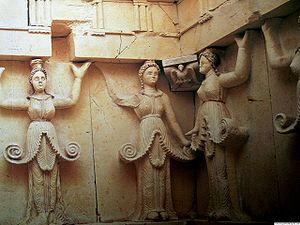


 Salbyk kurgan before excavation, 5th-4th century BC, upper Enisey-Irtysh interfluvial. Salbyk kurgan is surrounded by balbals, and topped with Kurgan stelae.
 Scythian royal Alexandropol (Ukraine) kurgan C14 dated 394–366 BC, before excavation in 1852–6.
 Engraving of Ukraine's Perepyat kurgan cemetery group before its excavation.
 Undated unattributed unexplored kurgan on the west side of the Samara Bend, Russian Federation, with a visible tunnel made by grave robbers.
 Kántor-kurgan near the city of Szentes
 Józsepi-kurgan near the Mindszent
 Kurgans near Mindszent. One of them is covered by trees.


 Bulgaria portal


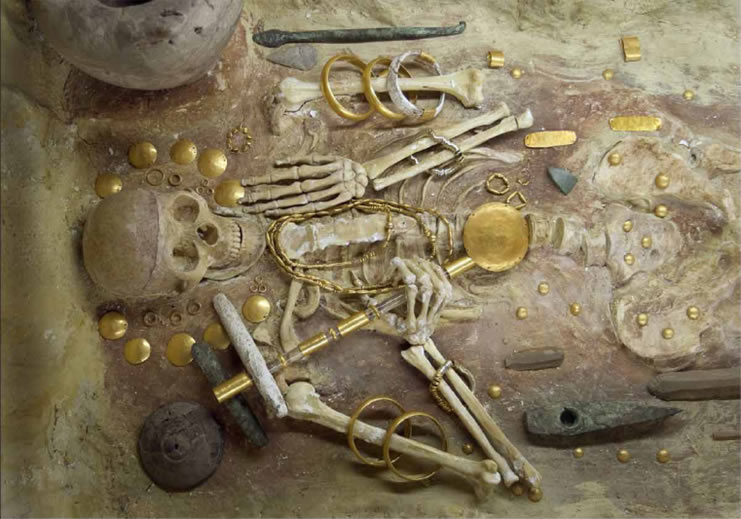
![[2]](http://tandem.nipne.ro/%7Eagata/dating_bulletin.jpg)