Search This Blog

Wikipedia

Search results

Showing posts with label Mikoyan MiG-LMFS. Show all posts

Sunday, March 2, 2014

Mikoyan MiG-LMFS from Aircraft.Wikia.com

The Mikoyan MiG-LMFS (Lyogki Mnogofunkzionalny Frontovoi Samolyot = Lightweight Multirole Frontline Aircraft ), is an in-development Russian Multirole Aircraft, based on the MiG 1.44, after the failure of "Project R-33", the MiG-LMFS is the second try of Mikoyan-Gurevich ( newly RAC MiG ) to develop a replacement for the aging Mikoyan MiG-21 and Mikoyan MiG-23.

After the failure of the MiG 1.44 RAC MiG searched ways to use the new knowledge and technology otherwise. As Sukhoi was chosen to develop the heavy Air-Superiority Fighter PAK-FA, Mikoyan started to develop a new leightweight Multirole combat aircraft, the MiG-LMFS, which is also called "Project 1.27". Actually the MiG-LMFS is only a single engine stealth variant of the Mikoyan-Gurevich MiG 1.44. While the PAK-FA challenges the Lockheed Martin F-22 Raptor, the Mikoyan-LMFS is a direct competitor to the American F-35 Lightning II. Like on the MiG-1.44, Canards and tailless delta-wings will be used.
But at the beginning of 2011 RAC MiG published new concept designs of the LMFS, but this time, unlike on earlier designs, Diverterless Supersonic Inlets were included like they are on the F-35 Lightning II and the Chinese Chengdu J-20, and instead of Canards, conventional control surfaces are used.
RAC MiG is excepted to design the MiG-LMFS as a smaller and cheaper alternative to the heavy and expensive Sukhoi Fighters. Beacause of the MiG-23, MiG-21 and MiG-27, which are used in many countries and they must be replaced, the MiG-LMFS could be very successful on global market. The problem is that it is unknown if the Russian Air Force will want the LMFS, while it is impossible for Mikoyan to finance itself only with the MiG-29 and the MiG-35. But because the Sukhoi PAK-FA will have technical problems and will get more expensive, like the American F-22 Raptor, the LMFS, like the F-35 in the United States, could be very interesting for the Russian Air Force.

Comparable Aircraft

The performance of the LMFS is still unknown, but when looking on it´s design, it can be estimated against which aircraft it will compete and against which it will not:

China

Chengdu J-10 Vigorous Dragon

Sweden

JAS-39 Gripen

United States

F-35 Lightning II

MiG LMFS : Updates and discussion
The Russian Air Force made an unexpected shift in the priorities for its future fighter, stating that the service will back the simultaneous development of two programs for a fifth-generation aircraft. The PAK FA medium-weight fighter program, which has been underway since 2002, is joined by MiG's lighter-weight aircraft project. In addition to the goal of winning domestic orders, MiG's light multi-role fighter build on the company's earlier experience with its MiG 1.44 program, also may attract India as a co-developer and future customer.
In April 2002, the Russian military chose Sukhoi's T-50 proposal in the fifth-generation fighter contest — which was codenamed the Perspektivniy Aviatsionniy Kompleks Frontovoi Aviatsii (PAK FA), or future tactical aviation air system. Since 2002, Sukhoi has been regularly meeting the subsequent milestones in the new fighter's development, which led to the Russian Air Force's approval of the T-50's preliminary design. To date, Sukhoi has developed a computer mock-up of the aircraft and an operating mockup of the cockpit. The PAK FA prototype's maiden flight is expected in 2009.
Sukhoi's victory in the Russian Air Force competition resulted not only from the T-50's design characteristics. The choice was made with the consideration of the company's sizeable profits from the sales of the Su-27 family aircraft to China and India in the 1990s and early 2000s. At that time, Sukhoi fighters represented half of Russia's aircraft production, and nearly half of Russian military technology exports. During the 1990s, Sukhoi maintained the largest workload of all Russian design bureaus. Unlike other Russian aircraft designers, the company counted more on its own resources than on government subsidies.
The Sukhoi T-50's rival in 2002 was the MiG design, the exact designation of which is classified. Later, when MiG Corp. decided to continue this program, it received the codename Liogkiy Mnogofunktsionalniy Frontovoi Samolyot (LMFS) or Light Multi-role Tactical Aircraft. MiG Corp. did not accept defeat in the contest against Sukhoi, and criticized the decision-making procedure. According to MiG, several aspects were omitted during the evaluation, like the purchase cost for the Air Force, the aircraft's lifetime maintenance costs and the export possibilities of various versions during the next few decades. MiG insisted that instead of initial projects, the choice of a winner should have been made at the phase of prototype tests.

Looking for foreign partner
About a year ago, MiG's LMFS project came out of the shadows again due to a series of fortunate events. Some time ago, the Indian Defense Research and Development Organization (DRDO) and Aeronautical Development Agency (ADA) started analyzing the development options for a home-grown fifth-generation fighter, called the Medium Combat Aircraft (MCA), which was a twin-engine version of the its Light Combat Aircraft (LCA) Tejas fighter. After a bad experience with the LCA, India sought a partner in Russia for the MCA program.
The re-birth of MiG's LMFS project also was helped by the company's improved financial situation, resulting from several contracts for new versions of the MiG-29 that were signed in recent years. India ordered 16 MiG-29K/KUB ship-based fighters with the option for 30 more, Yemen purchased or upgraded 20 MiG-29SMT/UBT fighters, and Algeria ordered 34 MiG-29SMT/UBTs. New contracts for 32 fighters for Yemen and the upgrade of 66 aircraft in India are expected to be signed in the coming months. This will provide MiG with a portfolio of orders worth $4.5 billion.
Another event favorable for the LMFS program was the September 2004 nomination of Alexey Fedorov, the president of Russia's largest privately-held jet manufacturer — the Irkut Corporation — as the top manager at MiG. Fedorov is well known in India because in his previous role as Irkut's leader, he sold the Su-30MKI combat aircraft to India and was starting its license production there. Fedorov's contacts will certainly help the promotion of MiG-35 and LMFS fighters in India. In the coming months, Fedorov is to become the head of the OAK Corporation, which is a consolidation of Russia's aircraft industry. Therefore, it is expected that the LMFS program will be high on OAK's priority list.
A joint Russian-Indian fighter was discussed for the first time in June 2001. Later, during the visit of then-Indian Defense Minister George Fernandez to Moscow in January 2003, Russia and India signed a protocol declaring the intention to jointly develop a new-generation fighter. At the Sukhoi Design Bureau, Fernandez was shown the T-50 project. The trip of Indian Defense Minister Pranab Mukherjee to Moscow in November 2005 (where he visited both MiG and Sukhoi) was crucial for the Indian-Russian contacts about the new generation fighter. The minister stated that India is not intending to be only a source of money for the project. "Our air force and industry are willing to participate in all stages of the new fighter's creation, starting with the conception, and continuing through the design and research to common production," he said. Mukherjee did not name specific companies and designs, but the phrase above distinctly refers to the MiG fighter, as Sukhoi's design is already complete and the documentation for prototype aircraft manufacture is nearly ready. Moreover, the Sukhoi aircraft is being developed in accordance with the Russian Air Force requirements and does not meet the needs of India. However, Russia is still pressing India to join the Sukhoi PAK FA program. In early August 2006, a Sukhoi delegation was again in India, and presented their project to the Ministry of Defense.


LMFS is different
A great advantage of the MiG project is the fact that its design and technical parameters are significantly different from the Sukhoi T-50. As a result, the market does not have to choose between an "either-or" situation, and both aircraft can find their place, depending upon the needs of potential export clients. The MiG proposal is for a "right-sized" aircraft that would be in the realistic price range for most foreign buyers, as best described by the frequently-quoted phrase of Mikoyan Design Bureau Director Vladimir Barkovskiy: "smaller and simpler aircraft would be inferior to its competitors, but larger and more sophisticated would be too expensive." In 2002, the then-CEO of MiG Corp. Nikolay Nikitin stated that an outlay of $1.3 billion per year between 2010-2025 would be enough to cover a Russian Air Force purchase and operation of a necessary number of MiG-designed aircraft, while a heavier Sukhoi aircraft would cost $2 billion per year. MiG also estimates the export potential of its lighter-weight fighter as 3-4.5 times higher than the Sukhoi fighter.
At the moment, one thing is certain: the LMFS will be about 30% lighter than the T-50. According to approximate assessments, the T-50 will have a normal take-off weight of 21 tons, which places it between present MiG-29 and Su-27 fighters — whereas the LMFS is likely to weigh 15 tons. Most probably, the LMFS will retain the delta canard configuration of the heavy MiG 1.44 prototype. Being asked directly about the new fighter configuration, Barkovskiy answered indirectly: "It would be illogical if we reject the experience we accumulated while developing that project [MiG 1.44]." He also mentioned that "the number of wind tunnel tests [of the 1.44 models] was vast, setting a new record in Russia. [So] we are making use of these materials and transforming them into the fifth generation aircraft."
It is not known at the moment whether the new MiG fighter will be powered by one or two engines. Originally, the company's design had two Klimov VK-10 turbofans rated at about 10.5 tons each, which are a further development of the MiG-29's RD-33 engines. In this configuration, the aircraft entered the Russian fighter contest in 2002 and was presented to India in 2005. In addition to their application on MiG's new aircraft, the VK-10 engines also could be used to extend the MiG-29's life in its new MiG-35 version. Moreover, the RD-33/VK-10's manufacturer, the Klimov Company, has become a part of MiG Corporation's engine division, and it is obviously easier for MiG to cooperate with Klimov than with other engine manufacturers.
Developing a single-engine design for MiG's fifth-generation fighter has become a more frequently discussed issue. Such an option was backed Russian Air Force Commander Gen. Mikhailov last January, while similar opinions have come from India as well. If the customers insist on a single-engine design, the use of a version of the AL-41 engine (to be installed on the T-50) with a thrust increase to about 20 tons is possible. Such a solution is cheaper, although it requires the engine to be mature at its entry into service and reach a high level of reliability first.
the Phazotron-NIIR institute will present the first Russian fighter radar with an active electronic scanning antenna (AESA): the Zhuk-MAE, which was developed for the MiG-35. Two prototypes of the radar were under assembly in the autumn of 2006. The fifth-generation LMFS fighter will certainly be fitted with a development of this radar. The cooperative links between MiG Corp. and Phazotron-NIIR were strengthened at the beginning of 2006 when a group of MiG's top managers purchased a controlling stake of Phazotron. In May 2006, Mikhail Korzhuyev became the director general of Phazotron, while Sergei Tsivilev, the MiG Corp's First Deputy CEO, was elected the chairman of Phazotron's board.

One or two fifth generation fighters?
The possibility of India's participation in the LMFS project generated new interest in this program from the Russian Air Force. Shortly after the Moscow visit of Indian Defense Minister Mukherjee last January, Russian Air Force Gen. Vladimir Mikhailov declared that "two fifth generation fighters, a medium one and a light one, are being developed" in Russia. The medium fighter will be Sukhoi's PAK FA chosen in 2002, while the light next generation fighter was described by the Russian Air Force Commander as a single engine MiG aircraft with the same engine, avionics and armament as the PAK FA.
It is understandable that Gen. Mikhailov's declaration caused anxiety at Sukhoi. A few days later, the head of Sukhoi Holding, Mikhail Pogosyan, said "there is no technology in Russia to develop a light fighter," clearly indicating that — in his opinion — only Sukhoi's PAK FA can be the fifth generation fighter. Moreover, he added that the PAK FA is not a heavy fighter, as "it is considerably smaller than the F-22A, Su-47 or MiG 1.44." According to Pogosyan, "any discussions about Russian heavy and light fifth generation fighters are pointless."
 http://www.the-blueprints.com/blueprints-depot-restricted/modernplanes/mikoyan-gurevich-mig/mikoyan_gurevich_mig_1_42_mfi-18480.jpg

 http://media.moddb.com/images/groups/1/3/2044/86731644.jpg

 http://www.militaryfactory.com/aircraft/imgs/mikoyangurevich-mig144-flatpack_2.jpg

 http://www.janes.com/images/assets/279/32279/New_Russian_fighter_-_main.jpg

 http://www.defensasur.com.ar/imagenes/noticias/2013/DIC/291213_Mig%201-44b.jpg

 http://www.airart3d.com/wp-content/gallery/mikoyan-1-44/1-44_3.jpg

 http://www.mycity-military.com/thumbs2/139317_tmb_325208878_mikoyanlfifr0.jpg

 http://jpcolliat.free.fr/mig144/images/mig142t.jpg

 http://i.ytimg.com/vi/nLxuUnAlNWk/maxresdefault.jpg

 http://www.military-today.com/aircraft/mikoyan_mig_mfi.jpg

 http://vignette2.wikia.nocookie.net/aircraft/images/b/bf/I42-001-1-.jpg/revision/latest?cb=20120320193128

http://img4.imageshack.us/img4/1410/mikoyanlmfs.jpg

http://www.aereo.jor.br/wp-content/uploads/2011/01/Mikoyan-LMFS-2.png


http://www.defensasur.com.ar/imagenes/noticias/2012/MAR/220312_LMFS.jpg


https://blogger.googleusercontent.com/img/b/R29vZ2xl/AVvXsEgsK4PtCttQb6H0HuBVl8WGKt-o4ybPCZHABEjPnScMWggYJddy19esMSwwLnRuKIn38yFKQfleJo3WxXFnXVkSIUMP-91KygRIEoxsq4jwqXjkJOLxa2397LSZGd0TezlXoNkAySEAuPpD/s1600/mikoyan+1.44_1.jpg

http://media.moddb.com/images/downloads/1/65/64467/descarga.jpg

http://upload.wikimedia.org/wikipedia/commons/d/dd/Medium_combat_aircraft.jpg


http://i215.photobucket.com/albums/cc316/Novgorodsfleet/data%20transfer/MiG-33_bmp.jpg

http://hushkit.files.wordpress.com/2012/12/gd-mig-2000-1.jpg

http://hushkit.files.wordpress.com/2012/12/gd-mig-2000-22.jpg

ValueWalk

Russia Developing Yet Another Fifth Generation Fighter Jet

Turns out, the dreaded Sukhoi T-50 PAK FA is not the only fifth-generation fighter jet under development by Russia. The PAK FA is expected to enter services in 2017. But the Russian Aircraft Corporation MiG is developing yet another cutting-edge lightweight fifth generation fight jet. The new lightweight fighter jet will be based on Mikoyan Project 1.44 (NATO reporting name: Flatpack), reports Sputnik News.

Russia Fifth Generation Fighter Jet

Russia's new fifth generation jet to replace MiG-29

The Mikoyan Project 1.44 was meant to develop an alternative to the Advanced Tactical Fighter (ATF) project of the United States that led to the development of Lockheed Martin Corporation (NYSE:LMT) F-22 Raptor. The aircraft made its first flight in 2000. It boasted of stealth technology, advanced avionics, super-cruise, and super-maneuverability. However, Russia shut down the project over a decade ago.
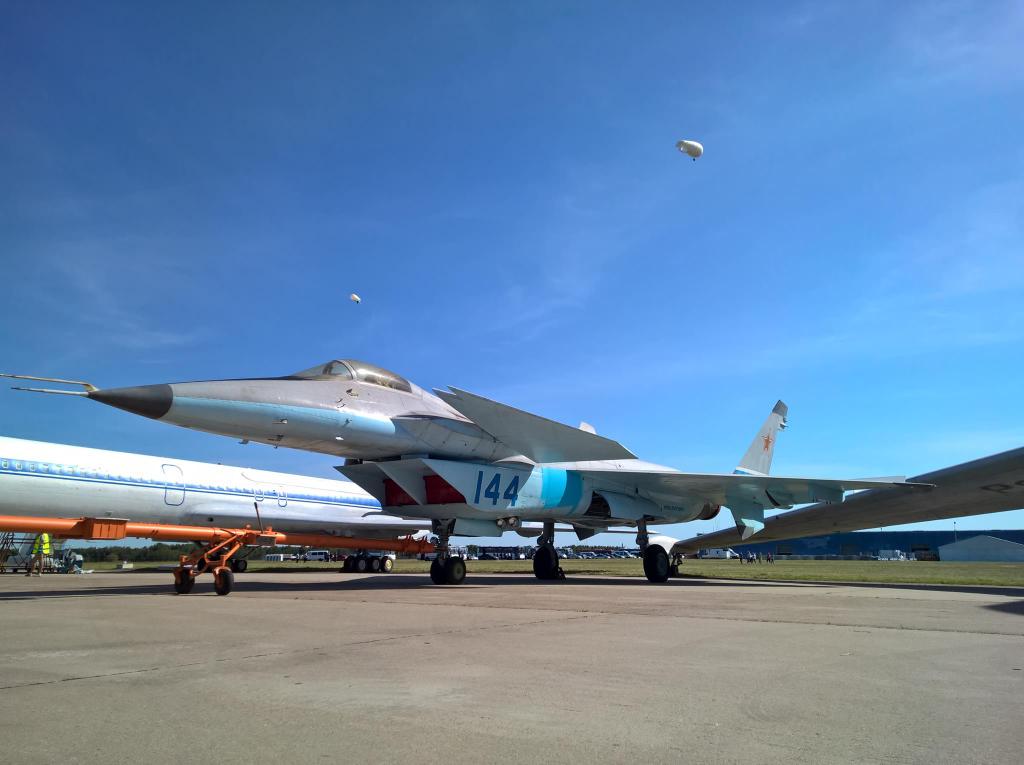
On Tuesday, MiG CEO Sergei Korotkov said that the company will use the experience gained from the Project 1.44 to develop the new fifth-generation fighter jet. He added that the new plane will also use some of the technology developed for MiG-35 (Fulcrum-F) air superiority fighter. The new fifth-generation jet is supposed to replace the ageing MiG-29, which was first introduced in 1983.

Embedded image permalink

Russian Air Force to get the first batch of PAK FA in 2017

However, it may take years before this lightweight jet is inducted into the Russian Air Force. Meanwhile, the first batch of Sukhoi T-50 PAK FA will join the Air Force in late 2016 or early 2017. PAK FA is a multi-role, twin-engine, single-seat, air superiority fighter with stealth capabilities. It is expected to have a service life of up to 35 years. It boasts of new avionics package that provides intelligent support and superior automatic control.
According to Sputnik News, the PAK FA is outfitted with a unique digital weapon guidance system with "fire-and-forget" capabilities. This technology allows the jet to lock on a target and hit it when it is no longer in the line-of-sight. It also features an improved technology to locate and track targets.
Russia is modernizing its military under a massive $400 billion program as tensions with the West continue to escalate.

Monday, February 24, 2014

Mikoyan Project 1.44

From Wikipedia, the free encyclopedia


MIG Project 1.44 MFI
Mig 1-44-2.png
Artist's conception of two MiG 1.44s in-flight
Role Technology demonstrator
National origin Soviet Union
Russia
Manufacturer Mikoyan
First flight 29 February 2000
Status Unknown
The Mikoyan Project 1.44/1.42[N 1] (Russian: Микоян МиГ-1.44; NATO reporting name: Flatpack)[2] was a technology demonstrator developed by the Mikoyan design bureau. It was the Soviet Union's answer to the Advanced Tactical Fighter (ATF) of the United States, incorporating many fifth-generation fighter aspects such as advanced avionics, stealth, supermaneuverability, and supercruise. The design’s development was a protracted one, characterized by repeated and lengthy postponements due to a chronic lack of funds; the Mig 1.44 made its maiden flight in February 2000, nine years behind schedule. The current status of the 1.44 is unknown.

Development

Preliminary design

The MiG 1.44 had its origins in the early 1980s, when the U.S. Air Force began developing an advanced fighter under the Advanced Tactical Fighter (ATF) project, which would ultimately materialise in the form of the supermanoueverable and stealthy, albeit costly, Lockheed Martin F-22 Raptor. Consequently, the Soviet government tasked its fighter design bureaux the job of developing a fighter with which to counter the American threat, and replace the Sukhoi Su-27.[3][4][5] Mikoyan busied itself with two concurrent projects, one of which focused on a heavy multi-role design designated MFI (Mnogofunksionalni Frontovoy Istrebitel, "Multifunctional Frontline Fighter"), the other a light tactical fighter named LFI (Lyogkiy Frontovoy Istrebitel, "Light Frontline Fighter"). To minimise costs, both designs were to share as many components as possible.[6]
However, as the research and development phase for the two projects progressed, costs escalated due to the complexity normally associated with advanced aircraft projects. As a result, the Soviet government created the Combined Task Programme in 1983 with the aim of maximising efficiency and developing technologies to be used for all classes of aircraft.[6] Mikoyan became the primary contractor for the programme, the importance of which was illustrated with its inclusion into the Soviet five-year economic plan.[6] The design bureau soon formulated initial specifications for the new fighters.[6]
Mikoyan proceeded with the preliminary design of both the MFI and LFI with participation from numerous institutions, which assisted in the progressive definition of the designs. TsAGI (Tsentralniy Aerogidrodinamicheskiy Institut, "Central Aero- and Hydrodynamic Institute") was responsible for collecting wind tunnel test results, which, along with theoretical studies, were vital during this phase of development. The institution recommended that Mikoyan include canards for the MFI, since it offers great agility and lift, the latter important as the MFI was a statistically unstable design.[6] The delta wings then had a wing leading edge sweep of 40–45°.[6] During this period, engineers undertook unprecedented wind tunnel testing to refine the MFI's aerodynamics and verify its radar cross-section (RCS).[6]
The MFI would have a variable engine intake located under the front fuselage, reminiscent of the Eurofighter Typhoon; this was particularly important with the nature of the aircraft, since it allows for sustained air flow into the engine during sudden manoeuvres.[6] As for the engine themselves, research was conducted on thrust-vectoring, allowing for markedly improved manoeuvrability and short take-off and landing performance.[7] Besides the mechanical and aerodynamic aspects of the design, engineers investigated hundreds of issues to refine the layout and specifications.[7] In 1987, Mikoyan and the associated institutions submitted the MFI and LFI proposals for review.[7]

Full-scale development

While both MFI and LFI designs passed critical review, due to budgetary constraints, Mikoyan shelved the latter to free up funds for the development of the MFI, which had by then been redesignated Isdeliye (item) 1.42.[7] Under the leadership and coordination of Chief Project Engineer Gheogiy A. Sedov, Mikoyan embarked on major design effort. Because the LFI was shelved, 1.42 had by then assumed the multi-role approach, meaning that it had to fulfill both air-to-air and air-to-ground missions.[8] TsAGI was still a part of the design effort, having tested radio-controlled models for research into stability and handling characteristics, particularly at high angles of attack. It was later confirmed that the 1.42 is still controllable at angles of attack of up to 60°.[8]
By now the specifications were being firmed. Engineers from various establishments had settled on a definite design, having refined the flight-control software, verified all wind tunnel test results, and checked important systems using test rigs and modified aircraft.[9] In 1988, Mikoyan was issued a specific operational requirement for the 1.42. Three years later, the design passed the Soviet Air Force's critical review. This paved the way for the construction of a flyable technology demonstrator, and so Mikoyan issued specifications to specialised factories tasked with such roles.[10]
The technology demonstrator, bearing the designation 1.44, would be used to verify the aerodynamic layout and flight control system of the design. Construction of it was halfway when the collapse of the Soviet Union brought a halt to further funding. Inevitably the scheduled first flight of the almost-complete aircraft slipped indefinitely.[10] However, full-scale mock-ups and sections of the 1.44 were built in support of static tests, while factories were gearing up for the construction of prototypes.[10] Mikoyan lobbied the government to declassify the project so it could display the aircraft at various air shows. In June 1995, MiG's Deputy General Designer Anatoliy Belosvet announced that the prototype could be displayed at that year’s MAKS Airshow; in the end, the government refused.[11] The company tried in 1997, to no avail.[12]

Testing interrupted

In early 1994, the incomplete aircraft was transported to Zhukovsky Airfield, where it would undertake flight tests. Ground tests began in later that year, culminating in the first high-speed runs at the controls of Mikoyan's Chief Test Pilot Roman Taskayev.[10] Just as the test programme begin to pick up, it was again put on hold as the design bureau did not have enough funds to purchase the remaining components still missing on the demonstrator.[10] This would be the main factor in the indefinite postponement of the programme for the next few years. In 1997, the Russian government cancelled the MFI program in 1997 due to its unacceptably high unit cost.[13] Mikoyan was financially insecure, resulting with the change in the management during the years leading up to 2000; this opened up other sources of funds.[14]
The change in the company’s management also brought many changes. In late 1998, the Russian government agreed to reveal the existence of the project. On 24 December 1998, the Nezavisimaya Gazeta published a brief article on the fighter, accompanied by several photos.[15] On 12 January the following year, the 1.44 was officially rolled out in the presence of top-ranking Russian military and government personnel, international journalists and other dignitaries.[16][17] Until then, the status of the 1.44 was largely a secret; the previous day, however, Aviation Week & Space Technology published a photo taken from the roof of the hangar in which the demonstrator was parked.[18]

Design

Note: since the MiG 1.44 did not conduct an extensive flight test programme, not every predicted performance aspects by engineers were verified. Thus, this section refers to the design as the MiG MFI.
The MiG MFI was a delta wing, twin-tailed, fifth-generation air superiority/strike fighter design that incorporated advanced technology to theoretically give the aircraft excellent stealth and fighting attributes. It was of a tail-first (canards) layout which, when working in concert with the engines, give the aircraft remarkable manoeuvrability. It has a tricycle landing gear system, with a single, dual-wheel landing gear in the front, and two single-wheels in the rear. The MFI is controlled by a fly-by-wire flight control system, without which the aircraft is almost impossible to fly because of the statically unstable nature of the MFI.[19] Mikoyan made use of weight-saving materials in the construction of the aircraft, with aluminium-lithium alloys making up 35% of the empty weight, steel and titanium alloys (30%), composites (30%) and others (5%).[20]
The MiG MFI was unconventional in its layout, in an effort to improve in-flight efficiency and stealth characteristics. Efforts were made to minimise surface-area, possibly to reduce drag. The wings are of delta planform, with leading-edge sweep at 52°. At the tips are dielectric fairings which house electronic countermeasures/electronic support measures. The wings have full-span leading edge. The canards, meanwhile, have a leading-edge sweep of 58°, and have prominent dogtooth which improve airflow over the wings at high alpha (angles of attack).[21] Russian aviation experts claim that the unorthodox design, use of radar-absorbent materials (RAM), and internally mounted weapons, give an RCS comparable to that of the F-22.[22]
Two Lyul'ka Saturn AL-41F afterburning turbofans produce 177 kN (39,020 lbf) of thrust, giving the MFI a top speed of Mach 2.35. The engines also allow the jet to supercruise. The axisymmetrical engines can be vectored in both pitch and yaw planes. The nozzle's inner petals are lined with ceramic tiles to reduce heat signatures. The engines, through serpentine ducts covered in RAM, are fed by a rectangular intake underneath the front fuselage.[5][23] Weapons and fuel tanks can be carried under the wings as well.[5]

Testing and cancellation

During 1999, final preparations were made for first flight. The aircraft was finally completed after missing components were purchased. It underwent ground tests, including high-speed taxis during which the aircraft was rotated.[24][25] On 29 February 2000, the aircraft performed its first flight at the hands of Vladimir Gorboonov. During the 18-minute flight, 1.44 reached a maximum height of 1,000 m (3,300 ft) and reached speeds of 600 km/h (370 mph). The aircraft touched down at 11:43 am Moscow Time, amid tight security. Gorboonov later described the aircraft as docile.[5][25][26] After the 22-minute second flight on 27 April, engineers probably uncovered some problems, since there were no reported flights thereafter.[25] The programme had since apparently been cancelled, with the aircraft's status unknown.

Variants

  • MiG 1.42/42 Primary version which may go onto production; the functions are better than that of the 1.44. NATO named it "Foxglove".[1]
  • MiG 1.44 Demonstrator prototype with failed upgrades; will remain a demonstrator. 2 have been built. NATO named it "Flatpack".[1]
Despite the close similarity to the Chengdu J-20, MiG has denied any intentional disclosure of technical information on the 1.44 to China.[27]

Specifications (Project 1.42/44)

4 view illustration
Note: Since the 1.44 and 1.42 never went beyond pre-production, most specifications are estimated.
Data from[citation needed]
General characteristics
Performance
Armament
  • Guns: 1× 30 mm Izhmash GSh-301 cannon, 250 rounds
  • Missiles: R-77 (AA-12 Adder) medium-range radar-guided missiles, R-73 (AA-11 Archer) short-range IR-guided missiles, K-37 long-range radar-guided missiles, K-74 short-range IR-guided missiles
  • Payload: likely any AGM or small-diameter free fall bomb in the Russian inventory

See also

Aircraft of comparable role, configuration and era
Related lists

References

Sunday, February 23, 2014

Sukhoi PAK FA

From Wikipedia, the free encyclopedia

PAK FA
Sukhoi T-50 Beltyukov.jpg
PAK FA T-50
Role Stealth multirole fighter
National origin Russia
Manufacturer Sukhoi
First flight 29 January 2010[1]
Introduction 2016[2]
Status Test flight/pre-production
Primary users Russian Air Force
Russian Navy[3]
Number built 5 prototypes[4]
Program cost US$8–10 billion (est.)[5][6][7]
Unit cost
T-50: US$50+ million[8]
FGFA: US$100 million[9]
Variants Sukhoi/HAL FGFA
The Sukhoi PAK FA (Russian: Сухой ПАК ФА, Russian: Перспективный авиационный комплекс фронтовой авиации, Perspektivny Aviatsionny Kompleks Frontovoy Aviatsii, literally "Prospective Airborne Complex of Frontline Aviation") is a twin-engine jet fighter being developed by Sukhoi for the Russian Air Force. The Sukhoi T-50 is the prototype for PAK FA.[10]
The PAK FA, a fifth generation jet fighter, is intended to be the successor to the MiG-29 and Su-27 in the Russian inventory and serve as the basis of the Sukhoi/HAL FGFA being developed with India.[11][12] The T-50 prototype performed its first flight 29 January 2010.
The Russian Defence Ministry will purchase the first 10 evaluation example aircraft after 2012 and then 60 production standard aircraft after 2016.[13][14][15] The first batch of fighters will be delivered with current technology engines. The PAK-FA is expected to have a service life of about 30–35 years.[16]

Development

Origins

In the late 1980s, the Soviet Union outlined a need for a next-generation aircraft to replace its MiG-29s and Su-27s in front line service. Two projects were proposed to meet this need – the Sukhoi Su-47 and the Mikoyan Project 1.44. In 2002, Sukhoi was chosen to lead the design for the new combat aircraft.[17] The Novosibirsk Aircraft Production Association is manufacturing the new multirole fighter at Komsomol'sk-on-Amur along with Komsomolsk-on-Amur Aircraft Production Association. Final assembly is to take place at Komsomol'sk-on-Amur.[citation needed]
The Tekhnokompleks Scientific and Production Center, Ramenskoye Instrument Building Design Bureau, the Tikhomirov Scientific Research Institute of Instrument Design, the Ural Optical and Mechanical Plant (Yekaterinburg), the Polet firm (Nizhny Novgorod) and the Central Scientific Research Radio Engineering Institute (Moscow) were pronounced winners in the competition held in early 2003 for the development of the avionics suite. NPO Saturn is the lead contractor for the engines.[citation needed]
In 2007, Russia and India agreed to jointly develop the Fifth Generation Fighter Aircraft Programme (FGFA) for India.[18][19][20] In September 2010, it was reported that India and Russia had agreed on a preliminary design contract where each country invests $6 billion; development of the FGFA fighter was expected to take 8–10 years.[21] The agreement on the preliminary design was to be signed in December 2010.[22]
On 8 August 2007, Russian Air Force Commander-in-Chief (CinC) Alexander Zelin was quoted by Russian news agencies that the development stage of the PAK FA program was complete and construction of the first aircraft for flight testing would begin.[23] Zelin also said that by 2009 there would be three fifth-generation aircraft ready. "All of them are currently undergoing tests and are more or less ready," he said.[24] In mid-2009 the design was approved.[17]

Flight testing

The T-50's maiden flight had been repeatedly postponed since early 2007 as the aircraft encountered unspecified technical problems. Alexander Zelin admitted as recently as August 2009 that problems with the engine and in technical research remained unsolved.[25] On 28 February 2009, Mikhail Pogosyan announced that the airframe for the aircraft was almost finished and that the first prototype should be ready by August 2009.[26] On 20 August 2009, Pogosyan said that the first flight would be by year's end. Konstantin Makiyenko, deputy head of the Moscow-based Centre for Analysis of Strategies and Technologies said that "even with delays", the aircraft would likely make its first flight by January or February, adding that it would take five to ten years for commercial production.[27]
PAK FA T-50 with landing gear down, April 2010
On 8 December 2009, Deputy Prime Minister Sergei Ivanov announced that the first trials with the fifth-generation aircraft would begin in 2010.[28] The first taxi test was successfully completed on 24 December 2009.[29][30][31] Piloted by Hero of the Russian Federation Sergey Bogdan, the aircraft's 47-minute maiden flight took place on 29 January 2010 at KnAAPO's Dzemgi Airport in the Russian Far East.[32][33][34][35] By 31 August 2010, it had made 17 flights and by mid-November, 40 flights in total.
The second T-50 was to start its flight test by the end of 2010, but this was delayed until early 2011.[36][37][38][39][40] On 3 March 2011, the second aircraft completed a 44-minute test flight.[36] These first two aircraft will lack radar and weapon control systems. The third and fourth aircraft, to be added in 2011, will be fully functional test aircraft.[41] On 14 March 2011, the aircraft achieved supersonic flight at a test range near Komsomolsk-on-Amur.[42]
T-50 flying at MAKS 2011
The T-50 was displayed publicly for the first time at the 2011 MAKS Airshow. Russian Prime Minister Vladimir Putin was in attendance.[43][44] In June 2011, an unauthorized video was made of the Sukhoi PAK FA in flight displaying a variety of aerobatic moves.[45] On 3 November 2011, the PAK FA program achieved its 100th flight.[46] More than 20 test flights were made in the next nine months.[47]
The third prototype, T-50-3, was the first prototype to fly with an AESA radar. Originally scheduled for the end of 2011, these flights occurred in August 2012, and showed performance comparable to existing radars.[48][49] On 22 November 2011, T-50-3 took its first flight from KnAAPO's airfield in Komsomolsk-on-Amur, piloted by Sergey Bogdan. The aircraft spent over an hour in the air, and was subjected to basic stability and powerplant checks.[50] It differs from the other prototypes in the way it lacks a pitot tube. All 14 test aircraft are scheduled to fly by 2015.[51]
The fourth prototype had its first flight on 12 December 2012[52] and joined the other three aircraft in testing near Moscow a month later.[53][54] The fifth prototype had its first flight on 27 October 2013; with this flight the program has amassed more than 450 flights.[55] The first aircraft for State testing was delivered on 21 February 2014.[56]

Design

Overview

Prototype T-50 in flight
Although most information about the PAK FA is classified, sources within in the Russian Air Force and Defense Ministry have openly stated that it features stealth technology and has the capability to supercruise,[6] and incorporate advanced avionics such as an Active Electronically Scanned Array (AESA) radar and an artificial intelligence system.[57] It is to be outfitted with the next generation of air-to-air, air-to-surface, and air-to-ship missiles.[58]
The T-50 has a blended wing-body design and incorporates all-moving vertical stabilizers and horizontal elevators. The aircraft has wing leading-edge devices above the jet engine (LEVCONs) designed to control vortices generated by the leading edge for improved behaviour at high AOA. The two engines incorporate 3D thrust vectoring (TVC) nozzles canted at an angle, similar to the configuration on the Su-35S. Differential actuation of these nozzles can produce rolling and yawing moments. The aircraft inlet incorporates variable intake ramps for increased supersonic engine efficiency and retractable mesh screens to prevent foreign object debris from being ingested into the engines.[59]
Composites are used extensively on the T-50 and comprise 25% of its weight and almost 70% of the outer surface.[41] Weapons are housed in two tandem missile bays, each estimated to be between 4.6-4.7 m long. The main bays are augmented by bulged, triangular-section bays near the wing root.[60]

Stealth

The T-50 will be the first operational stealth aircraft in Russian service. Similar to Western stealth fighters like the F-22, the airframe incorporates planform alignment in its leading and trailing edges and sawtooth edges for its skin panels.[61] The serpentine inlet obscures most, but not all, of the compressor face of the engine. The production aircraft will incorporate radar blockers similar in principle to that of the F/A-18E/F to hide the compressor face from all angles. The T-50's stealthy features are most apparent in the forward hemisphere; the shaping of the aft fuselage is much less conducive to radar stealth.[59] The production T-50 is estimated to have reduced the radar cross-section to that of a tennis ball from optimal angles.[62]

Avionics

The T-50's avionics consists of the Sh121 multifunctional integrated radio electronic system (MIRES) and the 101KS Atoll electro-optical system.[63] The Sh121 consists of the N036 Byelka radar complex and L402 Himaraya electronic countermeasures system. The N036 Byelka radar complex is developed by Tikhomirov NIIP Institute and consists of a main nose-mounted X-band AESA radar with 1526 T/R modules, designated the N036-1-01,[61] and two smaller L-band AESA radars with 358 T/R modules mounted on the sides of the forward fuselage designated N036B-1-01. The suite also has two N036L-1-01 L-band arrays on the wing's leading edge extensions that are not only used for friend-or-foe identification but also for ground and aerial target detection. Computer processing of the X- and L-band signals enable the system’s information to be significantly enhanced.[64]
The radar will reduce pilot load and make use of a new data link to share information between aircraft.[65] In 2012 ground tests began on the third aircraft of the Tikhomirov Scientific Research Institute of Instrument Design's AESA radar.[66] The L402 Himaraya electronic countermeasures (ECM) suite made by the KNIRTI institute uses both its own arrays and that of the N036 Byelka radar. One of its arrays is mounted in the dorsal sting between the two engines.[67]
The 101KS Atoll electro-optical system includes the 101KS-V infra-red search and track mounted on the starboard side in front of the cockpit. This sensor can detect, identify, and track multiple airborne targets simultaneously.[61] The 101KS-O is mounted on a turret in the dorsal spine and has a laser-based countermeasure against heat-seaking missiles. The complex will also include the 101KS-U ultraviolet warning sensors and 101KS-N navigation and targeting pod.[68]

Cockpit

The T-50 has a glass cockpit with two large main multi-functional displays similar in appearance to that of the Su-35S and the F-35. The cockpit has a wide head-up display (HUD).[69] Life support systems will enable pilots to perform 9-g maneuvers for up to 30 seconds at a time. New pressure suits will allow safe ejection at altitudes of up to 23 km.[70]

Armament

The PAK FA has a reported maximum weapons load of 7,500 kg.[71] It has an apparent provision for a cannon (most likely GSh-301).[16] The PAK FA has two internal bays estimated at 4.6-4.7 metres by 1-1.1 metres.[72] The expected initial armaments include Kh-35UE (AS-20 "Kayak"), Kh-38ME, Kh-58UShKE (AS-11 "Kilter"), and RVV-MD (AA-11 "Archer") missiles.[73]
Two Izdeliye 810 Extended beyond visual range missiles per weapons bay. Multiple Izdeliye 180 / K-77M beyond visual range missiles. K-74 and K-30 within visual range missiles can also be carried.[72] Two KH38M or KH58 USHK air-to-ground missiles per weapons bay. Multiple 250–500 kg precision guided bombs per weapons bay,[72] with a maximum of 10 bombs in internal bays.[71] Other possible loads include one 1,500 kg bomb per weapons bay or two 400 km+ range anti-AWACS weapons (such as the RVV-BD) on external hardpoints.[74][75]
PAK FA chief designer Alexander Davydenko has said that there is a possibility of the installation of BrahMos supersonic missile on the PAK FA and its FGFA derivative. However, it is unclear how these missiles will be installed, though it can be one or two missiles only due to heavy weight of the BrahMos.[76]

Engines

Pre-production and initial serial production models of the T-50 will use first stage engines, a pair of Izdeliye 117 (AL-41F1).[77] The engine is a highly improved variant of the AL-31, and features an increased diameter fan, new high and low pressure turbines, and a digital control system (FADEC). According to Sukhoi director Mikhail Pogosyan, the 117 is a new fifth generation engine built specifically for the PAK-FA. Though the specifics of the new engine remain classified, information provided has included: increased engine thrust by 2.5 tonnes over the AL-31 engine, a reduction in engine weight by 150 kilograms (330 lb). These changes allow the aircraft to supercruise, sustaining supersonic flight speeds without using afterburners.[78] Mikhail Pogosyan further mentioned that the 117 engine meets most of the Russian Air Force's requirements and will be installed on initial production PAK-FA aircraft.[78] The engine produces 21,000 lbs (93.1 kN) of dry thrust, 33,000 lbs (147 kN) of thrust in afterburner, and has a dry weight of 1420 kilogram and a thrust to weight ratio of 10.5:1.[79]
In addition to increased thrust compared to its predecessors, the engine has a complex automation system to facilitate maneuverability and handling. Each nozzle has 2-D thrust vectoring canted at an angle to enable the T-50 to produce thrust vectoring moments in all three directional axes, pitch, yaw and roll. These engines will incorporate infrared and RCS reduction measures.[80][81]
Production T-50 from 2020 onwards will be equipped with a more powerful engine known as the Izdeliye 30, which will be a clean sheet design. The engine will have increased thrust and fuel efficiency as compared to 117.[79] The powerplant is being designed to have 30% lower specific weight than the 117 and a thrust of about 107 kN of dry thrust and 176 kN in full afterburner. Development began in 2011 and the engine is planned to be bench tested starting in 2014.[82]

Operational history

PAK FA compressor stall at MAKS-2011
In August 2011, the Russian Air Force said that the new Sukhoi fighter is to enter service in 2014–2015. "We will receive a T-50 prototype in 2013," CinC Zelin told reporters. "Mass produced aircraft will not arrive until 2014–2015."[83] Former deputy defense minister Vitaly Shlykov has questioned Russia's industrial capacity to produce the fighter in significant numbers.[84]
In March 2013, the first aircraft is to be delivered for two years of state trials.[85][86] As of June 2012, construction of modernized testing facilities and a new runway to accommodate the next phase of the PAK FA program is underway at the 929th State Flight Test Center in Akhtubinsk.[87][88]
On 6 August 2013, the Russian Air Force announced they will take delivery of their first T-50 "in the third quarter of this year," with final state test flights starting in the fourth quarter. The aircraft will enter service in 2016.[89]

Exports

Sukhoi states that the main export advantage of the PAK FA is its lower cost than current US fifth generation jet fighters.[90] Russia was reported to be offering the PAK FA for South Korea's next generation jet fighter.[91] South Korea's defence procurement agency confirmed that the Sukhoi PAK FA was a candidate for the Republic of Korea Air Force's next-generation fighter (F-X Phase 3) aircraft;[92] however, Sukhoi did not submit a bid by the January 2012 deadline.[93]
Russia's Centre for Analysis of World Arms Trade predicts that the PAK FA will be available for export in 2025;[94] though this may include the Sukhoi/HAL FGFA for India,[95] the primary export version.[96]
Ruslan Pukhov, director of the Centre for Analysis of Strategies and Technologies, has projected that Vietnam will be the second export customer for the fighter.[97]
In 2012, Russian Defense Minister Anatoly Serdyukov said that Russia and India would jointly build the export version of the T-50 starting in 2020.[98] In 2013, United Aircraft Corporation president Mikhail Pogosyan said that the Russian PAK FA and the Sukhoi/HAL FGFA will use the "identical onboard systems and avionics".[99]
In 2013, Russia made an unsolicited call for Brazil to help in developing a next-generation fighter based on the T-50.[100][101]

Variants

FGFA

The completed joint Indian/Russian versions of the single-seat or two-seat FGFA will differ from the current T-50 flying prototypes in 43 ways with improvements to stealth, supercruise, sensors, networking, and combat avionics.[102]
In March 2010, Sukhoi director Mikhail Pogosyan projected a market for 1,000 fighter aircraft over the next four decades, which will be produced in a joint venture with India, 200 each for Russia and India and 600 for other countries.[103] He has also said that the Indian contribution would be in the form of joint work under the current agreement rather than as a joint venture.[104] In June 2010, the Indian Air Force planned to receive 50 of the single-seat "Russian version" before receiving the two-seat FGFA.[105] Then in an October 2012 interview the Chief of Air Staff of India, NAK Browne, said that the IAF will purchase 144 of the single-seat FGFA. In order to reduce development costs and timelines, the IAF plans to begin induction of the FGFA in 2020.[106]

Naval and other versions

Navalized Sukhoi T-50 PAK FAs will be deployed on the Russian aircraft carrier Admiral Kuznetsov and future Russian aircraft carriers.[107] There will be a competition between the Sukhoi, Mikoyan and Yakovlev design bureaus to choose the new naval aircraft.[3]
Alexei Fedorov has said that any decision on applying fifth-generation technologies to produce a smaller fighter (comparative to the F-35) must wait until after the heavy fighter, based on the T-50, is completed.[108]

UCAV

On 30 August 2013, the United Aircraft Corporation said they were developing an unmanned combat air vehicle based on the T-50 fighter. The drone is currently at a preliminary research stage. Once the fundamental specifications are agreed upon, creating it should be simple with the technology provided by the T-50 program.[109] The UCAV version will weigh 20 tons and is expected to be unveiled in 2018.[110]

Specifications

Т-50 3 views.svg
Because the aircraft is in development, these specifications are preliminary and are taken as estimates from the available images.
Data from warfare.ru,[111] pravda.ru[112]
General characteristics
  • Crew: 1
  • Length: 19.8 m (65.9 ft)
  • Wingspan: 14 m (46.6 ft)
  • Height: 6.05 m (19.8 ft)
  • Wing area: 78.8 m2 (848.1 ft2)
  • Empty weight: 18,500 kg (40,785 lb)
  • Loaded weight: 29,772 kg[N 1] (65,636 lb)
  • Useful load: 7,500 kg (combat load) (16,534 lb)
  • Max. takeoff weight: 37,000 kg (81,570 lb)
  • Powerplant: 2 × Izdeliye 117 (AL-41F1) for initial production, Izdeliye 30 for later production[79] thrust vectoring turbofan
    • Dry thrust: 93.1 kN (21,000 lbf) each
    • Thrust with afterburner: 147 kN (33,047 lbf) each
  • Fuel capacity: 10,300 kg (22,711 lb)[111]
Performance
Armament
  • Guns: None on prototype. Apparent provision for a cannon (most likely GSh-301).
  • Hardpoints: Currently 6 internal hardpoints and up to 6 external hardpoints: two internal bays running longitudinally on the fuselage supporting a total of 4 RVV-BD AAMs (R-37 derived), plus 2 small internal wing bays for 2 RVV-SD AAMs and up to six external hardpoints.[117]
Avionics
  • Sh121 multifunctional integrated radio electronic system (MIRES)
    • N036 Byelka radar built by Tikhomirov NIIP
      • Main X-band N036-1-01 AESA radar with 1522 T/R modules
      • 2 Side facing X-band N036B-1-01 AESA radars with 358 T/R modules each, to increase angular coverage
      • 2 L-band N036L-1-01 arrays on the Leading-edge extension for IFF functionality
    • L402 Himaraya ECM suite built by KNIRTI institute
  • 101KS Atoll electro-optical suite[61]
    • 101KS-O: Laser-based countermeasures against infrared missiles
    • 101KS-V: IRST for airborne targets
    • 101KS-U: Ultraviolet warning sensors
    • 101KS-N: Targeting pod

See also

Related development
Aircraft of comparable role, configuration and era
Related lists