Search This Blog

Wikipedia

Search results

Showing posts with label Saab JAS 39 Gripen. Show all posts

Wednesday, March 18, 2015

Small Diameter Bomb

From Wikipedia, the free encyclopedia


GBU-39 (Small Diameter Bomb)
SDB3.jpg
4 SDBs (training/ground handling variant) loaded on an F-15E Strike Eagle
Type Bomb
Place of origin United States
Service history
In service 2006–present
Used by United States
Israel
Italy
Wars War in Afghanistan, Iraq War, Gaza War
Production history
Manufacturer Boeing Integrated Defense Systems
Unit cost US$40,000 (SDB)[1]
US$250,000FY2014[2] (SDB II)
Produced 2005–present
Variants GBU-39 / GBU-40
Specifications
Weight 285 lb (129 kg)
Length 70.8 in (1.80 m)[3]
Width 7.5 in (190 mm)

Warhead AFX-757 Dense Inert Metal Explosive[citation needed]
SDB: penetrating blast fragmentation[4]
SDB FLM: blast ultra low fragmentation[5]
Warhead weight 206 lb (93 kg)[4][5]

Operational
range
SDB I (GBU-39)
more than 60 nmi (110 km)[3]
SDB II (GBU-53)
45 miles (72km) against moving targets[6]
Guidance
system
SDB I (GBU-39)
GPS / INS
SDB II (GBU-53)
GPS/INS with coupled IMU/datalink, IIR and millimeter wave Active radar homing
Accuracy SDB I (GBU-39)
5–8 m CEP
SDB II (GBU-53)
1m CEP est.
GBU-39 Small Diameter Bomb
The GBU-39 Small Diameter Bomb (SDB) is a 250 lb (110 kg) precision-guided glide bomb that is intended to provide aircraft with the ability to carry a higher number of bombs. Most US Air Force aircraft will be able to carry (using the BRU-61/A rack) a pack of four SDBs in place of a single 2,000 lb (907 kg) bomb.[7]
The Small Diameter Bomb II (SDB-II) / GBU-53/B scheduled to enter production in January 2014 will add a tri-mode seeker (radar, infrared homing, and semiactive laser guidance) to the INS and GPS guidance of the original SDB.[8]
The patent of the GBU-39 lists depleted uranium as one of the materials likely to be used for incendiary purposes.[9]

Description

The original SDB is equipped with a GPS-aided inertial navigation system to attack fixed/stationary targets such as fuel depots, bunkers etc. The second variant (Boeing's GBU-40 or Raytheon's GBU-53 (SDB II)) will include a thermal seeker and radar with automatic target recognition features for striking mobile targets such as tanks, vehicles, and mobile command posts.[10]
The small size of the bomb allows a single strike aircraft to carry more of the munitions than is possible utilizing currently available bomb units. The SDB carries approximately 38 pounds (17 kg) of AFX-757 high explosive.[citation needed] It also has integrated "DiamondBack" type wings which deploy after release, increasing the glide time and therefore the maximum range. Its size and accuracy allow for an effective munition with less collateral damage.[11]
  • Warhead penetration: 3 feet (0.91 m) of steel reinforced concrete [12]
  • Fuze: Electronic safe and fire (ESAF) cockpit selectable functions, including air burst and delayed options.
The GBU-39 has a circular error probable (CEP) of 5–8 meters,[11] which means it has a 50% probability of hitting within that distance of its intended target. CEP is reduced by updating differential GPS offsets prior to weapon release. These offsets are calculated using an SDB Accuracy Support Infrastructure, consisting of three or more GPS receivers at fixed locations transmitting calculated location to a correlation station at the theatre Air Operations Center. The corrections are then transmitted by Link 16 to SDB-equipped aircraft.

Development

In 2002, while Boeing and Lockheed Martin were competing to develop the Small Diameter Bomb, Darleen A. Druyun—at that time Principal Deputy Assistant Secretary of the Air Force for Acquisition and Management—deleted the requirement for moving target engagement, which favored Boeing. She was later convicted of violating a conflict of interest statute.[13][14]
On May 1, 2009, Raytheon announced that it had completed its first test flight of the GBU-53/B Small Diameter Bomb II, which has a data link and a tri-mode seeker built with technology developed for the Precision Attack Missile.[15] And on August 10, 2010 the U.S. Air Force awarded a $450 million contract for engineering and development.[16]
Although unit costs were somewhat uncertain as of 2006, the estimated cost for the INS/GPS version was around US$70,000. Boeing and the Italian firm Oto Melara have signed a contract covering the license production of 500 GBU-39s (INS/GPS) and 50 BRU-61/a racks for the Aeronautica Militare, at a cost of nearly US$34 million. US$317m was spent on R&D and spares for SDB II in FY13/14, with US$148.5m requested in these categories for FY15, the total budget split roughly 70:30 between USAF and USN.[2] SDB II production began in FY14 with 144 bombs for the USAF at a unit cost of US$250,000.[2] The FY15 budget requested 246 bombs at a cost of US$287,000 each.[2]

Timeline

  • October 2001 – Boeing is awarded the SDB contract.[17]
  • September 2005 – Small Diameter Bomb certified for operational test, evaluation.[18]
  • September 2006 – SDB team deliver the first SDBs to the USAF.[19]
  • October 2006 – Initial Operational Capability declared for SDB on the F15E.[20]
  • October 2006 – First use in combat.[21]
  • February 2008 – 1,000th SDB I and first 50 FLM delivered.[22]
  • September 2008 – Israel receives approval from the US Congress to purchase 1,000 bombs.[23]
  • December 2008 – Reportedly used against Hamas facilities in the Gaza Strip, including underground rocket launchers.[23]
  • January 2009 – Unnamed Boeing official stated that they have yet to deliver any SDBs to Israel.[24]
  • August 2010 – U.S. Air Force selects Raytheon's GBU-53/B for Small Diameter Bomb II Program.[25]

Aircraft

The SDB is currently integrated on the F-15E Strike Eagle, Panavia Tornado, and AC-130W. Future integration is planned for the F-16 Fighting Falcon, F-22 Raptor, F-35 Lightning II, A-10 Thunderbolt II, B-1 Lancer, B-2 Spirit, and the B-52 Stratofortress. Other aircraft, including UCAVs, may also receive the necessary upgrades.
GBU-39 began separation tests on the F-22 in early September 2007 after more than a year of sometimes difficult work to integrate the weapon in the weapons bay and carry out airborne captive carry tests.

Ground-launched SDB

Boeing is modifying the Small Diameter Bomb with a rocket motor to be launched from ground-based missile systems such as the M270 MLRS. With the Army demilitarizing cluster munitions from M26 rockets, the company says a special adapter case could reuse the rocket to launch the SDB. After the motor launches it to a high enough altitude and speed, the wings will deploy and glide the bomb to its target. The company believes it can fill a gap for long-range precision fires while using its smaller warhead to save larger rocket munitions for strategic targets. While typical MLRS systems follow a ballistic trajectory, the rocket-launched SDB can be launched to an altitude and glide on a selected trajectory.[26][27] Boeing and Saab Group announced a successful GLSDB test in March 2015.[28]

Laser SDB

In mid-2012, the U.S. Senate recommended zeroing out funding for the SDB II due to fielding delays with the F-35 Lightning II. With the delay in SDB II fielding, Boeing recommended an upgrade to their SDB as a temporary gap-filler to get desired performance at a fraction of the cost. Called the Laser Small Diameter Bomb (LSDB), it integrates the laser used on the JDAM to enable the bomb to strike moving targets. Boeing began testing the LSDB in 2011 and successfully hit targets traveling 30–50 mph (48–80 km/h).[29] In June 2013, the Air Force announced it would award Boeing a contract to develop and test the LSDB; the contract is for phase one part two engineering, integration and test, and production support and an LSDB Weapon Simulator. Boeing says the LSDB can be built at a lower cost than the planned Raytheon SDB II, as it will use the same semi-active laser sensor as the JDAM to hit moving and maritime targets. However, Boeing admits that it does not have the capability to engage targets in zero-visibility weather, as it lacks the SDB II's millimeter wave radar.[30]

SDB Focused Lethality Munition (FLM)

Under a contract awarded in September 2006, Boeing is developing a version of the SDB I which replaces the steel casing with a lightweight composite casing and the warhead with a focused-blast explosive such as Dense Inert Metal Explosive (DIME). This should further reduce collateral damage when using the weapon for pin-point strikes in urban areas.[31]
On 28 February 2008, Boeing celebrated the delivery of the first 50 FLM weapons.[32]
The USAF intends to use the same FLM casing on a weapon of 500 pounds (227 kg).[33]
In December 2013, Boeing delivered the last of the 500 FLMs under contract.[34]

Tuesday, July 1, 2014

KAI T-50 Golden Eagle

From Wikipedia, the free encyclopedia
 
T-50 Golden Eagle
ROK Air Force TA-50(06-008) (4340109745).jpg
Republic of Korea Air Force TA-50 in 2010
Role Advanced trainer, multirole fighter
Manufacturer Korea Aerospace Industries (with technical support from Lockheed Martin)
First flight 20 August 2002[1]
Introduction 22 February 2005[2]
Status In service
Primary users Republic of Korea Air Force
Indonesian Air Force
Philippine Air Force
Produced 2001–present
Number built 82
Unit cost
T-50: US$21 million (2008)[3]
TA-50: US$25 million (2011)[4]
FA-50: US$30 million (2012)[5]
The KAI T-50 Golden Eagle (골든이글) is a family of South Korean supersonic advanced trainers and multirole light fighters, developed by the consortium that established by Korea Aerospace Industries (KAI) along with the American aerospace company Lockheed Martin. The T-50 is South Korea's first indigenous supersonic aircraft and one of the world's few supersonic trainers.[6] Development began in the late 1990s, and its maiden flight occurred in 2002. The aircraft entered active service with the Republic of Korea Air Force (ROKAF) in 2005.
The T-50 has been further developed into aerobatic and combat variants, namely T-50B, TA-50, and FA-50. The F-50 is another advanced fighter variant being considered. The T-50B serves with the South Korean air force's aerobatics team. The TA-50 light attack variant has been ordered by Indonesia. The Philippines ordered 12 units of the FA-50 variant. The T-50 is also being marketed as a candidate for the United States Air Force's next-generation T-X trainer programme.[7]

Development

Origins

The T-50 program was originally intended to develop an indigenous trainer aircraft capable of supersonic flight, to train and prepare pilots for the KF-16 and F-15K, replacing trainers such as T-38 and A-37 that were then in service with the ROKAF.[8] Prior South Korean aircraft programs include the propeller-driven KT-1 basic trainer produced by Daewoo Aerospace (now part of KAI), and license-manufactured KF-16.[1] In general, the T-50 series of aircraft closely resembles the KF-16 in configuration.[8]
An ROKAF T-50, 2005
The mother program, code-named KTX-2, began in 1992,[9] but the Ministry of Finance and Economy suspended KTX-2 in 1995 due to financial constraints.[10] The basic design of the aircraft was set by 1999.[1] The development of the aircraft was funded 70% by the South Korean government, 17% by KAI, and 13% by Lockheed Martin.[1]
The aircraft was formally designated as the T-50 Golden Eagle in February 2000.[1] The T-50A designation was reserved by the U.S. military to prevent to it from being inadvertently assigned to another aircraft model.[11][12] Final assembly of the first T-50 took place between 15 January and 14 September 2001.[1] The first flight of the T-50 took place in August 2002, and initial operational assessment from 28 July to 14 August 2003.[1]
KAI and Lockheed Martin are currently pursuing a joint marketing program for the T-50 internationally. The ROKAF placed a production contract for 25 T-50s in December 2003, with aircraft scheduled to be delivered between 2005 and 2009.[13] Original T-50 aircraft are equipped with the AN/PG-67(v)4 radar from Lockheed Martin.[14] The T-50 is equipped with a GE F404 engine with Full Authority Digital Engine Control (FADEC) built under license by Samsung Techwin.[15] Under the terms of the T-50/F404-102 co-production agreement, GE provides engine kits directly to Samsung Techwin who produces designated parts as well as performing final engine assembly and testing.[16]

Improved versions

The program has expanded beyond a trainer concept to include the TA-50 light attack aircraft, as well as the FA-50 multirole fighter similar to the multirole KF-16. The TA-50 variant is a more heavily armed version of the T-50 trainer, intended for lead-in fighter training and light attack roles. It is equipped with the Elta EL/M-2032 fire control radar.[17] The TA-50 is designed to operate as a full-fledged combat platform for precision-guided weapons, air-to-air missiles,[18] and air-to-ground missiles.[19] The TA-50 can mount additional utility pods for reconnaissance, targeting assistance, and electronic warfare. Reconnaissance and electronic warfare variants are also being developed, designated as RA-50 and EA-50.[20][21]
The FA-50 is the most advanced version of the T-50. It is equipped with a modified Israeli EL/M-2032 pulse-Doppler radar with further Korean-specific modifications by LIG Nex1,[22] and has more internal fuel capacity, enhanced avionics, a longer radome and a tactical datalink.[23][24] The engine could be either Eurojet EJ200 or General Electric F414, upgraded to 20,000 lb or 22,000 lb thrust, which is about 12-25% higher than the F404's thrust.[7][25] The engines are already being offered for the baseline T-50 for future customers. The radar selected for the FA-50 has a range two-thirds greater than the TA-50's radar.[26] The EL/M-2032 was initially chosen over Lockheed Martin's preferred AN/APG-67(V)4 and SELEX Vixen 500E active electronically scanned array (AESA) radars. Other AESA radars such as Raytheon Advanced Combat Radar and Northrop Grumman's Scalable Agile Beam Radar are options for future production,[27][28] and will likely be shared with the same AESA radar chosen for the USAF and ROKAF F-16 fighters.[5] Samsung Thales is also independently developing a domestic multi-mode AESA radar for the FA-50.[29] In December 2008, South Korea awarded a contract to KAI to convert four T-50s to FA-50 standard by 2012. In 2012, the ROKAF ordered 20 FA-50 fighters to be delivered by the end of 2014.[5] The maiden flight of the FA-50 took place in 2011.[30] 60 FA-50 aircraft are to be produced for the ROKAF from 2013 to 2016.[31] KAI received a 1.1 trillion won ($1 billion) order for FA-50 fighter aircraft in May 2013.[32]

Design

Overview

The T-50 Golden Eagle design is largely derived from the F-16 Fighting Falcon, and they have many similarities: use of a single engine, speed, size, cost, and the range of weapons.[9] KAI's previous engineering experience in license-producing the KF-16 was a starting point for the development of the T-50.[33]
The trainer can carry two pilots in tandem seating. The high-mounted canopy developed by Hankuk Fiber is applied with stretched acrylic, providing the pilots with good visibility, and has been tested to offer the canopy with ballistic protection against 4-lb objects impacting at 400 knots.[34] The altitude limit is 14,600 metres (48,000 ft), and airframe is designed to last 8,000 hours of service.[35] There are seven internal fuel tanks with capacity of 2,655 litres (701 US gal), five in the fuselage and two in the wings. An additional 1,710 litres (452 US gal) of fuel can be carried in the three external fuel tanks.[13] T-50 trainer variants have a paint scheme of white and red, and aerobatic variants white, black, and yellow.[36]
The T-50 uses a single General Electric F404-102 turbofan engine license-produced by Samsung Techwin,[37] upgraded with a FADEC system jointly developed by General Electric and KAI.[38] The engine consists of three-staged fans, seven axial stage arrangement, and an afterburner.[13] The aircraft has a maximum speed of Mach 1.5.[39] Its engine produces a maximum of 78.7 kN (17,700 lbf) of thrust with afterburner.[13] The more powerful F414 and EJ200 engines have been suggested as the new engine for the T-50 family.[7]

Avionics

The T-50's central processing unit and its operating system are developed by MDS Technology.[40] The T-50's NEOS avionics operating system is the first and only real-time operating system to be developed by an Asian company, and holds both DO-178B and IEEE POSIX certification.[40][41][42][43] Samsung Thales and LIG Nex1 are the main avionics and electronic warfare equipment developers for T-50 and its variants.[44][45] Other South Korean companies and defense institutes such as DoDAAM Systems, Aeromaster, Intellics, and Korea Institute of Defense Analysis are responsible for the aircraft's secondary avionics and embedded systems, including store management computers,[46] avionics testing equipment,[47] flight data recorders,[48] portable maintenance aids,[49] data analysis software,[50] post-flight data processing system,[51] aircraft structure and engine management software,[52][53] and mission planning and support systems.[54] The TA-50 version is equipped with an ELTA EL/M-2032 fire control radar.[55]
The T-50 is equipped with a Honeywell H-764G embedded global positioning/inertial navigation system and HG9550 radar altimeter.[13] The aircraft is the first trainer to feature triple-redundant digital fly-by-wire controls.[35] The cockpit panels, switches, and joysticks are produced by South Korea's FirsTec and Sungjin Techwin, head-up display by DoDaaM Systems, and multi-function display by Samsung Thales.[54][56][57][58] Other South Korean subcontractors such as Elemech, Dawin Friction, and Withus cooperate in T-50 components production.[59] Hanwha supplies the mechanical parts for the flight control system,[60] and WIA supplies the undercarriage.[61]

Armament and equipment

The TA-50 version mounts a three-barrel cannon version of the M61 Vulcan internally behind the cockpit, which fires linkless 20 mm ammunition.[13] Wingtip rails can accommodate the AIM-9 Sidewinder missile, a variety of additional weapons can be mounted to underwing hardpoints.[13] Compatible air-to-surface weapons include the AGM-65 Maverick missile, Hydra 70 and LOGIR rocket launchers, CBU-58 and Mk-20 cluster bombs, and Mk-82, −83, and −84 general purpose bombs.[1]
FA-50 can be externally fitted with Rafael's Sky Shield or LIG Nex1's ALQ-200K ECM pods, Sniper or LITENING targeting pods, and Condor 2 reconnaissance pods to further improve the fighter's electronic warfare, reconnaissance, and targeting capabilities.[62][63] Other improved weapon systems include SPICE multifunctional guidance kits,[64] Textron CBU-97/105 Sensor Fuzed Weapon with WCMD tail kits, JDAM, JDAM-ER for more comprehensive air-to-ground operations, and AIM-120 missiles for BVR air-to-air operations.[65] FA-50 has provisions for, but does not yet integrate, Python and Derby missiles, also produced by Rafael, and other anti-ship missiles, stand-off weapons, and sensors to be domestically developed by Korea.[66][67][68]

Operational history

Republic of Korea

A T-50 of the Black Eagles aerobatic team in 2012
In 2011, the first squadron with the TA-50, the T-50's light attack variant, become operational with the ROKAF.[69] The ROKAF's Black Eagles aerobatic team operates the T-50B version.

Indonesia

Indonesia had been considering the T-50, along with four other aircraft to replace its BAE Hawk Mk 53 trainer and OV-10 Bronco attack aircraft.[70] In August 2010, Indonesia announced that T-50, Yak-130 and L-159 were the remaining candidates for its requirement for 16 advanced jet trainers.[71] In May 2011, Indonesia signed a contract to order 16 T-50 aircraft for US$400 million.[72] The aircraft is to feature weapons pylons and gun modules, enabling light attack capabilities.[4][73] The Golden Eagles are to replace the Hawk Mk 53 in Indonesian Air Force service.[74] Indonesia's version has been designated T-50i. Deliveries began in September 2013.[75] The last pair of T-50i aircraft were delivered in January 2014.[76]

Iraq

Iraq was negotiating the acquisition of T-50 trainer jets, having first publicly expressed official interest during the Korea-Iraq summit in Seoul on 24 February 2009.[77] In April 2010, Iraq reopened the jet lead-in fighter-trainer competition for 24 aircraft, in which TA-50 competed.[78] In December 2013, it was announced that Iraq signed a contract on the acquisition of 24 aircraft of the T-50IQ variant plus additional equipment and pilot training over the next 20 years.[79][80] The first delivery will occur in April 2016, with all aircraft to be delivered over the next 12 months.[81]

Philippines

The Philippine Air Force chose 12 KAI TA-50 aircraft to fulfill its requirement for a light attack and lead-in fighter trainer aircraft. The Department of National Defense (DND) announced the selection of the type in August 2012.[55][82]
Funding for 12 aircraft was approved by Congress on September 2012,[83] but by late January 2013, state media reported that the FA-50, not the TA-50 as previously reported, was selected for the 12-aircraft procurement.[84]
In October 2013, the President Aquino said the DND was close to finalizing the FA-50 deal,[85] and on 19 October 2013, President Aquino and President Park Geun-hye of South Korea signed a memorandum of understanding (MoU) with provisions for acquisitions.[86] On 13 February 2014, President Aquino approved the payment scheme for purchasing 12 lead-in fighter trainers with P18.9 billion ($415.7 million) budgeted.[87] On 28 March 2014, the Philippines' Department of National Defense signed a contract for 12 FA-50 light attack aircraft worth P18.9 billion (US$421.12 million).[88][89][90] The first two FA-50s are planned to be delivered 18 months after signing of the contract. Deliveries are to finish in 2017.[91]

Possible sales

The Spanish Air Force is interested in a cooperation agreement with South Korea for use of training aircraft, including the T-50.[92]
The United Arab Emirates (UAE) is seeking 35–40 fighter-trainers. In February 2009, UAE selected the M-346 over the T-50.[93] But in January 2010, the UAE reopened the trainer contest.[94] In 2011, it was confirmed that T-50 was still competing for the UAE purchase.[95]
In the United States, South Korea will attempt to sell T-50s and buy F-35s.[96] The T-50 is one of the contenders for the US Air Force's T-X program, with an opportunity to export 300 to 1,000 aircraft worth about $6 billion to $20 billion.[7]
Azerbaijan has expressed interest in purchasing T-50 trainers.[97]

Failed bids

Singapore evaluated the T-50 against the Italian Alenia Aermacchi M-346 and the BAE Systems Hawk for a $500 million trainer acquisition program contract for 12–16 aircraft.[98] The Singapore Ministry of Defense eventually selected the M-346 aircraft ahead of T-50 and BAE Hawk in July 2010.[99]
Israel has been evaluating the T-50 as a possible replacement for its Douglas TA-4H Skyhawk trainers since 2003.[100] On 16 February 2012, Israel announced its decision to procure thirty M-346 instead.[101][102]

Variants

Operators

 Indonesia
 Iraq
 Philippines
 Republic of Korea

Specifications

T-50B in 2012
Data from Korea Aerospace,[39] Lockheed Martin[109]
General characteristics
Performance
Armament
Avionics

See also

Related development
Aircraft of comparable role, configuration and era

Sunday, March 2, 2014

Mikoyan MiG-LMFS from Aircraft.Wikia.com

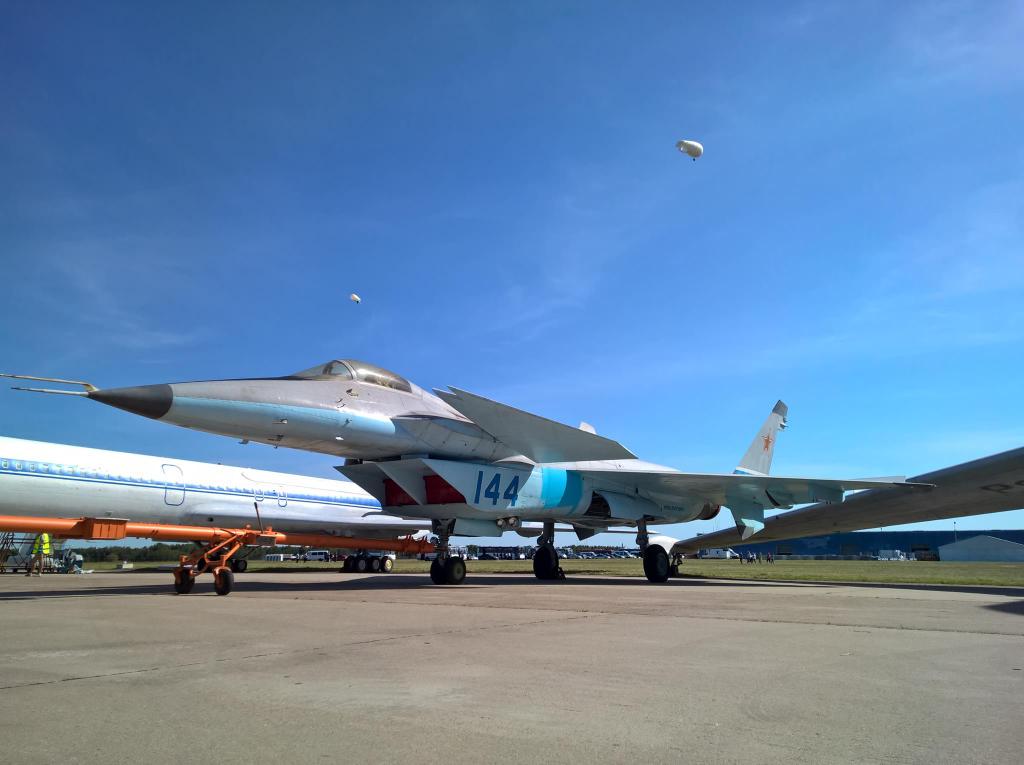
The Mikoyan MiG-LMFS (Lyogki Mnogofunkzionalny Frontovoi Samolyot = Lightweight Multirole Frontline Aircraft ), is an in-development Russian Multirole Aircraft, based on the MiG 1.44, after the failure of "Project R-33", the MiG-LMFS is the second try of Mikoyan-Gurevich ( newly RAC MiG ) to develop a replacement for the aging Mikoyan MiG-21 and Mikoyan MiG-23.

After the failure of the MiG 1.44 RAC MiG searched ways to use the new knowledge and technology otherwise. As Sukhoi was chosen to develop the heavy Air-Superiority Fighter PAK-FA, Mikoyan started to develop a new leightweight Multirole combat aircraft, the MiG-LMFS, which is also called "Project 1.27". Actually the MiG-LMFS is only a single engine stealth variant of the Mikoyan-Gurevich MiG 1.44. While the PAK-FA challenges the Lockheed Martin F-22 Raptor, the Mikoyan-LMFS is a direct competitor to the American F-35 Lightning II. Like on the MiG-1.44, Canards and tailless delta-wings will be used.
But at the beginning of 2011 RAC MiG published new concept designs of the LMFS, but this time, unlike on earlier designs, Diverterless Supersonic Inlets were included like they are on the F-35 Lightning II and the Chinese Chengdu J-20, and instead of Canards, conventional control surfaces are used.
RAC MiG is excepted to design the MiG-LMFS as a smaller and cheaper alternative to the heavy and expensive Sukhoi Fighters. Beacause of the MiG-23, MiG-21 and MiG-27, which are used in many countries and they must be replaced, the MiG-LMFS could be very successful on global market. The problem is that it is unknown if the Russian Air Force will want the LMFS, while it is impossible for Mikoyan to finance itself only with the MiG-29 and the MiG-35. But because the Sukhoi PAK-FA will have technical problems and will get more expensive, like the American F-22 Raptor, the LMFS, like the F-35 in the United States, could be very interesting for the Russian Air Force.

Comparable Aircraft

The performance of the LMFS is still unknown, but when looking on it´s design, it can be estimated against which aircraft it will compete and against which it will not:

China

Chengdu J-10 Vigorous Dragon

Sweden

JAS-39 Gripen

United States

F-35 Lightning II

MiG LMFS : Updates and discussion
The Russian Air Force made an unexpected shift in the priorities for its future fighter, stating that the service will back the simultaneous development of two programs for a fifth-generation aircraft. The PAK FA medium-weight fighter program, which has been underway since 2002, is joined by MiG's lighter-weight aircraft project. In addition to the goal of winning domestic orders, MiG's light multi-role fighter build on the company's earlier experience with its MiG 1.44 program, also may attract India as a co-developer and future customer.
In April 2002, the Russian military chose Sukhoi's T-50 proposal in the fifth-generation fighter contest — which was codenamed the Perspektivniy Aviatsionniy Kompleks Frontovoi Aviatsii (PAK FA), or future tactical aviation air system. Since 2002, Sukhoi has been regularly meeting the subsequent milestones in the new fighter's development, which led to the Russian Air Force's approval of the T-50's preliminary design. To date, Sukhoi has developed a computer mock-up of the aircraft and an operating mockup of the cockpit. The PAK FA prototype's maiden flight is expected in 2009.
Sukhoi's victory in the Russian Air Force competition resulted not only from the T-50's design characteristics. The choice was made with the consideration of the company's sizeable profits from the sales of the Su-27 family aircraft to China and India in the 1990s and early 2000s. At that time, Sukhoi fighters represented half of Russia's aircraft production, and nearly half of Russian military technology exports. During the 1990s, Sukhoi maintained the largest workload of all Russian design bureaus. Unlike other Russian aircraft designers, the company counted more on its own resources than on government subsidies.
The Sukhoi T-50's rival in 2002 was the MiG design, the exact designation of which is classified. Later, when MiG Corp. decided to continue this program, it received the codename Liogkiy Mnogofunktsionalniy Frontovoi Samolyot (LMFS) or Light Multi-role Tactical Aircraft. MiG Corp. did not accept defeat in the contest against Sukhoi, and criticized the decision-making procedure. According to MiG, several aspects were omitted during the evaluation, like the purchase cost for the Air Force, the aircraft's lifetime maintenance costs and the export possibilities of various versions during the next few decades. MiG insisted that instead of initial projects, the choice of a winner should have been made at the phase of prototype tests.

Looking for foreign partner
About a year ago, MiG's LMFS project came out of the shadows again due to a series of fortunate events. Some time ago, the Indian Defense Research and Development Organization (DRDO) and Aeronautical Development Agency (ADA) started analyzing the development options for a home-grown fifth-generation fighter, called the Medium Combat Aircraft (MCA), which was a twin-engine version of the its Light Combat Aircraft (LCA) Tejas fighter. After a bad experience with the LCA, India sought a partner in Russia for the MCA program.
The re-birth of MiG's LMFS project also was helped by the company's improved financial situation, resulting from several contracts for new versions of the MiG-29 that were signed in recent years. India ordered 16 MiG-29K/KUB ship-based fighters with the option for 30 more, Yemen purchased or upgraded 20 MiG-29SMT/UBT fighters, and Algeria ordered 34 MiG-29SMT/UBTs. New contracts for 32 fighters for Yemen and the upgrade of 66 aircraft in India are expected to be signed in the coming months. This will provide MiG with a portfolio of orders worth $4.5 billion.
Another event favorable for the LMFS program was the September 2004 nomination of Alexey Fedorov, the president of Russia's largest privately-held jet manufacturer — the Irkut Corporation — as the top manager at MiG. Fedorov is well known in India because in his previous role as Irkut's leader, he sold the Su-30MKI combat aircraft to India and was starting its license production there. Fedorov's contacts will certainly help the promotion of MiG-35 and LMFS fighters in India. In the coming months, Fedorov is to become the head of the OAK Corporation, which is a consolidation of Russia's aircraft industry. Therefore, it is expected that the LMFS program will be high on OAK's priority list.
A joint Russian-Indian fighter was discussed for the first time in June 2001. Later, during the visit of then-Indian Defense Minister George Fernandez to Moscow in January 2003, Russia and India signed a protocol declaring the intention to jointly develop a new-generation fighter. At the Sukhoi Design Bureau, Fernandez was shown the T-50 project. The trip of Indian Defense Minister Pranab Mukherjee to Moscow in November 2005 (where he visited both MiG and Sukhoi) was crucial for the Indian-Russian contacts about the new generation fighter. The minister stated that India is not intending to be only a source of money for the project. "Our air force and industry are willing to participate in all stages of the new fighter's creation, starting with the conception, and continuing through the design and research to common production," he said. Mukherjee did not name specific companies and designs, but the phrase above distinctly refers to the MiG fighter, as Sukhoi's design is already complete and the documentation for prototype aircraft manufacture is nearly ready. Moreover, the Sukhoi aircraft is being developed in accordance with the Russian Air Force requirements and does not meet the needs of India. However, Russia is still pressing India to join the Sukhoi PAK FA program. In early August 2006, a Sukhoi delegation was again in India, and presented their project to the Ministry of Defense.


LMFS is different
A great advantage of the MiG project is the fact that its design and technical parameters are significantly different from the Sukhoi T-50. As a result, the market does not have to choose between an "either-or" situation, and both aircraft can find their place, depending upon the needs of potential export clients. The MiG proposal is for a "right-sized" aircraft that would be in the realistic price range for most foreign buyers, as best described by the frequently-quoted phrase of Mikoyan Design Bureau Director Vladimir Barkovskiy: "smaller and simpler aircraft would be inferior to its competitors, but larger and more sophisticated would be too expensive." In 2002, the then-CEO of MiG Corp. Nikolay Nikitin stated that an outlay of $1.3 billion per year between 2010-2025 would be enough to cover a Russian Air Force purchase and operation of a necessary number of MiG-designed aircraft, while a heavier Sukhoi aircraft would cost $2 billion per year. MiG also estimates the export potential of its lighter-weight fighter as 3-4.5 times higher than the Sukhoi fighter.
At the moment, one thing is certain: the LMFS will be about 30% lighter than the T-50. According to approximate assessments, the T-50 will have a normal take-off weight of 21 tons, which places it between present MiG-29 and Su-27 fighters — whereas the LMFS is likely to weigh 15 tons. Most probably, the LMFS will retain the delta canard configuration of the heavy MiG 1.44 prototype. Being asked directly about the new fighter configuration, Barkovskiy answered indirectly: "It would be illogical if we reject the experience we accumulated while developing that project [MiG 1.44]." He also mentioned that "the number of wind tunnel tests [of the 1.44 models] was vast, setting a new record in Russia. [So] we are making use of these materials and transforming them into the fifth generation aircraft."
It is not known at the moment whether the new MiG fighter will be powered by one or two engines. Originally, the company's design had two Klimov VK-10 turbofans rated at about 10.5 tons each, which are a further development of the MiG-29's RD-33 engines. In this configuration, the aircraft entered the Russian fighter contest in 2002 and was presented to India in 2005. In addition to their application on MiG's new aircraft, the VK-10 engines also could be used to extend the MiG-29's life in its new MiG-35 version. Moreover, the RD-33/VK-10's manufacturer, the Klimov Company, has become a part of MiG Corporation's engine division, and it is obviously easier for MiG to cooperate with Klimov than with other engine manufacturers.
Developing a single-engine design for MiG's fifth-generation fighter has become a more frequently discussed issue. Such an option was backed Russian Air Force Commander Gen. Mikhailov last January, while similar opinions have come from India as well. If the customers insist on a single-engine design, the use of a version of the AL-41 engine (to be installed on the T-50) with a thrust increase to about 20 tons is possible. Such a solution is cheaper, although it requires the engine to be mature at its entry into service and reach a high level of reliability first.
the Phazotron-NIIR institute will present the first Russian fighter radar with an active electronic scanning antenna (AESA): the Zhuk-MAE, which was developed for the MiG-35. Two prototypes of the radar were under assembly in the autumn of 2006. The fifth-generation LMFS fighter will certainly be fitted with a development of this radar. The cooperative links between MiG Corp. and Phazotron-NIIR were strengthened at the beginning of 2006 when a group of MiG's top managers purchased a controlling stake of Phazotron. In May 2006, Mikhail Korzhuyev became the director general of Phazotron, while Sergei Tsivilev, the MiG Corp's First Deputy CEO, was elected the chairman of Phazotron's board.

One or two fifth generation fighters?
The possibility of India's participation in the LMFS project generated new interest in this program from the Russian Air Force. Shortly after the Moscow visit of Indian Defense Minister Mukherjee last January, Russian Air Force Gen. Vladimir Mikhailov declared that "two fifth generation fighters, a medium one and a light one, are being developed" in Russia. The medium fighter will be Sukhoi's PAK FA chosen in 2002, while the light next generation fighter was described by the Russian Air Force Commander as a single engine MiG aircraft with the same engine, avionics and armament as the PAK FA.
It is understandable that Gen. Mikhailov's declaration caused anxiety at Sukhoi. A few days later, the head of Sukhoi Holding, Mikhail Pogosyan, said "there is no technology in Russia to develop a light fighter," clearly indicating that — in his opinion — only Sukhoi's PAK FA can be the fifth generation fighter. Moreover, he added that the PAK FA is not a heavy fighter, as "it is considerably smaller than the F-22A, Su-47 or MiG 1.44." According to Pogosyan, "any discussions about Russian heavy and light fifth generation fighters are pointless."
 http://www.the-blueprints.com/blueprints-depot-restricted/modernplanes/mikoyan-gurevich-mig/mikoyan_gurevich_mig_1_42_mfi-18480.jpg

 http://media.moddb.com/images/groups/1/3/2044/86731644.jpg

 http://www.militaryfactory.com/aircraft/imgs/mikoyangurevich-mig144-flatpack_2.jpg

 http://www.janes.com/images/assets/279/32279/New_Russian_fighter_-_main.jpg

 http://www.defensasur.com.ar/imagenes/noticias/2013/DIC/291213_Mig%201-44b.jpg

 http://www.airart3d.com/wp-content/gallery/mikoyan-1-44/1-44_3.jpg

 http://www.mycity-military.com/thumbs2/139317_tmb_325208878_mikoyanlfifr0.jpg

 http://jpcolliat.free.fr/mig144/images/mig142t.jpg

 http://i.ytimg.com/vi/nLxuUnAlNWk/maxresdefault.jpg

 http://www.military-today.com/aircraft/mikoyan_mig_mfi.jpg

 http://vignette2.wikia.nocookie.net/aircraft/images/b/bf/I42-001-1-.jpg/revision/latest?cb=20120320193128

http://img4.imageshack.us/img4/1410/mikoyanlmfs.jpg

http://www.aereo.jor.br/wp-content/uploads/2011/01/Mikoyan-LMFS-2.png


http://www.defensasur.com.ar/imagenes/noticias/2012/MAR/220312_LMFS.jpg


https://blogger.googleusercontent.com/img/b/R29vZ2xl/AVvXsEgsK4PtCttQb6H0HuBVl8WGKt-o4ybPCZHABEjPnScMWggYJddy19esMSwwLnRuKIn38yFKQfleJo3WxXFnXVkSIUMP-91KygRIEoxsq4jwqXjkJOLxa2397LSZGd0TezlXoNkAySEAuPpD/s1600/mikoyan+1.44_1.jpg

http://media.moddb.com/images/downloads/1/65/64467/descarga.jpg

http://upload.wikimedia.org/wikipedia/commons/d/dd/Medium_combat_aircraft.jpg


http://i215.photobucket.com/albums/cc316/Novgorodsfleet/data%20transfer/MiG-33_bmp.jpg

http://hushkit.files.wordpress.com/2012/12/gd-mig-2000-1.jpg

http://hushkit.files.wordpress.com/2012/12/gd-mig-2000-22.jpg

ValueWalk

Russia Developing Yet Another Fifth Generation Fighter Jet

Turns out, the dreaded Sukhoi T-50 PAK FA is not the only fifth-generation fighter jet under development by Russia. The PAK FA is expected to enter services in 2017. But the Russian Aircraft Corporation MiG is developing yet another cutting-edge lightweight fifth generation fight jet. The new lightweight fighter jet will be based on Mikoyan Project 1.44 (NATO reporting name: Flatpack), reports Sputnik News.

Russia Fifth Generation Fighter Jet

Russia's new fifth generation jet to replace MiG-29

The Mikoyan Project 1.44 was meant to develop an alternative to the Advanced Tactical Fighter (ATF) project of the United States that led to the development of Lockheed Martin Corporation (NYSE:LMT) F-22 Raptor. The aircraft made its first flight in 2000. It boasted of stealth technology, advanced avionics, super-cruise, and super-maneuverability. However, Russia shut down the project over a decade ago.
On Tuesday, MiG CEO Sergei Korotkov said that the company will use the experience gained from the Project 1.44 to develop the new fifth-generation fighter jet. He added that the new plane will also use some of the technology developed for MiG-35 (Fulcrum-F) air superiority fighter. The new fifth-generation jet is supposed to replace the ageing MiG-29, which was first introduced in 1983.

Embedded image permalink

Russian Air Force to get the first batch of PAK FA in 2017

However, it may take years before this lightweight jet is inducted into the Russian Air Force. Meanwhile, the first batch of Sukhoi T-50 PAK FA will join the Air Force in late 2016 or early 2017. PAK FA is a multi-role, twin-engine, single-seat, air superiority fighter with stealth capabilities. It is expected to have a service life of up to 35 years. It boasts of new avionics package that provides intelligent support and superior automatic control.
According to Sputnik News, the PAK FA is outfitted with a unique digital weapon guidance system with "fire-and-forget" capabilities. This technology allows the jet to lock on a target and hit it when it is no longer in the line-of-sight. It also features an improved technology to locate and track targets.
Russia is modernizing its military under a massive $400 billion program as tensions with the West continue to escalate.