Project Icarus: Specific Power for Interstellar Missions Using Inertial Confinement Fusion Propulsion
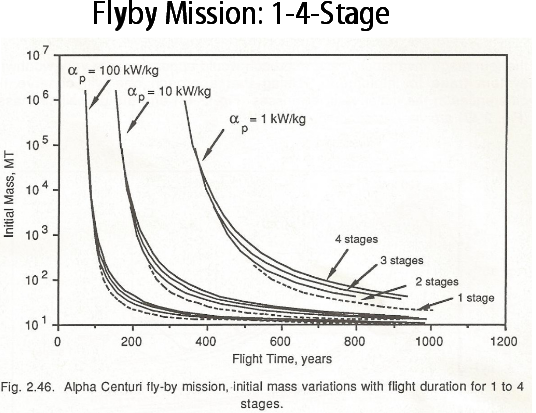
Current chemical energy systems yield low specific energy which lead to
energy conversion systems with a low performance design, less than 10
km/s.
Higher specific power drastically shortens mission times.
Interstellar travel
From Wikipedia, the free encyclopedia
Interstellar space travel is manned or unmanned
travel between
stars. Interstellar travel is conceptually much more difficult than
interplanetary travel: the distance between the
planets in the Solar System is typically measured in standard
astronomical units (AU) — while the distance between the stars is typically hundreds of thousands of AU, and usually expressed in
light years.
This means that some combination of huge travel time (lasting from
years to millennia) and great speed (some percentage of the
speed of light) would be required. These speeds are far beyond what current methods of
spacecraft propulsion can provide.
A variety of concepts have been discussed in the literature, since the first astronautical pioneers (such as
Konstantin Tsiolkovsky,
Robert Esnault-Pelterie and
Robert Hutchings Goddard).
Given sufficient travel time and engineering work, both unmanned and
manned interstellar travel require no break-through physics to be
achieved, but considerable technological and economic challenges need to
be met.
NASA,
ESA
and other space agencies have been engaging in research into these
topics for decades, and have accumulated a number of theoretical
approaches.
(
Intergalactic travel, or travel between different galaxies, would be even more difficult.) The concept of interstellar travel via
starships is a staple of
science fiction.
Challenges
Interstellar distances
The main challenge facing interstellar travel is the immense distances between the stars.
Astronomical distances are often measured in the time it would take a beam of
light to travel between two points (
see light-year). Light in a vacuum travels approximately 300,000 kilometers per second or 186,000 miles per second.
The distance from
Earth to the Moon is 1.3
light-seconds.
With current spacecraft propulsion technologies, a craft can cover the
distance from the Earth to the Moon in around eight hours (
New Horizons).
That means light travels approximately thirty thousand times faster
than current spacecraft propulsion technologies. The distance from Earth
to other planets in the Solar System ranges from three light-minutes to
about four light-hours. Depending on the planet and its alignment to
Earth, for a typical unmanned spacecraft these trips will take from a
few months to a little over a decade.
[citation needed]
The nearest known star to the
Sun is currently
Proxima Centauri, which is 4.23 light-years away. (However, there may be undiscovered
brown dwarf systems that are closer.
[1]) The fastest outward-bound spacecraft yet sent,
Voyager 1,
has covered 1/600th of a light-year in 30 years and is currently moving
at 1/18,000th the speed of light. At this rate, a journey to Proxima
Centauri would take 80,000 years.
[2] On such timescales, motion of the stars would become relevant; for example, in about 31,000 years the star
Ross 248 would start to become closest to us and by 36,000 years would be as close as 3.02 light years.
[citation needed]
A better understanding of the vastness of the interstellar distance
to one of the closest stars to the sun, Alpha Centauri A (a Sun-like
star), can be obtained by scaling down the
Earth-Sun distance
(~150,000,000 km) to one meter (~3.3 ft). On this scale the distance to
Alpha Centauri A would still be 271 kilometers or about 169 miles.
This means some combination of great speed and long travel time are required. The time required by
propulsion methods based on currently known physical principles would require
years to
millennia.
Required energy
A significant factor contributing to the difficulty is the energy
which must be supplied to obtain a reasonable travel time. A lower bound
for the required energy is the
kinetic energy K = ½ mv
2 where m is the final mass. If
deceleration
on arrival is desired and cannot be achieved by any means other than
the engines of the ship, then the required energy at least doubles,
because the energy needed to halt the ship equals the energy needed to
accelerate it to travel speed.
The velocity for a manned round trip of a few decades to even the
nearest star is several thousand times greater than those of present
space vehicles. This means that due to the v
2 term in the
kinetic energy formula, millions of times as much energy is required.
Accelerating one ton to one-tenth of the speed of light requires at
least 450 PJ or 4.5
×10
17 J
or 125 billion kWh, without factoring in efficiency of the propulsion
mechanism. This energy has to be generated on-board from stored fuel,
harvested from the interstellar medium, or projected over immense
distances.
The energy requirements make interstellar travel very difficult. It
has been reported that at the 2008 Joint Propulsion Conference, multiple
experts opined that it was improbable that humans would ever explore
beyond the Solar System.
[3]
Brice N. Cassenti, an associate professor with the Department of
Engineering and Science at Rensselaer Polytechnic Institute, stated at
least the total energy output of the entire world [in a given year]
would be required to send a probe to the nearest star.
[3]
The habitual illumination energy requirement for each person is estimated to be 12 kilowatts (12,139.7
Watt).
[4][5] Other long-term energy requirements are still being investigated.
[6]
Interstellar medium
A major issue with traveling at extremely high speeds is that
interstellar dust and gas
may cause considerable damage to the craft, due to the high relative
speeds and large kinetic energies involved. Various shielding methods to
mitigate this problem have been proposed.
[7]
Larger objects (such as macroscopic dust grains) are far less common,
but would be much more destructive. The risks of impacting such objects,
and methods of mitigating these risks, have been discussed in the
literature, but many unknowns remain.
[8]
Virtually all the material that would pose a problem is in our solar
system along the disk that contains the planets, asteroid belt, Oort
cloud, comets, free asteroids, macro and micro-meteroids, etc. so any
device or projectile must be sent in a direction opposite of all of this
material. The larger the object humans send, the greater the chances of
it hitting something. One option is to project something very small
where the chance of it striking something is virtually non-existent in
the vacuum of interplanetary and interstellar space.
[9][10]
Travel time
It has been argued that an interstellar mission which cannot be
completed within 50 years should not be started at all. Instead,
assuming that a civilization is still on an increasing curve of
propulsion system velocity, not yet having reached the limit, the
resources should be invested in designing a better propulsion system.
This is because a slow spacecraft would probably be passed by another
mission sent later with more advanced propulsion (Incessant Obsolescence
Postulate).
[11]
On the other hand, Andrew Kennedy has shown that if one calculates the
journey time to a given destination as the rate of travel speed derived
from growth (even exponential growth) increases, there is a clear
minimum in the total time to that destination from now (see
wait calculation).
[12]
Voyages undertaken before the minimum will be overtaken by those who
leave at the minimum, while those who leave after the minimum will never
overtake those who left at the minimum.
One argument against the stance of delaying a start until reaching
fast propulsion system velocity is that the various other non-technical
problems that are specific to long-distance travel at considerably
higher speed (such as interstellar particle impact, possible dramatic
shortening of average human life span during extended space residence,
etc.) may remain obstacles that take much longer time to resolve than
the propulsion issue alone, assuming that they can even be solved
eventually at all. A case can therefore be made for starting a mission
without delay, based on the concept of an achievable and dedicated but
relatively slow interstellar mission using the current technological
state-of-the-art and at relatively low cost, rather than banking on
being able to solve all problems associated with a faster mission
without having a reliable time frame for achievability of such.
The travel time could be reduced to a millennium using
solar sails, or to a century or less using
nuclear pulse propulsion.
An interstellar ship would face manifold hazards found in
interplanetary travel, including
vacuum,
radiation,
weightlessness, and
micrometeoroids.
Even the minimum multi-year travel times to the nearest stars are
beyond current manned space mission design experience. The fundamental
limits of
spacetime present another challenge. The distances between stars isn't a problem in and of itself.
However, more speculative approaches to interstellar travel offer the possibility of circumventing these difficulties.
Special relativity offers the possibility of shortening the travel time: if a starship with sufficiently advanced engines could reach
velocities approaching the speed of light, relativistic
time dilation
would make the voyage much shorter for the traveler. However, it would
still take many years of elapsed time as viewed by the people remaining
on Earth, and upon returning to Earth, the travelers would find that far
more time had elapsed on Earth than had for them. (For more on this
effect, see
twin paradox.)
General relativity
offers the theoretical possibility that faster-than-light travel may be
possible without violating fundamental laws of physics, for example,
through
wormholes, although it is still debated whether this is possible, in part, because of
causality concerns. Proposed mechanisms for
faster-than-light travel within the theory of general relativity require the existence of
exotic matter.
Communications
The
round-trip delay time
is the minimum time between an observation by the probe and the moment
the probe can receive instructions from Earth reacting to the
observation. Given that information can travel no faster than the
speed of light, this is for the
Voyager 1
about 17 hours, and near Proxima Centauri it would be 8 years. Faster
reaction would have to be programmed to be carried out automatically. Of
course, in the case of a manned flight the crew can respond immediately
to their observations. However, the round-trip delay time makes them
not only extremely distant from, but, in terms of
communication,
also extremely isolated from Earth (analogous to how past long distance
explorers were similarly isolated before the invention of the
electrical telegraph).
Interstellar communication is still problematic — even if a probe
could reach the nearest star, its ability to communicate back to Earth
would be difficult given the extreme distance. See
Interstellar communication.
Manned missions
The mass of any craft capable of carrying humans would inevitably be substantially larger than that necessary for an unmanned
interstellar probe. For instance, the first space probe,
Sputnik 1, had a payload of 83.6 kg, while spacecraft to carry a living passenger (
Laika the dog),
Sputnik 2,
had a payload six times that at 508.3 kg. This underestimates the
difference in the case of interstellar missions, given the vastly
greater travel times involved and the resulting necessity of a
closed-cycle life support system.
As technology continues to advance, combined with the aggregate risks
and support requirements of manned interstellar travel, the first
interstellar missions are unlikely to carry earthly life forms.
A manned craft will require more time to reach its top speed as humans have limited
tolerance to
acceleration.
Time dilation
Main article:
Time dilation
Assuming one can not travel faster than light, one might conclude
that a human can never make a round-trip further from the Earth than 40
light years if the traveler is active between the ages of 20 and 60. So a
traveler would never be able to reach more than the very few star
systems which exist within the limit of 10–20 light years from the
Earth.
But that would be a mistaken conclusion because it fails to take into account
time dilation.
Informally explained, clocks aboard ship run slower than Earth clocks,
so if the ship engines are powerful enough the ship can reach mostly
anywhere in the galaxy and go back to Earth within 40 years ship-time.
The problem is that there is a difference between the time elapsed in
the astronaut's ship and the time elapsed on Earth.
An example will make this clearer. Suppose a spaceship travels to a
star 32 light years away. First it accelerates at a constant 1.03g
(i.e., 10.1 m/s
2) for 1.32 years (ship time). Then it stops
the engines and coasts for the next 17.3 years (ship time) at a constant
speed. Then it decelerates again for 1.32 ship-years so as to come at a
stop at the destination. The astronaut takes a look around and comes
back to Earth the same way.
After the full round-trip, the clocks on board the ship show that 40
years have passed, but according to Earth calendar the ship comes back
76 years after launch.
So, the overall average speed is 0.84 lightyears per earth year, or
1.6 lightyears per ship year. This is possible because at a speed of
0.87 c, time on board the ship seems to run slower. Every two Earth
years, ship clocks advance 1 year.
From the viewpoint of the astronaut, onboard clocks seem to be
running normally. The star ahead seems to be approaching at a speed of
0.87 lightyears per ship year. As all the universe looks contracted
along the direction of travel to half the size it had when the ship was
at rest, the distance between that star and the Sun seems to be 16 light
years as measured by the astronaut, so it's no wonder that the trip at
0.87 ly per shipyear takes 20 ship years.
At higher speeds, the time onboard will run even slower, so the astronaut could travel to the center of the
Milky Way
(30 kly from Earth) and back in 40 years ship-time. But the speed
according to Earth clocks will always be less than 1 lightyear per Earth
year, so, when back home, the astronaut will find that 60 thousand
years will have passed on Earth.
Constant acceleration
Regardless of how it is achieved, if a propulsion system can produce 1
g of acceleration continuously from departure to destination, then this
will be the fastest method of travel. If the propulsion system drives
the ship faster and faster for the first half of the journey, then turns
around and brakes the craft so that it arrives at the destination at a
standstill, this is a constant acceleration journey. This would also
have the advantage of producing constant gravity.
From the planetary observer perspective the ship will appear to
steadily accelerate but more slowly as it approaches the speed of light.
The ship will be close to the speed of light after about a year of
accelerating and remain at that speed until it brakes for the end of the
journey.
From the ship perspective there will be no top limit on speed – the
ship keeps going faster and faster the whole first half. This happens
because the ship's time sense slows down – relative to the planetary
observer – the more it approaches the speed of light.
The result is an impressively fast journey if you are in the ship.
Here is a table of journey times, in years, for various constant
accelerations.
Note again, that times observed from the planetary frame of reference
(which applies to both departure and destination points) are very
different from those observed in the space craft, and that from the ship
frame of reference there is no limit on the top speed.
[14]
Prime targets for interstellar travel
There are 59 known stellar systems within 20 light years from the
Sun, containing 81 visible stars. The following could be considered
prime targets for interstellar missions:
[15]
Proposed methods
Slow missions
Potential slow manned interstellar travel missions, based on current
and near-future propulsion technologies are associated with trip times,
starting from about one hundred years to thousands of years. The
duration of a slow interstellar journey presents a major obstacle and
existing concepts deal with this problem in different ways.
[20] They can be distinguished by the "state" in which humans are transported on-board of the spacecraft.
Generation ships
A
generation ship (or
world ship) is a type of
interstellar ark
in which the crew that arrives at the destination is descended from
those who started the journey. Generation ships are not currently
feasible because of the difficulty of constructing a ship of the
enormous required scale and the great biological and sociological
problems that life aboard such a ship raises.
[21][22][23][24]
Suspended animation
Scientists and writers have postulated various techniques for
suspended animation. These include human
hibernation and
cryonic preservation. While neither is currently practical, they offer the possibility of
sleeper ships in which the passengers lie inert for the long years of the voyage.
[25]
Extended human lifespan
A variant on this possibility is based on the development of substantial human life extension, such as the "
Strategies for Engineered Negligible Senescence" proposed by
Dr. Aubrey de Grey.
If a ship crew had lifespans of some thousands of years, or had
artificial bodies, they could traverse interstellar distances without
the need to replace the crew in generations. The psychological effects
of such an extended period of travel would potentially still pose a
problem.
Frozen embryos
A
robotic space mission carrying some number of frozen early stage human
embryos is another theoretical possibility. This method of
space colonization requires, among other things, the development of a method to replicate conditions in a
uterus, the prior detection of a habitable
terrestrial planet, and advances in the field of fully autonomous
mobile robots and educational robots which would replace human parents.
[26]
Mind uploading
A more speculative method of transporting humans to the stars is by using
mind uploading or also called brain emulation.
[27][28] Frank J. Tipler speculates about the colonization of the universe by starships transporting uploaded humans.
[29]
Hein presents a range of concepts how such missions could be conducted,
using more or less speculative technologies, for example
self-replicating machines,
wormholes, and
teleportation.
[27] One of the major challenges besides
mind uploading itself are the means for downloading the uploads into physical entities, which can be biological or artficial or both.
Island hopping through interstellar space
Interstellar space is not completely empty; it contains trillions of icy bodies ranging from small asteroids (
Oort cloud) to possible
rogue planets.
There may be ways to take advantage of these resources for a good part
of an interstellar trip, slowly hopping from body to body or setting up
waystations along the way.
[30]
Fast missions
If a spaceship could average 10 percent of light speed (and
decelerate at the destination, for manned missions), this would be
enough to reach
Proxima Centauri
in forty years. Several propulsion concepts are proposed that might be
eventually developed to accomplish this (see section below on propulsion
methods), but none of them are ready for near-term (few decades)
development at acceptable cost.
[citation needed]
Unmanned
Nanoprobes
Near-lightspeed nanospacecraft might be possible within the near
future built on existing microchip technology with a newly developed
nanoscale thruster. Researchers at the University of Michigan are
developing thrusters that use nanoparticles as propellant. Their
technology is called “nanoparticle field extraction thruster”, or
nanoFET. These devices act like small particle accelerators shooting conductive nanoparticles out into space.
[31]
Given the light weight of these probes, it would take much less
energy to accelerate them. With on board solar cells they could
continually accelerate using solar power. One can envision a day when a
fleet of millions or even billions of these particles swarm to distant
stars at nearly the speed of light, while relaying signals back to earth
through a vast interstellar communication network.
By transmission
Main article:
Teleportation
If physical entities could be transmitted as information and
reconstructed at a destination, travel at nearly the speed of light
would be possible, which for the "travelers" would be instantaneous.
However, sending an atom-by-atom description of (say) a human body would
be a daunting task. Extracting and sending only a
computer brain simulation
is a significant part of that problem. "Journey" time would be the
light-travel time plus the time needed to encode, send and reconstruct
the whole transmission.
[32]
Propulsion
Rocket concepts
All rocket concepts are limited by the
rocket equation, which sets the characteristic velocity available as a function of exhaust velocity and mass ratio, the ratio of initial (
M0, including fuel) to final (
M1, fuel depleted) mass.
Very high
specific power, the ratio of
jet-power to total vehicle mass, is required to reach interstellar targets within sub-century time-frames.
[33] Some heat transfer is inevitable and a tremendous heating load must be adequately handled.
Thus, for interstellar rocket concepts of all technologies, a key
engineering problem (seldom explicitly discussed) is limiting the heat
transfer from the exhaust stream back into the vehicle.
[34]
Nuclear fission powered
Fission-electric
Nuclear-electric or plasma engines, operating for long periods at low
thrust and powered by fission reactors, have the potential to reach
speeds much greater than chemically powered vehicles or nuclear-thermal
rockets. Such vehicles probably have the potential to power Solar System
exploration with reasonable trip times within the current century.
Because of their low-thrust propulsion, they would be limited to
off-planet, deep-space operation.
Electrically powered spacecraft propulsion powered by a portable power-source, say a
nuclear reactor, producing only small accelerations, would take centuries to reach for example 15% of the
velocity of light, thus unsuitable for interstellar flight during a single human lifetime.
[35][36][37]
Fission-fragment
Fission-fragment rockets use
nuclear fission
to create high-speed jets of fission fragments, which are ejected at
speeds of up to 12,000 km/s. With fission, the energy output is
approximately 0.1% of the total mass-energy of the reactor fuel and
limits the effective exhaust velocity to about 5% of the velocity of
light. For maximum velocity, the reaction mass should optimally consist
of fission products, the "ash" of the primary energy source, in order
that no extra reaction mass need be book-kept in the mass ratio. This is
known as a
fission-fragment rocket.
thermal-propulsion engines such as
NERVA
produce sufficient thrust, but can only achieve relatively low-velocity
exhaust jets, so to accelerate to the desired speed would require an
enormous amount of fuel.
[35][36][37]
Nuclear pulse
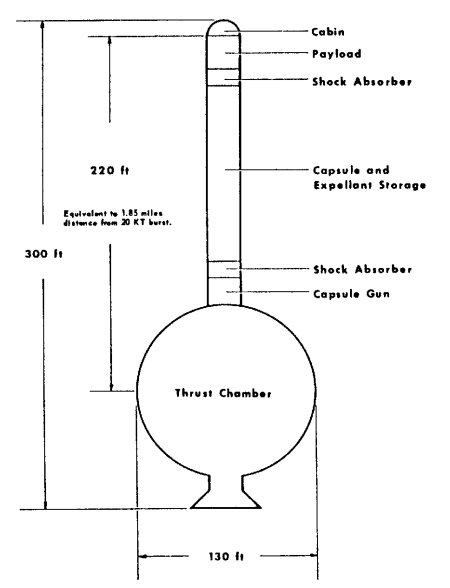
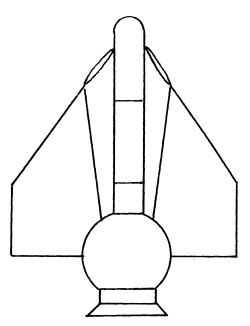
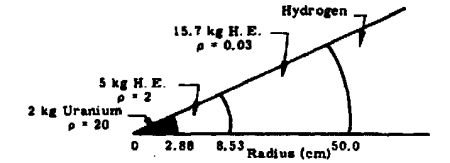
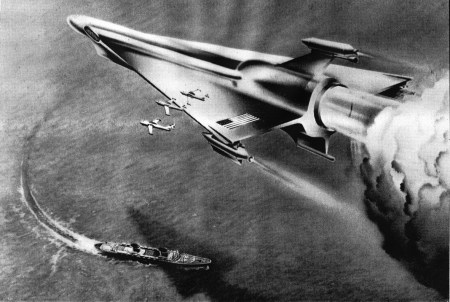
Based on work in the late 1950s to the early 1960s, it has been technically possible to build spaceships with
nuclear pulse propulsion engines, i.e. driven by a series of nuclear explosions. This propulsion system contains the prospect of very high
specific impulse (space travel's equivalent of fuel economy) and high
specific power.
[38]
Project Orion team member,
Freeman Dyson, proposed in 1968 an interstellar spacecraft using nuclear pulse propulsion which used pure
deuterium fusion detonations with a very high fuel-
burnup fraction. He computed an exhaust velocity of 15,000 km/s and a 100,000 tonne space-vehicle able to achieve a 20,000 km/s
delta-v allowing a flight-time to
Alpha Centauri of 130 years.
[39]
Later studies indicate that the top cruise velocity that can
theoretically be achieved by a Teller-Ulam thermonuclear unit powered
Orion starship, assuming no fuel is saved for slowing back down, is
about 8% to 10% of the speed of light (0.08-0.1c).
[40]
An atomic (fission) Orion can achieve perhaps 3%-5% of the speed of
light. A nuclear pulse drive starship powered by Fusion-antimatter
catalyzed nuclear pulse propulsion units would be similarly in the 10%
range and pure Matter-antimatter annihilation rockets would be
theoretically capable of obtaining a velocity between 50% to 80% of the
speed of light. In each case saving fuel for slowing down halves the
max. speed. The concept of using a magnetic sail to decelerate the
spacecraft as it approaches its destination has been discussed as an
alternative to using propellant, this would allow the ship to travel
near the maximum theoretical velocity.
[41] Alternative designs utilizing similar principles include
Project Longshot,
Project Daedalus, and
Mini-Mag Orion.
The principle of external nuclear pulse propulsion to maximize
survivable power has remained common among serious concepts for
interstellar flight without external power beaming and for very
high-performance interplanetary flight.
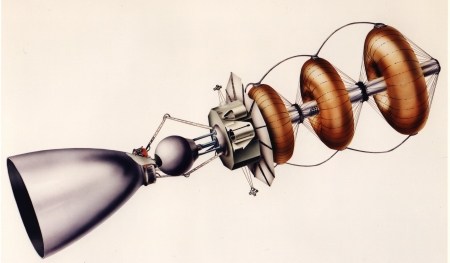
In the 1970s the Nuclear Pulse Propulsion concept further was refined by
Project Daedalus by use of externally triggered
inertial confinement fusion, in this case producing fusion explosions via compressing fusion fuel pellets with high-powered electron beams. Since then
lasers,
ion beams,
neutral particle beams and hyper-kinetic projectiles have been suggested to produce nuclear pulses for propulsion purposes.
[42]
A current impediment to the development of
any nuclear explosive powered spacecraft is the
1963 Partial Test Ban Treaty
which includes a prohibition on the detonation of any nuclear devices
(even non-weapon based) in outer space. This treaty would therefore need
to be re-negotiated, although a project on the scale of an interstellar
mission using currently foreseeable technology would probably require
international co-operation on at least the scale of the
International Space Station.
Nuclear fusion rockets
Fusion rocket starships, powered by
nuclear fusion
reactions, should conceivably be able to reach speeds of the order of
10% of that of light, based on energy considerations alone. In theory, a
large number of stages could push a vehicle arbitrarily close to the
speed of light.
[43] These would "burn" such light element fuels as deuterium, tritium,
3He,
11B, and
7Li.
Because fusion yields about 0.3–0.9% of the mass of the nuclear fuel as
released energy, it is energetically more favorable than fission, which
releases <0.1% of the fuel's mass-energy. The maximum exhaust
velocities potentially energetically available are correspondingly
higher than for fission, typically 4–10% of c. However, the most easily
achievable fusion reactions release a large fraction of their energy as
high-energy neutrons, which are a significant source of energy loss.
Thus, while these concepts seem to offer the best (nearest-term)
prospects for travel to the nearest stars within a (long) human
lifetime, they still involve massive technological and engineering
difficulties, which may turn out to be intractable for decades or
centuries.
Early studies include
Project Daedalus, performed by the
British Interplanetary Society in 1973–1978, and
Project Longshot, a student project sponsored by NASA and the
US Naval Academy, completed in 1988. Another fairly detailed vehicle system, "Discovery II",
[44] designed and optimized for crewed Solar System exploration, based on the D
3He reaction but using hydrogen as reaction mass, has been described by a team from NASA's
Glenn Research Center. It achieves characteristic velocities of >300 km/s with an acceleration of ~1.7•10
−3 g,
with a ship initial mass of ~1700 metric tons, and payload fraction
above 10%. While these are still far short of the requirements for
interstellar travel on human timescales, the study seems to represent a
reasonable benchmark towards what may be approachable within several
decades, which is not impossibly beyond the current state-of-the-art.
Based on the concept's 2.2%
burnup fraction it could achieve a pure fusion product exhaust velocity of ~3,000 km/s.
Antimatter rockets
An
antimatter rocket
would have a far higher energy density and specific impulse than any
other proposed class of rocket. If energy resources and efficient
production methods are found to make
antimatter
in the quantities required and store it safely, it would be
theoretically possible to reach speeds approaching that of light. Then
relativistic
time dilation
would become more noticeable, thus making time pass at a slower rate
for the travelers as perceived by an outside observer, reducing the trip
time experienced by human travelers.
Supposing the production and storage of antimatter should become
practical, two further problems would present and need to be solved.
First, in the annihilation of antimatter, much of the energy is lost in
very penetrating high-energy gamma radiation, and especially also in
neutrinos, so that substantially less than
mc2 would
actually be available if the antimatter were simply allowed to
annihilate into radiations thermally. Even so, the energy available for
propulsion would probably be substantially higher than the ~1% of
mc2 yield of nuclear fusion, the next-best rival candidate.
Second, once again heat transfer from exhaust to vehicle seems likely
to deposit enormous wasted energy into the ship, considering the large
fraction of the energy that goes into penetrating gamma rays. Even
assuming biological shielding were provided to protect the passengers,
some of the energy would inevitably heat the vehicle, and may thereby
prove limiting. This requires consideration for serious proposals if
useful accelerations are to be achieved, as the energies involved (e.g.,
for 0.1
g ship acceleration, approaching 0.3 trillion watts per ton of ship mass) are very large.
Rockets with external energy sources
Rockets deriving their power from external sources, such as a
laser,
could bypass the ordinary rocket equation, potentially reducing the
mass of the ship greatly and allowing much higher travel speeds.
Geoffrey A. Landis has proposed for an
interstellar probe, with energy supplied by an external laser from a base station powering an
Ion thruster.
[45]
Non-rocket concepts
A problem with all traditional rocket propulsion methods is that the
spacecraft would need to carry its fuel with it, thus making it very
massive, in accordance with the
rocket equation. Some concepts attempt to escape from this problem (
[46]):
Interstellar ramjets
In 1960,
Robert W. Bussard proposed the
Bussard ramjet, a fusion rocket in which a huge scoop would collect the diffuse hydrogen in interstellar space, "burn" it on the fly using a
proton–proton fusion
reaction, and expel it out of the back. Though later calculations with
more accurate estimates suggest that the thrust generated would be less
than the drag caused by any conceivable scoop design, the idea is
attractive because, as the fuel would be collected
en route (commensurate with the concept of
energy harvesting), the craft could theoretically accelerate to near the speed of light.
Beamed propulsion
A
light sail or
magnetic sail powered by a massive
laser
or particle accelerator in the home star system could potentially reach
even greater speeds than rocket- or pulse propulsion methods, because
it would not need to carry its own
reaction mass and therefore would only need to accelerate the craft's
payload.
Robert L. Forward
proposed a means for decelerating an interstellar light sail in the
destination star system without requiring a laser array to be present in
that system. In this scheme, a smaller secondary sail is deployed to
the rear of the spacecraft, while the large primary sail is detached
from the craft to keep moving forward on its own. Light is reflected
from the large primary sail to the secondary sail, which is used to
decelerate the secondary sail and the spacecraft payload.
[48]
A
magnetic sail
could also decelerate at its destination without depending on carried
fuel or a driving beam in the destination system, by interacting with
the plasma found in the solar wind of the destination star and the
interstellar medium.
[49]
Unlike Forward's light sail scheme, this would not require the action
of the particle beam used for launching the craft. Alternatively, a
magnetic sail could be pushed by a particle beam
[50] or a plasma beam
[51] to reach high velocity, as proposed by
Landis and
Winglee.
Beamed propulsion
seems to be the best interstellar travel technique presently available,
since it uses known physics and known technology that is being
developed for other purposes,
[15] and would be considerably cheaper than nuclear pulse propulsion.
[citation needed]
The following table lists some example concepts using beamed laser propulsion as proposed by the physicist
Robert L. Forward:
[48][52]
Geoffrey A. Landis proposed for interstellar travel an
interstellar probe with supplying the energy from an external source (
laser of base station) and
Ion thruster.
[45][53][54]
Pre-accelerated fuel
Achieving start-stop interstellar trip times of less than a human
lifetime require mass-ratios of between 1,000 and 1,000,000, even for
the nearer stars. This could be achieved by multi-staged vehicles on a
vast scale.
[43] Alternatively large linear accelerators could propel fuel to fission propelled space-vehicles, avoiding the limitations of the
Rocket equation.
[55]
Speculative methods
Hawking radiation rockets
In a
black hole starship, a
parabolic reflector would reflect
Hawking radiation from an
artificial black hole. In 2009, Louis Crane and Shawn Westmoreland of
Kansas State University
published a paper investigating the feasibility of this idea. Their
conclusion was that it was on the edge of possibility, but that
quantum gravity effects that are presently unknown may make it easier or make it impossible.
[56][57]
Magnetic monopole rockets
If some of the
Grand unification models are correct, e.g.
't Hooft–Polyakov, it would be possible to construct a photonic engine that uses no antimatter thanks to the
magnetic monopole which hypothetically can
catalyze decay of a proton to a
positron and
π0-meson:
[58][59]

π
0 decays rapidly to two photons, and the positron
annihilates with an electron to give two more photons. As a result, a
hydrogen atom turns into four photons and only the problem of a mirror
remains unresolved.
A magnetic monopole engine could also work on a once-through scheme such as the
Bussard ramjet (see below).
At the same time, most of the modern
Grand unification theories such as
M-theory predict no magnetic monopoles, which casts doubt on this attractive idea.
Faster-than-light travel

Artist's depiction of a hypothetical
Wormhole Induction Propelled Spacecraft, based loosely on the 1994
"warp drive" paper of
Miguel Alcubierre. Credit: NASA CD-98-76634 by Les Bossinas.
Scientists and authors have postulated a number of ways by which it
might be possible to surpass the speed of light. Even the most
serious-minded of these are speculative.
According to
Einstein's equation of
general relativity,
spacetime is curved:

General relativity may permit the travel of an object faster than light in curved spacetime.
[60] One could imagine exploiting the curvature to take a "shortcut" from one point to another. This is one form of the
warp drive concept.
In physics, the
Alcubierre drive
is based on an argument that the curvature could take the form of a
wave in which a spaceship might be carried in a "bubble". Space would be
collapsing at one end of the bubble and expanding at the other end. The
motion of the wave would carry a spaceship from one space point to
another in less time than light would take through unwarped space.
Nevertheless, the spaceship would not be moving faster than light within
the bubble. This concept would require the spaceship to incorporate a
region of
exotic matter, or "negative mass".
Wormholes
are conjectural distortions in spacetime that theorists postulate could
connect two arbitrary points in the universe, across an
Einstein–Rosen Bridge.
It is not known whether wormholes are possible in practice. Although
there are solutions to the Einstein equation of general relativity which
allow for wormholes, all of the currently known solutions involve some
assumption, for example the existence of
negative mass, which may be unphysical.
[61] However, Cramer
et al. argue that such wormholes might have been created in the early universe, stabilized by
cosmic string.
[62] The general theory of wormholes is discussed by Visser in the book
Lorentzian Wormholes.
[63]
Designs and studies
Project Hyperion
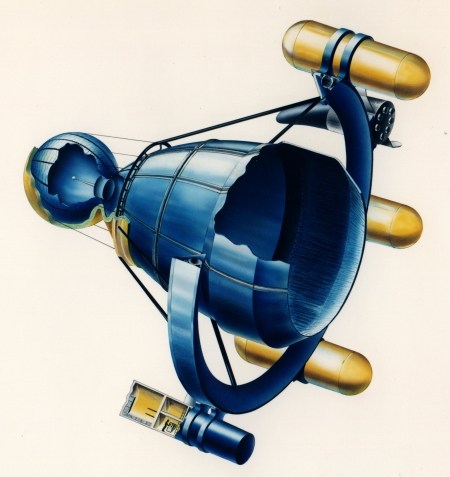
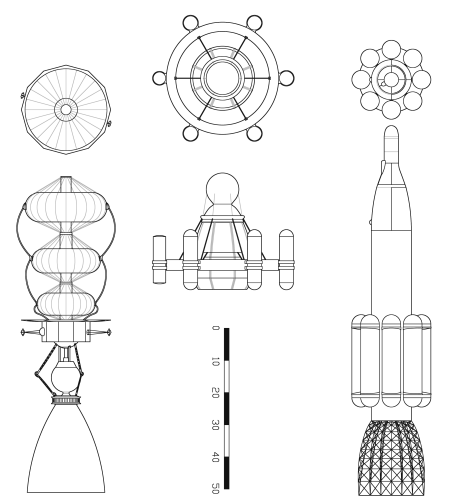
Project Hyperion, one of the projects of
Icarus Interstellar.
[64]
Enzmann starship
The Enzmann starship, as detailed by
G. Harry Stine in the October 1973 issue of
Analog, was a design for a future
starship, based on the ideas of Dr. Robert Duncan-Enzmann.
[65] The spacecraft itself as proposed used a 12,000,000 ton ball of frozen
deuterium to power 12–24 thermonuclear pulse propulsion units.
[65] Twice as long as the
Empire State Building and assembled in-orbit, the spacecraft was part of a larger project preceded by
interstellar probes and telescopic observation of target star systems.
[65][66]
NASA research
NASA
has been researching interstellar travel since its formation,
translating important foreign language papers and conducting early
studies on applying fusion propulsion, in the 1960s, and laser
propulsion, in the 1970s, to interstellar travel.
The
NASA Breakthrough Propulsion Physics Program (terminated in FY 2003 after 6-year, $1.2 million study, as "No breakthroughs appear imminent.")
[67] identified some breakthroughs which are needed for interstellar travel to be possible.
[68]
Geoffrey A. Landis of NASA's
Glenn Research Center
states that a laser-powered interstellar sail ship could possibly be
launched within 50 years, using new methods of space travel. "I think
that ultimately we're going to do it, it's just a question of when and
who," Landis said in an interview. Rockets are too slow to send humans
on interstellar missions. Instead, he envisions interstellar craft with
extensive sails, propelled by laser light to about one-tenth the speed
of light. It would take such a ship about 43 years to reach Alpha
Centauri, if it passed through the system. Slowing down to stop at Alpha
Centauri could increase the trip to 100 years,
[69]
while a journey without slowing down raises the issue of making
sufficiently accurate and useful observations and measurements during a
fly-by.
Hundred-Year Starship study
The
100 Year Starship
(100YSS) is the name of the overall effort that will, over the next
century, work toward achieving interstellar travel. The effort will also
go by the moniker 100YSS. The 100 Year Starship study is the name of a
one year project to assess the attributes of and lay the groundwork for
an organization that can carry forward the 100 Year Starship vision.
Dr. Harold ("Sonny") White[70] from NASA's Johnson Space Center is a member of
Icarus Interstellar,
[71]
the nonprofit foundation whose mission is to realize interstellar
flight before the year 2100. At the 2012 meeting of 100YSS, he reported
using a
laser to try to warp spacetime by 1 part in 10 million with the aim of helping to make interstellar travel possible.
[72]