

![[Martian+City.jpg]](https://blogger.googleusercontent.com/img/b/R29vZ2xl/AVvXsEiaYAQQg0WRkDQ2EJSxMx_fll8Fsw-0DRbVUb2KjosxrswybJuPZ0jYQlaL7ftKU8rstQRZss4Sk2nq4m1JwJHvTVrlG4gguF9f06KifkSDPG9Z3bhN1_EuHbDZx1ZS1jf6QuIQnfv87hXy/s400/Martian+City.jpg)






Martian canal
From Wikipedia, the free encyclopedia

Map of Mars by Giovanni Schiaparelli.
For a time in the late 19th and early 20th centuries, it was erroneously believed that there were
canals on Mars. These were a network of long straight lines in the equatorial regions from 60° N. to 60° S. Lat. on the
planet Mars. They were first described by the Italian astronomer
Giovanni Schiaparelli during the
opposition of 1877, and confirmed by later observers. Schiaparelli called these
canali, which was translated into English as "canals". The Irish astronomer
Charles E. Burton
made some of the earliest drawings of straight-line features on Mars,
although his drawings did not match Schiaparelli's. By the early 20th
century, improved astronomical observations revealed the "canals" to be
an
optical illusion, and modern high resolution mapping of the Martian surface by spacecraft shows no such features.
Controversy

Mars as seen through 6 inch (15 cm) aperture reflecting telescope, as Schiaparelli may have seen it.
Some people went so far as to propose the idea that the canals were
irrigation canals built by a supposed intelligent civilization on Mars.
Percival Lowell
was a strong proponent of this view, pushing the idea much further than
Schiaparelli, who for his part considered much of the detail on
Lowell's drawings to be imaginary. Some observers drew maps in which
dozens if not hundreds of canals were shown with an elaborate
nomenclature for all of them. Some observers saw a phenomenon they
called "gemination", or doubling - two parallel canals.
Other observers disputed the notion of canals. The observer
E. E. Barnard did not see them. In 1903, Joseph Edward Evans and
Edward Maunder conducted visual experiments using schoolboy volunteers that demonstrated how the canals could arise as an
optical illusion.
[1]
This is because when a poor-quality telescope views many point-like
features (e.g. sunspots or craters) they appear to join up to form
lines.
[2] In 1907 the British naturalist
Alfred Russel Wallace published the book
Is Mars Habitable?
that severely criticized Lowell's claims. Wallace's analysis showed
that the surface of Mars was almost certainly much colder than Lowell
had estimated, that the atmospheric pressure was too low for liquid
water to exist on the surface, and he pointed out that several recent
efforts to find evidence of water vapor in the Martian atmosphere with
spectroscopic analysis had failed. He concluded that complex life was impossible, let alone the planet-girding irrigation system claimed by Lowell.
[3] The influential observer
Eugène Antoniadi used the 83-cm (32.6 inch) aperture telescope at
Meudon Observatory at the 1909
opposition of Mars and saw no canals, the outstanding photos of Mars taken at the new Baillaud dome at the
Pic du Midi observatory also brought formal discredit to the Martian Canals theory in 1909,
[4]
and the notion of canals began to fall out of favor. Around this time
spectroscopic analysis also began to show that no water was present in
the Martian atmosphere.
[2]

Mars surface by Mariner 4 in 1965
The arrival of the United States'
Mariner 4 by
NASA in 1965, which took pictures revealing
impact craters
and a generally barren landscape, was the final nail in the coffin of
the idea that Mars could be inhabited by higher forms of life. A surface
atmospheric pressure of 4.1 to 7.0
millibars (410 to 700
pascals) and daytime temperatures of −100 degrees
Celsius were estimated. No
magnetic field[5][6] or
Martian radiation belts[7] was detected.
William Kenneth Hartmann,
a Mars imaging scientist from the 1960s to the 2000s, explains the
"canals" as streaks of dust caused by wind on the leeward side of
mountains and craters.
[8]
History of canals

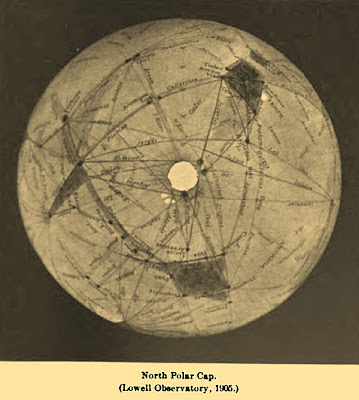
Martian channels depicted by Percival Lowell
The
Italian word
canale (plural
canali) can mean "canals" (including artificial canals or ducts) or "channels" or "gullies".
[9] The first person to use the word
canale in connection with Mars was
Angelo Secchi
in 1858, although he did not see any straight lines and applied the
term to large features —for example, he used the name "Atlantic Canale"
for what later came to be called
Syrtis Major Planum.
It is often stated that Schiaparelli intended the meaning "channels"
and that "canals" was a misunderstanding or mistranslation into English.
Nevertheless, the English term "canals" was used from the very earliest
accounts in English, and as far as is known, Schiaparelli made no
effort to correct the supposed misunderstanding if he was aware of it.
As the word "canal" can also mean "channel" or "watercourse" – not
necessarily artificial – in English, the charge of "mistranslation" is
unwarranted.
It is not necessarily odd that the idea of Martian canals was so
readily accepted by many. At this time in the late 19th century,
astronomical observations were made without photography. Astronomers had
to stare for hours through their telescopes, waiting for a moment of
still air when the image was clear, and then draw a picture of what they had seen. They saw some lighter or darker
albedo features
(for instance Syrtis Major) and believed that they were seeing oceans
and continents. They also believed that Mars had a relatively
substantial atmosphere. They knew that the
rotation period of Mars (the length of its day) was almost the same as Earth's, and they knew that Mars'
axial tilt
was also almost the same as Earth's, which meant it had seasons in the
astronomical and meteorological sense. They could also see Mars' polar
ice caps shrinking and growing with these changing seasons. It was only
when they interpreted changes in surface features as being due to the
seasonal growth of plants that life was hypothesized by them (in fact,
Martian
dust storms
are responsible for some of this). By the late 1920s, however, it was
known that Mars was very dry and had a very low atmospheric pressure.
In addition, the late 19th century was a time of great
canal building on Earth. For instance, the
Suez Canal was completed in 1869, and the abortive French attempt to build the
Panama Canal began in 1880. It is natural that some thought similar projects were being undertaken on Mars. In 1889, astronomer
Charles A. Young
reported that Schiaparelli's canal discovery of 1877 had been confirmed
in 1881, though new canals had appeared where there hadn't been any
before, prompting "very important and perplexing" questions as to their
origin.
[10]
During the favourable opposition of 1892,
W. H. Pickering
observed numerous small circular black spots occurring at every
intersection or starting-point of the "canals". Many of these had been
seen by Schiaparelli as larger dark patches, and were termed seas or
lakes; but Pickering's observatory was at
Arequipa, Peru,
about 2400 meters above the sea, and with such atmospheric conditions
as were, in his opinion, equal to a doubling of telescopic aperture.
They were soon detected by other observers, especially by Lowell.
During the oppositions of 1892 and 1894, seasonal color changes were
reported. As the polar snows melted the adjacent seas appeared to
overflow and spread out as far as the tropics, and were often seen to
assume a distinctly green colour. The idea that Schiaparelli's
canali
were really irrigation canals made by intelligent beings, was first
hinted at, and then adopted as the only intelligible explanation, by
Lowell and a few others. Newspaper and magazine articles about Martian
canals captured the public imagination.
At this time (1894) it began to be doubted whether there were any
seas at all on Mars. Under the best conditions, these supposed 'seas'
were seen to lose all trace of uniformity, their appearance being that
of a mountainous country, broken by ridges, rifts, and canyons, seen
from a great elevation. These doubts soon became certainties, and it is
now universally agreed that Mars possesses no permanent bodies of
surface water.
In popular culture
Although the concept of the canals had been available since
Schiaparelli's 1877 description of them, early fictional descriptions of
Mars omitted these features. They receive no mention, for instance, in
H. G. Wells'
The War of the Worlds
(1897), which describes a slowly drying Mars, covetous of Earth's
resources, but one which still has dwindling oceans such as are depicted
on Schiaparelli's maps. Later works of fiction, influenced by the works
of Lowell, described an ever-more arid Mars, and the canals became a
more prominent feature, though how they were explained varied widely
from author to author.
- Camille Flammarion's Uranie (1889, published as Urania
in English in 1890) include descriptions of life on Mars; "They have
straightened and enlarged the watercourses and made them like canals,
and have constructed a network of immense canals all over the
continents. The continents themselves are not bristling all over with
Alpine or Himalayan upheavals like those of the terrestrial globe, but
are immense plains, crossed in all directions by canals, which connect
all the seas with one another, and by streams made to resemble canals."
- Garrett P. Serviss' Edison's Conquest of Mars
(1898) repeatedly mentions Schiaparellian canals (which play a key part
in the denouement of the story), but does not describe them in detail,
apparently considering them simply irrigation canals comparable to those
on Earth — ignoring the fact that, in that case, they could hardly be
visible from Earth. Serviss' Mars also has lakes and oceans.
- George Griffith's A Honeymoon in Space (1900) describes the canals as the remnants of gulfs and straits "widened and deepened and lengthened by... Martian labour".
- Edgar Rice Burroughs' influential A Princess of Mars
(1912) describes an almost entirely desert Mars, with only one small
body of liquid water on the surface (though swamps and forests appear in
the sequels).
The canals, or waterways as Burroughs calls them, are still irrigation
works, but these are surrounded by wide cultivated tracts of farmland
which make their visibility somewhat credible.
- Alexander Bogdanov's Engineer Menni
(1913) details the social, scientific, and political history of the
construction of the Martian canals and the socio-economic ramifications
the construction had on Martian society.
- Otis Adelbert Kline's Outlaws of Mars
(1933) has multiple parallel canals, surrounded by walls and terraces,
and describes the construction of the canals by Martian machines.
- In C. S. Lewis' Out of the Silent Planet (1938), the "canals" (handramit
in Martian) are actually vast rifts in the surface of an almost
airless, desert Mars, in which the only breathable atmosphere and water
have collected where life is possible, with the rest of Mars being
entirely dead.
- In Robert A. Heinlein's Red Planet
(1949), colonists use the frozen canals for travel and a seasonal
migration (by iceboat during winter when the canals are frozen and by
boat when the ice melts during the Martian summer). Teenagers Jim
Marlowe and Frank Sutton set out to skate the thousands of miles to
their homes on the frozen Martian canals when escaping the Lowell
Academy boarding school.
- In Ray Bradbury's The Martian Chronicles
(1950), the canals are artificial waterways stretching between stone
banks, filled with blue water, or sometimes poetically described as full
of "green liquors" or "lavender wine". Bradbury revisited the martian
canals in 1967 in his short story "The Lost City of Mars".
- In the BBC radio production Journey into Space: The Red Planet (1954–1955), the canals are valleys filled with a plant life resembling giant rhubarbs.
- In Robinson Crusoe on Mars (1964) Kit Draper and Friday flee from the enemy aliens through the underground canals on their way to the polar ice cap.
- The Mars of the steampunk role-playing game Space: 1889 (1988) is crisscrossed by artificial canals which support cities inhabited by the ancient civilization of the Canal Martians.
- The 1991 computer game Ultima: Martian Dreams
features a plot based around Victorian expeditions to Mars. The Martian
canals play a very prominent role as the main characters have to find a
way to refill them using ice from the polar caps.
- Kim Stanley Robinson's science fiction chronicling of the terraforming of Mars in the Mars trilogy (1993-1999) and 2312 (2012) features the creation of canals on Mars ("burned" into the land with magnified sunlight) with the Lowell maps as inspiration. "Thus a nineteenth-century fantasy forms the basis for the actual landscape."[11]
- In S. M. Stirling's 2008 In the Courts of the Crimson Kings
alternate history novel Mars is terraformed and seeded with earth life
including early humans, at some point in prehistory. The humans of Mars
do indeed build a planet wide canal network due to their world's
exceptional dryness, however it's left ambiguous whether or not these
were what Lowell actually saw in the 19th century.
- Ken Kalfus's 2013 novel, Equilateral,
is based entirely on the supposed existence of "man"-made Martian
canals and on the construction of a vast triangle in the Arabian desert
in order to communicate with the Martian beings.
List of canals
The canals were named, by Schiaparelli and others, after real and
legendary rivers of various places on Earth or the mythological
underworld.
Mars in fiction
From Wikipedia, the free encyclopedia
Fictional representations of Mars have been popular for over a century. Interest in
Mars has been stimulated by the planet's dramatic
red color, by early scientific speculations that its surface conditions might be capable of supporting
life,
and by the possibility that Mars could be colonized by humans in the
future. Almost as popular as stories about Mars are stories about
Martians engaging in activity (frequently invasions) away from their
home planet.
Mars in fiction before Mariner
Before the
Mariner 4
spacecraft arrived at Mars in July 1965 and dispelled some of the more
exotic theories about the planet, the conventional image of Mars was
shaped by the observations of the astronomers
Giovanni Schiaparelli,
Camille Flammarion and
Percival Lowell. Flammarion assumed its red surface came from red-colored vegetation,
[1]
and Schiaparelli observed what he took to be linear features on the
face of Mars, which he thought might be water channels. Because the
Italian for channels is
canali, English translations tended to render the word as "
canals", implying artificial construction. Lowell's books on Mars expanded on this notion of
Martian canals, and a standard model of Mars as a drying, cooling, dying world was established. It was frequently speculated that ancient
Martian
civilizations had constructed irrigation works that spanned the planet
in an attempt at saving their dying world. This concept spawned a large
number of science fiction scenarios.
The following works of fiction deal with the planet itself, with any
assumed Martian civilization as part of its planetary landscape.
Novels and short stories
First ventures
Several early modern writers, including
Athanasius Kircher and
Emanuel Swedenborg,
hypothesized contact with Mars. Early science fiction about Mars often
involved the first voyages to the planet, sometimes as an invasion
force, more often for the purposes of exploration.
Early works to 1910
- Across the Zodiac (1880) by Percy Greg. The narrator flies his craft, the "Astronaut," to visit diminutive beings on Mars.
- Uranie (1889, translated as Urania in 1890) by Camille Flammarion. A young astronomer and his fiancée are killed in a ballooning accident, and are reincarnated in new bodies on Mars.
- Melbourne and Mars: My Mysterious Life on Two Planets (1889) by Joseph Fraser.
A sick man named Jacobs starts having visions in his sleep, which turns
out to be a telepathic link between him and a child called Charlie
Frankston, his other self on Mars, who lives in a technological utopia.
- Mr. Stranger's Sealed Packet (1889 ) by Hugh MacColl.
People from Earth travel to Mars in a flying machine, and find peaceful
Martians that are technologically inferior to humans with a few
exceptions like voice-recording devices and electric lighting.
- A Plunge into Space (1890) by Robert Cromie. Dedicated to Jules Verne,
the character Henry Barnett learns how to control the ethereal force
which combines electricity and gravity and "which permeates all material
things, all immaterial space", and secretly builds a globular spaceship
called the "Steel Globe". Barnett and some friends travel to Mars and
find a society where there is no need for politicians, and Martians who
travel in airships or flying through levitation.
- Unveiling a Parallel (1893) by Alice Ilgenfritz Jones and Ella Merchant. The authors use a journey to Mars as the frame for a utopian feminist novel.
- Journey to Mars (1894) by Gustavus W. Pope. An adventure story that may have influenced Edgar Rice Burroughs's later books.
- A Prophetic Romance (1896) by John McCoy. Reversing the usual pattern, the book brings a Martian visitor to Earth for a utopian novel.
- Auf zwei Planeten (1897) by Kurd Lasswitz.
A Martian expedition to Earth takes Earthmen back to visit Mars;
interplanetary war follows the initially peaceful contact. Lasswitz's
Martians are human in appearance, but with much larger eyes.
- The War of the Worlds (1898) by H. G. Wells. Features an attack on England by cephalopod like Martians and their advanced technology to employ fighting machines to decimate the world.
- Edison's Conquest of Mars (1898) by Garrett P. Serviss. In this Edisonade, Earthmen respond to an attack from Mars with a successful genocide of the Martian race.
- A Honeymoon in Space (1900), by George Griffith. A young couple on a journey through the solar system are captured by hostile Martians.
- Gullivar of Mars (1905) by Edwin Lester Arnold.
An Edwardian fantasy in which Gullivar Jones travels to Mars on a magic
carpet and interacts with the slothful but innocent Hithers and the
brutish but honorable Thithers.
- Doctor Omega (1906) by Arnould Galopin.
A crew of explorers from Earth visit a Mars inhabited by reptilian
mermen, savage dwarf-like beings with long, tentacled arms, bat-men and a
race of civilized macrocephalic gnomes.
- Le prisonnier de la planète Mars [Vampires of Mars] (1908) and its sequel La guerre des vampires [War of the Vampires] (1909) by Gustave Le Rouge. French engineer Robert Darvel is dispatched to Mars by the psychic powers of Hindu Brahmins.
On the Red Planet, he runs afoul of hostile, bat-winged, blood-sucking
natives, a once-powerful civilization now ruled by the Great Brain.
- Red Star (1908) by Alexander Bogdanov. The narrator is taken to Mars, which is imagined as a socialist utopia.
1910s and 1920s
- A Trip to Mars is a silent film created by Thomas Edison in
1910. It plots a scientist in a discovery of reverse gravity in his lab.
But accidentally applies the dust on himself and flies up to Mars where
he finds absurd discoveries before returning home.
- Le Mystère des XV (1911) by Jean de La Hire. De la Hire's hero, the Nyctalope helps a group of fifteen Earth scientists establish a permanent settlement on Mars.
- To Mars via the Moon (1911) by Mark Wicks. Telepathic
Martians have developed advanced canal-building technology and live in
an Utopian socialist society.[2]
- A Princess of Mars and another 10 Mars stories (1912–1943) by Edgar Rice Burroughs. These stories feature Virginia gentleman John Carter mysteriously transported to a Mars (called Barsoom
by the natives) distinguished by fierce warriors and maidens of several
species, exotic animals, and mixtures of antique with advanced
technology. Burroughs has had many imitators and inspired many nostalgic references.
- Aelita (1922) by A.N. Tolstoy,
one of the first Soviet science fiction novels. It describes a Soviet
expedition to Mars headed by the engineer Los. Los falls in love with
the beautiful Aelita, daughter of the Martian Supreme Ruler, while Los'
companion is trying to organize a communist revolution which is supposed
to bring happiness and progress to the ancient and stagnating
civilization. This was the source for the 1924 movie Aelita.
- Les Navigateurs de l'Infini (1925) by J.-H. Rosny aîné. Humans travels to Mars in a spaceship named Stellarium, and meets two competing races on the planet.
1930s
- Last and First Men by Olaf Stapledon
(1930) has the Second Men in a far future Earth invaded by the utterly
alien Martians, who seek our water and air. Parts 8 and 9 detail this
protracted and ultimately ruinous war.
- The Swordsman of Mars and Outlaws of Mars (both 1933) by Otis Adelbert Kline.
Voyages to Mars in the Burroughs style, but set on a Mars of the past.
(In Kline's original work, his Mars and Venus stories were set in
contemporary [1920s and 1930s] times. Only the reprints from the 1960s
state the tales are set in the distant past.)
- "A Martian Odyssey" (1934), a short story by Stanley G. Weinbaum. A Martian named Tweel
(one of several species encountered) is depicted as a sympathetic,
intelligent being who thinks as well as or better than a human, but in a
convincingly alien manner (a rare feat at any time, but especially
striking for pulp science fiction of that era). The story was included
in the Science Fiction Hall of Fame. Weinbaum also wrote a sequel called "Valley of Dreams" (1934).
- Out of the Silent Planet, by C. S. Lewis (1938), was written as a conscious answer and antithesis to the works of H. G. Wells and Olaf Stapledon. The first book of Lewis's Space Trilogy, a rare example of theological science fiction, it features a philologist named Ransom who arrives by accident on Mars (called Malacandra
by the natives). Ransom is at first fearful of being killed in a
barbaric rite; but discovers three highly sympathetic, intelligent
Martian species, completely different from each other but living in
harmony. As in the other books, Lewis' Mars is a dying world; large
parts of it are already dead, and various species - such as an
intelligent winged species - have become extinct. At the end of the
book, it is disclosed that the Martians' ancestors had possessed the
technology to build spaceships and invade Earth, but renounced that
possibility and stoically resigned themselves to dying out.
1940s
- Marvin the Martian (1948) is one of Looney Tunes' most prominent characters, a soft-spoken villain, whose mission throughout his appearances is to destroy Earth because it "Obstructs his view of Venus".
In one episode 'Instant Martians' appear, who resemble giant flightless
birds, which in another episode are implied to be from Jupiter.
- What Mad Universe (1949) by Fredric Brown depicts an alternate history
where humans discovered anti-gravity in 1903 and launched a war to
conquer Mars, which is inhabited by creatures with a culture equal to
that of Earth, but militarily weaker. The Martians are decimated and
finally accept human colonization. H.G. Wells
writes a book denouncing the war and conquest of Mars as an act of
unjustified aggression. Later, Martians are drawn into Earth's war with Arcturus.
1950s
- The Martian Chronicles (1950) by Ray Bradbury. Features human-like Martians with copper-colored skin, human emotions, and telepathic
abilities. They have an advanced culture, but the human explorers are
greeted with incomprehension and eventually the Martian civilisation is
destroyed by human disease. Bradbury wrote many other short stories set
on Mars.
- Marooned on Mars (1952) by Lester del Rey.
A young adult novel in which a teenager stows away on the first ship to
Mars, causing it to crash during landing. He discovers the underground
remains of a native Martian civilization.
- Star of Ill-Omen (1952) by Dennis Wheatley.
Creatures from a dying Mars kidnaps humans and takes them to the planet
so that the Martians can learn how to make nuclear weapons, which they
plan to use to invade Earth.
- No Man Friday (1956) by Rex Gordon.
A secret British Mars expedition crashes on Mars leaving one survivor
who struggles to provide his basic needs from a hostile planet and is
eventually discovered by intelligent natives. Inspired the 1964 movie Robinson Crusoe on Mars.
- Phobos, the Robot Planet (aka Lost: A Moon) (1955) by Paul Capon.
Four humans are abducted and brought to the moon Phobos by an A.I. to
study human emotions. During the stay, a young couple ends up on Mars by
accident, where they encounters the local fauna and ruins of buildings
built by the long gone Martians.
- A World's Revival (Hebrew: תבל בתחיתה Tevel Be-Thiatah) (1955) by Tzvi Livneh.[3]
Takes place some 500 years in the future. This story describes an
expedition from a Utopian Socialist Earth arriving at a Mars which is
divided between two oppressive, warring empires. The Earth people
eventually succeed in fomenting a Martian revolution and overthrowing
both empires. The Earth expedition is headed by an Israeli scientist
while a leading role among the revolutionaries is played by the
"Yunodins", members of a dispersed and persecuted minority explicitly
described as "The Jews of Mars". Livneh may have been influenced by Aelita; his story also involves interplanetary love.
- The Outward Urge (1959) by John Wyndham. Describes a comparatively realistic Mars landing, without any Martians.
Living on Mars
By the 1930s, stories about reaching Mars had become somewhat trite,
and the focus shifted to Mars as an alien landscape. In the following
stories, human contact and basic exploration had taken place sometime in
the past; Mars is a setting rather than a goal.
1930s
- Dweller in the Gulf (1932), The Vaults of Yoh-Vombis (1932) and Vulthoom (1935) by Clark Ashton Smith. Weird tales of horror set on Mars.
- The Northwest Smith stories (1933–1936) by C. L. Moore. Many of these stories take place on a Mars populated by intelligent, humanoid Martians - and other, more Lovecraftian things.
- Legion of Space Series (1934–1982) by Jack Williamson. In this future history,
humans conquer and colonise Mars in a long series of wars with its
inhabitants. All that is long in the past of the series' 30th century
plot, where Mars is an established human-settled planet, humans living
mainly "in the fertile canal areas" while most of the planet is desert.
1940s
- The Secret of Sinharat, People of the Talisman and another eleven stories published between 1940 and 1964 by Leigh Brackett. These planetary romances
describe a desert Mars populated by barbarian warriors and citizens of
decadent city-states, coming into explosive contact with Terran
civilization. Brackett's The Sword of Rhiannon (1953) shows an oceanic Mars of the distant past, and comes close to pure fantasy.
- In "Heredity" (1941), a short story by Isaac Asimov, twin brothers who have been raised separately on Earth and Ganymede must work together to operate a Martian fungus farm.
- Robert A. Heinlein repeatedly used Mars as a setting for his novels and short stories, including:
- The Green Hills of Earth
(1947). The space poet Rhysling cries out against fellow-humans who had
torn down "the slender, fairy-like towers" of the native Martians and
replaced them with ugly factories which pollute the Martian canals.
- Red Planet (1949). Young adult novel. Includes some very intelligent Martians similar to those mentioned in Stranger in a Strange Land, who help human colonists free themselves of tyrannical Earth authorities.
- The Rolling Stones (1952). Mars has a major role in the carefree adventures of a space-roving family.
- Podkayne of Mars
(1962). A teenage girl named Podkayne "Poddy" Fries and her younger
brother Clark leave their home on Mars to visit Earth, accompanied by
their uncle.
- Seetee Ship (1949) and Seetee Shock (1950) by Jack Williamson. Mars is colonized by European Fascists and Neo-Nazis, and its main holiday is "Hitler
Day", celebration of which often entails bloody riots. The Fascist Mars
is one of the main powers contending for control of the mineral wealth
of the Asteroid Belt.
1950s and early 1960s
- Genesis (story) (1951) by H. Beam Piper
- The last survivors of the ancient humanoid culture on Mars flee their
dying planet about at 100,000 B.C. Near Earth most of the ship's 1500
passengers are killed by meteors, and only two men and six women land in
a lifeboat and become the ancestors of humanity. Later Piper "paratime"
stories introduce timelines where more Martians survived, resulting in far more technologically advanced Earths by the 20th Century (see [1],[4]).
- "Omnilingual" (1957) by H. Beam Piper. Short story in which archaeologists from Earth (returning to the Mars of their distant ancestors; see Genesis above, although the stories are not explicitly related save through the author's Paratime
stories), excavating the remains of a humanoid Martian civilization
find an entire library they at first cannot read, but then come upon a Rosetta Stone of sorts, giving the story its title.
- The Sands of Mars (1951) by Arthur C. Clarke
involves a reporter who makes the long voyage to a desert Mars to write
about the human colonists and discovers native life on Mars.
- David Starr, Space Ranger (1952) by Isaac Asimov
writing as Paul French. A juvenile novel set in the distant future
whose title character discovers an unsuspected Martian civilization deep
beneath the Red Planet's surface.
- The Martian Way (1952) by Isaac Asimov.
Earth people are scornful of the Martian colonists, who survive by
salvaging "space junk", yet their way of life suits the Martian
colonists for further space exploration, reaching Saturn first and eventually (Asimov implies) leading the way to the stars.
- In Jerome Bixby's 1954 story, "The Holes Around Mars" puzzle the first astronauts on the planet.
- "One in Three Hundred" (1954) by J. T. McIntosh relates the discovery there will be a great increase in the Sun's
solar output causing the Earth's oceans to boil away. There being no
doubt, and the exact hour and minute of "Boil Away" being confirmed
daily, the world's leaders decide to commit themselves to a massive
building program for the creation of as many spaceships
as possible, more or less suitable for rescuing a small percentage of
Earth's population. If enough spaceships can be built in time, the human
race might be able to make it to Mars and eke out a living there.
- "The Badge of Infamy" (1957) by Lester Del Rey. This novelette describes a colonized Mars run by earth lobbies, including a military-industrial lobby and a health lobby similar to the American Medical Association.
A humanitarian doctor seeks to cure a disease that afflicts humans
whose metabolisms been chemically altered for Mars adaptation.
- In The Sirens of Titan by Kurt Vonnegut
(1959), previously uninhabited Mars is populated by brainwashed
transplants from Earth, leading to the invasion of Earth by the newly
created Martian army.
- In the Perry Rhodan
series (1961- ), Mars is the site of an ancient gateway to the
"negative side" of the universe. Through this gateway, the planet
becomes infested with death crystals whose life-destroying radiation
threatens to spread to the Earth.
- "A Rose for Ecclesiastes" (1963) by Roger Zelazny.
One of the last stories of this type, describing an Earth poet's study
of Martian language and literature. The story is deliberately written as
an elegiac farewell to the old conception of Mars, complete with canals
and an ancient, dying Martian race, as "The Doors of His Face, the
Lamps of His Mouth" (1965) was his farewell to the Venus of earlier science fiction.
- In Philip K. Dick's
fiction, Mars is an almost empty, dry land, with isolated communities
and individuals, most of whom do not want to be there. (Martian Time Slip (1964), The Three Stigmata of Palmer Eldritch (1965)). The characters in these stories could be in small communities in the Arizona desert, but placing them on Mars emphasises their isolation, both from one another and from Earth.
- Destination Mars (1963), Hugh Walters'
sixth book in the Chris Godfrey of UNEXA series. The first astronaut to
explore the planet has been driven mad, and a crew is launched to
investigate.
Radio, film and television
- The second series of the British radio science fiction program Journey Into Space (1954–1955) deals with a trip to Mars and what the astronauts find there.
- The Angry Red Planet (1959) – A low-budget horror/science fiction film.
- The Serial Flash Gordon’s trip to Mars shows Mars being inhabited by
intelligent life. Queen Azura rules Mars and turns those who oppose her
into Clay Men. At the end of the serial the Clay men are restored.
- Several episodes of Space Patrol, a 1962 puppet television series, dealt with Mars
- Robinson Crusoe on Mars (1964) – A pastiche of the classic Daniel Defoe novel.
- Santa Claus Conquers the Martians (1964) – Known as one of the worst movies ever made, as such it was made fun of on the TV series Mystery Science Theater 3000.
- Thunderbirds Are GO (1966) - followed the first manned mission to Mars aboard the Zero-X.
This is a notable depiction, which displays a pre-exploration idea of
how Mars would look - rocky and desert-like. The crew encounter "rock
snakes", which can live without water.
- In Captain Scarlet and the Mysterons,
a global security agency, Spectrum, fights the Mysterons, a formerly
Mars-based alien species who evacuated the planet several millennia ago
and has the ability to 'retro-metabolise' deceased organic matter.
- The Twilight Zone featured several episodes that focused on Mars and/or Martians including Will the Real Martian Please Stand Up, People Are Alike All Over, and Mr. Dingle the Strong.
Mars in fiction after Mariner
Novels and short stories
Beginning in 1965, the
Mariner and
Viking
space probes revealed that the canals were an illusion, and that the
Martian environment is extremely hostile to life. By the 1970s, the
ideas of canals and ancient civilizations had to be abandoned.
Authors soon began writing stories based on the new Mars (frequently treating it as a
desert planet). Most of these works feature humans struggling to tame the planet, and some of them refer to
terraforming (using technology to transform a planet's environment).
A common theme, particularly among American writers, is that of a
Martian colony fighting for independence from Earth. It appeared already
in Heinlein's
Red Planet and is a major plot element in Greg Bear's
Moving Mars and Kim Stanley Robinson's
Mars trilogy. It is also part of the plot of the movie
Total Recall and the television series
Babylon 5. Many
video games also use this concept, such as the
Red Faction and
Zone of the Enders series. A historical rebellion of Mars against Earth is also mentioned in the
Star Trek series of novels, which are not considered canon.
In the decades following Mariner and Apollo, the once-popular subgenre of realistic stories about a first
expedition to Mars fell out of fashion, possibly due to the failure of the
Apollo Program
to continue on to Mars. The early 1990s saw a revival and
re-envisioning of realistic novels about Mars expeditions. Early novels
in this renaissance were
Jack Williamson's novel
Beachhead and
Ben Bova's novel
Mars (both 1992), which envisioned large-scale expeditions to Mars according to the thinking of the 1990s. These were followed by
Gregory Benford's
The Martian Race (1999),
Geoffrey A. Landis's
Mars Crossing (2000), and
Robert Zubrin's
First Landing
(2002), which took as their starting points the smaller and more
focussed expedition strategies evolved in the late 1990s, mostly
building on the concepts of
Mars Direct.
Late 1960s and the 1970s
- In Larry Niven's harsh Known Space stories (1964- ) Mars is a backwater bypassed by humans in their rush to the mineral wealth of the Asteroid Belt.
A single attempt to colonise Mars ended disastrously, due to the
combination of violent conflict between the would-be colonists and a
confrontation with the native Martians—a shadowy race spending most of
their time swimming under the surface of the Martian dust, and to whom
water is a deadly poison. They are neither able nor interested in going
into space, and humans are not really interested in Mars, so there seems
no reason for conflict. Still, in the book Protector
(1973), the Martians are brutally exterminated by a large water
asteroid deliberately hurled at the planet, raising the water content in
the atmosphere to a degree deadly to them, by Jack Brennan, a human who had turned into a Pak Protector—a
creature completely devoted to protecting its descendants, or sometimes
his entire species, and is unreasonably xenophobic towards anybody
else. This act of interplanetary genocide in effect ties Niven's Mars
with the older Wells/Stapledon tradition. Some of these Martians are
thought to have survived on the Ringworld, however. See Ringworld Engineers, Ringworld Throne, and Ringworld's Children. Various Protectors set up traps against Niven Martians.
- In Die Erde is nah: die Marsexpedition (1970), by Ludek Pesek, published in English as The Earth is Near
(1973), a crew of twenty men undertake the first manned mission to
Mars, and after landing in the wrong area due to computer malfunction
and/or human error, have to cope with vicious sand storms, and a long
trek undertaken in vehicles to their original intended area of
exploration. The story is told from the viewpoint of the expedition's
psychologist, and tries to be (based on the knowledge then known about
Mars when written) accurate and realistic as to the problems encountered
due to the Martian environment, the technology they have, and the human
emotional response to their situation.
- In Police Your Planet (1975) by Lester Del Rey,
a disgraced, embittered Earth cop is exiled to a Mars that has been
thoroughly corrupted by domed city life - he who controls the air
machinery, makes the rules. The local police and city government are
utterly corrupt, Chicago style. At first he tries to fit in, then his
contact with other downtrodden outsiders renews his old idealism.
- Birth of Fire (1976) by Jerry Pournelle.
The story of a troubled youth transported to Mars as a convict laborer
who becomes involved with a rebellion by independent farmers and
tradesmen who want to terraform Mars and break the stranglehold by the
corporations and domed cities sponsored by Earth governments.
- In Man Plus (1976) by Frederik Pohl, an astronaut is transformed into a cyborg capable of living on Mars.
- The Far Call by Gordon R. Dickson
describes a first international mission to Mars featuring a redundant
architecture where two spacecraft are sent at once to Mars. It also
provides illuminating insight to the culture at NASA.
1980s
- "Ananke" (1982) by Stanisław Lem (a story in More Tales of Pirx the Pilot)
- Watchmen (1985) by Alan Moore and Dave Gibbons.
Several Martian landmarks appear in a section of the famous graphic
novel, visited by the superhuman Dr. Manhattan and human Laurie
Juspeczyk.
- The Forge of God (1987) by Greg Bear.
The only surviving humans, numbering in the thousands, and the only
surviving Earth life, are resettled on Mars, after the annihilation of
Earth.
- Desolation Road (1988) by Ian McDonald is a magic-realist
science fiction novel set on a planet that's never explicitly named
(though the name "Ares" makes frequent appearances in various contexts)
but is clearly meant to be a terraformed Mars.
- Draka series (1989-), a dystopian alternate history by S. M. Stirling.
Mars is colonised by the harsh Draka who create a slave society. To
control their slaves there, they breed a special kind of artificial
horrendous beast, the ghouloon, out of baboons.
- Lobster Man from Mars (1989) is a parody of 1950s science fiction films, and tells of a race of Martians who are dying due to a rapidly thinning atmosphere, and send an anthropomorphic lobster to investigate the possible colonisation of Earth.
- Venus Prime (1989) The third book of the series: Hide & Seek is set on Mars.
1990s
- In Terry Bisson's Voyage to the Red Planet (1990), the first expedition to Mars is organized by a Hollywood producer so he can film a science fiction movie on location.
- Kim Stanley Robinson's Mars trilogy (Red Mars, Green Mars, Blue Mars, 1992–1996) is concerned with a centuries-long program of terraforming the planet. In Robinson's companion book The Martians, the escarpment is the scene of an epic multi-pitched rock climb. His Icehenge
(1984) also features a Mars in process of terraforming. Olympus Mons
features as the site of an annual festival. Mars is also one of the
terraformed worlds visited during the course of Robinson's The Memory of Whiteness (1985).
- Mars (1992), Return to Mars (1999) and Mars Life (2008) by Ben Bova, from the Grand Tour series.
- Moving Mars (1993) by Greg Bear depicts a colonised Mars seeking independence from the control of Earth.
- Red Dust (1993) by Paul J. McAuley takes place against a backdrop of a failing attempt at terraforming Mars by the Chinese.
- Bright Messengers (1995) by Gentry Lee
a novel set in the Arthur C. Clarke's Rama universe. A faithful
priestess and an engineer who share the same vision of sparkling
particules on Earth meet on Mars as civilization faces total collapse.
This affects the Mars colony and during the threat of a global sand
storm, they found escape of the doomed outpost inside an alien pod,
which carried the fugitive humans into a gigantic and espherical
spaceship orbiting Mars.
- Voyage (1996) by Stephen Baxter. An alternate history about the 20-year lead-up to a 3-person Mars expedition in 1986 using Apollo-derived technology.
- Mars Underground (1997) by William K. Hartmann, a novel about a partially terraformed Mars by a noted astronomer.
- Olympus Mons (1998) by Bud Sparhawk. the mountain is the setting for a 21st-century downhill race.
- Beige Planet Mars (1998) by Lance Parkin and Mark Clapham, a novel in Virgin Publishing's New Adventures
series is set on a terraformed Mars which has become a retirement home
for Earth's wealthy elderly. The title is a deliberate play on the books
of Robinson's Mars Trilogy.
- Semper Mars (1998) by Ian Douglas depicts the Cydonia region of Mars as home to ancient alien ruins where mummified early humans are found in 2040.
- "Mars is No Place for Children" (1999) by Mary A. Turzillo, a Nebula-award winning novella about a child growing up on Mars.
- The Martian Race (1999) by Gregory Benford
- Brian Aldiss and Roger Penrose wrote White Mars
(1999) as a response to the terraforming science fiction of Kim Stanley
Robinson and Paul J. MaCauley above. However, their work rejects
terraforming and Mars has been designated as a "planet for science",
analogously to Antarctica's current status as an ecologically preserved
site for managed scientific experimentation.
Recent
- Mars Crossing (2000) by Geoffrey A. Landis, about a stranded expedition; which won the Locus Award for best first novel.
- "The Great Wall of Mars" (2000) by Alastair Reynolds,
in which the most technologically advanced faction of humans is based
on Mars and embroiled in an interplanetary war; introduced some of the
most important characters and groups in the Revelation Space universe. Several later Revelation Space novels add additional details of history of groups and characters on Mars.
- First Landing (2002) by Robert Zubrin
- Mars is the scene of the last of three recent space operas by John Barnes: In the Hall of the Martian King (2003). Barnes also sets one of the two Meme Wars novels on Mars: The Sky So Big and Black (2002).
- "Falling Onto Mars, by Geoffrey A. Landis, a Hugo-award winning short story that envisions Mars as a prison planet,
- Ilium/Olympus series (2003- ) by Dan Simmons. Olympus Mons has become the Mount Olympos of Greek myth, home of beings playing the roles of the various Greek gods.
- Stories by Caitlín R. Kiernan:
- "Bradbury Weather" (2005). Set entirely on a colonized Mars where a
plague has made the planet uninhabitable by men, so that only women
populate Mars, living alongside an ancient parasitic organism (perhaps
also alien to Mars) referred to as "the Fenrir" and "the Wolf."
- "Zero Summer" (2007). Includes a closing scene set on a station on Mars' satellite Phobos.
- "Excerpt from Memoirs of a Martian Demirep" (2007).
- An Old Fashioned Martian Girl (2004), by Mary A. Turzillo, a novel serialized in Analog magazine.
- New Mobile Report Gundam Wing: Frozen Teardrop (2010-ongoing) by Katsuyuki Sumisawa is a novel continuation of the Gundam Wing anime series taking place primarily on the terraformed Mars.
- The Quantum Thief
(2010) by Hannu Rajaniemi is a novel set in the far future of Mars in
the Oubliette a city moving across the face of the planet.
- "The Martian" is a novel by Andy Weir about an astronaut stranded on Mars trying to survive.
Nostalgic Mars fiction
Several post-Mariner works are homages to the older phase of Mars
fiction, circumventing the scientific picture of a dry and lifeless Mars
with an unbreathable atmosphere through such science fiction generic
staples as positing its future
terraforming, or creating
alternate history versions of Mars, where Burroughs'
Barsoom, Bradbury's
Martian Chronicles or
The War of the Worlds are literal truth.
- Philip José Farmer's World of Tiers series (1965–1993) contains a nostalgic and ironic reminder of the Barsoom
stories. Kickaha, the series' adventurer protagonist, asks his friend
The Creator of Universes to create for him a Barsoom. The latter agrees
only to make an empty world, since "It would go too far for me to create
all these fabulous creatures only for you to amuse yourself by running
your sword through them". Kickaha visits from time to time the empty
Barsoom, complete with beautiful palaces in which nobody ever lived, but
goes away frustrated.
- Some Sword and planet series, such as Michael Moorcock's Kane of Old Mars trilogy (1965) and Lin Carter's Mysteries of Mars (1973–1984) are deliberately anachronistic homages to earlier visions of Mars, particularly Burroughs'.
- In one of Robert A. Heinlein's last novels, The Number of the Beast
(1980), the heroes flee Earth in a car capable of flight in six
dimensions and find several alternate versions of Mars, one which had
been colonised by the British and another which is an improbable
combination of Burroughs' fabulous Barsoom with the home planet of the vicious Martians whose invasion of Earth was described by Wells.
- A World Of Difference (1990) by Harry Turtledove. In this alternate history, the fourth planet of our solar system - named Minerva instead of Mars
- is larger, nearer to Earth and has conditions congenial to the
existence of life, including intelligent creatures with their
well-defined biology and culture (and wars with each other). Until the
1970s this makes no substantial difference to human history, beyond some
minor differences in myths. But when a Viking
space probe sends back the picture of an alien creature swinging a
stick, a joint US/USSR mission is sent in a hurry to explore the planet,
and things develop fast from there.
- S. M. Stirling's Lords of Creation series includes In the Courts of the Crimson Kings, in which Mars (as well as Venus)
have been terraformed by unknown aliens over the course of hundreds of
millions of years and seeded with all kinds of terrestrial life. Terran
explorers arrive in the latter part of the 20th century to discover that
Mars is home to a decaying but still highly advanced culture that was
creating technological marvels back when Earthlings were still living in
caves.
- The title Larry Niven's Rainbow Mars (1999) alludes to Robinson's three-colored Mars trilogy,
and the plot concerns a time machine that is used to visit ancient
Mars. The only problem is that time travel is impossible, and the
machine actually travels back to a fictitious/alternate-universe
Mars. The protagonist meets a wide variety of different Martians,
including most of those from the pre-Mariner novels listed above.
- "Larklight" (2006), a story by Phillip Reeve
is set in the 18th century, where Mars is inhabited by an elven race,
which formerly commanded great space empires. Humans are thought to be
their descendants. They are describe as purple haired and russet
skinned. Mars and most other planets have a breathable atmosphere for
humanity in Larklight.
Nostalgia for the older Mars also frequently appears in comics and role-playing games, particularly of the
steampunk genre:
- The role-playing game Space: 1889
(1988) features an alternate history in which a heroic Mars, complete
with natives, is being colonized by the European empires of the 19th
century.
- The wargame Sky Galleons of Mars (1988) is set in the same alternate history as Space:1889.
- The League of Extraordinary Gentlemen
(1999-) takes place in a world where characters from various literary
sources interact. A scene taking place on Mars features the Hithers from
Gullivar of Mars, the Green Martians from Barsoom, and the Séroni from Out of the Silent Planet, with references to Kane of Old Mars. In the world of The League, the Martians from The War of the Worlds are not originally from Mars, but were invading aliens who moved on to try to conquer Earth.
- In the graphic novel Scarlet Traces- the Great Game (2002), Olympus Mons is the main base of the British Mars Expeditionary Force. Scarlet Traces is intended as a sequel to H. G. Wells' The War of the Worlds and centres on a counter-invasion of Mars, beginning about 1908 and continuing over the next three decades.
Film and television
- Twilight Zone (1961) - Will the Real Martian Please Stand Up?
has an attempted Martian colonisation of Earth. A Martian infiltrates a
group of humans. He is humanoid with a third arm. However the
colonisation is prevented by the Venusians having already set up a colony.
- Total Recall (1990) – Loosely based upon a Philip K. Dick short story, "We Can Remember It for You Wholesale." The protagonist (Arnold Schwarzenegger)
must journey to Mars in order to uncover his past. Mars is shown as
being previously inhabited by an ancient race of aliens who created a machine for producing a breathable atmosphere and later terraforming the planet.
- RocketMan (1997) - A comedy film about a wacky computer programmer who is recruited by NASA to travel to Mars.
- Mission to Mars (2000) – A science fiction thriller adventure about a rescue mission of the first manned mission to Mars, which encountered a catastrophic and mysterious disaster.
- Red Planet (2000) – A group of astronauts try to make Mars suitable for human life. No relation to the Robert A. Heinlein novel of the same title.
- Ghosts of Mars (2001) – Director John Carpenter uses the planet as a science fiction setting for a remake of his earlier Assault on Precinct 13.
- An episode of Transformers: Armada (2003) – , entitled "Mars", features some of the Transformers visiting the planet in an effort to locate a Mini-Con.
- Stranded: Náufragos (2004) - thriller adventure about the crew of the first manned mission to Mars getting stranded on the surface. Based on a script by the noted Spanish sci-fi writer Juan Miguel Aguilera.
- Space Odyssey: Voyage To The Planets (2004) – A documentary style series about a scientific voyage by the crew of the interplanetary ship Pegasus.
Mars was one of the first planets visited, and the crew stayed on the
surface for some time, finding water and experiencing a huge dust storm.
- Doom (2005) – Barely based on the third installment of the Doom computer game series,
a group of Marines are sent to the red planet via an ancient Martian
portal called the Ark to deal with an outbreak of a mutagenic virus.
- Race to Mars (2007) – a miniseries produced in 2007 by Discovery Channel Canada.
- Mars Needs Moms (2011) - an animated film produced by Robert Zemeckis.
- Princess of Mars (2009) - A direct-to-video movie produced by the
independent studio The Asylum, based on A Princess of Mars by Edgar Rice
Burroughs, starred by Antonio Sabato Jr. as John Carter and Traci Lords
as Dejah Thoris.
- John Carter (2012) – A Disney-produced reimagining of the John Carter stories of Edgar Rice Burroughs.
- The Last Days on Mars
(2013) - Science fiction-horror depicting a small research/exploration
base in the 2040s that discovers a devastating parasitic-pathogen
- The Great Martian War 1913 - 1917 (2013) – a mockumentary about a martian invasion, inspired by the H. G. Wells classic and the Great War
Secondary references to Mars in film and television
In the following works of fiction, the Martian setting is of secondary importance to the work as a whole.
- Doctor Who television series. Mars is the now uninhabitable homeworld of the Ice Warriors, a recurring adversary of the Second and Third Doctors from 1967 to 1974. In Pyramids of Mars (1975), the Fourth Doctor defeats Sutekh,
last of the Osirians, who had been imprisoned for his crimes beneath a
pyramid, with a signal to keep him paralyzed sent from a Martian
pyramid. In "The Waters of Mars" (2009), an episode set on the planet itself, the Tenth Doctor implies that the Ice Warriors have become extinct. (This episode also introduces a viral, water-borne Martian named the Flood.)
- Blue Comet SPT Layzner (1985–1986) anime series. Several episodes take place on Mars.
- Exosquad (1993–1995) animated television series.
- Babylon 5 (1993–1998 plus spin-offs) television series and fictional universe. Mars is a human colony seeking independence from the Earth Alliance, which it eventually achieves.
- seaQuest DSV
television series. The episode "Better Than Martians" (1994) deals with
the first manned mission to Mars returning to Earth, but, encountering
difficulty upon re-entering Earth's atmosphere and splashing into the
ocean, leaving seaQuest to find the capsule before an unfriendly foreign confederation can.
- Futurama (1999–2003, 2008–2013) animated television series. By the year 3000, Mars has been completely terraformed
to make it habitable for humans - the native Martian aliens are forced
to live in specially designated areas, in a parody of the treatment of Native Americans. Amy Wong's parents own half of the planet, and it features its own university.
- Invader Zim
(2001–2006) animated television series. In one episode, Zim finds that
Mars is a giant spaceship and attempts to roll it over Earth in order to
wipe out all human life.
- The Star Trek television franchise contains many references to Mars:
- In the film Star Trek Generations, Jean-Luc Picard mentions that several of his ancestors were among the first settlers of the Martian Colonies.
- The original series episode "Court Martial"
contains references to the "Fundamental Declarations of the Martian
Colonies", long considered an important legal precedent in the
development of individual rights.
- Some starships are assembled at the Utopia Planitia region on Mars, particularly the Galaxy class starships featured in Star Trek: The Next Generation. The Utopia Planitia shipyard appears onscreen in the Star Trek: Voyager episode "Relativity".
- In the Star Trek: Enterprise episodes "Demons" and "Terra Prime"
(both 2005) it is revealed that Mars is in the process of being
terraformed by use of the Verteron array which redirects comets to
crashland on the planet's surface; by 2155 the atmosphere had been
sufficiently altered so that, in the lowlands, Humans could breathe the
air unassisted, though temperatures were still cold enough to require
thermal gear. The opening credits of this series feature real images of
the Sojourner rover on Mars, being the first Star Trek production featuring real footage filmed on another world.
- In the Star Trek: Voyager episode "One Small Step", USS Voyager discovers the fate of Ares IV, one of the first manned expeditions to Mars in 2032.
- Starhunter 2300
Canadian sci-TV series. Several episodes take place in the vicinity of
Mars, known as "Mars Federation." It is a more populated and wealthier
system than the Jupiter and Saturn Federations. One of the main
characters, Callista Larkadia, is a bounty hunter who came from a
wealthy family on Mars. She also used to be an officer for "Mars Special
Ops."
Comics
- In the Watchmen comic by Alan Moore and Dave Gibbons
Dr. Manhattan character tours Mars and visits Olympus Mons, admiring
its features. He takes his girlfriend there, soon after he leaves for
another galaxy.
- In the 2000 AD series The V.C.s Olympus Mons' crater is covered by a massive dome to retain an atmosphere as the main settlement on the planet.
- Several stories of the DC Comics character Martian Manhunter
take place on Mars, and the Manhunter is a Martian. Most of the Green
Martians were wiped out by a plague, although the more ruthless White
Martians still exist. Martians were among the most powerful races in the
Universe, capable of telepathy, shapeshifting, and flight, though they
have an aversion to fire.
- The most recent issue of the webcomic Dr. McNinja features Dracula revealing that he discovered the cure for cancer and hid it on Mars.
- In Wonder Woman Pre-Crisis comics, Mars was the base of the god Mars, (see Ares). Spirits of the dead from various planets were taken to Mars and given new bodies to work. The Duke of Deception is a major villain of that world, operating a Lie Factory and making several attempts to invade Earth.
- In January–February 1950, Superman journeys to Mars to help
actor-director Orson Welles smash a plot by the Martian dictator Martler
to "blitzkrieg the solar system" and conquer the Earth (S No. 62/1:
"Black Magic on Mars!").
- In Tales to Astonish
#2 (1959) "My Job: To Catch a Martian", a professor, who discovers an
empty alien spacecraft, hires a private investigator to find the
occupant when no one else will listen to him.
- In Tales to Astonish
#3 (1959) "I Discovered the Men From Mars", a man from the year 1990
discovers a Martian space-craft while patrolling the coast on the
lookout for communist spies.
- In the Manga and Anime Sailor Moon,
released in 1992, in the silver millennium, Mars was inhabited by the
warlike descendants of the Greek god Ares. The character of Rei Hino is a modern descendant of Ares and is Sailor Mars. All her attacks are based on fire. Like the other planets in the modern solar system, Mars is no longer inhabitable.
- In the comic strip, Calvin and Hobbes: Weirdos From Another Planet! by Bill Watterson, Calvin and Hobbes travel to Mars because the Earth is too polluted.
- In Marvel Family
#36 Mars is shown to be inhabited by a warlike treacherous race that
resemble 1940s military dictators. They join the Invaders from Infinity
(see List of Captain Marvel (DC Comics) enemies) in their attempt to destroy the Solar System after being defeated, but are beaten and sent back to Mars while the Invaders are imprisoned and destroyed.
- The manga and anime series Aria
by Kozue Amano depicts a fully terraformed Mars in the year 2301 A.D.
now known as "Aqua". The planet is now covered by lush oceans where many
people live in cities that resemble Venice, Italy.
Computer and video games
- In the id Software game Commander Keen, Keen explores Mars in the first episode and keeps a Martian pet for the remainder of the series.
- In the turned-based tactics game X-COM: UFO Defense the alien invaders use Mars as a base of operations in which to launch UFO attacks on Earth.
- UFO: Afterlight,
a game similar to the X-COM series, is set entirely on Mars and its
moons. It involves a human colony struggling for survival against
various hostile aliens and the harsh Martian environment. Strategic
gameplay takes place on a 3-D rendered globe of Mars, which includes
familiar landmarks such as Olympus Mons. The player has the option of
altering the landscape through terraforming.
- The first-person shooter Red Faction tells the story of a Martian mining colony that leads a revolt to throw off an oppressive corporation. Its successor, Red Faction: Guerilla,
tells the story of another revolt half a century later, on a partially
terraformed planet with a breathable atmosphere, against the
corporate-funded Earth Defence Force, in the Tharsis region of Mars. Some of the locations are named after the characters of the first uprising.
- The computer game Elite 2 starts on Mars in one scenario.
- The video game series Zone of the Enders is based during a war between Earth's Government and Martian Colonists seeking independence.
- In the 1993 video game Doom, game events took place on military bases on both of Mars' moons, Phobos and Deimos. The 2004 sequel Doom 3 is set on Mars itself.
- Mars is the setting for Worlds of Ultima II: Martian Dreams RPG by Origin Systems
released in 1991. The heroic Avatar travels first to the year 1887,
then on to Mars to rescue many of Earth's scientists, celebrities, and
politicians stranded there by accident. The Avatar will uncover the
secrets of a lost Martian civilization.
- In the video game Airforce Delta Strike, the EDAF establishes a base on Mars to use as a rally point to finish off the OCC's remaining forces.
- Three levels of the computer game Descent
are set in facilities on Mars. Level 8 is set in a processing station,
while levels 9 and 10 are (appropriately) set in a military dig and
military base. In the game's third installment, Descent³,
the player's character is rescued and then assisted by a group of
scientists whose base of operations is located on Mars, before the
facility is destroyed at one particular game level by an invading Earth
force. The next game level after that also takes place on Mars in an
underground colony.
- The survival horror Martian Gothic: Unification is set on a research base on the surface of Mars, and a volcanic vent of Olympus Mons is also explored.
- Most of the 1986 Infocom game Leather Goddesses of Phobos occurs (despite the name) on Mars.
- The video game Armored Core 2 takes place on Mars while it is undergoing terraforming and colonization. The game's final mission however takes place on Phobos.
- In the shoot 'em up game Terra Diver
(SoukyouGurentai in Japan), the player's rival company sets up their
attack HQ on Mars where the player's final mission takes place.
- In Darius II (arcade game), players travel to Mars to eliminate one of many underground enemy bases.
- In the shoot 'em up Mars Matrix, Martian colonists revolt turning their colony upside down and the players are ordered to stop them.
- In the Cave shoot em' up DoDonPachi,
players control an Earth-bound pilot who is assigned to stop an attack
on Earth initiated by an unknown race of highly skilled Martian pilots
whereupon the second level in the game takes place on the Martian
surface.
- In Mass Effect,
an expedition to Mars launched by the European Space Agency discovers
an ancient cache of advanced technology leftover from an alien race
known as the Protheans. This allows humanity to expand out of the solar system and become part of a larger galactic community. The capitol of Mars is called "Lowell City" - probably named after Percival Lowell, who fueled belief in the possibility of alien structures on Mars.
- In the second mission of Mass Effect 3, Commander Shepard has to defend the aforementioned cache from a human supremacist terrorist organization known as Cerberus.
- Destroy All Humans! mentions the Furons having a great war with Mars centuries, maybe millennia, before the events of the game. In the sequel
survivors of the Martian war are revealed to be the main antagonists of
the game in an attempt to colonize once more after Mars was turned into
a desert wasteland from the Furons; instead of Martians they are
referred to as Blisk.
Role-playing games
- In Palladium Games' post-apocalyptic role-playing game Rifts,
the Martian canals are mystical ley lines, magical tunnels of energy
that create portals through space, time and dimension wherever they
cross. In Palladium's After The Bomb Sourcebook 6: Mutants in Orbit, there is a section pertaining to Rifts that also says that there were several points where the ley lines create dimensional pockets (similar to the Bermuda Triangle) in which full-fledged jungles grow within the borders of three nearby Rifts.
- In the GURPS role-playing game Transhuman Space,
Mars is in the process of being terraformed, while several million
people live in colonies. China, the first nation to land on Mars and the
leader of the most extensive colonies, has built a space elevator on Mars to speed colonization. The Transhuman Space sourcebook In The Well places a University town, "Nix Olympia" and a ski resort "Zeus Tourist Resort" on Olympus Mons.
- In the RPG Mutant Chronicles, Mars is the homeworld of Capitol Megacorporation.
- Space: 1889
portrays an arid, aging Mars on the Lowellian model. Its native
civilization is decadent and the various city-states and desert tribes
squabble as the canal system slowly falls apart and Earthmen arrive to
carve out colonial holdings.
Wargames
- In the tabletop wargame Warhammer 40,000 (set 38,000 years in the future), Mars is a vast, heavily colonized 'Forge World,' home to the Adeptus Mechanicus,
the Tech-Priests of Mars. They are the engineers and technicians of the
Imperium, who create most of the Imperium's more advanced weaponry. The
planet is almost as well defended as the Holy planet Terra itself and
home to those who worship the 'Machine Spirit.' Mars is also suspected
to be the lair of the Void Dragon, an ancient C'tan imprisoned there by the God-Emperor of Mankind
at some point between 1300 AD and 1600 AD (how the Emperor accomplished
this has never been described in detail). It is also mentioned that the
planet was once terraformed, but the terraforming was undone due to
rampant industrialism.
- In the tabletop wargame and fictional universe of BattleTech,
Mars is the location of a military academy. Mars was held by the Terran
Hegemony and the Star League before its collapse. Afterward it was
controlled by the interstellar communication order known as ComStar. After ComStar split into two factions Mars was claimed along with Terra by the Word of Blake during Operation Odysseus.
During the Word of Blake's jihad against the rest of the Inner Sphere
the mercenary command Wolf's Dragoons launched a failed assault on Mars
which resulted in the nuclear scouring of their base planet of Outreach.
Music
Martian
From Wikipedia, the free encyclopedia
This article is about hypothetical or fictional inhabitants of the planet Mars. For other uses, see
Martian (disambiguation).

Sculpture of a Wellsian Martian Tripod in the town of
Woking.
A
Martian is a native inhabitant of the planet
Mars. Although the search for evidence of
life on Mars continues, many
science fiction writers have imagined what
extraterrestrial life on Mars might be like. Some writers also use the word
Martian to describe a
human colonist on Mars.
Martians in fiction
The word "Martian," used as a noun instead of an adjective, first
entered the English language in late 1877. It appeared nearly
simultaneously in England and the United States, in magazine articles
detailing Asaph Hall's discovery of the
moons of mars in August of that year.
[1]
An early, brief fictional account of an invasion of Earth by Martians
appeared in 1881, in a futuristic article inspired by the
International Exposition of Electricity, Paris.
[2]
Aleriel, or A Voyage to Other Worlds (1883) by
W. S. Lach-Szyrma was previously reputed to be the first published work to apply the word
Martian
as a noun instead of an adjective. The usage is incidental; it occurs
when Aleriel, the novel's protagonist, lands on Mars in a spacecraft
called an "ether-car" (an allusion to
aether, which was once postulated as a gaseous medium in
outer space). Aleriel buries the car in snow "so that it might not be disturbed by any Martian who might come across it."
[3]
15 years later,
H. G. Wells' landmark novel
The War of the Worlds (1898) was published by
William Heinemann, Ltd. when the latter was a relatively new publishing house. In this story, the
Martians are a technologically-advanced race of
cephalopod-like
extraterrestrials
who invade Earth because Mars is becoming too cold to sustain them. The
Martians' undoing is a lethal vulnerability to Earth bacteria.
In his book
Mars and Its Canals (1906), astronomer and businessman
Percival Lowell conjectured that an extinct Martian race had once constructed a vast network of
aqueducts to channel water to their settlements from Mars'
polar ice caps,
Planum Australe and
Planum Boreum. Lowell did not invent this
Martian canal hypothesis, but he supported it.
[4] The belief that Mars had
canals was based on observations
Giovanni Schiaparelli made through his
reflecting telescope.
Although the telescope's image was fuzzy, Schiaparelli thought he saw
long, straight lines on the Martian surface; some astronomers came to
believe that these lines were structures built by Martians. This idea
inspired Lowell, who returned to the subject in
Mars As the Abode of Life (1910), wherein he wrote a fanciful description of what this Martian society may have been like.
[5] Although his description was based on almost no evidence, Lowell's words evoked vivid pictures in his readers' imaginations.
One of the people Lowell inspired was
Edgar Rice Burroughs, who began writing his own story about Mars in the summer of 1911. The story is a
planetary romance in which an
American Civil War veteran named
John Carter is transported to Mars when he walks inside a cave on Earth. He finds that Mars is populated by two species of warring
humanoids, and he becomes embroiled in their conflict.
In February 1912, an American
pulp magazine called
The All-Story published Burroughs' story as the first installment of a
serial novel, which the editor titled
Under the Moons of Mars (retitled
A Princess of Mars in subsequent editions). The book was the first in Burroughs'
Barsoom series.
Although the noun
Martian can describe any organism from Mars, these and later works typically imagine Martians as a humanoid monoculture.
Martian, in this sense, is more like the word
human than the word
Earthling. (Few writers describe a
biodiverse Mars.) In science fiction, Martians are stereotypically imagined in one or more of the following ways: As
alien invaders; as humanoids with a civilization that resembles one on Earth; as
anthropomorphic
animals; as beings with superhuman abilities; as humanoids with a lower
intelligence than humans; as human colonists who adopt a Martian
identity; and/or as an extinct race who possessed high intelligence.
Martians as invaders of Earth
H. G. Wells' novel
The War of the Worlds (1898) and its adaptations have been an extraordinary influence to science fiction writers for more than 100 years. Wells'
Martians are a technologically advanced species with an ancient civilisation. They resemble
cephalopods
(such as the octopus), and walk around Earth in fighting machines that
have great, stilt-like legs. They invade Earth because Mars is cooling
down, and they decide that they need a warmer planet to live on. They
attack cities with
rayguns that they fire with their tentacles.
In
Last and First Men (1930),
Olaf Stapledon visited Wells' theme of Martian invasion.
Last and First Men
summarizes tens of thousands of years of invasions and war between
Martians and humans. Eventually, humans destroy the Martians' empire.
In 1948,
Warner Bros. introduced a new villain to their animated films:
Marvin the Martian,
a short, slender figure with comically oversized eyes, hands, and feet,
but no visible mouth. His big, spherical head is either completely
black or always under the shadow of his helmet. His clothing is
patterned on that of
Mars, the
god of war in
Roman mythology. In Marvin's film debut,
Haredevil Hare (1948), he attempts to blow up Earth because it "obscures [his] view of
Venus".
In the
Superman story "Black Magic on Mars" (1950),
[6] Superman faces Martians led by a dictator called Martler, who is an admirer of
Adolf Hitler.
Invaders from Mars (1953), a film that was remade in 1986, fuses the tentacles of Wells' Martians to
little green men. In his 1955
comic novel Martians, Go Home,
Fredric Brown
spoofs the Wellsian invasion, and reinterprets the Martian invader as a
rude houseguest. Brown, too, employs the "little green men"
trope.
In
Mars Attacks! (1996), a sci-fi
black comedy written by
Jonathan Gems and directed by
Tim Burton,
the Martian invaders are loud, irritating, and dim-witted, despite
having outsized heads with extremely large, protuding brains. They
invade a town in the
Midwestern United States during a re-broadcast of the
1938 radio dramatisation of The War of the Worlds.
In "
Will the Real Martian Please Stand Up?", a 1961 episode of
The Twilight Zone, Martians attempt to colonize Earth, but are thwarted by
Venusians. Here, the Martians are disguised as humans, but towards the end we see that they have three arms.
In
Mars Needs Moms (2007), a
picture book by
Berkeley Breathed,
Martians are squat, humanoid beings with antennae and skin color that
varies by individual. When they travel to Earth, they wear transparent
helmets and a bulbous, ribbed outer garment. In the story, a
five-year-old boy learns to appreciate his mother more after three
Martians kidnap her while he sleeps. Writer-director
Simon Wells and his wife Wendy adapted the book into a film,
Mars Needs Moms (2011).
Little green men recur in the 2009 video game
Stalin vs. Martians, a spoof of earlier
strategy video games. As the president of the
Soviet Union, the player defends Earth from Martian invasion. This time the caricature of the Martians appears to be influenced by
H. R. Giger.
Martians as civilized humanoids
In April 1911, about a year before
The All-Story published the first installment of Burroughs'
Under the Moons of Mars,
Modern Electrics began publishing
Hugo Gernsback's own romance,
Ralph 124C 41+,
which takes place on Earth. Gernsback's Martians live among the humans
on Earth; they are taller and physically stronger than humans, with
green skin and large eyes. The serial wasn't republished as a book until
1925.
1923 saw the publication of
Aelita, or The Decline of Mars, a novel that is equally science fiction and
political fiction. Its author, Soviet Russian writer
Aleksey Nikolayevich Tolstoy,
tells a story of a Soviet engineer who builds a rocket and invites an
acquaintance to accompany him in it to Mars. There they find a humanoid
race of Martians who are the offspring of both an elder Martian species
and of humans from
Atlantis. The Martians live in a
class society; the workers rise up against the
ruling class, but the revolution fails. All the while, Mars is entering a phase of
climate change that threatens disaster for the population.
Red Planet (1932), a play cowritten by
John L. Balderston and John Hoare, also deals with radical environmental change on Mars, except in this case it occurs through
terraforming.
Balderston was one of the few playwrights of the 20th century to adopt
Mars or Martians as a subject for the stage. He was, however, also a
screenwriter who specialized in
fantasy film and
horror film. Many years later,
United Artists bought a screen adaptation that Balderston and fellow screenwriter
Anthony Veiller wrote.
Harry Horner directed the film, called
Red Planet Mars,
and it was released to cinemas in 1952. In the film, a scientist
communicates with Martians by radio, and they tell him that Mars is a
utopia. When the news circulates, it causes widespread unrest among the
people of Western nations. The US government tries to silence further
messages, then later announces that the Martians have informed them that
they must all worship
God
in order to save themselves. After millions of people revolt against
their governments, it seems the Martian communiques may haven been a
hoax.
In four stories by
Eric Frank Russell published in the early 1940s and collected in the classic
Men, Martians and Machines
(1955), a crew of humans and humanoid Martians are shipmates and
compatriots on an interstellar voyage. During their travels, they
encounter hostile aliens.
Ray Bradbury's novel
The Martian Chronicles
(1950) depicts Martians as a refined and artistic race of
golden-skinned beings who closely resemble humans. The Martians are
almost completely wiped out by the diseases brought to Mars by human
invaders. At the end of the book, the human inhabitants of Mars realize
that they are the new Martians. The novel's themes and its portrayal of
Martians resemble Bradbury's 1949 short story "
Dark They Were, and Golden-Eyed".
Brothers
Jim Thomas and
John Thomas teamed with
Graham Yost to write
Mission to Mars
(2000), a film that depicts Martians as tall, feminine, peaceful
humanoids who left Mars to escape the havoc caused by a massive
meteorite impact.
Martians as anthropomorphic animals
C. S. Lewis wrote, in
Out of the Silent Planet
(1938), about three humans who visit Mars and meet three different
kinds of intelligent native creatures: The hrossa, the sorns/séroni, and
the pfifltriggi. They are dying out, but are resigned to their fate.
The books also describe a prey animal called hnakra, which is hunted.
The planet is ruled by the Oyarsa, who are also called "eldil".
As a writer for
Doctor Who,
Brian Hayles created a Martian species of
reptilian humanoids called
Ice Warriors,
who move stiffly and speak in a husky whisper. Most of the Ice Warriors
that the Doctor encounters are brutish and belligerent. As Mars'
climate becomes less favorable to sustaining them, the Ice Warriors seek
a new planet.
These reptilians debuted in
The Ice Warriors (1967), a
Doctor Who television serial about an impending
ice age
in Earth's future. As British scientists try to slow or avert a glacier
encroaching on Great Britain, they find an Ice Warrior near their base,
frozen in the glacier, and apparently in
suspended animation.
No one knows the being's identity, but they understand that it is
probably from another planet. When the Ice Warrior revives, he attacks
the first person he sees and kidnaps a young woman.
Martians and human colonists
Many of
Robert A. Heinlein's Martian characters are humans born and raised on Mars. In
Red Planet (1949), boys attend a
boarding school
in a human colony on Mars. A population of native Martians tolerates
them until the colony administrator threatens a Martian child. The
Martians demand that the humans leave Mars, but a human doctor convinces
them to let reconsider.
In Heinlein's 1956 novel
Double Star, humans have colonized the solar system, and a politician on Mars faces the
civil rights issue of granting a native Martian species (who are
second-class citizens) the
right to vote.
In
Philip K. Dick's novel
Martian Time-Slip
(1964), a human colony on Mars is trying to cope with arduous
environmental conditions. They treat an aboriginal race, whom they call
"Bleekmen", with casual racism. In
The Three Stigmata of Palmer Eldritch
(1965), Mars has no indigenous life. To cope with the sterile habitat,
the human colonists abuse drugs such as "Can-D" and "Chew-Z."
Dick previously published a shorter version of the story in 1963, called
All We Marsmen. Like Heinlein's
Double Star,
All We Marsmen
was conceived at a time in US history when many marginalized people
were fighting especially vehemently for more civil rights. US President
Lyndon B. Johnson signed the
Civil Rights Act of 1964 into law on 2 July 1964.
1
Total Recall (1990) is a science fiction
action film about an apparently unsophisticated
construction worker who turns out to be a
freedom fighter
from Mars who has been relocated to Earth. He later learns of an alien
artifact that proves Mars harbored life before the human colonization.
The character designers for
Futurama, a comical American
animated series, imagine Mars after human colonization as being like the
American frontier; native Martians inhabit zones analogous to
Indian reservations. One of the series principal characters,
Amy Wong, is a scientist of Chinese descent who was born on Mars. Her parents have amassed an enormous fortune and enterprise there.
Rebecca Bloomer's novel
Unearthed (2011), the first in a series, describes a futuristic human colony on Mars amidst the populations of native Martians.
1. ^ See also African-American Civil Rights Movement (1955–68)
Martians as an extinct race
For his
Known Space series of novels,
Larry Niven conceived humanoid Martians with a primitive material culture who inhabit an environment of red dust and
nitric acid, and for whom water is lethal. In the 1973 novel
Protector, a man named Jack Brennan allies himself with a ruthless, xenophobic humanoid species called the
Pak. To preclude the possibility future competition for Pak offspring, Brennan engineers a Martian
genocide by sending an ice-covered asteroid to collide with Mars.
In
Dennis Feltham Jones' 1977 novel
Colossus and the Crab, Martian life predated life on Earth, but faced a process of devolution as conditions on the planet worsened.
Quatermass and the Pit
(1958–59) is a British television serial in which a crashed spacecraft
is discovered in London. The wreck evidences that the human population
of Earth resulted from the experiments of a Martian civilisation, now
long dead. A film remake was released in 1967.
Ghosts of Mars (2001) human invaders war with Martians in an attempt to conquer Mars.
In the
Invader Zim
episode "Battle of the Planets" (2001), Zim discovers that a Martian
race died off after converting Mars into a giant spacecraft.
In
Doom 3 (2004), the entire Martian race sacrificed itself many millennia ago in order to prevent a
demonic invasion of our universe. By the year 2145, humanity has
colonized Mars
and begun excavating the ruins of their civilization, recovering
several important artifacts. One of these artifacts - known as the Soul
Cube - is
the player's most valuable tool in combating a second demonic invasion, as it is the only weapon capable of killing the
Cyberdemon.
Martians as superbeings
In Robert Heinlein's
Stranger in a Strange Land (1961), a man raised by native Martians emigrates to Earth, where he must reacclimate. In the novel he functions as a
Christ figure.
Soon he demonstrates psychic powers, superhuman intelligence, and an
ability to manipulate higher dimensions. He founds a church on Earth
based on Martian philosophy, and starts a cultural shift. At the novel's
climax, he is murdered by a mob from a rival religious group.
In 1963, American television network
CBS premiered a
sitcom called
My Favorite Martian.
The series proved popular in the US, especially during the first
season, and CBS broadcast more than one hundred episodes before
canceling it when the third season ended in 1966. In this comedy, a
Martian anthropologist (who passes for human in most respects) crashes
on Earth, where he is harbored by an American man who keeps the
Martian's identity secret. Also secret are the Martian's extraordinary
abilities, not the least of which are invisibility and
telepathy. CBS's rival networks,
NBC and
ABC, did not fail to notice the success of
My Favorite Martian, or the comic potential of a character with secret powers. In 1964, ABC introduced
Bewitched (a sitcom about a married, suburban witch), and NBC countered the following year with
I Dream of Jeannie, a sitcom about an
astronaut who discovers and marries a genie.
In
Captain Scarlet and the Mysterons (1967–68), the
Mysterons are a race of invisible superbeings from Mars who are at war with humans from Earth. The conflict begins when
Captain Black, a human officer investigating radio signals from Mars, mistakes a
surveillance camera
for a weapon. In violation of his orders, he attacks, but the Mysterons
immediately repair the damage he caused. The conflict escalates, and
the Mysterons attempt to assassinate the president of Earth.
DC Comics introduced the first Martian
superhero to the
DC Universe in 1955.
Martian Manhunter (J'onn J'onzz), a green humanoid who is believed to be the last of the peaceful Green Martians, joins the
Justice League. Meanwhile, the warlike, shapeshifting
White Martians
regard the Green Martians as enemies. The White Martians adopt a
humanoid form which, they say, expresses their distinctive philosophy.
DC introduced a White Martian superhero,
Miss Martian, in 2006. A third race, the
Yellow Martians, may or may not have survived as long as the Green and White Martians.