A
single-stage-to-orbit (or
SSTO) vehicle reaches
orbit
from the surface of a body without jettisoning hardware, expending only
propellants and fluids. The term usually, but not exclusively, refers
to
reusable vehicles.
[1] No Earth-launched SSTO launch vehicles have ever been constructed. To date, orbital launches have been performed either by
multi-stage fully or partially
expendable rockets, or by the
Space Shuttle which was multi-stage and partially reusable.
A large proportion of the cost of Earth space launches comes, not
from fuel, but from damage and destruction of hardware in launch and
reentry. Single stage to orbit flight from Earth with a complete return
of hardware to Earth offers the promise of significant reductions in the
cost of launching people, equipment and supplies into orbit.
It is considered to be marginally possible to launch a single stage
to orbit spacecraft from Earth. The principal complicating factors for
SSTO from Earth are: high orbital velocity of over 7400 m/s; the need to
overcome the earth's gravity, especially in the early stages of flight;
and flight within the Earth's atmosphere, which limits speed in the
early stages of flight and influences engine performance. The
marginality of SSTO can be seen in the launch of the space shuttle. The
shuttle and main tank combination successfully orbits after booster
separation from an altitude of 45 kilometers (140,000 ft) and a speed of
4,828 kilometers per hour (3,000 mph). This is approximately 12% of the
gravitational potential energy and just 3% of the kinetic energy needed
for orbital velocity (4% of total energy required).
Notable single stage to orbit research spacecraft include
Skylon, the
DC-X, the
X-33, and the
Roton SSTO.
However, despite showing some promise, none of them has come close to
achieving orbit yet due to problems with finding the most efficient
propulsion system.
[1]
Single-stage-to-orbit has been achieved from the
Moon by both the
Apollo program's
Lunar Module and several robotic spacecraft of the Soviet
Luna program; the lower lunar gravity and absence of any significant atmosphere makes this much easier than from Earth.
History
- Early rocket pioneers believed that single stage to orbit was impossible.[citation needed]
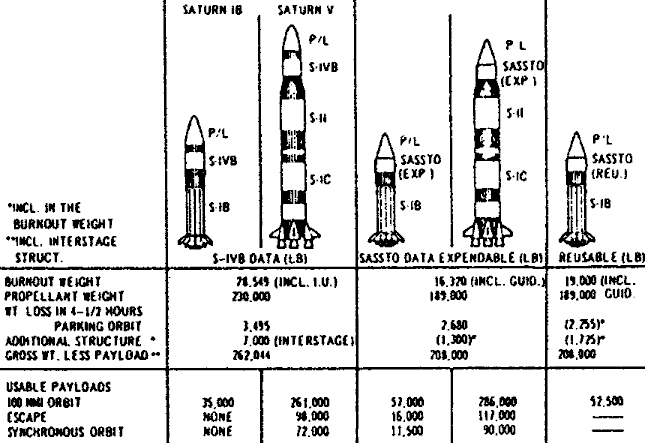
- In the 1960s some people (Ex. Philip Bono) began to investigate SSTOs.[2]
- From 1965 Robert Salked investigated various single stage to orbit spaceplane concepts.[3][4][5]
- Around 1985 the NASP project was intended to create a scramjet vehicle to reach orbit, but this had its funding stopped and was cancelled.
- The HOTOL tried to use precooled jet engine technology, but failed to show significant advantages over rocket technology.[6]
- Around 1992 the Skylon spaceplane concept was created.
- 1999-2001 Rotary Rocket attempted to build a SSTO called the Roton.[7]
Approaches
There have been various approaches to SSTO, including pure rockets that are launched and land vertically, air-breathing
scramjet-powered vehicles that are launched and land horizontally,
nuclear-powered vehicles, and even
jet-engine-powered vehicles that can fly into orbit and return landing like an airliner, completely intact.
For rocket-powered SSTO, the main challenge is achieving a high enough mass-ratio to carry sufficient
propellant to achieve
orbit, plus a meaningful
payload weight.
[citation needed] One possibility is to give the rocket an initial speed with a
space gun, as planned in the
Quicklaunch project.
For air-breathing SSTO, the main challenge is system complexity and associated
research and development costs,
material science, and construction techniques necessary for surviving sustained high-speed flight within the atmosphere,
and
achieving a high enough mass-ratio to carry sufficient propellant to
achieve orbit, plus a meaningful payload weight. Air-breathing designs
typically fly at
supersonic or
hypersonic speeds, and usually include a rocket engine for the final burn for orbit.
[1]
Whether rocket-powered or air-breathing, a reusable vehicle must be
rugged enough to survive multiple round trips into space without adding
excessive weight or maintenance. In addition a reusable vehicle must be
able to reenter without damage, and land safely.
[citation needed]
While single-stage rockets were once thought to be beyond reach,
advances in materials technology and construction techniques have shown
them to be possible. For example, calculations show that the
Titan II first stage, launched on its own, would have a 25-to-1 ratio of fuel to vehicle hardware.
[8] It has a sufficiently efficient engine to achieve orbit, but without carrying much payload.
[9]
Dense versus hydrogen fuels
Hydrogen might seem the obvious fuel for SSTO vehicles. When burned with
oxygen, hydrogen gives the highest
specific impulse of any commonly used fuel: around 450 seconds, compared with up to 350 seconds for
kerosene.
Hydrogen has the following advantages:
- Hydrogen has nearly 30% higher specific impulse (about 450 seconds vs. 350 seconds) than most dense fuels.
- Hydrogen is an excellent coolant.
- The gross mass of hydrogen stages is lower than dense-fuelled stages for the same payload.
- Hydrogen is environmentally-friendly
However, hydrogen also has these disadvantages:
- Very low density (about 1/7 of the density of kerosene) — requiring a very large tank
- Deeply cryogenic — must be stored at very low temperatures and thus needs heavy insulation
- Escapes very easily from the smallest gap
- Wide combustible range — easily ignited and burns with a dangerously invisible flame
- Tends to condense oxygen which can cause flammability problems
- Has a large coefficient of expansion for even small heat leaks.
These issues can be dealt with, but at extra cost.
While kerosene tanks can be 1% of the weight of their contents,
hydrogen tanks often must weigh 10% of their contents. This is because
of both the low density and the additional insulation required to
minimize boiloff (a problem which does not occur with kerosene and many
other fuels). The low density of hydrogen further affects the design of
the rest of the vehicle — pumps and pipework need to be much larger in
order to pump the fuel to the engine. The end result is the
thrust/weight ratio of hydrogen-fueled engines is 30–50% lower than
comparable engines using denser fuels.
This inefficiency indirectly affects
gravity losses
as well; the vehicle has to hold itself up on rocket power until it
reaches orbit. The lower excess thrust of the hydrogen engines due to
the lower thrust/weight ratio means that the vehicle must ascend more
steeply, and so less thrust acts horizontally. Less horizontal thrust
results in taking longer to reach orbit, and gravity losses are
increased by at least 300 meters per second. While not appearing large,
the mass ratio to
delta-v
curve is very steep to reach orbit in a single stage, and this makes a
10% difference to the mass ratio on top of the tankage and pump savings.
The overall effect is that there is surprisingly little difference in
overall performance between SSTOs that use hydrogen and those that use
denser fuels, except that hydrogen vehicles may be rather more expensive
to develop and buy. Careful studies have shown that some dense fuels
(for example liquid
propane) exceed the performance of hydrogen fuel when used in an SSTO launch vehicle by 10% for the same dry weight.
[10]
In the 1960s
Philip Bono investigated single stage, VTVL
tripropellant rockets, and showed that it could improve payload size by around 30%.
[11]
Operational experience with the DC/X experimental rocket has caused a
number of SSTO advocates to reconsider hydrogen as a satisfactory fuel.
The late Max Hunter, while employing hydrogen fuel in the DC/X, often
said that he thought the first successful orbital SSTO would more likely
be fueled by propane.
One engine for all altitudes
Some SSTO vehicles use the same engine for all altitudes, which is a problem for traditional engines with a bell-shaped
nozzle.
Depending on the atmospheric pressure, different bell shapes are
optimal. Engines operating in the lower atmosphere have shorter bells
than those designed to work in vacuum. Having a bell not optimized for
the height makes the engine less efficient.
One possible solution would be to use an
aerospike engine, which can be effective in a wide range of ambient pressures. In fact, a linear aerospike engine was used in the X-33 design.
Other solutions involve using multiple engines and other
altitude adapting designs such as double-mu bells or
extensible bell sections.
Still, at very high altitudes, the extremely large engine bells tend
to expand the exhaust gases down to near vacuum pressures. As a result,
these engine bells are counterproductive due to their excess weight.
Some SSTO vehicles simply use very high pressure engines which permit
high ratios to be used from ground level. This gives good performance,
negating the need for more complex solutions.
Airbreathing SSTO
Some designs for SSTO attempt to use
airbreathing jet engines that collect oxidizer and reaction mass from the atmosphere to reduce the take-off weight of the vehicle.
Some of the issues with this approach are:
- No known air breathing engine is capable of operating at orbital speed within the atmosphere (for example hydrogen fueled scramjets seem to have a top speed of about Mach 17).[12] This means that rockets must be used for the final orbital insertion.
- Rocket thrust needs the orbital mass to be as small as possible to minimize propellant weight.
- The thrust-to-weight ratio of rockets that rely on on-board oxygen
increases dramatically as fuel is expended, because the oxidizer fuel
tank has about 1% of the mass as the oxidizer it carries, whereas
air-breathing engines traditionally have a poor thrust/weight ratio
which is relatively fixed during the air-breathing ascent.
- Very high speeds in the atmosphere necessitate very heavy thermal protection systems, which makes reaching orbit even harder.
- While at lower speeds, air-breathing engines are very efficient, the efficiency (Isp)
and thrust levels of air-breathing jet engines drop considerably at
high speed (above Mach 5–10 depending on the engine) and begin to
approach that of rocket engines or worse.
- Lift to drag ratios
of vehicles at hypersonic speeds are poor whereas since acceleration is
a vector, the effective lift to drag ratios of rocket vehicles at high g
is not dissimilar.
Thus with for example scramjet designs (e.g.
X-43) the mass budgets do not seem to close for orbital launch.
Similar issues occur with single stage vehicles attempting to carry
conventional jet engines to orbit- the weight of the jet engines is not
compensated by the reduction in propellant sufficiently.
[13]
On the other hand LACE-like
precooled airbreathing designs such as the
Skylon spaceplane (and
ATREX) which transition to rocket thrust at rather lower speeds (Mach 5.5) do seem to give, on paper at least, an improved orbital
mass fraction
over pure rockets (even multistage rockets) sufficiently to hold out
the possibility of full reusability with better payload fraction.
[14]
It is important to note that mass fraction is an important concept in
the engineering of a rocket. However, mass fraction may have little to
do with the costs of a rocket, as the costs of fuel are very small when
compared to the costs of the engineering program as a whole. As a
result, a cheap rocket with a poor mass fraction may be able to deliver
more payload to orbit with a given amount of money than a more
complicated, more efficient rocket.
Launch assists
Many vehicles are only narrowly suborbital, so practically anything
that gives a relatively small delta-v increase can be helpful, and
outside assistance for a vehicle is therefore desirable.
Proposed launch assists include:
And on-orbit resources such as:
Nuclear propulsion
Due to weight issues such as shielding, many nuclear propulsion
systems are unable to lift their own weight, and hence are unsuitable
for launching to orbit. However some designs such as the
Orion project and some
nuclear thermal designs do have a
thrust to weight ratio
in excess of 1, enabling them to lift off. Clearly one of the main
issues with nuclear propulsion would be safety, both during a launch for
the passengers, but also in case of a failure during launch. No current
program is attempting nuclear propulsion from Earth's surface.
Beam-powered propulsion
Because they can be more energetic than the potential energy that
chemical fuel allows for, some laser or microwave powered rocket
concepts have the potential to launch vehicles into orbit, single stage.
In practice, this area is relatively undeveloped, and current
technology falls far short of this.
Comparison with the Shuttle
The high cost per launch of the
Space Shuttle
sparked interest throughout the 1980s in designing a cheaper successor
vehicle. Several official design studies were done, but most were
basically smaller versions of the existing Shuttle concept.
Most cost analysis studies of the Space Shuttle have shown that
workforce is by far the single greatest expense. Early shuttle
discussions speculated airliner-type operation, with a two-week
turnaround. However, senior NASA planners envisioned no more than 10 to
12 flights per year for the entire shuttle fleet. The absolute maximum
flights per year for the entire fleet was limited by external tank
manufacturing capacity to 24 per year.
[15]
Very efficient (hence complex and sophisticated)
main engines were required to fit within the available vehicle space. Likewise the only known suitable lightweight
thermal protection was delicate, maintenance-intensive
silica
tiles. These and other design decisions resulted in a vehicle that
requires great maintenance after every mission. The engines are removed
and inspected, and prior to the new "block II" main engines, the
turbopumps were removed, disassembled and rebuilt. While
Space Shuttle Atlantis was refurbished and relaunched in 53 days between missions
STS-51-J and
STS-61-B, generally months were required to repair an orbiter for a new mission.
Many in the aerospace community
[who?]
concluded that an entirely self-contained, reusable single-stage
vehicle could solve these problems. The idea behind such a vehicle is to
reduce the processing requirements from those of the Shuttle.
Examples
The early
Atlas rocket is an expendable SSTO by some definitions.
[citation needed] It is a
"stage-and-a-half"
rocket, jettisoning two of its three engines during ascent but
retaining its fuel tanks and other structural elements. However, by
modern standards the engines ran at low
pressure
and thus not particularly high specific impulse and were not especially
lightweight; using engines operating with a higher specific impulse
would have eliminated the need to drop engines in the first place.
[citation needed]
The first stage of the
Titan II
had the mass ratio required for single-stage-to-orbit capability with a
small payload. A rocket stage is not a complete launch vehicle, but
this demonstrates that an expendable SSTO was probably achievable with
1962 technology.
[citation needed]
It is easier to achieve SSTO from a body with lower gravitational pull than Earth, such as the
Moon or
Mars. The
Apollo Lunar Module achieved deorbit to a soft landing, and return to lunar orbit, each with a single stage for descent and ascent.
A detailed study into SSTO vehicles was prepared by
Chrysler Corporation's Space Division in 1970–1971 under NASA contract NAS8-26341. Their proposal (
Shuttle SERV) was an enormous vehicle with more than 50,000 kg of payload, utilizing
jet engines for (vertical) landing.
[16] While the technical problems seemed to be solvable, the
USAF required a winged design (for
cross range) that led to the Shuttle as we know it today.
The unmanned
DC-X technology demonstrator, originally developed by
McDonnell Douglas for the
Strategic Defense Initiative
(SDI) program office, was an attempt to build a vehicle that could lead
to an SSTO vehicle. The one-third-size test craft was operated and
maintained by a tiny crew of three people based out of a trailer, and
the craft was once relaunched less than 24 hours after landing. Although
the test program was not without mishap (including a minor explosion),
the DC-X demonstrated that the maintenance aspects of the concept were
sound. That project was cancelled when it crashed on the fourth flight
after transferring management from the
Strategic Defense Initiative Organization to NASA.
The
Aquarius Launch Vehicle was designed to bring bulk materials to orbit as cheaply as possible.
Current development
Current private SSTO projects include the Japanese
Kankoh-maru project and the
Skylon.
Skylon
The British Government partnered with the
ESA in 2010 to promote a
single-stage to orbit spaceplane concept called
Skylon.
[17] This design was pioneered by
Reaction Engines Limited,
[18][19] a company founded by
Alan Bond after
HOTOL was canceled.
[20] The Skylon spaceplane has been positively received by the British government, and the
British Interplanetary Society.
[21] Pending a successful engine test in June 2011,
[22] the company will begin Phase 3 of development with the first orders expected around 2011-2013.
[22]
Haas 2C
On June 1, 2012, Romanian organization
ARCA announced that they are constructing an expendable rocket, named
Haas 2C
that will attempt to reach orbit in one stage. The rocket has 520 kg
empty weight and can carry 15.5 tons of fuel. It will use kerosene as
fuel and liquid oxygen as oxydizer. In Spring 2012 they have
successfully tested a lightweight composite kerosene fuel tank. The
liquid oxygen tank is being designed and it will also be made of
composite materials. The launch is expected to take place in Spring
2013.
[23]
Alternative approaches to inexpensive spaceflight
Many studies have shown that regardless of selected technology, the most effective cost reduction technique is
economies of scale[citation needed] . Merely launching a large total quantity reduces the manufacturing costs per vehicle, similar to how the
mass production of automobiles brought about great increases in affordability.
Using this concept, some aerospace analysts believe the way to lower
launch costs is the exact opposite of SSTO. Whereas reusable SSTOs would
reduce per launch costs by making a reusable high-tech vehicle that
launches frequently with low maintenance, the "mass production" approach
views the technical advances as a source of the cost problem in the
first place. By simply building and launching large quantities of
rockets, and hence launching a large volume of payload, costs can be
brought down. This approach was attempted in the late ’70s, early ’80s
in
West Germany with the
Democratic Republic of the Congo-based
OTRAG rocket and might have been successful if the project was not killed following political pressure from
France, the
Soviet Union and other parties.
A related idea is to obtain economies of scale from building simple,
massive, multi-stage rockets using cheap, off-the-shelf parts. The
vehicles would be dumped into the ocean after use. This strategy is
known as the "
big dumb booster" approach.
This is somewhat similar to the approach some previous systems have
taken, using simple engine systems with "low-tech" fuels, as the
Russian and
Chinese space programs still do. These nations' launches are significantly cheaper than their Western counterparts.
An alternative to scale is to make the discarded stages practically reusable: this is the goal of the
SpaceX reusable launch system development program and its Grasshopper demonstrator.
See also




![[icon]](http://en.wikipedia.org/wiki/File:Wiki_letter_w_cropped.svg)
