Search This Blog

Wikipedia

Search results

Sunday, May 25, 2014

Is thorium a cleaner, safer and cheaper alternative to uranium?

http://advantage-environment.com/index.php

Nuclear power is both a promising and problematic energy source. On the one hand, nuclear power continuously generates large amounts of energy without consuming fuels that contribute to global warming. On the other hand, there are concerns about nuclear accidents and the storage of spent radioactive material. The Royal Swedish Academy of Engineering Sciences, or IVA, and the Royal Swedish Academy of Sciences have found a number of future technologies that may improve nuclear power. One of them is to use thorium as fuel.

An untapped source of energy

Thorium is not strictly a renewable energy source. The element, which was discovered in the early 1800s by the Swedish chemist Jons Jakob Berzelius, has been around for eons.
A large part of the heat generated in the earth’s core actually comes from nuclear processes involving thorium. But even if thorium is not renewable, it is estimated it to be 3-4 times more common than uranium. The issue is that found deposits have largely not yet been used.

Nuclear power plants generate large amounts of energy but create concerns about accidents and fuel storage

The advantages of thorium

According to the UN nuclear agency IAEA there are many benefits with thorium compared to uranium, which is currently used in nuclear reactors.
To begin with, there is limited radioactive debris when thorium is used. And in terms of chemical stability and resistance to radioactivity thorium is a safer alternative compared to uranium.
Depending on the core process utilized, thorium leads to more energy that can be recovered from this cheap, available and relatively safe energy.
One of the major drawbacks of nuclear power is the fear that countries that have the technology will use it to acquire nuclear weapons.
This is much more difficult to do with the material that is created in nuclear reactors fueled with thorium compared to those that run on uranium.

Investments in India and China

The obvious advantages of using thorium in core processes have been particularly interesting to India and China. Both countries have invested in a new generation of thorium-based nuclear power plants.
The Indian reactors Kakrapar-1 and Kakrapar-2 were the first in the world to use thorium on a large scale. Already in 1995, the reactors succeeded to operate 400 days at full strength based on thorium. India’s long-term interest in thorium is not just about its environmental benefits. India has only one percent of the world’s uranium resources, but about 30 percent of the world’s thorium resources. Canada, the U.S., Germany, UK and the Netherlands have also tested thorium as an alternative fuel.

Technical challenges to be solved

Although thorium can already be used, a number of technical challenges need to be resolved before this new technology can reach its full potential.
For example, higher temperatures are required to produce thorium-based fuels. Residual materials from thorium-based nuclear power lose their radioactivity faster than residual materials from uranium-based nuclear fuels. In the short term, however, thorium’s residual materials emit stronger radiation and this increases the cost of the immediate handling.

Will thorium replace uranium?

As experience is gained from thorium-based nuclear power plants, and from the research done in the field, we will most likely become aware of the pros and cons of this relatively new energy source.
Perhaps the biggest challenge when moving from uranium to thorium is the time and the investments that are required. Many countries, because of these high investment costs, cling to the uranium that is already used as a nuclear fuel. Given that thorium is regarded as a less dangerous, less expensive, more accessible and more environmentally friendly alternative to uranium, there are good reasons to keep an eye on developments.
The article was published in September 2012

Chinese scientists urged to develop new thorium nuclear reactors by 2024

PUBLISHED : Tuesday, 18 March, 2014, 11:42pm
UPDATED : Wednesday, 19 March, 2014, 4:50pm
The deadline to develop a new design of nuclear power plant has been brought forward by 15 years as the central government tries to reduce the nation's reliance on smog-producing coal-fired power stations.
A team of scientists in Shanghai had originally been given 25 years to try to develop the world's first nuclear plant using the radioactive element thorium as fuel rather than uranium, but they have now been told they have 10, the researchers said.
"In the past the government was interested in nuclear power because of the energy shortage. Now they are more interested because of smog," said Professor Li Zhong, a scientist working on the project.


Premier Li Keqiang told the national legislature in Beijing on March 5 that the government had declared "war on pollution", and measures to tackle the problem included closing coal-fired power stations. About 70 per cent of China's electricity was produced by coal-fired plants last year, according to government figures. Nuclear power stations generated just over 1 per cent.
The Chinese Academy of Sciences set up an advanced research centre in Shanghai in January with the aim of developing the world's first industrial reactor using thorium molten-salt technology, according to a statement from the academy's Bureau of Major Research and Development Programmes.
All commercial nuclear plants in China, whether in operation or under construction, are designed to use uranium as fuel, but the country has run short of uranium and depends on imports from other countries.

The technology under development in Shanghai involves burning the radioactive element thorium in a salty "soup" to, in theory, release heat many times greater than today's reactors.
Other potential advantages of the technology are that China has large thorium reserves, at least the world's third-largest, according to some experts. The process may also produce less radioactive waste.
Professor Li, director of the project's molten salt chemistry and engineering technology division, said the smog crisis had provided huge impetus for their research.
"The problem of coal has become clear. If the average energy consumption per person doubles, this country will be choked to death by polluted air," he said. "Nuclear power provides the only solution for massive coal replacement and thorium carries much hope."
Researchers working on the project said they were under unprecedented "war-like" pressure to succeed and some of the technical challenges they faced were difficult, if not impossible to solve in such a short period.
They would also probably face opposition from sections of the Chinese public after the nuclear disaster at Fukushima in Japan and also from some senior officials with interests in the coal industry who were unlikely to give their backing to a new form of nuclear energy, they said.
One of the technical difficulties is that the molten salt produces highly corrosive chemicals such as fluoride that could damage the reactor.
The power plant would also have to operate at extremely high temperatures, raising concerns about safety. In addition, researchers have limited knowledge of how to use thorium.
"We are still in the dark about the physical and chemical nature of thorium in many ways," said Li. "There are so many problems to deal with but so little time."
Western countries such as the United States have experimented with thorium reactors but gave up on the technology because of the engineering difficulties.
Analysts have also suggested the US lost interest in thorium as a fuel for reactors because uranium was a more suitable material to produce nuclear weapons.
Interest, however, has been revived in recent years and research projects have been established in several countries, including the United States, France and Japan.
"This is definitely a race," said Li. China "faces fierce competition from overseas and to get there first will not be an easy task", he said.
The thorium reactor is not the only technology China is researching in an attempt to upgrade its nuclear power programme.
These projects are beautiful to scientists, but nightmarish to engineers
Professor Gu Zhongmao
The Hefei Institute of Physical Science in Anhui province finished construction last month of the world's largest experimental platform for an accelerator reactor that burns nuclear fuel with a powerful "particle gun".
An experimental fast reactor is also operating in Beijing, and construction has started of a demonstration plant for a very-high-temperature reactor at Shidao Bay in Shandong province.
Professor Gu Zhongmao, an official at the China Institute of Atomic Energy, said so-called fourth-generation reactors were troubled by technological uncertainties, and to solve the smog issue the central government should approve and start construction of new nuclear power plants using existing technology as soon as possible.
The thorium reactors would need years, if not decades, to overcome the corrosion issue and the stability of accelerator-driven plants was also in doubt, he said.
"These projects are beautiful to scientists, but nightmarish to engineers," he said.
Smog would be reduced noticeably if nuclear power produced 5 to 10 per cent of the nation's electricity, according to Gu. China has about 20 nuclear reactors and is building nearly 30 more.
Its use of nuclear power is tiny compared with countries such as France, which produces about 75 per cent of its electricity from nuclear power plants.
After the Fukushima nuclear disaster three years ago, the central government withheld approval for new nuclear plants.
Part of the resistance came from the public, as many people were worried that nuclear plants would cause more serious contamination than the pollution created by coal-fired stations, Gu said.
Government agencies such as the Ministry of Water Resources also opposed the construction of nuclear plants in land-locked areas over concerns that radioactive waste would worsen river pollution.
"To completely get rid of smog, nuclear power is the only option," according to Gu.
"If we build as many nuclear power stations as there are in France and Japan, we will also enjoy blue skies and clean air like they do."

Thorium As Nuclear Fuel


http://www.whatisnuclear.com/index.html

What is thorium nuclear fuel?

Thorium is a basic element of nature, like Iron and Uranium. Like Uranium, its properties allow it to be used to fuel a nuclear chain reaction that can run a power plant and make electricity (among other things). Thorium itself will not split and release energy. Rather, when it is exposed to neutrons, it will undergo a series of nuclear reactions until it eventually emerges as an isotope of uranium called U-233, which will readily split and release energy next time it absorbs a neutron. Thorium is therefore called fertile, whereas U-233 is called fissile.
Reactors that use thorium are operating on what’s called the Thorium-Uranium (Th-U) fuel cycle. The vast majority of existing or proposed nuclear reactors, however, use enriched uranium (U-235) or reprocessed plutonium (Pu-239) as fuel (in the Uranium-Plutonium cycle), and only a handful have used thorium. Current and exotic designs can theoretically accommodate thorium.
The Th-U fuel cycle has some intriguing capabilities over the traditional U-Pu cycle. Of course, it has downsides as well. On this page you’ll learn some details about these and leave with the ability to productively discuss and debate thorium with knowledge of the basics.
Up and coming nuclear reactor powerhouses China and India both have substantial reserves of Thorium-bearing minerals and not as much Uranium. So, expect this energy source to become a big deal in the not-too-distant future...
If someone on the internet told you something about Thorium, you might want to check out our Thorium Myths page just to double check what you heard.

On this page:

Thor is a mythical Norse god associated with thunder, lightning, storms, oak trees, strength, the protection of mankind, healing, and fertility. Thorium was so named in the 1820s, well before its nuclear properties were discovered in 1942. Coincidence?
Thor by Marten Eskil Winge

What are the key benefits of Thorium?

  • Thorium cycles exclusively allow thermal breeder reactors (as opposed to fast breeders). More neutrons are released per neutron absorbed in the fuel in a traditional (thermal) type of reactor. This means that if the fuel is reprocessed, reactors could be fueled without mining any additional U-235 for reactivity boosts, which means the nuclear fuel resources on Earth can be extended by 2 orders of magnitude without some of the complications of fast reactors. Thermal breeding is perhaps best suited for Molten Salt Reactors, which are discussed on their own page as well as in summary below.
  • The Th-U fuel cycle does not irradiate Uranium-238 and therefore does not produce transuranic (bigger than uranium) atoms like Plutonium, Americium, Curium, etc. These transuranics are the major health concern of long-term nuclear waste. Thus, Th-U waste will be less toxic on the 10,000+ year time scale.

Are there any additional benefits of Thorium?

  • Thorium is more abundant in Earth’s crust than Uranium, at a concentration of 0.0006% vs. 0.00018% for Uranium (factor of 3.3x). This is often cited as a key benefit, but if you look at the known reserves of economically extractable Thorium vs. Uranium [1,2], you’ll find that they are both nearly identical. Also, substantial Uranium is found dissolved in sea-water, whereas there is 86,000x less Thorium in there. If closed fuel cycles or breeding ever become mainstream, this benefit will be irrelevant because both the Th-U and the U-Pu fuel cycles will last us well into the tens of thousands of years, which is about as long as modern history.

What are the downsides of Thorium?

  • We don’t have as much experience with Th. The nuclear industry is quite conservative, and the biggest problem with Thorium is that we are lacking in operational experience with it. When money is at stake, it’s difficult to get people to change from the norm.
  • Thorium fuel is a bit harder to prepare. Thorium dioxide melts at 550 degrees higher temperatures than traditional Uranium dioxide, so very high temperatures are required to produce high-quality solid fuel. Additionally, Th is quite inert, making it difficult to chemically process. This is irrelevant for fluid-fueled reactors discussed below.
  • Irradiated Thorium is more dangerously radioactive in the short term. The Th-U cycle invariably produces some U-232, which decays to Tl-208, which has a 2.6 MeV gamma ray decay mode. Bi-212 also causes problems. These gamma rays are very hard to shield, requiring more expensive spent fuel handling and/or reprocessing.
  • Thorium doesn’t work as well as U-Pu in a fast reactor. While U-233 an excellent fuel in the thermal spectrum, it is between U-235 and Pu-239 in the fast spectrum. So for reactors that require excellent neutron economy (such as breed-and-burn concepts), Thorium is not ideal.

Proliferation Issues

Thorium is generally accepted as proliferation resistant compared to U-Pu cycles. The problem with plutonium is that it can be chemically separated from the waste and perhaps used in bombs. It is publicly known that even reactor-grade plutonium can be made into a bomb if done carefully. By avoiding plutonium altogether, thorium cycles are superior in this regard.
Besides avoiding plutonium, Thorium has additional self-protection from the hard gamma rays emitted due to U-232 as discussed above. This makes stealing Thorium based fuels more challenging. Also, the heat from these gammas makes weapon fabrication difficult, as it is hard to keep the weapon pit from melting due to its own heat. Note, however, that the gammas come from the decay chain of U-232, not from U-232 itself. This means that the contaminants could be chemically separated and the material would be much easier to work with. U-232 has a 70 year half-life so it takes a long time for these gammas to come back.
The one hypothetical proliferation concern with Thorium fuel though, is that the Protactinium can be chemically separated shortly after it is produced and removed from the neutron flux (the path to U-233 is Th-232 -> Th-233 -> Pa-233 -> U-233). Then, it will decay directly to pure U-233. By this challenging route, one could obtain weapons material. But Pa-233 has a 27 day half-life, so once the waste is safe for a few times this, weapons are out of the question. So concerns over people stealing spent fuel are largely reduced by Th, but the possibility of the owner of a Th-U reactor obtaining bomb material is not.

Liquid Fluoride Thorium Reactors (LFTR)

Update: See our full page on Molten Salt Reactors for more info.
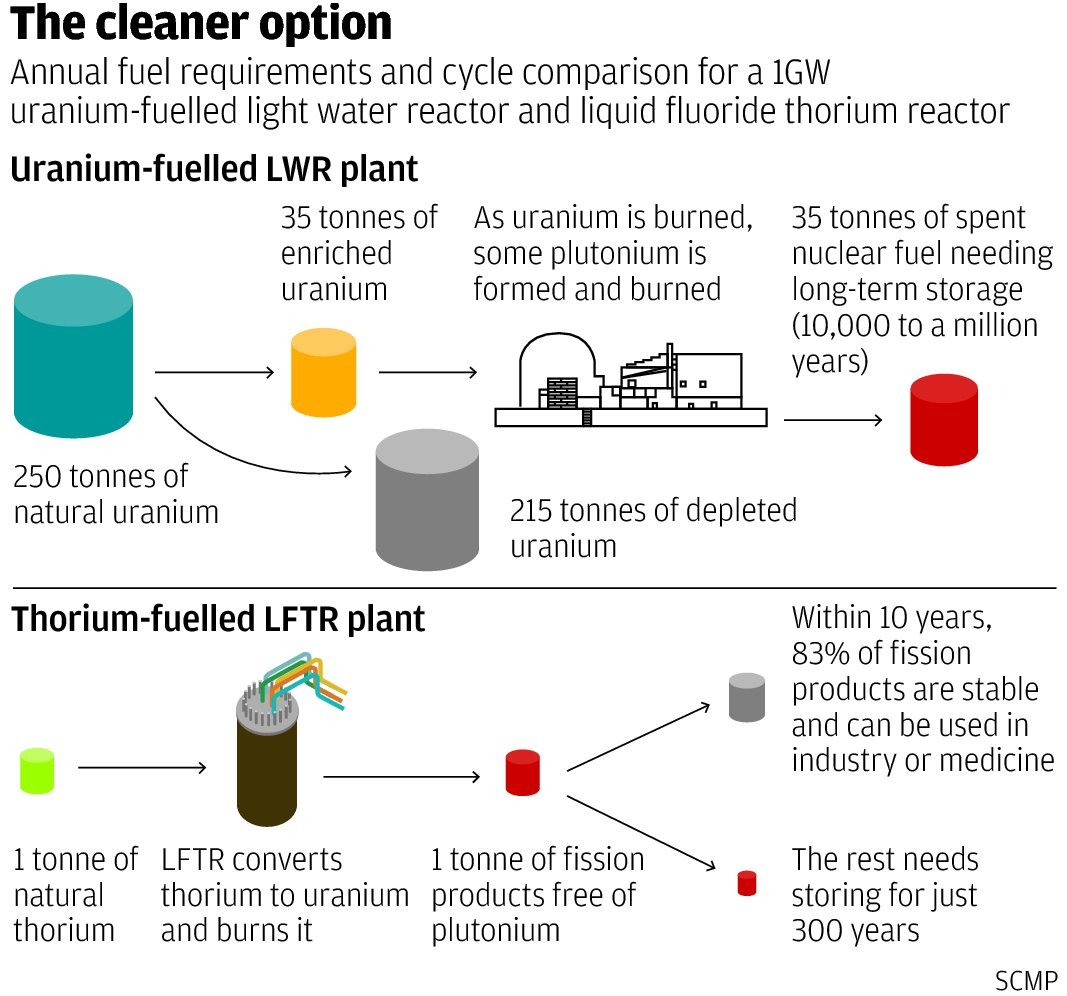
One especially cool possibility suitable for the thermal-breeding capability of the Th-U fuel cycle is the molten salt reactor. In these, fuel is not cast into pellets, but is rather dissolved in a vat of liquid salt. The chain reaction heats the salt, which naturally convects through a heat exchanger to bring the heat out to a turbine and make electricity. Online chemical processing removes fission product neutron poisons and allows online refueling (eliminating the need to shut down for fuel management, etc.). None of these reactors operate today, but Oak Ridge had a test reactor of this type in the 1960s called the Molten Salt Reactor Experiment [wikipedia] (MSRE). The MSRE successfully proved that the concept has merit and can be operated for extended amounts of time. It competed with the liquid metal cooled fast breeder reactors (LMFBRs) for federal funding and lost out. Alvin Weinberg discusses the history of this project in much detail in his autobiography, The First Nuclear Era [amazon.com], and there is more info available all over the internet. These reactors could be extremely safe, proliferation resistant, resource efficient, environmentally superior (to traditional nukes, as well as to fossil fuel obviously), and maybe even cheap. Exotic, but successfully tested. Who’s going to start the startup on these? (Just kidding, there are already like 4 startups working on them, and China is developing them as well).

Is safe, green thorium power finally ready for prime time?

http://www.extremetech.com/

Nuclear power plant
If you’ve not been tracking the thorium hype, you might be interested to learn that the benefits liquid fluoride thorium reactors (LFTRs) have over light water uranium reactors (LWRs) are compelling. Alvin Weinberg, who invented both, favored the LFTR for civilian power since its failures (when they happened) were considerably less dramatic — a catastrophic depressurization of radioactive steam, like occurred at Chernobyl in 1986, simply wouldn’t be possible. Since the technical hurdles to building LFTRs and handling their byproducts are in theory no more challenging, one might ask — where are they?
The enrichment of natural uranium is the first and perhaps most difficult step to building nuclear weapons. LWRs, which by their nature require enriched uranium, were the logical choice at the dawn of the nuclear age to develop an industry around. Richard Martin, a writer for Wired and author of Superfuel: Thorium, the Green Energy Source for the Future, summarized the argument a little more succinctly: the US abandoned thorium reactors because they didn’t produce plutonium bombs. The larger truth, of course, is a little more complex.

thorium-waste-comparison

Today’s nuclear industry might be described as an elephant. It would be very difficult for an elephant to evolve wings (thorium) because big animals just do not evolve wings — little animals evolve wings and they in turn might evolve into bigger animals with wings. The chosen gimmick of the proto-elephant was the trunk (uranium), at first just a little one, but as elephants got larger, their trunks got really really large; it became their defining feature.
The molten salt reactor (MSR), predecessor of the LFTR, lost out to the LWR in the early ’50s for a simple reason. When Navy Admiral Hyman Rickover got wind of the possibilities of nuclear power, he wanted and got nuclear-powered submarines. Unfortunately for the MSR, sodium would react violently if it accidentally contacted water. The baby nuclear elephant would be a small machine, but light water uranium reactors, which already had a little head start, would be the technology. It also didn’t help the case for MSRs that naval and shipyard engineers were already the best in the world at working with water. They were experts at building the corrosion resistant pumps, valves, bearings and other machinery needed to utilize it. But as Martin keenly observes in Superfuel, five decades later we see that the essential element of today’s technology, pressurized water, has become its Achilles heal.

thorium metal

Weinberg continued to pour his efforts into a small, workable MSR to be used as a powerplant for a nuclear airplane. This was an unfortunate misdirection. In a time when there were actual plans to use nuclear technology to dam the Straight of Gibraltar and reclaim lands long ago submerged under the Mediterranean, the idea of a nuclear airplane was not so absurd. The Cold War not withstanding, in times of prevailing peace, a flying nuclear reactor cannot count its first success as managing not to crash and destroy itself. The US and Russia ran similar programs and flew test reactors on board conventional aircraft, but ultimately both projects were scrapped.
Many people think it is not too late today, to attempt put some muscle into Dumbo’s ears so to speak, and revisit the thorium reactor. Several private efforts in the US have sprung up, led by entrepreneurs who have the knowledge necessary to do so. One project undertaken by Terrapower, funded through Microsoft’s Intellectual Ventures, is trying to build a device called a travelling wave reactor. It is a little more exotic than the MSR technology from decades ago and will require considerable effort to realize. Other homegrown efforts by start-ups like Flibe Energy, Thorium Power, and Lightbridge are struggling to fund their projects without visible government support.
Flibe Energy is looking to make ends meet by exploiting the fact that LFTRs are very good at producing medical isotopes like molybdenum-99, 90% of which we currently import from Canada. Our looming medical isotope problem is irresponsible and inexcusable as these isotopes are critical to patient diagnoses and treatment. Any health care system which fails to provide for their reliable procurement will only accelerate current medical cost inflation. Transatomic is another US-based company scrapping to survive. It is now running tests using the IR-8 research reactor at the Kurchatov Institute in Moscow. Thorium Power, based outside of Washington DC, is also working with Russian scientists to use thorium fuel — not to directly generate energy, but instead to burn surplus military plutonium.

Observing the struggle of these groups just to raise capital, one might ask how the US could possibly develop thorium power on our soil if we can’t even dig up rare earths? The reason why we can’t dig up monazite deposits which contain abundant rare earths is because the ores are “contaminated” with too much, well — thorium. Apparently regulations on handling thorium — actually a rather mild, low-alpha emitter — are restrictive to the point of being prohibitive.
Efforts to organize a strategic thorium reserve in our country for future use by someone, or anyone, have emitted a plaintive cry largely lost in a system dominated by shortsighted policy and shareholder obligation. Just as our regulatory policy guarantees China’s supremacy in rare earths, so it does for thorium. Meanwhile, that which a mining company in our country must expensively handle as radioactive waste, stabilize in concrete, and return to a landfill, China is cherishing and funding with a five-year reactor plan to the tune of half a billion dollars. The industry sentiment, “if we like foreign oil dependency, we are going to love foreign nuclear technology dependency,” needs to be taken to heart.
China is more than happy to get a little bit dirty, to mine rare earths

India has shown the greatest long term commitment to thorium power, and perhaps represents perhaps its future even more than China. In 1974 India tested a nuclear bomb made from plutonium extracted from spent reactor fuel. Governments around the world were forced to face the realty of large scale commercial reprocessing. India never signed the Nuclear Proliferation Treaty and was barred from international trade in nuclear technology until 2006. With the world’s most abundant thorium deposits, the country initiated a long-term plan to integrate thorium fuel reactors into its comprehensive nuclear strategy, and now hopes to have its first successes within a few years.
The thorium power industry today is highly dynamic. New players, like Thor Energy in Norway, can burst on the scene and capture world attention within a short time. Recently the journal Nature published a pair of noteworthy articles on thorium power. One of them noted that in spite of its obvious safety advantages, thorium is not a route to a nuclear future that is completely immune to proliferation risks. The authors detailed pathways by which thorium could in theory be transmuted into feedstock for nuclear weapons. They called on the larger community to independently corroborate their analysis and institute necessary oversights. The geopolitical implications for thorium energy demand that the US be more that a spectator of the serious sport it founded — we must also be part player, and part referee to the extent that which we still can.

Saturday, May 24, 2014

Thorium-based nuclear power

From Wikipedia, the free encyclopedia
A sample of thorium.
 
Thorium-based nuclear power is nuclear reactor-based electrical power generation fueled primarily by the fission of the isotope uranium-233 produced from the fertile element thorium. According to proponents, a thorium fuel cycle offers several potential advantages over a uranium fuel cycle—including much greater abundance on Earth, superior physical and nuclear fuel properties, and reduced nuclear waste production. However, development of Thorium power has significant start-up costs. Proponents also cite the lack of weaponization potential as an advantage of thorium, while critics say that development of breeder reactors in general (including thorium reactors that are breeders by nature) increase proliferation concerns. Since about 2008, nuclear energy experts have become more interested in thorium to supply nuclear fuel in place of uranium to generate nuclear power. This renewed interest has been highlighted in a number of scientific conferences, the latest of which, ThEC13 [1] was held at CERN by iThEC and attracted over 200 scientists from 32 countries.
A nuclear reactor consumes certain specific fissile isotopes to make energy. The three most practical types of nuclear reactor fuel are:
  • Uranium-235, purified (i.e. "enriched") by reducing the amount of uranium-238 in natural mined uranium. Most nuclear power has been generated using low-enriched uranium (LEU), whereas high-enriched uranium (HEU) is necessary for weapons.
  • Plutonium-239, transmuted from uranium-238 obtained from natural mined uranium. Plutonium is also used for weapons.
  • Uranium-233, transmuted from thorium-232, derived from natural mined thorium. That is this article's subject.
Some believe thorium is key to developing a new generation of cleaner, safer nuclear power.[2][3] According to an opinion piece (not peer-reviewed) by a group of scientists at the Georgia Institute of Technology, considering its overall potential, thorium-based power "can mean a 1000+ year solution or a quality low-carbon bridge to truly sustainable energy sources solving a huge portion of mankind’s negative environmental impact."[4]
After studying the feasibility of using thorium, nuclear scientists Ralph W. Moir and Edward Teller suggested that thorium nuclear research should be restarted after a three-decade shutdown and that a small prototype plant should be built.[5][6][7] Research and development of thorium-based nuclear reactors, primarily the Liquid fluoride thorium reactor, (LFTR), MSR design, has been or is now being done in India, China, Norway, U.S., Israel and Russia.

Background and brief history

After World War II, uranium-based nuclear reactors were built to produce electricity. These were similar to the reactor designs that produced material for nuclear weapons. During that period, the U.S. government also built an experimental molten salt reactor using U-233 fuel, the fissile material created by bombarding thorium with neutrons. The reactor, built at Oak Ridge National Laboratory, operated critical for roughly 15000 hours from 1965 to 1969. In 1968, Nobel laureate and discoverer of Plutonium, Glenn Seaborg, publicly announced to the Atomic Energy Commission, of which he was chairman, that the thorium-based reactor had been successfully developed and tested:
So far the molten-salt reactor experiment has operated successfully and has earned a reputation for reliability. I think that some day the world will have commercial power reactors of both the uranium-plutonium and the thorium-uranium fuel cycle type.[8]
In 1973, however, the U.S. government shut down all thorium-related nuclear research—which had by then been ongoing for approximately twenty years at Oak Ridge National Laboratory. The reasons were that uranium breeder reactors were more efficient, the research was proven, and byproducts could be used to make nuclear weapons. In Moir and Teller’s opinion, the decision to stop development of thorium reactors, at least as a backup option, “was an excusable mistake.”[5]
Science writer Richard Martin states that nuclear physicist Alvin Weinberg, who was director at Oak Ridge and primarily responsible for the new reactor, lost his job as director because he championed development of the safer thorium reactors.[9][10] Weinberg himself recalls this period:
[Congressman] Chet Holifield was clearly exasperated with me, and he finally blurted out, "Alvin, if you are concerned about the safety of reactors, then I think it may be time for you to leave nuclear energy." I was speechless. But it was apparent to me that my style, my attitude, and my perception of the future were no longer in tune with the powers within the AEC.[11]
Martin explains that Weinberg's unwillingness to sacrifice potentially safe nuclear power for the benefit of military uses forced him to retire:
Weinberg realized that you could use thorium in an entirely new kind of reactor, one that would have zero risk of meltdown. . . . his team built a working reactor . . . . and he spent the rest of his 18-year tenure trying to make thorium the heart of the nation’s atomic power effort. He failed. Uranium reactors had already been established, and Hyman Rickover, de facto head of the US nuclear program, wanted the plutonium from uranium-powered nuclear plants to make bombs. Increasingly shunted aside, Weinberg was finally forced out in 1973.[12]
Despite the documented history of thorium nuclear power, many of today’s nuclear experts were nonetheless unaware of it. According to Chemical & Engineering News, "most people—including scientists—have hardly heard of the heavy-metal element and know little about it...," noting a comment by a conference attendee that "it's possible to have a Ph.D. in nuclear reactor technology and not know about thorium energy."[13] Nuclear physicist Victor J. Stenger, for one, first learned of it in 2012:
It came as a surprise to me to learn recently that such an alternative has been available to us since World War II, but not pursued because it lacked weapons applications.[14]
Others, including former NASA scientist and thorium expert Kirk Sorensen, agree that "thorium was the alternative path that was not taken … "[15][16]:2 According to Sorensen, during a documentary interview, he states that if the U.S. had not discontinued its research in 1974 it could have "probably achieved energy independence by around 2000."[8]

Possible benefits

Early thorium-based (MSR) nuclear reactor at Oak Ridge National Laboratory in the 1960s
The World Nuclear Association explains some of the possible benefits[17]
The thorium fuel cycle offers enormous energy security benefits in the long-term – due to its potential for being a self-sustaining fuel without the need for fast neutron reactors. It is therefore an important and potentially viable technology that seems able to contribute to building credible, long-term nuclear energy scenarios.[18]
Moir and Teller agree, noting that the possible advantages of thorium include "utilization of an abundant fuel, inaccessibility of that fuel to terrorists or for diversion to weapons use, together with good economics and safety features … "[5] Thorium is considered the "most abundant, most readily available, cleanest, and safest energy source on Earth," adds science writer Richard Martin.[16]:7
  • Thorium is four times as abundant as uranium, which is as common as lead. It is ~ 570 times as common as uranium-235, the fissile isotope of uranium used for nuclear energy. The Thorium Energy Alliance (TEA) estimates "there is enough thorium in the United States alone to power the country at its current energy level for over 1,000 years."[18][19][unreliable source] "America has buried tons as a by-product of rare earth metals mining," notes Evans-Pritchard. "Norway has so much that Oslo is planning a post-oil era where thorium might drive the country’s next great phase of wealth. Even Britain has seams in Wales and in the granite cliffs of Cornwall. Almost all thorium is fertile Th-232, compared to uranium that is composed of 99.3% fertile U-238 and 0.7% more valuable fissile U-235. There is enough to power civilization for thousands of years."[20]
  • It is difficult to make a practical nuclear bomb from a thorium reactor's byproducts. According to Alvin Radkowsky, designer of the world’s first full-scale atomic electric power plant, "a thorium reactor's plutonium production rate would be less than 2 percent of that of a standard reactor, and the plutonium's isotopic content would make it unsuitable for a nuclear detonation."[16]:11[21] Several uranium-233 bombs have been tested, but the presence of uranium-232 tended to "poison" the uranium-233 in two ways: intense radiation from the uranium-232 made the material difficult to handle, and the uranium-233 led to possible pre-detonation. Separating the uranium-232 from the uranium-233 proved very difficult, although newer laser techniques could facilitate that process.[22][23]
  • There is much less nuclear waste—up to two orders of magnitude less, states Moir and Teller,[5] eliminating the need for large-scale or long-term storage;[16]:13 "Chinese scientists claim that hazardous waste will be a thousand times less than with uranium."[20] The radioactivity of the resulting waste also drops down to safe levels after just a few hundred years, compared to tens of thousands of years needed for current nuclear waste to cool off.[24]
  • According to Moir and Teller, "once started up [it] needs no other fuel except thorium because it makes most or all of its own fuel."[5] Because it is non-fissile, it can also be used with fissile material, such as uranium and plutonium, as a nuclear fuel.[18]
  • Since all natural thorium can be used as fuel no expensive fuel enrichment is needed.[24] However the same is true for U-238 as fertile fuel in the uranium-plutonium cycle.
  • Comparing the amount of thorium needed with coal, Nobel laureate Carlo Rubbia of CERN, (European Organization for Nuclear Research), estimates that one ton of thorium can produce as much energy as 200 tons of uranium, or 3,500,000 tons of coal.[25] Coal, as the world's largest source of carbon dioxide emissions, makes up 42% of U.S. electrical power generation and 65% in China.[26]
Summarizing, Martin writes, "Thorium could provide a clean and effectively limitless source of power while allaying all public concern—weapons proliferation, radioactive pollution, toxic waste, and fuel that is both costly and complicated to process.[16]:13
From an economics viewpoint, U.K. business editor Ambrose Evans-Pritchard writes that "Obama could kill fossil fuels overnight with a nuclear dash for thorium," suggesting a "new Manhattan Project," and adding, "If it works, Manhattan II could restore American optimism and strategic leadership at a stroke …"[25] Moir and Teller estimated in 2004 that the cost for their recommended prototype would be "well under $1 billion with operation costs likely on the order of $100 million per year," and as a result a "large-scale nuclear power plan" usable by many countries could be set up within a decade.[5]

Possible disadvantages

Some experts note possible specific disadvantages of thorium nuclear power:[27]
  • Breeding in a thermal neutron spectrum is slow and requires extensive reprocessing. The feasibility of reprocessing is still open.[28]
  • Significant and expensive testing, analysis and licensing work is first required, requiring business and government support.[18] According to a 2012 report by the Bulletin of the Atomic Scientists, about using thorium fuel with existing water-cooled reactors, it would "require too great an investment and provide no clear payoff," noting that "from the utilities’ point of view, the only legitimate driver capable of motivating pursuit of thorium is economics."[29]
  • There is a higher cost of fuel fabrication and reprocessing than those that use traditional solid fuel rods.[18]
  • Thorium, when being irradiated for use in reactors, will make uranium-232, which is very dangerous due to the gamma rays it emits. This irradiation process may be able to be altered slightly by removing protactinium-233. The irradiation would then make uranium-233 in lieu of uranium-232, which can be used in nuclear weapons to make thorium into a dual purpose fuel.[30]

Current projects

Research and development of thorium-based nuclear reactors, primarily the Liquid fluoride thorium reactor, (LFTR), MSR design, has been or is now being done in the U.S., U.K., Germany, Brazil, India, China, France, the Czech Republic, Japan, Russia, Canada, Israel and the Netherlands.[14][16] Conferences with experts from as many as 32 countries are held, including one by the European Organization for Nuclear Research (CERN) in 2013, which focuses on thorium as an alternative nuclear technology without requiring production of nuclear waste.[31] Recognized experts, such as Hans Blix, former head of the International Atomic Energy Agency, calls for expanded support of new nuclear power technology, and states, "the thorium option offers the world not only a new sustainable supply of fuel for nuclear power but also one that makes better use of the fuel's energy content."[32]

Canada

CANDU reactors of Atomic Energy Canada Limited are capable of using thorium,[33][dead link][34] and TPC (Thorium Power Canada) has, in 2013, planned and proposed developing thorium power projects for Chile and Indonesia.[35]

China

At the 2011 annual conference of the Chinese Academy of Sciences it was announced that "China has initiated a research and development project in thorium molten-salt reactor technology."[36] In addition, Dr. Jiang Mianheng, son of China's former leader Jiang Zemin, led a thorium delegation in non-disclosure talks at Oak Ridge National Laboratory, Tennessee, and by late 2013 China had officially partnered with Oak Ridge to aid China in its own development.[37][38] The World Nuclear Association notes that the China Academy of Sciences in January 2011 announced its R&D program, "claiming to have the world's largest national effort on it, hoping to obtain full intellectual property rights on the technology."[18] According to Martin, "China has made clear its intention to go it alone," adding that China already has a monopoly over most of the world's rare earth minerals.[16]:157[20]
In March 2014, with their reliance on coal-fired power having become a major cause of their current "smog crisis," they reduced their original goal of creating a working reactor from 25 years down to 10. "In the past, the government was interested in nuclear power because of the energy shortage. Now they are more interested because of smog," said Professor Li Zhong, a scientist working on the project. "This is definitely a race," he added.[39]
In early 2012, it was reported that China, using components produced by the West and Russia, planned to build two prototype thorium molten salt reactors by 2015, and had budgeted the project at $400 million and requiring 400 workers."[16]:157 China also finalized an agreement with a Canadian nuclear technology company to develop improved CANDU reactors using thorium and uranium as a fuel.[40]

Germany

The German THTR-300 was a prototype commercial power station using thorium as fertile and highly enriched U-235 as fissile fuel. Though named thorium high temperature reactor, mostly U-235 was fissioned. The THTR-300 was a helium-cooled high-temperature reactor with a pebble-bed reactor core consisting of approximately 670,000 spherical fuel compacts each 6 centimetres (2.4 in) in diameter with particles of uranium-235 and thorium-232 fuel embedded in a graphite matrix. It fed power to Germany's grid for 432 days in the late 1980s, before it was shut down for cost, mechanical and other reasons.

India

In February 2014, Bhabha Atomic Research Centre (BARC), in Mumbai, India, presented their latest design for a "next-generation nuclear reactor" that will burn thorium as its fuel ore. Once built, with a target date of 2016, they estimate that the reactor could function without an operator for 120 days.[41]
According to Dr R K Sinha, chairman of their Atomic Energy Commission, "This will reduce our dependence on fossil fuels, mostly imported, and will be a major contribution to global efforts to combat climate change." Because of its inherent safety, they expect that similar designs could be set up "within" populated cities, like - Mumbai or Delhi.[41]
India's government is also developing up to 62, mostly thorium reactors, which it expects to be operational by 2025. It is the "only country in the world with a detailed, funded, government-approved plan" to focus on thorium-based nuclear power. The country currently gets under 3% of its electricity from nuclear power, relying for the rest on coal and oil imports. It expects to produce around 25% of its electricity from nuclear power.[16]:144 In 2009 the chairman of the Indian Atomic Energy Commission said that India has a "long-term objective goal of becoming energy-independent based on its vast thorium resources."[42][43]
In late June 2012, India announced that their "first commercial fast reactor" was near completion making India the most advanced country in thorium research." We have huge reserves of thorium. The challenge is to develop technology for converting this to fissile material," stated their former Chairman of India's Atomic Energy Commission.[44] That vision of using thorium in place of uranium was set out in the 1950s by physicist Homi Bhabha.[45][46] India’s first commercial fast breeder reactor — the 500 MWe Prototype Fast Breeder Reactor (PFBR) — is approaching completion at the Indira Gandhi Centre for Atomic Research, Kalpakkam, Tamil Nadu.
As of July 2013 the major equipment of the PFBR had been erected and the loading of "dummy" fuels in peripheral locations was in progress. The reactor was expected to go critical by September 2014.[47]
The Centre had sanctioned Rs. 5,677 crore for building the PFBR and “we will definitely build the reactor within that amount,” Mr. Kumar asserted. The original cost of the project was Rs. 3,492 crore, revised to Rs. 5,677 crore. Electricity generated from the PFBR would be sold to the State Electricity Boards at Rs. 4.44 a unit. BHAVINI builds breeder reactors in India. India's 300 MWe AHWR (pressurized heavy water reactor) reactor began construction in 2011. The design envisages a start up with reactor grade plutonium that will breed U-233 from Th-232. Thereafter thorium is to be the only fuel.[48]

Israel

In May 2010, researchers from Ben-Gurion University in Israel and Brookhaven National Laboratory in New York began to collaborate on the development of thorium reactors,[49] aimed at being self-sustaining, "meaning one that will produce and consume about the same amounts of fuel," which is not possible with uranium in a light water reactor.[49]

Japan

In June, 2012, Japan utility Chubu Electric Power, wrote that they regard thorium as “one of future possible energy resources.”[50]

Norway

In late 2012, Norway's privately owned Thor Energy, in collaboration with the government and Westinghouse, announced a four-year trial using thorium in an existing nuclear reactor."[51] In 2013, Aker Solutions purchased patents from Nobel Prize winning physicist Carlo Rubbia for the design of a proton accelerator-based thorium nuclear power plant.[52]

U.K.

In Britain, a few organizations are either promoting or examining research on thorium-based nuclear plants. House of Lords member Bryony Worthington is promoting thorium, calling it “the forgotten fuel” that could alter Britain’s energy plans.[53] However, in 2010, the UK’s National Nuclear Laboratory (NNL) concluded that for the short to medium term, "...the thorium fuel cycle does not currently have a role to play," in that it is "technically immature, and would require a significant financial investment and risk without clear benefits," and concluded that the benefits have been "overstated."[18] Friends of the Earth UK considers research into it as "useful" as a fallback option.[54]

U.S.

In its January 2012 report to the Secretary of Energy, the Blue Ribbon Commission on America's Future notes that a "molten-salt reactor using thorium [has] also been proposed."[55] That same month it was reported that the U.S. Department of Energy is "quietly collaborating with China" on thorium-based nuclear power designs using a molten salt reactor.[56]
Some experts and politicians want thorium to be "the pillar of the U.S. nuclear future."[57] Senators Harry Reid and Orrin Hatch have supported using $250 million in federal research funds to revive ORNL research.[4] In 2009, Congressman Joe Sestak unsuccessfully attempted to secure funding for research and development of a destroyer-sized reactor [reactor of a size to power a destroyer] using thorium-based liquid fuel.[58][59]
Alvin Radkowsky, chief designer of the world’s second full-scale atomic electric power plant in Shippingport, Pennsylvania, founded a joint U.S. and Russian project in 1997 to create a thorium-based reactor, considered a "creative breakthrough."[60] In 1992, while a resident professor in Tel Aviv, Israel, he founded the U.S. company, Thorium Power Ltd., near Washington, D.C., to build thorium reactors.[60]
The primary fuel of the proposed HT3R research project near Odessa, Texas, USA, will be ceramic-coated thorium beads. The earliest date the reactor will become operational is in 2015.[61]
In early 2014, some geologists speculated that there was a higher reserve of thorium, least 600,000 tons, in one county in northern Idaho, which they claim is "a higher reserve of thorium . . . than anywhere in the world."[62]

World sources of thorium

World thorium sources (2007)[63]
Country Tons  %
Australia 489,000 18.7%
USA 400,000 15.3%
Turkey 344,000 13.2%
India 319,000 12.2%
Brazil 302,000 11.6%
Venezuela 300,000 11.5%
Norway 132,000 5.1%
Egypt 100,000 3.8%
Russia 75,000 2.9%
Greenland (Denmark) 54,000 2.1%
Canada 44,000 1.7%
South Africa 18,000 0.7%
Other countries 33,000 1.2%
World Total 2,610,000 100.0%
Thorium is mostly found with the rare earth phosphate mineral, monazite, which contains up to about 12% thorium phosphate, but 6-7% on average. World monazite resources are estimated to be about 12 million tons, two-thirds of which are in heavy mineral sands deposits on the south and east coasts of India. There are substantial deposits in several other countries (see table "World thorium sources").[18]
Another estimate of reasonably assured reserves (RAR) and estimated additional reserves (EAR) of thorium comes from OECD/NEA, Nuclear Energy, "Trends in Nuclear Fuel Cycle", Paris, France (2001).[64] (see table "IAEA Estimates in tonnes")
IAEA Estimates in tons (2005)
Country RAR Th EAR Th
India 519,000 21%
Australia 489,000 19%
USA 400,000 13%
Turkey 344,000 11%
Venezuela 302,000 10%
Brazil 302,000 10%
Norway 132,000 4%
Egypt 100,000 3%
Russia 75,000 2%
Greenland 54,000 2%
Canada 44,000 2%
South Africa 18,000 1%
Other countries 33,000 2%
World Total 2,810,000 100%
The preceding reserve figures refer to the amount of thorium in high-concentration deposits inventoried so far and estimated to be extractable at current market prices; millions of times more total exist in Earth's 3×10¹⁹ tonne crust, around 120 trillion tons of thorium, and lesser but vast quantities of thorium exist at intermediate concentrations.[65][66][67] Proved reserves are "a poor indicator of the total future supply of a mineral resource."[67]

Types of thorium-based reactors

According to the World Nuclear Association there are seven types of reactors that can be designed to use thorium as a nuclear fuel. The first five of these have all entered into operational service at some point. The last two are still conceptual, although currently in development by many countries:[18]
Additionally, in the 1958 Atoms for Peace publication entitled Fluid Fueled Reactors, Aqueous Homogeneous Reactors (AHRs) were proposed as a fluid fueled design that could accept naturally occurring uranium and thorium suspended in a heavy water solution.[68] AHRs have been built and according to the IAEA reactor database, 7 are currently in operation as research reactors.

See also